
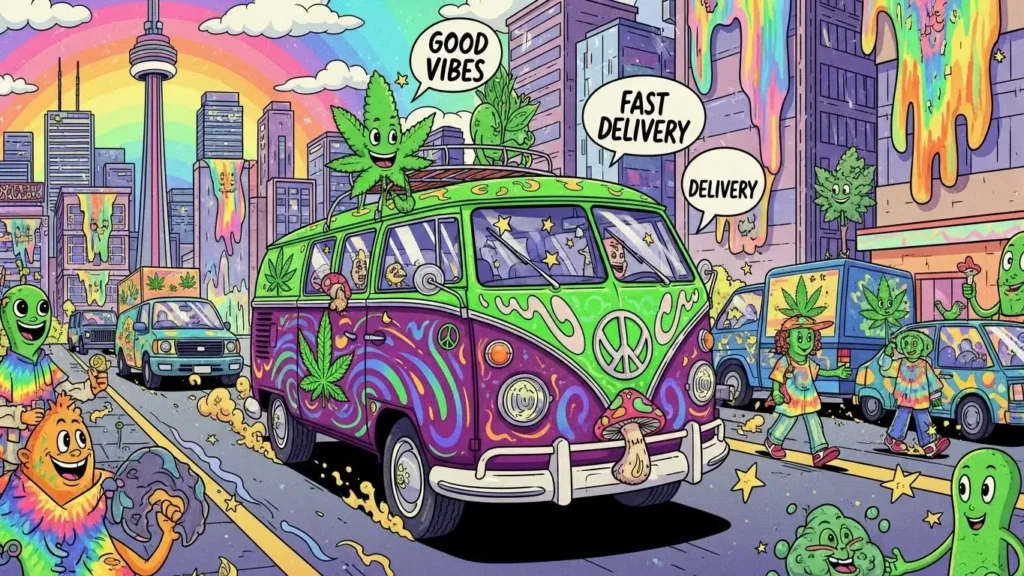
Picture this: It’s 2 AM in Toronto, and you’ve just realized your stash is running low. A few years ago, this scenario meant disappointment or a risky venture into the unregulated market. Today, thanks to the explosive growth of weed delivery services, it’s a minor inconvenience solved with a few taps on your phone. As we look toward 2026, Toronto’s weed delivery market is not just growing—it’s on the cusp of a fundamental transformation.
The landscape has evolved from a novel convenience into a sophisticated, competitive industry. With more than one in three Canadian adults now using cannabis and Toronto seeing an 85.2% increase in cannabis usage from 2020 to 2023, the demand for convenient, reliable access has never been higher. But what does the future hold? The journey from a seed planted in a facility to a discreet package at your door is becoming faster, smarter, and more personalized. This article will guide you through the key trends, technological innovations, and market shifts that will define Toronto’s weed delivery experience in 2026.
Are you ready to understand how your next late-night order will be faster, the products more tailored to your needs, and the entire experience seamlessly integrated into your digital life? Let’s explore the future.
Why Toronto’s Weed Delivery Is Changing Fast
Toronto is one of the most dynamic cannabis markets in Canada, with legal sales and delivery steadily growing every year. Since legalization, what began as a handful of players has turned into a crowded ecosystem of 24/7 weed delivery Toronto, budget services, premium craft delivery, and medically oriented platforms.
- The Canadian legal cannabis market is projected to keep growing at a strong pace through 2030, creating more pressure and opportunity for weed delivery in Toronto.
- At the same time, the Alcohol and Gaming Commission of Ontario (AGCO) keeps tightening compliance and standards, especially around legal cannabis delivery in Ontario.
If you are a consumer, are you noticing more promotions, more same-day weed delivery promises, and more choice than ever? If you are an operator, how will you stand out in this saturated SERP and map pack?
What Makes Toronto Weed Delivery Unique in 2026
Toronto is not just “another city” in the cannabis space; it is a hub where regulations, tech adoption, and urban density make weed delivery Toronto the default buying method for many users.
- Leading brands already position themselves as Toronto online cannabis dispensary – weed delivery service Ontario, combining fast logistics with curated menus.
- Services like GasDank, Prime Exotics, Pink House, and others compete on speed, same day weed delivery Toronto, pricing, and user-friendly online experiences.
Consumers now expect a mix of convenience (1–2 hour windows), transparent menus, and frictionless checkout from any weed delivery Toronto brand. Are you designing your customer journey with these expectations in mind?
Section 1: The Foundation – Understanding Toronto’s Current Delivery Landscape
To appreciate where we’re going, we must first understand where we are. Toronto’s legal weed delivery market operates within a strict framework set by federal, provincial, and municipal regulations.
The Legal and Regulatory Bedrock
All legal cannabis delivery in Ontario is regulated by the Alcohol and Gaming Commission of Ontario (AGCO). Licensed retailers are currently permitted to deliver between 9:00 AM and 11:00 PM. This creates an interesting tension with the consumer search for true 24/7 weed delivery. While some services operate under different frameworks (such as Indigenous-owned dispensaries), the fully compliant legal market adheres to these hours.
Consumer trust is firmly rooted in this legal structure. Statistics Canada reports that over 71% of cannabis consumers now buy exclusively from legal sources, citing product safety (38.0%) and convenience (16.9%) as their main reasons. This trust is the launchpad for future growth.
The Current Consumer Experience
Today, the best services have set a high bar. Leaders in the space, like Doobie Delivery, promise delivery within 1-2 hours across the GTA, using discreet, unmarked packaging and offering a vast selection that often surpasses physical storefronts. The convenience is undeniable: why battle traffic and parking downtown when you can have AAAAA-grade flower delivered to your door in Scarborough or North York?
But the market is maturing. The question for 2026 is no longer just if you can get delivery, but how exceptional that service can become. The competition is shifting from basic availability to superior experience, hyper-efficiency, and predictive personalization.
Section 2: Key Drivers of Change – What’s Fueling the 2026 Transformation?
Several powerful forces are converging to reshape Toronto’s weed delivery ecosystem. These are not mere speculations; they are trends backed by market data and evolving consumer behavior.
Explosive Market Growth and Economic Forces
The numbers speak volumes. The Canadian legal cannabis market was valued at USD $3.25 billion in 2024 and is projected to grow at a compound annual growth rate (CAGR) of 12%, reaching nearly USD $5.8 billion by 2030. Toronto, as the nation’s largest city, commands a significant share of this growth.
This economic engine fuels investment in logistics, technology, and product innovation. Furthermore, potential federal changes, like the rescheduling of cannabis in the United States, could have ripple effects, influencing investor confidence and cross-border business strategies for Canadian companies.
The Sophisticated Toronto Consumer
The profile of the cannabis user is changing dramatically. It’s no longer a niche group. With 38.4% of adults aged 18-24 and 34.5% of those 25-44 reporting cannabis use, the consumer base is broad and mainstream. These modern consumers are:
- Wellness-Oriented: There’s a growing demand for CBD-dominant products, balanced ratios, and specific formulations for sleep, focus, or pain relief, moving beyond just high-THC products.
- Quality-Conscious: Chasing high THC percentages is giving way to a demand for terpene profiles, clean cultivation (like veganic nutrients), and superior post-harvest care that preserves flavor and effect.
- Digitally Native: They expect the same seamless online ordering, real-time tracking, and personalized recommendations they get from Amazon or food delivery apps.
Technological Tipping Point
Technology is ready to leap from being a support function to the core of the delivery experience. Artificial Intelligence (AI), the Internet of Things (IoT) for logistics, and advanced data analytics are moving from concept to essential infrastructure. This sets the stage for the major evolution we can expect in 2026.
Section 3: The 2026 Evolution – Five Transformative Trends for Toronto Weed Delivery
Based on current trajectories, here are the five most impactful ways Toronto’s weed delivery market will evolve in 2026.
1. Hyper-Local & Predictive Logistics: Delivery Gets Smarter Than Ever
The promise of “same-day delivery” will evolve into predictive and hyper-local delivery.
- AI-Powered Demand Forecasting: Delivery platforms will use AI to analyze vast datasets—past purchase history, neighborhood trends, time of day, even local events—to pre-position popular inventory in micro-fulfillment centers across the GTA. Imagine a system that knows a certain hybrid strain is popular in Liberty Village on Friday evenings and ensures it’s stocked nearby.
- Dynamic Routing & Drone Trials: While widespread drone delivery may be a bit further out, 2026 will see expanded pilot programs and the use of AI for dynamic routing. This will minimize delays, allowing services to offer even more reliable and specific delivery windows, moving beyond the 1-2 hour estimate to a 30-minute precision window.
2. The Rise of the “Cannabis Concierge”: Personalized, Effect-Driven Commerce
In 2026, browsing a simple menu will feel archaic. The future is the “Cannabis Concierge”—a personalized digital experience.
- Effect-Based Search and Discovery: Forget filtering just by “Sativa” or “Indica.” You’ll tell your app, “I need something for creative focus in the afternoon” or “help me unwind after work without couch-lock.” Algorithms will match your request with products based on detailed cannabinoid and terpene profiles, not just marketing descriptions.
- Personalized Subscription Boxes: Leveraging your purchase history and feedback, services will offer curated monthly boxes. For example: “Your ‘Weekend Relaxation’ box is ready, featuring this new lavender-forward edible and a low-dose cannabis beverage, based on your preference for calming products.”
3. Product Innovation Meets Delivery: What You’ll Be Ordering
The products flowing through delivery channels will also mature, directly influencing delivery logistics.
- The Next Generation of Edibles and Beverages: Cannabis beverages and fast-acting nanoemulsified edibles will see a surge. Their popularity for controlled, social, and discreet consumption aligns perfectly with the delivery model. Delivery services will likely partner with beverage brands for exclusive launches.
- Precision Dosing and Microdosing: The trend toward microdosing for functional wellness will accelerate. Delivery services will become the primary channel for precise, low-dose products (e.g., 2.5mg THC gummies, dissolvable strips), catering to professionals and wellness-focused users.
- Traceability from Seed to Door: Consumers will demand more transparency. Scanning a QR code on your delivered package will show not just lab results, but the product’s journey—cultivation method, harvest date, and even the supplemental lighting techniques used to grow it.
4. Regulatory Evolution and the 24/7 Question
The most pressing consumer demand—true 24/7 legal weed delivery—will confront regulatory reality.
- Pressure on Operating Hours: Consumer demand for pre-dawn or late-night service will put significant pressure on regulators to revisit the 9 AM – 11 PM delivery window. While a full regulatory change may be complex, 2026 could see the introduction of extended “night owl” licenses or pilot programs in specific zones.
- Enhanced Compliance via Tech: Technology will make compliance smoother. Expect digital age verification at the time of order (using secure government ID portals) to streamline the delivery handoff. Blockchain could be piloted for immutable age and supply chain verification.
5. Market Consolidation and the Service Hierarchy
The market will stratify into clear tiers, helping consumers navigate their choices.
- The Ultra-Fast Commodity Players: Services competing purely on speed and price for high-volume, common products.
- The Premium Experience Curators: Services focusing on craft cannabis, rare exotic gas strains, and white-glove delivery experiences, akin to a sommelier service for cannabis.
- The Integrated Health & Wellness Partners: Services that blend medical cannabis delivery with telehealth consultations, dosage tracking apps (like those pioneered by Aurora Cannabis), and wellness content.
To visualize how these trends will differentiate the market, consider this future-facing comparison:
Section 4: Challenges on the Road to 2026
This evolution won’t be without hurdles. The industry must navigate:
- Profitability & Efficiency: With rising costs, operators must embrace data-driven cultivation and logistics to survive. Inefficient services will be squeezed out.
- Banking & Financial Services: Despite legalization, cannabis businesses still face banking challenges. Progress on acts like the SAFER Banking Act in the U.S. could influence the financial landscape in Canada.
- Consumer Education: As products become more sophisticated, responsible consumption education delivered through these platforms will be crucial.
Market Trends That Will Shape 2026
Growth, segmentation and premiumization
Canada’s legal market continues to grow, with billions in sales and double-digit projected CAGR, which directly fuels higher delivery volume in urban hubs like Toronto. As the market matures, Toronto weed delivery is splitting into clear segments:
- Ultra-fast same day weed delivery Toronto and near-instant 1–2 hour delivery.
- Premium, small-batch, connoisseur-focused delivery with higher average basket values.
- Budget-friendly cheap weed delivery in Toronto options competing heavily on price.
In this context, trying to be “everything for everyone” is a losing strategy. Which segment do you truly want to own in 2026?
Product innovation and consumer preferences
Infused pre-rolls, higher-potency vapes, and edibles with improved onset times are taking more shelf space in delivery menus. Research shows pre-roll and vaporizer categories in Canada are growing thanks to convenience and stronger potency, which impacts what people search for and order via weed delivery in Toronto.
If your menu is still focused on only traditional flower without differentiated SKUs, how will you compete when users filter by “strongest THC pre-roll” or “fast-acting edible delivery”?
Legal Framework: Weed Delivery in Ontario in 2025–2026
Is weed delivery legal in Ontario?
Yes, weed delivery is legal in Ontario, but only when done by licensed retailers following AGCO rules. That means every Toronto weed delivery service must operate from a physical store with a Retail Store Authorization and use in-house staff for delivery, not third‑party gig apps.
- Deliveries are only allowed during authorized hours (roughly 9 or 10 a.m. to 11 p.m., depending on store hours).
- Drivers must verify the customer is 19+ and deliver only to private residences or hotel rooms, not public spaces.
As a consumer, do you check whether your weed delivery Toronto provider is actually licensed, or do you only look at price and speed?
Why compliance will matter more in 2026
Regulators continue updating cannabis regulations, including packaging, labeling, and promotional restrictions under the Cannabis Act. This will push grey-market and non-compliant Toronto weed delivery operators out of search results and social platforms, making room for brands that invest in trust and transparency.
How Local SEO and Geo-Targeting Will Evolve
Hyper-local queries and service zones
Toronto is not a monolith; users search for weed delivery in Toronto plus micro-locations like Etobicoke, Scarborough, North York, or specific postal codes. Platforms that clearly communicate delivery zones, fees, and ETAs—for example, maps of same day weed delivery coverage across the GTA—already have an edge.
To dominate geo-intent in 2026:
- Build location-focused pages or sections like “same day weed delivery Toronto downtown”, “Scarborough weed delivery”, or “Etobicoke 1–2 hour cannabis delivery”.
- Use geo-modified keywords such as “Toronto weed delivery service”, “weed delivery Toronto cash”, and “near me” variations in headings and body content, always written naturally.
When a user types “weed delivery near me” at 10 p.m., will Google and AI tools associate that query with your brand or a competitor’s?
Competing in maps and local directories
Being visible in Google Maps and cannabis-specific directories is non‑negotiable for Toronto weed delivery in 2026. Vendors featured on marketplaces and local directories often benefit from aggregated reviews, trust signals, and cross-traffic.
Make sure your NAP (name, address, phone) and delivery hours are consistent across:
- Google Business Profile.
- Cannabis directories like Leafythings and similar hubs focusing on weed delivery Toronto Ontario.
Are all your listings aligned, or are you sending mixed signals to Google about your real service area and hours?
User Experience, Speed and Same-Day Expectations
Same day and 24/7: the new normal
In Toronto, same day weed delivery is no longer a “nice to have”; it is the baseline expectation. Top providers advertise deliveries in 45–120 minutes, extended evening hours, and sometimes pseudo‑24/7 weed delivery Toronto models within legal constraints.
- Brands like GasDank and others leverage same-day across the GTA and emphasize fast logistics and tracking codes.
- Services such as Prime Exotics position themselves as high-speed Toronto weed delivery service leaders with around-the-clock accessibility.
If your site promises “fast delivery” but offers vague time windows and poor tracking, how long will users tolerate that before bouncing?
Frictionless UX and checkout
A strong Toronto online cannabis dispensary – weed delivery service Ontario funnel requires UX obsessed with reducing friction at every touchpoint. The winners in 2026 will provide:
- Mobile-first menus with real-time inventory, clear THC/CBD data, and transparent pricing.
- Multiple payment options, including debit, credit, and weed delivery Toronto cash where legally allowed and clearly communicated.
Have you walked your own checkout flow on a phone, at night, on a slow connection, the way real users experience it?
Conclusion and Call to Action: Your Role in the Evolving Market
The evolution of Toronto’s weed delivery market by 2026 points toward a future of remarkable convenience, precision, and personalization. It will be shaped by smarter technology, more discerning consumers, and a regulatory environment struggling to keep pace with innovation.
For consumers, this means your voice matters. Your demand for quality, convenience, and access will continue to drive this evolution. Start paying attention now to the services that invest in technology, transparency, and education—they are the ones building for the future.
For businesses, the time to future-proof is now. Investing in logistics technology, consumer data (ethically), and a clear brand position as either a speed demon, a curator, or a wellness partner will be key to thriving in the 2026 Toronto weed delivery landscape.
FAQs: Toronto Weed Delivery in 2026
Q1: Will 24/7 weed delivery finally be legal in Toronto by 2026?
While the current AGCO regulations permit delivery only between 9:00 AM and 11:00 PM, significant consumer demand is pressuring this model. By 2026, we may see extended “night-owl” licenses or official pilot programs for expanded hours, though true, universal 24/7 legal delivery remains a complex regulatory challenge.
Q2: How will delivery times improve by 2026?
Expect a shift from “1-2 hour delivery” to more precise, predictive logistics. Using AI to forecast demand and pre-position inventory in neighborhood fulfillment hubs, leading services will aim to offer reliable 30-45 minute delivery windows, especially in dense urban cores.
Q3: What new product trends will be available for delivery?
Look for a major rise in cannabis beverages and fast-acting nanoemulsified edibles for social and controlled use. Furthermore, precision microdosing products (like 2.5mg gummies) and craft cannabis with full seed-to-door traceability will become mainstream delivery options.
Q4: How will I find the right product for me with so many choices?
Simple menus will be replaced by intelligent “Cannabis Concierge” features. You’ll be able to search by desired effect (e.g., “creative focus,” “deep relaxation”) and receive AI-powered recommendations based on your personal history and detailed product cannabinoid/terpene profiles.
Q5: Is the delivery market going to get more expensive?
The market will stratify. You will have ultra-fast, budget-friendly options for common products, but also premium services charging more for rare craft strains, white-glove delivery, and personalized curation. Overall, competition should keep base pricing competitive, but premium experiences will command premium prices.