
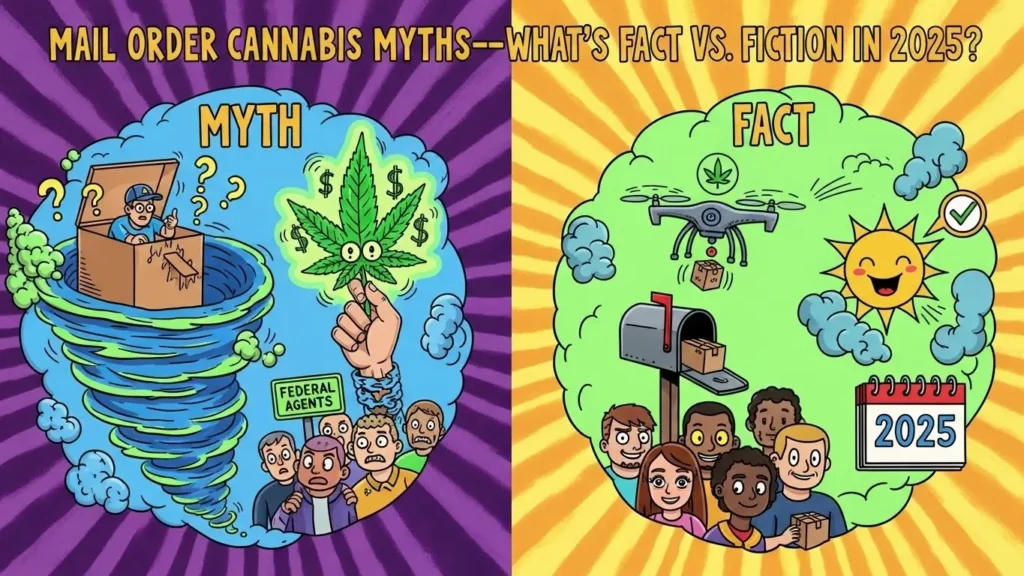
Have you ever wondered if that seemingly perfect mail order cannabis website is too good to be true? You’re not alone. In 2025, the digital cannabis marketplace is booming, but so is the cloud of confusion, outdated rumors, and straight-up misinformation that surrounds it. Scrolling through forums, you’ll find stories ranging from seamless deliveries to legal nightmares, leaving many potential buyers paralyzed by doubt. It’s a classic battle of fact versus fiction, where distinguishing a legitimate, safe service from a risky gamble feels like a task for a detective.
This guide isn’t here to sell you anything but the truth. We’re cutting through the haze to debunk the most persistent myths about buying cannabis online, using 2025’s legal landscape as our map. Let’s separate the savvy modern shopping tips for buying weed online from the dangerous fiction, so you can navigate this space with confidence and clarity.
Fact vs. Fiction: Debunking 7 Major Myths About Mail Order Cannabis
Myth 1: “All Mail Order Cannabis is Federally Illegal”
This is arguably the most pervasive and dangerous myth. The fiction is a blanket statement that mailing any cannabis product is a federal crime. The fact is far more nuanced and hinges on a critical legal distinction established by the 2018 Farm Bill.
The law defines hemp as any part of the Cannabis sativa plant with a delta-9 THC concentration of 0.3% or less on a dry weight basis. Anything above that threshold is classified as marijuana. Federally, hemp is legal, while marijuana remains a Schedule I controlled substance.
- The Legal Pathway: Reputable companies that ship nationwide operate strictly within the hemp framework. They sell products—like certain THCa flowers or carefully formulated edibles—that are derived from hemp and test under the 0.3% delta-9 THC limit. These products can be legally shipped via carriers like USPS, which has explicit regulations for compliant hemp.
- The Illegal Act: What is federally illegal is shipping marijuana (products over 0.3% delta-9 THC) across state lines, even between two states where recreational use is legal. This is a crucial point many misunderstand.
Verdict: FICTION. Legal, national mail order cannabis exists, but only for Farm Bill-compliant hemp products.
Myth 2: “You Need a Medical Card to Order Online”
This myth stems from the early days of online cannabis. The fiction is that a medical marijuana card is a universal requirement. The fact in 2025 is that the market serves multiple consumer pathways.
- Medical Market: Yes, in states with medical marijuana programs, you can often order online from licensed dispensaries for pickup or local delivery. This requires a valid patient card.
- Recreational Market: In states with legal adult-use (recreational) cannabis, you can typically order online from licensed dispensaries if you are of age (21+).
- National Hemp Market: This is where the myth completely falls apart. Legitimate online retailers selling federally legal hemp-derived products (like Mood) do not require a medical card. They can ship to most states because they comply with federal hemp law, not state marijuana programs.
Verdict: FICTION. While a card is needed for state medical programs, it is not required to purchase from compliant national online retailers specializing in legal hemp products.
Myth 3: “Packages Are Always Searched and Seized”
The image of postal inspectors intercepting every parcel is a scary one. The fiction is that the system is omnipresent. The fact, according to logistics experts and reports, is about volume and priority.
The USPS processes nearly 24 million packages a day. While postal inspectors do make drug-related arrests, their resources are overwhelmingly focused on dangerous substances like fentanyl, meth, and opioids, as well as security threats. A former inspector noted that for small amounts of cannabis, the agency might “lean more toward seizure and destruction than a criminal investigation”.
For legal hemp shipments, the risk is virtually nonexistent if the vendor is compliant. Legitimate businesses provide all required documentation (like a copy of the lab report) inside the package, proving its legal status to any inspector.
Verdict: MOSTLY FICTION. While illegal shipments carry a risk, compliant legal hemp packages are low-priority and designed to pass inspection smoothly. The overwhelming majority of packages arrive without issue.
Myth 4: “Online Cannabis is Lower Quality or Unsafe”
This myth projects the risks of the illicit market onto the regulated one. The fiction is that you can’t trust what you get online. The fact is that transparency and testing are often higher with reputable online retailers than in some physical stores.
Quality online dispensaries prioritize third-party lab testing. Every batch of product should be tested by an independent laboratory, and the results—called a Certificate of Analysis (COA)—should be publicly available on the product page. A proper COA shows:
- Potency: Confirming cannabinoid levels (THC, CBD, etc.).
- Safety: Passing marks for pesticides, heavy metals, mold, and microbial contaminants.
- Compliance: Verifying the delta-9 THC is at or below 0.3%.
Ask yourself: When was the last time you saw a full-panel lab report at a local smoke shop? Reputable online vendors make this their standard, turning a myth about inferior quality into a reality of superior transparency.
Verdict: FICTION. Legitimate online sources often provide more verifiable quality and safety data than many offline alternatives.
Myth 5: “Ordering Online is Less Discreet Than In-Store”
Many imagine a boldly labeled box arriving on their doorstep. The fiction is that online orders broadcast their contents. The fact is that discretion is a top priority for professional operations.
Reputable companies use plain, unmarked packaging—standard boxes or envelopes with no logos, branding, or indications of the contents. The return address will often use a parent company name, not the dispensary name. The packaging itself is typically odor-proof to prevent any scent from escaping.
Contrast this with visiting a physical dispensary, which may involve traveling to a specific part of town, interacting with security, and carrying out branded bags. For many, the privacy of direct-to-door delivery is a significant advantage.
Verdict: FICTION. When using a professional service, online ordering is typically the most discreet method of obtaining cannabis products.
Myth 6: “If It’s Legal Hemp, It Won’t Make You Fail a Drug Test”
This is a critical and potentially job-ending misunderstanding. The fiction is that legal status equals safety on drug screenings. The fact is brutally straightforward: Most employment drug tests do not distinguish between the source of THC metabolites.
Whether the THC came from federally legal hemp (like THCa or Delta-8) or from state-legal marijuana, your body processes it into similar metabolites. These are what urine or saliva tests detect. Reputable vendors are transparent about this risk and will warn customers explicitly.
If your job has a zero-tolerance policy or random testing, you should assume that consuming any psychoactive hemp-derived product carries a risk of a positive result.
Verdict: FICTION. Legal does not mean undetectable. This is one of the most important facts for any consumer to understand.
Myth 7: “You Can Get Any Product Shipped to Any State”
This myth ignores the complex patchwork of state laws. The fiction is that federal hemp legality means universal access. The fact is that states have the power to enact stricter laws, and reputable companies must comply.
Several states ban or restrict certain hemp-derived cannabinoids. For example, Idaho prohibits any detectable THC. Oregon restricts artificially derived cannabinoids, and California has blocked certain THCa products. A trustworthy online store will have a state-by-state filter on its website that automatically prevents you from adding a restricted product to your cart based on your shipping address.
Verdict: FICTION. While federal law creates a baseline, final delivery depends on your specific state and local laws. Always check if a vendor has clear geographic restrictions.
Your 2025 Blueprint: How to Safely Navigate Mail Order Cannabis
Now that the myths are busted, how do you apply this knowledge? Use this actionable checklist to evaluate any mail order cannabis service. Treat it as your essential guide for buying cannabis online safely.
1. Verify Legality & Transparency
- Farm Bill Compliance: The website should clearly state that its products are derived from hemp and comply with the 2018 Farm Bill (i.e., containing ≤0.3% delta-9 THC).
- State-Specific Filtering: Look for a system that asks for your state at checkout or filters products accordingly. This shows they respect local laws.
- Transparent Lab Results: Every single product should have a recent, batch-specific Certificate of Analysis (COA) linked directly on its page. Don’t settle for a “trust us” attitude.
2. Assess Quality & Safety Standards
- Third-Party Testing: Confirm tests are done by an independent, accredited lab (not in-house). The COA should test for both potency and contaminants like pesticides, heavy metals, and mold.
- Clear Product Descriptions: Descriptions should include cannabinoid profiles (THC, CBD, etc.), ingredients for edibles, and clear dosing instructions.
- Sourcing Information: Do they mention working with specific farms or growers? Transparency about the supply chain is a mark of quality.
3. Evaluate the Business’s Reputation & Practices
- Customer Reviews: Read reviews on the site and, if possible, on independent third-party platforms. Look for patterns in feedback about product quality, customer service, and shipping.
- Shipping & Packaging Policy: They should explicitly promise discreet, odor-proof packaging and use reliable carriers (often USPS for legal hemp).
- Customer Service: A legitimate business will have accessible contact information—email, phone, or live chat. Test their responsiveness with a pre-sales question.
- Return/Guarantee Policy: Understand their policy if a product arrives damaged or is unsatisfactory. A fair guarantee is a sign of a company that stands behind its products.
Red Flags to Avoid Immediately
- Promises to Ship Marijuana across state lines.
- No lab reports or only providing them after purchase.
- Payment methods that are exclusively cryptocurrency or cash-only (legitimate sites accept standard credit/debit cards).
- No physical address or verifiable contact information.
- Prices that seem unrealistically low compared to the market; this often indicates poor quality or a scam.
Looking Ahead: The Future of Mail Order Cannabis
The trend toward online cannabis delivery is only growing, driven by consumer demand for convenience, selection, and privacy. The legal framework will continue to evolve, potentially with new federal legislation that could further clarify or change the rules for interstate commerce. The key for consumers is to stay informed, prioritize vendors who champion transparency and compliance, and let the facts, not the fiction, guide their decisions.
Final Thoughts: Empowering Your Informed Choice
Navigating the world of mail order cannabis in 2025 doesn’t have to be a journey through a fog of myths. The landscape is defined by clear, if nuanced, legal parameters, a commitment to quality and transparency from leading businesses, and an ever-growing body of consumer knowledge. By understanding the critical difference between hemp and marijuana, demanding proof of quality via lab reports, and using the safety checklist provided, you can transform a potentially risky endeavor into a safe, convenient, and informed way to shop.
The power lies in asking the right questions and expecting clear, verifiable answers. Do your due diligence, start low and go slow with any new product, and enjoy the vast, legitimate marketplace that modern cannabis law and commerce have made possible.
Frequently Asked Questions (FAQs)
Is it safe to buy cannabis online?
Yes, it can be very safe, provided you do thorough research. The key is to only purchase from transparent, reputable vendors who provide third-party lab results (Certificates of Analysis), use discreet packaging, and clearly communicate their compliance with federal and state laws. Avoid any site that promises to ship illegal products or lacks verifiable contact information.
What’s the difference between hemp and marijuana I can buy online?
The legal difference is based on chemistry, not the plant species. Hemp is legally defined as cannabis containing 0.3% or less delta-9 THC by dry weight. Marijuana is cannabis containing more than 0.3% delta-9 THC. Reputable national online retailers sell hemp-derived products that are federally legal. Products defined as marijuana cannot legally be shipped across state lines.
What should I look for in lab results before I buy?
Always look for a recent Certificate of Analysis (COA) from an independent lab. Focus on three key things: 1) Potency: It should confirm the delta-9 THC is at or below 0.3%. 2) Safety: It should show a “PASS” for contaminants like pesticides, heavy metals, and mold. 3) Authenticity: The COA should be batch-specific, matching the exact product you’re buying, not a generic report from months ago.
How is the package shipped, and is it discreet?
Legitimate companies almost always use discreet shipping. This means your order will arrive in a plain, unmarked box or envelope with no logos or text indicating the contents (e.g., no “CBD” or “Cannabis” on the label). The return address will typically be a generic business name. They also use odor-proof packaging internally to prevent any scent.
What happens if my package is lost or I’m not satisfied with the product?
Before ordering, review the company’s shipping policy and guarantee. Reputable businesses have customer service channels to handle lost packages (often with tracking and insurance) and will have a stated return or satisfaction policy. A clear, fair guarantee is a strong indicator of a trustworthy vendor.