
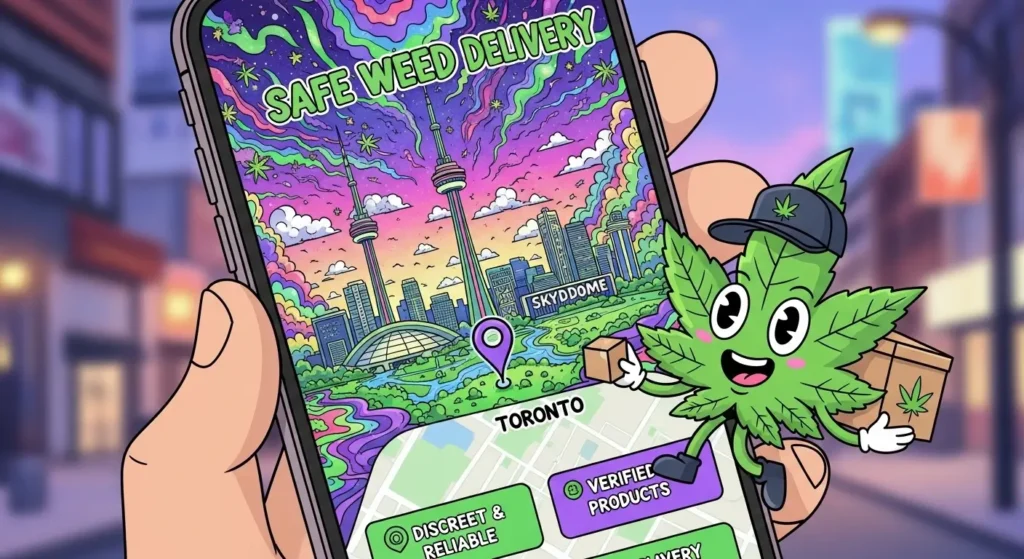
Open any app store, type in “weed delivery Toronto,” and you’re flooded with options. Some look slick. Some look like they were built in 2008 and never updated. And the deals? A zip for $50? A free vape with your first order? It smells off—literally and figuratively.
You’re not just looking for weed. You’re looking for peace of mind. You want to know that the safe weed delivery app you’re using actually verifies IDs, follows AGCO rules, and isn’t going to sell your data to spam bots. You want your same-day weed delivery to show up on time, with the right product, from a store that actually exists.
Whether you’re a medical patient who needs consistency or a weekend explorer hunting for AAAA‑quality premium flower, you need a system to separate the green flags from the 🚩 red flags.
This is that system.
We’re going deep on Is weed delivery legal in Toronto?, breaking down Leafly vs. Weedmaps, explaining why Doobie Delivery is winning the loyalty game, and giving you the exact questions to ask before you hit “Checkout.”
Is Weed Delivery Legal in Toronto? (Yes, But Read the Fine Print)
Before we talk about apps, let’s talk about the law. Because the #1 sign of a safe weed delivery app is incredibly simple: It follows the rules set by the Alcohol and Gaming Commission of Ontario (AGCO).
Green Flag ✅
The app only delivers from a specific, licensed retail store location. The weed cannot leave the store until you place your order. The driver is an employee of that store—not a random courier picking up multiple orders like it’s Uber Eats .
🚩 Red Flag
Third-party delivery. If the app works like SkipTheDishes where any driver can grab a bag and go, that is illegal in Ontario. Full stop. If your order is delivered by someone in a non-descript car who doesn’t work for the dispensary, you are using an unlicensed service.
Green Flag ✅
Mandatory, physical 19+ ID verification at the door. No exceptions. No “I left my wallet in the car.” If they don’t check, they aren’t legal.
🚩 Red Flag
The driver hands you the goods and walks away without glancing at your ID. This isn’t “cool” or “low-key.” It’s a violation of the AGCO’s core licensing requirements.
The Bottom Line:
Is weed delivery legal in Toronto?
Yes, but only if it originates from a provincially licensed store, is delivered by an employee of that store, and is received at a private residence. If an app uses gig-economy drivers for cannabis, it is operating illegally.
The Great Debate: Weedmaps vs. Leafly – Which App is Better?
If you’ve searched for “best app for finding weed,” you’ve landed on Weedmaps or Leafly. These two dominate the space. But here’s the thing most users don’t realize: Finding a dispensary on Weedmaps or Leafly does NOT automatically mean it’s legal.
What is Weedmaps?
Weedmaps started in 2008 as a digital directory for dispensaries. Today, it’s a full tech platform with mapping, ordering, and POS integration. It’s excellent for finding nearby stores and real-time deals. Think of it as Google Maps for cannabis—but with shopping carts .
What is Leafly?
Leafly is the world’s largest cannabis information resource. With over 5,000 strains in its database, it’s the go-to if you want to learn the difference between Blue Dream and Gelato. Leafly excels at education and community reviews. If you don’t know what terpenes are, start here .
So, which app is better, Leafly or Weedmaps?
- Choose Weedmaps if: You know what you want, you want it fast, and you want to compare menus side-by-side within a 5km radius. Their delivery tracking is generally smoother, and the map interface is intuitive .
- Choose Leafly if: You’re browsing. You want to read 50 reviews before committing. You care about lineage, effects, and whether a strain actually helps with anxiety or just makes you hungry .
🚩 Red Flag for Both:
Here’s the catch. Both platforms operate on advertising models. Dispensaries pay for premium placement. If a store is at the top of your search, it doesn’t mean they’re the best—it means they paid to be there .
Your Job: Always verify the dispensary’s AGCO license number. It should be clearly displayed on their website or app profile. If you can’t find it, ask them directly. If they can’t provide it, don’t order.
The Architecture of Trust: Green Flags vs. Red Flags
To make this actionable, I want you to think like a compliance officer. Here is your checklist for how to choose safe weed delivery apps in Toronto.
🟢 Green Flags (The “Order Now” Signals)
- Integrated Age Verification: The driver app should require a hard stop ID scan. If the platform uses software like SmartRoutes or Onfleet, they are logging a time-stamped record. This protects you from fines and protects them from regulators .
- Provincial Licensing: In Ontario, the retailer must be authorized by the AGCO. Legit apps make this easy to find.
- Specific Delivery Windows: “1-3 hours” is better than “ASAP.” Services like Pineapple Express thrive because they define windows (e.g., 6:00 p.m. to 9:00 p.m.), signaling operational maturity .
- Odor-Control Packaging: True discretion isn’t just a brown box; it’s heat-sealed, Mylar bags that lock in terpenes and lock out smell.
🔴 Red Flags (The “Abort Mission” Signals)
- The “Ghost” Retailer: This is a massive issue on major aggregators. You order from a menu, but the dispensary listed doesn’t actually exist or is using someone else’s license. According to Better Business Bureau complaints, some users have reported receiving opened products or dealing with unlicensed operators found through apps that claim to verify their partners .
- The “Dry-as-Dust” Guarantee: If reviews consistently mention “dry,” “underweight,” or “packaged 6 months ago,” run. The legacy market is struggling to transition quality to the legal market, and apps that don’t enforce inventory freshness are just passing the buck .
- Vague ID Policy: If a driver looks like they’re going to hand over a $200 order to a minor without scanning an ID, the business is on borrowed time.
- Banned on Weedmaps? Sometimes a business gets banned or delisted. While this can happen due to technicalities, frequent “banned on Weedmaps” rumors regarding specific retailers often trace back to non-compliance or chargeback issues .
The 10 Best Cannabis Delivery Apps in Canada: Discreet & Reliable (2026 Update)
We’ve segmented these into Aggregators (The Marketplaces) and Direct-to-Door (The Operators). Both are essential to understanding the best cannabis delivery apps in Canada.
Major Marketplaces & Aggregators (The “Google Maps” of Weed)
1. Leafly: The Community-Powered Authority
Best for: Research-driven buyers.
Leafly isn’t just an app; it’s the encyclopedia of cannabis. If you don’t know the difference between a Sativa and an Indica, you start here. They seamlessly integrate online ordering with local dispensary inventory.
Key Features:
- Massive Strain Database: Connects education directly to your cart.
- User Reviews: Highly detailed feedback on specific batches.
- Availability: Available across Canada, including premium cannabis delivery in Brampton and Toronto.
H4: Key Features:
- Real-time menu syncing.
- Effects-based search (e.g., “creative,” “relaxed”).
- Seamless integration with Uber Eats in select regions .
2. Weedmaps: The Established Industry Giant
Best for: Selection and speed.
Weedmaps is the 800-pound gorilla. If you want to compare five dispensaries’ prices on Live Resin at the exact same time, this is your tool. However, 2026 is about vetting. Weedmaps is a platform, not the retailer.
H4: Key Features:
- Extensive Network: Huge coverage in the GTA, Edmonton, and Vancouver.
- Deals & Promos: Easy access to first-order discounts.
- The Catch: Because they are an aggregator, your experience is 100% dependent on the specific store you choose.
Heads up: Can you get banned on Weedmaps? Yes. Retailers get banned for violating terms of service, but sometimes complaints arise because the consumer can’t distinguish between “Weedmaps the platform” and “Weedmaps the retailer.” Always check if the specific dispensary has separate BBB ratings .
3. Pineapple Express (Toronto Specialist)
Best for: GTA residents who value speed.
Acquired by Fire & Flower in 2021, Pineapple Express has matured from a startup into a logistics machine. They don’t just deliver; they specialize in time-sensitive delivery windows .
H4: Key Features:
- Delivery Promise: 1-3 hours across the GTA.
- Premium Focus: They curate higher-end craft products.
- Transparency: Flat fee structure ($10 under $80, free over $80).
4. Uber Eats (with Leafly Integration)
Best for: Mainstream convenience and low-friction checkout.
In a landmark move, Uber Eats partnered with Leafly to allow cannabis orders. Currently available in Toronto, Calgary, and Edmonton, this is the ultimate engagement tool for the casual user .
H4: Key Features:
- Familiar UX: If you can order a burger, you can order a pre-roll.
- Speed: Often delivers in under 60 minutes.
- Strict Protocol: Only provincially certified staff handle the product; regular Uber drivers just pick up the sealed package .
5. Buddi: The Retail Tech Engine
Best for: Supporting local storefronts.
Buddi isn’t an app you download to scroll through products—it’s the white-label engine powering many local dispensaries’ websites. If you’ve ever used “Click & Collect” at a local Toronto dispensary, you’ve likely used Buddi’s software .
H4: Key Features:
- In-Store Kiosks: Bridges the gap between physical and digital.
- Inventory Management: Ensures you don’t order something that’s actually out of stock.
- Delivery Tools: Integrated logistics for stores that do their own delivery.
6. Super Anytime
Best for: Late-night cravings.
While information is scarce on the corporate structure of Super Anytime, user feedback in GTA forums highlights their late-night operating hours. If your pain point is “I need this now and it’s 11:45 PM,” this is a key player in the cannabis delivery in Toronto GTA scene.
7. PotBot: The Medical Prescriber
Best for: Patients, not just recreational users.
PotBot functions like WebMD for weed. You type in your ailment (insomnia, anxiety, chronic pain), and it algorithmically matches you with strains proven to help based on peer-reviewed studies .
H4: Key Features:
- Science-Based Matching: Removes the guesswork.
- Dispensary Locator: Finds medical-focused retailers.
- Symptom Tracker: Log your sessions to see what works long-term.
8. Highway Leaf
Best for: Curated craft cannabis.
Highway Leaf has carved a niche by focusing on “craft” and “micro-cultivators.” In a market where consumers complain about “B.C. bud” failing to impress, Highway Leaf markets itself as the bridge between the legacy craft growers and the legal consumer .
H4: Key Features:
- Artisanal Focus: Limited drops, high quality.
- Narrative-driven: Tells the story of the grower.
9. Dutch Love
Best for: Boutique retail experience at home.
Dutch Love operates beautiful physical retail locations, and their delivery arm mirrors that high-end aesthetic. They are known for strong customer service recovery—if something is wrong, they fix it fast.
H4: Key Features:
- Brand Consistency: What you see in-store is what you get online.
- Staff Training: Highly knowledgeable “budtenders” via chat.
H3: 10. Eaze
Best for: Note: Eaze is a major US player.
While Eaze is primarily US-based, Canadian consumers often look to it as the “gold standard” of frictionless delivery. It serves as a benchmark for what Canadian apps are striving for: instant checkout and hyper-personalized AI recommendations.
Why “Real Experience” Matters More Than Fancy Websites
In 2026, the best weed delivery apps aren’t the ones with the flashiest animations. They’re the ones that feel human.
Think about it. If you were buying a used car, would you trust a website with stock photos and generic descriptions, or a dealer who posts detailed walkaround videos and points out the scratches?
Green Flag ✅
Apps that show real budtenders. Real photos of the actual flower—not trichome close-ups borrowed from a seed bank in Amsterdam. Lab testing results with cannabinoid and terpene percentages. Harvest dates. Packaged-on dates. This is the information that tells you the retailer has actually touched the product.
🚩 Red Flag
Stock photography of purple weed against a black background with a description that says “Fire kush, bro.” If the description doesn’t tell you the lineage, the dominant terpenes, or the effects, the seller doesn’t know what they’re selling. Or worse—they don’t care.
The Doobie Delivery Effect: What “Premium” Actually Looks Like
When locals in Toronto debate “What is the best online dispensary?”, one name keeps surfacing: Doobie Delivery.
Why? Because they treat weed delivery like a logistics problem, not a side hustle.
Doobie Delivery isn’t the cheapest. You can find $99 ounces elsewhere. But here’s what you’re actually paying for:
1. Curation, Not Clutter
Most dispensary apps show you everything they have, sorted by price. Doobie acts more like a curator. Their menu is lean. They don’t carry 50 mediocre strains; they carry 15 excellent ones. This reduces decision fatigue. You spend less time scrolling and more time enjoying .
2. The Subscription Model
This is their secret weapon. You can set up a subscription for your weekly or monthly order. The flower arrives automatically. You don’t forget to reorder. You don’t run out on a Sunday night. For medical users especially, this is a game-changer .
3. Transparency at Checkout
No surprise fees. No “delivery charge added at the last step.” You see the total cost—product, tax, delivery fee—before you enter your credit card.
Green Flag ✅
A clean, honest checkout flow is the ultimate signal of a safe weed delivery app. Shady operators hide fees and make returns impossible. Legitimate retailers make the transaction boring and predictable.
Green Flags: The 2026 Safe Delivery Checklist
Use this checklist when trying a new app:
✅ Visible AGCO License
The store’s CRSA number should be easy to find. If it’s buried in fine print or missing entirely, move on.
✅ Detailed Product Pages
Flower listings should include:
- THC %
- CBD %
- Top terpenes (Myrcene, Limonene, Caryophyllene, etc.)
- Harvest date
- Lab test QR code
✅ Mandatory ID Verification
No ID scan = No legal protection. Period.
✅ Human-Accessible Support
Can you reach a real person via live chat or phone at 9:00 PM on a Friday? If yes, that’s a premium service indicator.
✅ Consistent Branding
The email receipt matches the app name matches the e-transfer name. No “JohnSmith420@protonmail” nonsense.
🚩 Red Flags: Abort Mission Immediately
These are non-negotiable dealbreakers:
❌ Crypto or E-Transfer Only to Generic Email
Some privacy-focused users prefer cash weed delivery, and that’s fine. But if an app refuses credit card and only accepts e-transfer to a personal Gmail address, you are likely dealing with an unlicensed micro-operator. No consumer protection. No refunds.
❌ “No ID Required” Promises
If they advertise this, they are breaking the law. If they break the law on ID checks, what else are they cutting corners on? Pesticide testing? Storage temperatures?
❌ Pressure Tactics
“Only 3 left! Buy now or miss out!” on a mass-produced good like dried flower? Relax. Legitimate retailers don’t need to manufacture urgency like a flash sale on cheap sneakers.
❌ No Physical Store Address
If you cannot verify the originating retail location, you cannot verify the license. Hard pass.
How to Buy Cannabis Online in Canada Without Getting Scammed
The process is simple, but the traps are plentiful. Here is your quick win funnel for how to buy cannabis online in Canada safely:
- Verify the Domain: Legal sites have clear terms, conditions, and often AGCO symbols. Illegal sites usually have countdown timers and “MOM” (Mail Order Marijuana) language.
- Check for “Chain of Custody”: Does the app provide tracking from “Store to Door”? This is a huge green flag indicating they use proper cannabis delivery software .
- Read the 1-Star Reviews: Don’t look at the 5-stars praising the speed. Look at the 1-stars complaining about “no smell” or “shorted weight.” Patterns here reveal operational rot .
The Future of Cannabis Delivery in Canada: AI, IoT, and Hyper-Personalization
What does 2027 look like? We are moving toward predictive delivery.
Imagine your smart scale runs low on flower, and your preferred weed delivery app sends a push notification: “Ready to reorder your favorite strain?” That’s the Internet of Things (IoT) meeting cannabis .
Furthermore, we will see a split in the market:
- The Commodity Players: Uber Eats will dominate speed and low-cost flower.
- The Experience Curators: Apps like Highway Leaf will dominate LTV (Lifetime Value) by selling not just weed, but the lifestyle and story behind it.
Frequently Asked Questions (FAQs)
Is weed delivery legal in Toronto?
Yes, strictly regulated. Delivery is only legal if performed by an employee of a provincially licensed retail store. The order must be placed while the physical store is open, and the product must be delivered directly to a private residence in Ontario. Apps using third-party couriers are operating illegally .
What is the best app for finding weed?
For discovery and education, Leafly is unmatched. Their strain database and user-submitted effect reviews are the gold standard. For local inventory and speed, Weedmaps offers superior mapping and real-time menu updates. For the actual delivery transaction, specialized services like Doobie Delivery often provide a better experience than the directories .
What is the best online dispensary?
In terms of consistency, curation, and customer experience, Doobie Delivery is widely considered the leader in the GTA. They have optimized for reliability rather than just low prices, which resonates with users who have been burned by late deliveries or incorrect orders elsewhere .
Which app is better, Leafly or Weedmaps?
- Choose Leafly if you value research. You want to know exactly how a strain will feel before you buy it.
- Choose Weedmaps if you value speed and proximity. You want the closest inventory right now.
- Use both for due diligence. Check both apps to see if a dispensary is consistently listed with good reviews. Consistency across platforms is a green flag .
What is the best option for premium cannabis delivery in Brampton?
For premium cannabis delivery in Brampton, look toward specialized services that partner with craft growers. Highway Leaf and Pineapple Express (which services the wider GTA including Brampton) are top contenders. Always verify they deliver specifically to Brampton postal codes, as zoning laws can differ.
Where can I find premium cannabis delivery in Toronto?
Toronto offers the most competitive market in Canada. Pineapple Express is a local legend for speed. For selection, Weedmaps or Leafly allow you to scan all available retailers in your specific ward (Downtown, North York, Scarborough) instantly.
How can I buy cannabis online in Canada?
You can buy cannabis online in Canada via provincially run stores (like OCS in Ontario) or through private retailers listed on apps like Leafly and Weedmaps. You must be of legal age, and the product must be shipped/tracked by a licensed retailer.
Is weed delivery legal in Canada?
Yes, weed delivery is legal in Canada. Licensed retailers are permitted to deliver orders to homes. However, municipalities can opt-out or restrict delivery hours. Always ensure the delivery person scans your ID upon arrival .
Can you get banned on Weedmaps?
Yes. Can you get banned on Weedmaps? Retailers can be banned for violating the platform’s terms, which often include non-compliance with local laws, chargeback abuse, or fake listings. For consumers, you won’t get “banned” for buying, but you might lose access to a specific retailer if they get delisted .
Why does my cannabis arrive dry?
Dry cannabis is usually a symptom of poor supply chain management. If the product sits on a shelf for months or isn’t stored with proper humidity packs (Boveda/Integra), it degrades. Always check packaging/harvest dates before ordering.
Are Uber Eats drivers delivering weed?
No. This is a common misconception. When you order cannabis via Uber Eats, a licensed staff member from the dispensary fulfills the delivery. The Uber driver simply transports the sealed package. The ID check is performed by the dispensary staff member .
Conclusion: Your 2026 Delivery Playbook
The Toronto cannabis market has matured. The days of “anything goes” are fading, replaced by clear regulations and higher consumer expectations.
Your 3-Step Action Plan:
- Verify the License First
Before you even browse the menu, find the AGCO license number. This is the foundation of a safe weed delivery app. - Use Directories, Don’t Trust Them Blindly
Weedmaps and Leafly are incredible tools for discovery, but treat them like Yelp, not like a government registry. Cross-reference, read recent reviews, and trust your gut. - Optimize for Your Own Time
Calculate what your time is worth. A $5 gram that takes an hour of travel is actually a $20 gram. Same-day weed delivery with a transparent fee structure is often the better financial decision.
Ready for a delivery experience that actually respects you?
Skip the pop-up shops and anonymous Telegram groups. [Check out Doobie Delivery’s current menu] . Ask about their 2026 subscriber rewards—your future self (and your grinder) will thank you.