
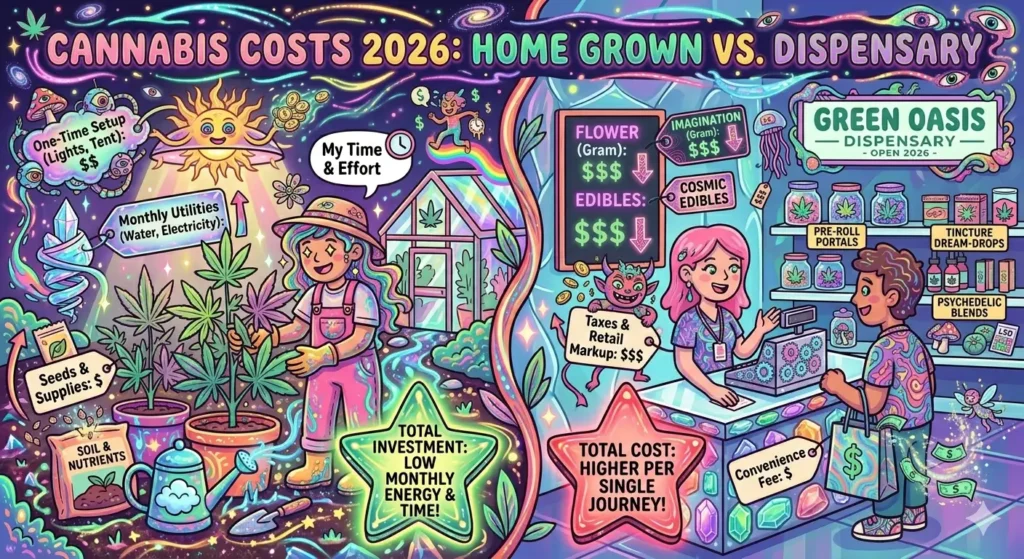
Let’s be honest: staring at your bank account after a trip to the dispensary can be a sobering experience. You walk in for an ounce, and you walk out feeling like you just financed a small car. With inflation impacting every corner of the market, the burning question on every cannabis enthusiast’s mind is this: Is it finally time to take matters into my own hands?
For years, the home grow vs. dispensary debate was settled by convenience. Dispensaries offered variety and lab-tested safety, while home growing was for the dedicated hobbyist. But 2026 has flipped the script. With electricity costs stabilizing but retail markups soaring, the financial landscape has shifted dramatically.
In this guide, we aren’t just going to scratch the surface. We’re going to open the books, look at the raw data, and give you the 2026 cost breakdown. Whether you are a medical patient consuming high volumes or a weekend social smoker, we will answer the ultimate question: Where does your money actually go further?
The True Cost of Convenience: Understanding Dispensary Pricing
Before we dive into the soil and lights, we need to understand what you are actually paying for when you walk into a retail store. Why does an eighth of premium flower sometimes cost $50 or more?
The Anatomy of a Dispensary Price Tag
When you purchase cannabis from a licensed retailer, you aren’t just paying for the plant. You are paying for a complex web of operational costs. According to industry reports from firms like BDSA and Whitney Economics, the average retail price of cannabis in mature markets (like California, Colorado, or Michigan) breaks down roughly like this:
- Cultivation Costs (20-25%): This is what it actually costs to grow the plant.
- Manufacturing & Packaging (10-15%): Compliance packaging, labeling, and testing.
- Taxes (15-35%): Depending on your state, this includes excise taxes, state sales tax, and local municipal taxes.
- Retail Overhead (25-30%): Rent, security, staff payroll, and the inevitable “dispensary markup” to ensure the business stays profitable.
So, what does this mean for you?
If you buy an ounce of premium flower for $300, roughly $100 of that is going directly to the government, and another $75 is keeping the lights on at the retail location. Only a fraction of that price reflects the actual plant material.
The “Premium” Trap
Have you ever wondered why the best dispensary deals often feel like a bait-and-switch? That $99 ounce special might look tempting, but savvy consumers know that you usually get what you pay for. Low-cost dispensary flower is often dry, old, or lacks the terpene profile that defines quality.
If you are a high-volume user—say, going through an ounce a month—your annual dispensary spend is likely sitting between $2,400 and $3,600. For medical patients, this number can easily double. This is where the home grow vs. dispensary argument starts to look less like a hobby and more like a financial necessity.
The Economics of Home Cultivation: Your Initial Investment
Switching to home cultivation is a shift from a transactional relationship (paying for a product) to a manufacturing mindset (paying for a setup). The barrier to entry is the initial setup cost. But don’t let that scare you. In the world of digital marketing and business, we talk about ROI (Return on Investment). Home growing has one of the most aggressive ROI curves of any consumer investment—if you do it right.
Budget Tiers for Home Growing
You don’t need a $5,000 laboratory to grow top-shelf weed. In 2026, technology has democratized cultivation. Here are the three typical tiers of investment:
- The “Tent & LED” Starter (Budget): $400 – $800
- Components: 2×2 or 3×3 grow tent, 200-300w LED light, inline fan, carbon filter, fabric pots, soil, nutrients, seeds.
- Yield Potential: 4-8 ounces every 3-4 months.
- Best for: Beginners wanting to test the waters without breaking the bank.
- The Premium Hobbyist (Mid-Tier): $1,000 – $2,500
- Components: 4×4 or 5×5 tent, high-end bar-style LED light (500-700w), automated climate control (AC/heat), auto-watering systems, genetics from reputable breeders.
- Yield Potential: 12-24 ounces per cycle.
- Best for: Heavy users or medical patients looking to replace dispensary trips entirely.
- The “Permanent Garden” (High-End): $3,000+
- Components: Dedicated room, split AC units, CO2 injection, top-tier environmental controllers.
- Yield Potential: 2-5 pounds per cycle.
Best for: Serious enthusiasts or caregivers providing for multiple patients.
Pro Tip: The biggest mistake new growers make is skimping on the light. In 2026, the market standard is full-spectrum LED lighting. While the upfront cost of a high-quality LED (like brands such as HLG, Gavita, or Spider Farmer) might be $600-$800, it will pay for itself in a single harvest compared to buying the equivalent weight at a dispensary.
The Recurring Costs (Electricity, Water, Nutes)
Unlike a dispensary transaction, home growing comes with a monthly utility bill increase. However, thanks to advancements in energy-efficient horticulture, the impact is lower than you might think.
- Electricity: A 500w LED light running 12 hours a day during flowering costs roughly $18-$25 per month (depending on your local kW/h rate).
- Water & Nutrients: $10-$30 per month. Organic living soil users often spend less, while synthetic hydroponic setups may require more precision but offer faster growth.
- Total Monthly Overhead: Between $30 and $60.
When you compare this to a $300 monthly dispensary bill, the math starts to look very attractive.
Home Grow vs. Dispensary: The 2026 Financial Face-Off
Let’s put the numbers side-by-side. To make this fair, we are comparing the cost of premium flower. We aren’t comparing your homegrown “fire” to the dispensary’s discount shake. We are comparing top-shelf to top-shelf.
Year 1: The Break-Even Analysis
Scenario A: The Dispensary Loyalist
- Monthly Spend: $300 (1 ounce of premium flower)
- Annual Total: $3,600
- Pros: No work, immediate availability, variety.
- Cons: Zero equity; you are paying for someone else’s overhead forever.
Scenario B: The Home Grower (Mid-Tier Setup)
- Initial Setup: $1,500 (Quality tent, light, ventilation, genetics)
- Recurring Monthly Costs: $50 (Electricity, water, soil amendments)
- First Harvest (3-4 months): 16 ounces (1 pound).
- Total Year 1 Cost: Setup ($1,500) + Recurring ($600) = $2,100.
- Yield: 1 pound (16 ounces).
The Verdict: In Year 1, the home grower spends roughly $1,500 less than the dispensary shopper. However, the home grower also ends the year with a full setup paid off and an additional 16 ounces of flower they can enjoy. If you factor in the value of the flower produced (16oz x $300/oz = $4,800 value), the home grower is not just saving money; they are generating tangible asset value.
Year 2 and Beyond: The Wealth Gap
This is where the home grow vs. dispensary comparison becomes laughable for the retail shopper.
- Dispensary Year 2 Cost: $3,600 (again).
- Home Grower Year 2 Cost: $600 (just recurring costs).
- Home Grower Yield: 3-4 cycles per year (if utilizing a perpetual harvest or autoflowers) = 3-4 pounds of flower.
By the end of year two, the home grower has effectively reduced their cost per ounce to $15-$25, compared to the dispensary price of $250-$350.
Have you ever calculated how much you actually consume in a year? For many, the realization is staggering. If you smoke a gram a day, switching to home cultivation could save you enough money to pay for a vacation, a new car payment, or a significant contribution to your savings account.
Quality Control: Why Your Home Grow Can Beat the Dispensary
Money isn’t everything. If the flower doesn’t get you where you need to go, the savings don’t matter. This is where the home grow vs. dispensary debate enters the realm of quality control.
The “PGR” Problem in Retail
Have you ever bought dispensary weed that looks perfect—dense, round, hard nugs—but tastes like cardboard and doesn’t get you high? You might have encountered PGRs (Plant Growth Regulators) . While many commercial growers use safe, organic PGRs, some use synthetic versions to bulk up weight and speed up harvests.
When you grow at home, you control the inputs. You decide if you want to grow organic living soil, which often produces a superior terpene profile and smoother smoke. You decide when to harvest, ensuring your trichomes are at peak ripeness (cloudy with some amber) rather than harvested early for commercial efficiency.
The Terpene Advantage
Terpenes are the aromatic compounds that dictate flavor and effects. In a commercial dispensary setting, flower is often harvested, dried quickly in industrial rooms, and then sits in plastic jars or bags for weeks before hitting the shelf. That degrades terpenes.
When you grow your own cannabis, you can practice slow drying and curing. You can hang the entire plant for 10-14 days at 60°F and 60% humidity—the “gold standard” that commercial operations rarely have the space or time to execute. The result is a jar of flower that smells like a skunk sprayed a bag of fruit, not like hay.
Overcoming the Hurdles: Is Home Growing Right for You?
It’s not all roses and rainbows. Growing cannabis requires time, attention, and a willingness to fail. But in 2026, the resources available to new growers are better than ever.
The Learning Curve
Let’s address the elephant in the room: what if I kill my plants?
Every grower, no matter how experienced, has killed a plant. The difference is that a failed home grow costs you a few seeds and a month of electricity. A failed dispensary trip costs you cash.
- Quick Win: Start with autoflowering seeds. Unlike photoperiod plants that rely on strict light schedules, autoflowers flower automatically. They are more forgiving to light leaks and beginner mistakes. You can go from seed to harvest in 10-12 weeks.
- Avoid This Mistake: Overwatering. New growers often kill their plants with kindness. “Helicopter parenting” your cannabis usually results in root rot. Trust the process; let the soil dry out between waterings.
Legal Considerations
Before you buy a single seed, you need to understand your local laws. In 2026, many states allow home cultivation for adults over 21, often with limits (e.g., 6 plants per household). However, some states still prohibit it entirely, even if dispensaries are legal.
- Always check your local regulations.
- Security: Ensure your grow is discreet. Carbon filters are not just for smell; they are for security.
Answering Your Burning Questions
To truly understand the home grow vs. dispensary landscape, let’s tackle the specific questions we know you’re asking Google (and ChatGPT) right now.
How much does it cost to grow a pound of weed in 2026?
Based on the mid-tier setup analysis above, once your initial equipment is paid off, the cost to produce a single pound (16 ounces) of high-quality cannabis is typically between $150 and $300. This includes electricity, water, nutrients, and soil. Compare that to a dispensary pound, which would cost you $2,400 to $4,800. The savings are astronomical.
Is homegrown weed better than dispensary weed?
Often, yes. Homegrown weed offers superior terpene preservation and potency because you control the drying and curing process. While dispensaries sell “top shelf” flower, it often loses its volatile terpenes during transport and storage. Growing your own cannabis allows you to harvest at peak maturity and consume it fresh, resulting in a more flavorful and potent product.
What is the biggest hidden cost of home growing?
The biggest hidden cost is environmental control, specifically managing humidity and temperature. If you set up a tent in a garage during summer, you will likely need an air conditioner. If you set up in a basement in winter, you need a heater. The initial setup cost often fails to account for the cost of climate management, which can add $20-$50 to your monthly electrical bill.
How many plants can I grow to replace dispensary visits?
For a heavy user (1-2 ounces per month), a perpetual harvest of 4 to 6 plants is usually sufficient. If you grow photoperiod plants, you can harvest every 3-4 months. By staggering your starts (planting one seed every few weeks), you can achieve a continuous supply without ever needing to step foot in a retail store.
The Future of Cannabis Consumption
We are witnessing a cultural shift. For the first decade of legalization, dispensaries held a monopoly on “legitimate” cannabis. But as the market matures, consumers are becoming more sophisticated. They are realizing that the dispensary experience is often a luxury tax.
In 2026, the savvy consumer is looking at long-term value (LTV). They aren’t just asking, “How much is this eighth?” They are asking, “How can I stabilize my supply chain?”
Home cultivation isn’t just about saving money; it’s about sovereignty. It’s about knowing exactly what went into your medicine. It’s about the pride of smoking a joint you grew yourself—a feeling no dispensary can replicate.
Frequently Asked Questions (FAQs)
1. Is home growing actually cheaper than buying from a dispensary in 2026?
Yes, significantly. While the initial setup cost for a grow tent and lights can be $500-$1,500, the cost per ounce drops to under $30 after the first harvest. In contrast, dispensary ounces routinely cost $200-$400.
2. How long does it take to grow cannabis from seed to harvest?
It depends on the strain. Autoflowering seeds typically take 10-12 weeks from germination to harvest. Photoperiod strains take longer, usually 4-5 months, because you control the vegetative growth phase before switching to a 12/12 light cycle to induce flowering.
3. What are the legal limits for home cultivation?
Laws vary by state and country. In many U.S. states like California, Michigan, and Colorado, adults over 21 can grow up to 6 plants (12 per household if two adults reside there). Always verify your local laws before starting.
4. Can I get the same potency from homegrown weed as I do from top-shelf dispensary weed?
Absolutely. In fact, you can often exceed dispensary potency. By purchasing high-quality genetics from reputable breeders and managing your drying and curing process meticulously, your homegrown flower can easily rival—and often surpass—the best dispensary deals available.
5. What is the hardest part of switching from dispensary to home grow?
Patience. The dispensary offers instant gratification. Growing requires a 3-4 month waiting period for your first harvest. Additionally, managing pests (like spider mites) and environmental factors (humidity/temp) are the most common challenges for new growers.