
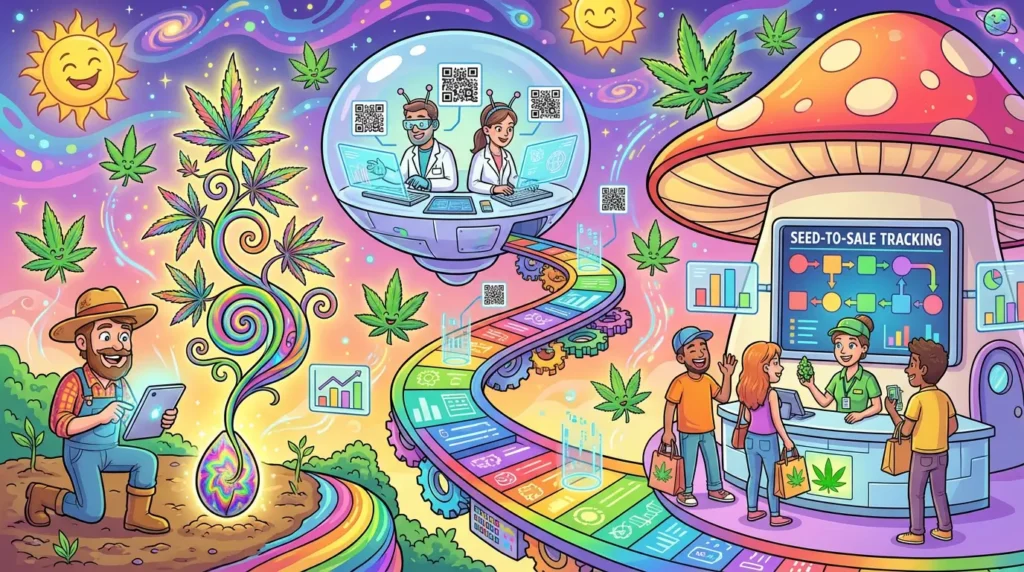
Imagine pouring your heart, soul, and capital into a cannabis cultivation facility. Your genetics are pristine, your grow room is dialed in, and your brand is starting to gain traction. Then, a state inspector arrives, finds a discrepancy in your inventory logs, and suddenly, your entire operation is at risk of being shut down. In the tightly regulated legal cannabis market, this scenario isn’t just a nightmare; it’s a daily potential reality. The single thread holding your business legitimacy together? A robust seed-to-sale tracking system.
This isn’t merely about compliance software; it’s the central nervous system of a modern cannabis enterprise. If you’ve ever wondered how a plant goes from a tiny clone to a packaged product on a dispensary shelf without a single gram leaking into the illicit market, you’re in the right place. We are diving deep into the technology that keeps the industry legal, accountable, and incredibly efficient.
By the end of this guide, you’ll understand the mechanics of this technology, how it directly impacts your bottom line, and why mastering it is the quickest path to scaling a resilient cannabis business. This is the blueprint for turning a regulatory requirement into a competitive advantage.
What is Seed-to-Sale Tracking Technology?
Before we dissect the code and the hardware, let’s define the concept clearly. Seed-to-sale tracking technology is a comprehensive software system designed to monitor every single action in the cannabis lifecycle. It tracks the plant from the moment it is a seed or immature clone, through every phase of cultivation, harvesting, processing, testing, and transport, until it is finally sold to a consumer at a licensed dispensary.
Think of it as an extremely high-stakes inventory management and supply chain logistics platform, but with the added complexity of government oversight. The primary goal is to create an unbroken chain of custody. This prevents diversion into the black market and ensures that consumers are purchasing products that have been properly tested for potency and contaminants.
But is it really just a digital filing cabinet for bureaucrats? Absolutely not. When leveraged correctly, a seed-to-sale tracking platform is your most powerful data analytics tool, giving you granular visibility into your cost of goods sold (COGS), operational bottlenecks, and customer lifetime value.
Why the Legal Cannabis Industry Depends on Tracking Systems
You cannot participate in the legal market without a tracking system. It’s the price of entry. States like California, Colorado, and Michigan have mandated the use of track-and-trace systems, often integrating directly with state-run databases like Metrc (Marijuana Enforcement Tracking Reporting & Compliance).
The “why” goes deeper than a simple rule book, though. The legalization of cannabis was sold to voters and legislators on promises of public safety, restricted youth access, and a controlled, taxable market. This technology provides the proof. It answers the critical questions: Where did this product originate? Who handled it? Has tax been paid on it?
For you, as an operator, this technology is the shield that protects your license. It builds credibility with investors and creates the foundation for a valuable, sellable asset. After all, how do you put a valuation on a business that can’t verify its own inventory?
Direct Answer: A state-mandated seed-to-sale tracking system operates by assigning a unique radio-frequency identification (RFID) tag or barcode to each individual cannabis plant. This digital tag follows the plant and its byproducts through the entire supply chain, logging every transfer, growth phase change, and weight adjustment into an immutable central database.
The Complete Lifecycle: From Seed to Sale
How exactly does a digital log follow a living, breathing plant? It’s a multi-stage process that blends physical labor with rigorous digital reporting. Let’s break down the cannabis supply chain technology step-by-step.
Step 1: Propagation and Cultivation
The journey starts in the mother room or nursery. When a cutting is snipped or a seed is planted, the operator assigns it a unique identifier in the software. This plant’s birth certificate is instantiated.
- Tagging: A physical tag with a barcode or RFID chip is attached to the plant.
- Event Logging: Every time the plant is watered, fed nutrients, moved to a different room, or treated with a pesticide, the action is time-stamped and recorded. This ensures no unauthorized or unapproved chemicals are used, directly protecting consumer health.
Step 2: Harvest and Drying
Harvest is the most vulnerable time for inventory shrinkage. As the plant is chopped down, the system must account for the “waste” (leaves, root balls, stems).
- Weight Reconciliation: The system will often require the “wet weight” of the harvested plant material. It then tracks the “dry weight” once moisture is removed. Any significant unexplained weight loss here will trigger a red flag with regulators, suggesting potential diversion.
Step 3: Extraction and Processing
When the dried flower moves to a manufacturing facility to become vape cartridges, edibles, or tinctures, the complexity intensifies. This is often handled by an advanced cannabis manufacturing software module.
- Waste Accounting: Creating distillate or shatter leads to waste biomass. The system mathematically tracks the input (flower) against the outputs (oil, waste). It’s a mass-balance equation that leaves no room for error.
- Batch Lot Tracking: New products derived from the same plant material are linked together in parent-child relationships. This means if a pesticide is later detected in a tub of gummies, the software can instantly trace back exactly which plants contributed to that batch.
Step 4: Testing and Compliance Hold
Before any product reaches a customer, it must pass mandatory testing. The seed-to-sale tracking system is fully integrated here. A product remains locked in “quarantine” status until a certified lab uploads a passing certificate of analysis (COA) via an API. Without this digital green light, a dispensary physically cannot sell the product.
Step 5: Distribution and Final Sale
The final mile. When a dispensary orders 50 units of premium flower, the distributor creates a digital manifest. Using cannabis inventory management tools, the dispensary scans the shipment upon arrival, instantly updating their stock levels. When the budtender scans the barcode at the point of sale, the plant’s digital soul is retired. The state registry is automatically notified, and the excise tax is calculated instantly.
The Technology Stack: Mapping the Backbone
What’s happening under the hood that makes all this possible? It’s a harmonious blend of hardware, cloud computing, and immutable data structures. We are talking about the future of cannabis supply chain technology, and it relies on several key pillars.
1. Radio-Frequency Identification (RFID)
Forget tedious manual counting. RFID tags allow operators to walk through a grow room with a wand and perform a “flash audit” of 1,500 plants in seconds. Each plant tag contains a microchip that transmits its unique ID via radio waves. This hardware integration is the physical backbone that prevents phantom inventory entries.
2. API Integrations
A closed system is a dead system. State regulators, like the Metrc franchise, require real-time data pushes. Your internal software must have a flexible API to communicate seamlessly with the state hub. Furthermore, robust APIs allow your tracking platform to talk to your accounting software, your customer relationship management (CRM) tools, and your e-commerce menus. If these systems don’t talk to each other, you’re paying a human to copy-paste data, a recipe for errors that bleed profit.
3. Cloud-Based Architecture with Immutable Ledgers
Data must survive server crashes and must be unchangeable. Cloud hosting ensures that a fire at your facility doesn’t wipe out your compliance records. More advanced systems are even leveraging the principles of immutable ledgers—similar to the security seen in blockchain technology—to prove that records haven’t been tampered with after the fact. This is the “audit-proof” layer.
4. The Role of Artificial Intelligence
How do you spot a problem before a regulator does? The industry is rapidly adopting AI in the cannabis sector to analyze historical tracking data. Smart algorithms can detect anomalies in yield patterns that might indicate a “rogue employee” skimming product. AI can also predict exactly when a batch of flower will finish curing based on environmental sensor data, automating the workflow and maximizing throughput.
Quick Win Checklist: Is Your Tech Stack Optimized?
- Does your hardware support RFID, or are you stuck on manual barcoding?
- Is your API connection to the state hub in a “passive” listen mode, or is it a real-time bidirectional sync?
- Can your system auto-generate waste disposal logs for extraction byproducts?
- Are you visualizing real-time yield analytics, or just logging data?
Navigating State Regulations and Government Oversight
You cannot choose your compliance software in a vacuum. Your freedom-to-operate hinges on selecting a cannabis compliance software that speaks the language of your specific state. Let’s examine the landscape.
The Metrc Monopoly
In the majority of legal states, the government has contracted Metrc. Understanding the Metrc integration is non-negotiable. Metrc operates on a “seed-to-sale” logic where the state owns the database, and you are essentially contributing to it. If your internal software has a “sync failure” with Metrc, your business stops. You cannot sell. Period.
BioTrack in Other States
Other states utilize BioTrackTHC, which operates a little differently, often focusing on a government-managed database where the state grants visibility. Operators in these states need software that treats BioTrack not just as a reporting destination, but as a core operating system layer.
So, how do you choose the right path? Ask yourself this: Does your software provider handle 100% of the API maintenance and error resolution with the state provider, or does your internal team have to fix broken syncs? The latter is a surefire way to burn out your operations manager.
Beyond Compliance: Turning Data into Growth
This is the section that separates the industry leaders from the merely compliant. A world-class operator looks at a scanning terminal not as a police requirement, but as a goldmine of business intelligence.
Fine-Tuning Your Grow with Yield Analysis
By cross-referencing the time-stamped nutrient feeds (entered into the tracking system) against the final harvest data, you can run a retrospective analysis. Which nutrient regimen actually delivered the highest grams-per-square-foot? Without a meticulous tracking system, you are just guessing. This is the difference between cultivating a plant and engineering a product.
Boosting Average Order Value (AOV)
When your inventory management system is fully integrated with the point of sale, as it is in best-in-class retail cannabis technology, you unlock true full-funnel visibility. You can identify “affinity pairs”—customers who buy a specific vape cart also buy a specific edible. This data lets you build automated marketing triggers that increase AOV without increasing your ad spend. This is how you optimize the customer experience and scale revenue simultaneously.
Recall Readiness: Protecting Your Brand
Imagine a disaster: You sourced trim from a third-party vendor for your pre-rolls, and a safety test later triggers a recall. With a full implementation of seed-to-sale tracking, you don’t have to issue a blanket recall for all your pre-rolls. You pinpoint the exact 47 units created from that specific batch of trim. The financial impact drops from “catastrophic” to “a bad Tuesday,” and your brand integrity remains intact.
FAQs
Q1: What exactly is a seed-to-sale tracking system in cannabis?
A: It’s a comprehensive cannabis supply chain technology platform required by law. It records every life stage of a cannabis plant, from cultivation and processing to transport and retail sale, using unique identifiers like RFID to ensure an unbroken chain of custody.
Q2: Is seed-to-sale tracking mandatory in all legal states?
A: Yes. Every state with a regulated adult-use or medical market mandates a version of cannabis compliance software. The specific state contractor (like Metrc or BioTrack) might differ, but the core requirement to digitally track inventory within a government-monitored database is universal.
Q3: What is the difference between RFID and barcode in cannabis tracking?
A: RFID (Radio-Frequency Identification) lets you scan dozens of plants at once without a direct line of sight, saving massive labor hours during audits. Barcodes require individual manual scanning, which is more error-prone but cheaper to implement initially for small operations.
Q4: How does tracking software prevent cannabis inventory shrinkage?
A: It uses mass-balance logic. If you input 100 pounds of biomass but only output 3 pounds of oil and 50 pounds of waste, the cannabis inventory management system flags the missing 47 pounds. These mathematical reconciliations make it extremely difficult to divert product without leaving a detectable digital paper trail.
Q5: Can a seed-to-sale system help me improve my cultivation ROI?
A: Absolutely. By layering in AI in the cannabis sector analytics, the system maps cost inputs (labor, nutrients, electricity) directly to specific harvest yields. You can identify exactly which growing conditions or genetic strains generate the highest margins, turning your compliance tool into a profit engine.
Q6: What happens if my software loses connection with the state Metrc database?
A: This is called a “sync breach,” and it’s a code-red scenario. When the API integration fails, you lose the ability to create new plant tags, transfer inventory, or finalize sales legally. That’s why enterprise-grade cannabis manufacturing software invests heavily in offline caching and failover redundancy.
Q7: How does track-and-trace technology protect consumers?
A: It enforces mandatory quality testing. When flower enters a processing lab, the tracking system places a “compliance hold” on the batch. It is physically impossible to package and sell that flower until a state-authorized lab uploads a passing Certificate of Analysis (COA) into the API, confirming the product is free of pesticides, mold, and heavy metals.
The Future Landscape of Cannabis Tracking Technology
Where is the technology headed? The integration is going to get tighter, and the insights, sharper. We are moving toward an era of predictive compliance and hyper-automation.
We will see a much more aggressive use of generative AI to handle reporting. Instead of an audit costing your team hundreds of hours of manual reconciliation, a smart agent will auto-populate the data and write the narrative summary for the government, flagging only a few contextual items for human review.
The line between retail cannabis technology and state databases will blur further, potentially integrating directly with the banking sector via secure fintech channels to guarantee real-time excise tax payments at the moment a register rings. For operators, the burden of proof is only rising. This isn’t a threat, but an opportunity for those who choose the right digital partners.
Conclusion
The legal cannabis industry does not exist without a reliable seed-to-sale tracking backbone. It’s the mechanism of trust between the business, the state, and the consumer. But as we’ve explored, viewing this software merely as a regulatory weight is a costly mistake. When you select a platform that masters cannabis compliance software, state integrations, and internal business intelligence, you are not just dodging fines; you are building a data-fortified fortress.
Your inventory accuracy becomes your competitive edge. Your traceability becomes your brand safety net. The question isn’t whether you have to use this technology; it’s whether you are extracting every dollar of value from the data you are already collecting.
Are you ready to stop serving the system and start letting the system serve you? Dive into your current platform’s analytics dashboard tomorrow morning. Look for the “waste percentage” report or the “yield variance” metric. That number isn’t just data; it’s raw working capital sitting on the table. Take control of your supply chain technology today.