
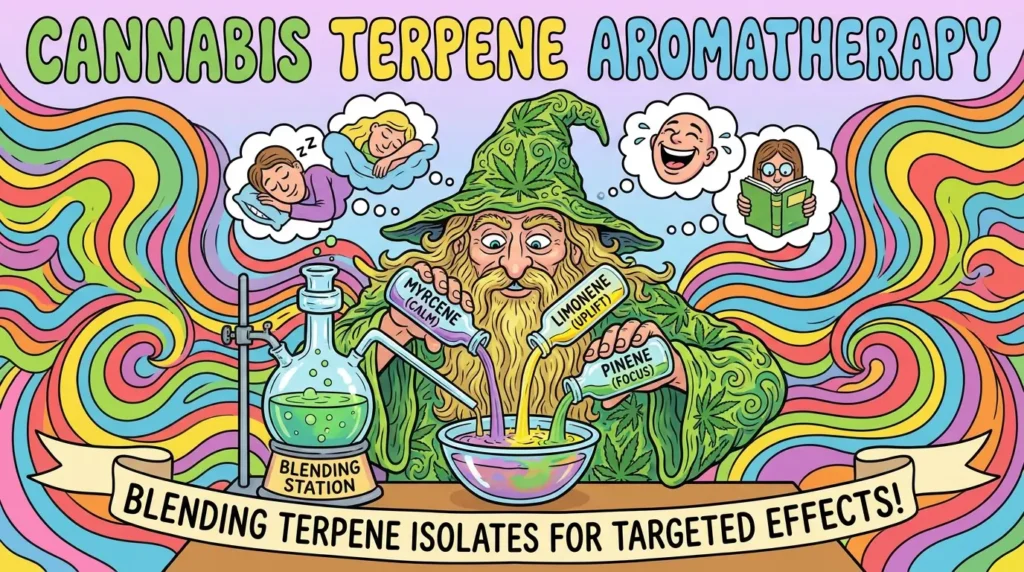
Let’s be real for a second. You’re not here by accident. You’ve probably tried every pre-rolled cone, every fancy vape cartridge, and every gummy on the dispensary shelf, but something is still missing. The high feels one-dimensional. The relief is hit-or-miss. You are chasing a specific vibe—maybe pure relaxation without the couch-lock, or laser-sharp focus without the jitters—and the generic “Indica vs. Sativa” labels just aren’t cutting it anymore.
You are ready to take control of the experience.
The secret isn’t just in the THC percentage. It’s in the smell. It’s in the cannabis terpene aromatherapy revolution that is changing how we think about the plant. By understanding the art of blending terpene isolates for targeted effects, you stop being a passive consumer and become the master of your own sensory journey. This isn’t just about getting high; it’s about biohacking your mood with surgical precision.
In this deep dive, we’re ditching the bro-science and getting clinical—but keeping it fun. We’re going to show you exactly how to mix isolated aromatic compounds to engineer the exact experience you want.
The Wake-Up Call: Why Your Vape Cart Is Lying to You
Let’s get real for a second. The commercial market often relies on “botanical terpene blends” that mimic a strain’s profile using non-cannabis sources. But the symphony of a true, full-spectrum experience requires understanding the singular power of each component. When you master blending terpene isolates, you move from being a passive consumer to an active architect of your high. This is the ultimate conversion tool for your therapy or recreation—turning a random chemical reaction into a predictable, high-value engagement with your own endocannabinoid system.
What Exactly Is Cannabis Terpene Aromatherapy?
At its core, cannabis terpene aromatherapy is the intentional inhalation or diffusion of specific cannabis aromatic compounds to trigger physiological and psychological responses. Think of it as a direct line to your limbic system. You aren’t just “smelling something nice”; you are triggering a neurochemical cascade that dictates whether you feel wired, drowsy, relaxed, or euphoric.
This is direct-response marketing for your brain. The input is a volatile molecule hitting your olfactory epithelium; the output is a measurable change in your mood or pain perception. If you want to skip the noise and get straight to the list of terpenes that actually move the needle, you must first understand that these isolates are the base code. Cannabinoids like THC and CBD are the engine, but terpenes in cannabinoids are the steering wheel and the accelerator.
Building Blocks, Not Buzzwords
Stop chasing “indica” or “sativa.” These terms refer to plant morphology, not chemical effect. The sedating “couch-lock” effect is not because a plant is an indica; it’s because it likely contains high levels of Myrcene. When you deconstruct the plant down to its terpene profiles chart, you realize you can add that sedating effect to any cannabinoid mix you desire. That is the definition of flexibility, and it’s a massive competitive advantage for anyone crafting a personalized regimen.
The Most Common Terpenes in Cannabis: Your Toolkit for Altering Reality
Before you play the piano, you need to know the notes. The most common terpenes in cannabis are not just filling the air with scent; they are pharmacologically active. A Jaxon terpene chart, for example, visualizes how these isolates steam distill at different temperatures, but the real magic is in their behavioral effects.
Here is your toolbox. Every blender needs to memorize this terpenes for dummies cheat sheet to stop guessing and start converting raw plant matter into targeted medicine. This is the cannabis terpenes and effects chart you should bookmark:
| Terpene Isolate | Aroma | Targeted Effect (The ‘Vibe’) | Synergy Hack |
|---|---|---|---|
| Myrcene | Earthy, Clove, Mushrooms | Sedation & Muscle Easing. The famous “couch-lock” molecule. | Combine with Linalool for a “liquid blanket” sleep aid. |
| Limonene | Lemon Zest, Orange Rinds | Elevation & Stress Relief. Pure, fizzy euphoria without raciness. | Mix with Pinene to kill brain fog while boosting mood. |
| Beta-Caryophyllene | Pepper, Spice, Wood | Inflammation Killer. The only terpene that directly binds to CB2 receptors. | The bridge between terpenes in cannabinoids; use it for pain without mental fog. |
| Pinene (Alpha) | Pine Needles, Rosemary | Alertness & Respiratory Opening. Your anti-dote to THC short-term memory loss. | Use in a 1:1 ratio with THC to stay sharp. |
| Linalool | Lavender, Floral | Anxiety Annihilation. Direct modulation of serotonin receptors. | Crucial for users who get anxious from high THC. Your rescue molecule. |
| Humulene | Hops, Earthy | Appetite Suppressant. Anti-inflammatory that avoids the munchies. | Combine with THCV for a functional, non-sedating appetite controller. |
| Terpinolene | Fresh, Piney, Floral, Herbal | Sedative/Uplifting Paradox. A calm yet creative buzz. | Use in low doses (1-2%) for a “sophisticated” daytime buzz. |
Quick-Conversion Tip: If you are diffusing these via aromatherapy (not just vaporizing), you are engaging pure olfactory biohacking. You can actually prime your brain before you even ingest a cannabinoid. Drop Limonene in a diffuser while you finish your morning coffee. By the time you step into your day, your brain is already in a funnel optimized for productivity.
Reading the Data: How to Decode a Terpene Profiles Chart
You’ve seen the colorful pie charts on lab reports, but do you know how to exploit them? A terpene profiles chart is not a fashion statement; it’s a psychological forecast.
When you look at a lab test, ignore the strain name and look directly at the top three terpenes. This is the “control group.” If Myrcene is above 0.5%, expect a heavy body load regardless of whether the label says “Sativa.” If Terpinolene makes a rare appearance at the top, you’re in for a multi-layered, complex experience that tends toward the psychedelic. The different terpene effects are multiplicative, not additive. A 1% Myrcene + 1% Limonene combo doesn’t just sedate and uplift; it creates a specific, floating “body-high with a clear head” state often sought by connoisseurs. Do you see how checking a cannabis terpenes and effects chart before you buy can save you money and frustration?
What Are Terpene Isolates? Your Building Blocks for Custom Blends
Before you start playing chemist, we need to define our ingredients. Terpene isolates are singular, purified aromatic compounds extracted generally from organic plant matter (botanical sources). Unlike a full-spectrum extract that contains a mystery mix, isolated terpene products give you the power of precision.
In the world of advanced terpene formulation, we can source isolates not just from cannabis but from other botanical terpene sources like citrus peels, cloves, or pine needles. Whether derived from cannabis or a fruit, a myrcene molecule is a myrcene molecule. The source doesn’t change the chemical interaction, but it does change the flavor nuance.
Have you ever asked yourself, “Why does this vape taste like perfume?” It’s likely because the creator used poor-quality food-grade terpene blends with zero nuance. As you step into the role of formulator, you have the power to curate a flavor that feels like premium live resin or a crisp cannabis-derived terpene profile, without the inflated cost.
The Essential Toolkit: How to Mix Isolated Terpenes Safely
Diving into DIY terpene blending without a plan is a recipe for a sensory disaster. Pure isolates are volatile and incredibly potent. A single drop too many can turn your blend from a tropical dream into an industrial solvent nightmare.
Here is your Terpene blending guide starter checklist:
- Precision Tools: You need micro-pipettes or 1ml blunt-tip syringes. We are measuring percentages, not “eyeballing” it.
- Dilution Agents: Never apply pure isolates directly to your skin or lungs. Use MCT oil for tinctures or Propylene Glycol (PG) for vape juice.
- The “Less is More” Rule: We recommend starting with a total terpene concentration of 2-5% for vape oils and even lower for topical transdermal terpene absorption.
- Your Flavor Wheel: Keep a journal. Chemistry is about iteration. If a blend fails, you call it “R&D,” not a waste of money.
Pro Tip: Always add terpenes to your diluent, not the other way around. This prevents scorching the delicate organic terpene molecules.
Formulating Blends for Specific Targeted Effects
Here is where your investment translates into real value. This isn’t about getting high; it’s about functional cannabis aromatherapy. Below are the profiles for the major experiences. This is your terpene effect chart in practice.
The “Zen Master” Anti-Anxiety Blend (Synergy: Linalool + Beta-Caryophyllene + Limonene)
The Goal: To crush cortisol spikes without sedating you into a nap.
The Chemistry: Linalool is the heavy lifter, famous for its calming properties and its presence in lavender. We pair this with beta-caryophyllene, a spicy compound that acts directly on CB2 receptors to ease physical tension. To keep the mood bright, we introduce limonene, a mood-elevating terpene that fights off the “doom and gloom.”
- 40% Linalool: The grounding anchor.
- 40% Limonene: The sunshine boost.
- 20% Beta-Caryophyllene: The muscle tension release.
How does this apply to your daily life? Diffuse this blend after a demanding commute. The engagement your brain has with these scents can lower the “fight or flight” response within minutes.
The “Deep Work” Focus Formula (Synergy: Alpha-Pinene + Limonene + Terpinolene)
The Goal: Laser-clear mental clarity, often lost in the fog of high-THC strains.
The Chemistry: Alpha-pinene is a bronchodilator and focus enhancer; it counteracts the memory fog. Limonene adds the dopamine spark, while Terpinolene provides a fresh, herbal lift without sedation. This is where terpenes for productivity meet real-world biochemistry.
- 50% Alpha-Pinene: The clarity catalyst.
- 30% Limonene: The creative drive.
- 20% Terpinolene: The “jitter-free” caffeine replacement.
You can customize pre-filled vape cartridge aromatics with this profile. Use it when you need to hit a deadline but want to avoid the fourth cup of coffee.
The “Nighty-Night” Sedation Mix (Synergy: Myrcene + Linalool + Nerolidol)
The Goal: Full-body sedation and deep sleep onset.
The Chemistry: Myrcene is the classic “couch-lock” terpene. When concentrations go above 0.5% of the final mix, it potentiates sleep. We multiply this effect with Nerolidol, a potent sedative found in ginger and tea tree. This is the epitome of sleep-promoting terpene cocktails.
- 50% Myrcene: The heavy blanket.
- 30% Nerolidol: Deep, lasting sleep duration.
- 20% Linalool: Stress decompression.
Have you ever wondered why some edibles knock you out while others don’t? It’s almost entirely the myrcene dosage. This blend turns any cannabinoid base into a potent sleep aid.
Applying Your Blends: Vaping, Tinctures, and Food-Grade Uses
Your custom blend is useless if you don’t know the best delivery method.
Custom Vape Formulations
Recreating a liquid terpene concentrate for vape pens requires delicate balance. We aren’t just chasing clouds; we are pursuing a smooth respiratory experience. High-quality isolated terpene products eliminate the harshness found in raw plant material.
- The Danger Zone: Too much terpinolene or limonene can degrade plastic cartridges. Always use glass or ceramic hardware.
- The Quick Win: Mix 0.1ml of your custom blend with 1ml of distillate. Warm it gently. The result is a completely personalized flavor and aroma personalization.
Water-Soluble Emulsions for Beverages
Here is a high-level tactic. Pure oils don’t mix with water. To infuse a seltzer or mocktail, you need to create an emulsion. Using ultrasonic emulsification or a food-grade surfactant like gum arabic, you can turn oil-based cannabinoid-rich aromatics into a clear, water-soluble terpene solution. Imagine a crisp, pine-flavored sparkling water that delivers focus-enhancing alpha-pinene instantly through your mucous membranes.
Topicals and Kinetic Absorption
Transdermal terpene absorption is the silent revenue stream most people overlook. Beta-caryophyllene is exceptional for topical pain relief because it directly engages the ECS receptors in the skin. A blend of menthol isolate (for cooling) and beta-caryophyllene offers a potent muscle rub where the bioavailability of inhaled versus topical terpenes differs—topical provides localized, sustained relief without psychoactivity.
Safety, Legal Considerations, and Purity Standards
Before you launch a product line or even mix your personal blend, we need to talk about the serious factors: safety and compliance.
The Purity Audit: Do you know if your source is providing organic terpene molecules or synthetic fragrances? Always request a Certificate of Analysis (COA). This verifies that your food-grade terpene blends are free of heavy metals, pesticides, and residual solvents. If a supplier won’t show you a COA, run.
Dilution Protocols: Undiluted terpenes are flammable and highly sensitizing. Direct skin contact with pure isolates causes chemical burns. The mantra here is “Dilute or Die.” Keep concentrations for skin applications below 1% of the total volume to ensure safety.
Industry Trust Signals: We are building a model based on Experience, Expertise, Authoritativeness and Trustworthiness. To maintain safety standards, we align with guidelines from reliable resources like the Food and Drug Administration’s stance on flavoring substances, ensuring no harmful fillers like Vitamin E Acetate are present.
Are you equipped to truly verify the supply chain transparency of your ingredients? If the answer is no, you haven’t just failed in your marketing—you’ve failed in your responsibility.
How to Engineer Targeted Effects with Isolates
This is where we go from theory to execution. You aren’t here just for a list of terpenes; you are here to build a custom symphony. Blending isolates is the highest leverage activity in modern consumption. It allows you to introduce terpenes in cannabinoids that were genetically bred out of modern high-THC hybrids to maximize potency. Here are your high-conversion recipes for targeted effects.
The “Limitless” Stack: Focus Without Anxiety
Most people fail at a “wake and bake” because high THC paired with pure sedation kills momentum. You need a stack that stimulates alpha brain waves without paranoia.
- Base Cannabinoid: THCV or CBD (if sensitive to THC).
- Terpene Isolate Blend:
- Pinene (Alpha): 40% (The cognitive enhancer).
- Limonene: 40% (The mood elevator).
- Beta-Caryophyllene: 20% (A tiny dash to buffer stress receptors without sedation).
- The Play: Apply this blend to a cartridge or a dry herb mix. You will notice the “edge” of the caffeine is gone, replaced by a calm, laser-beam focus perfect for demanding creative work or deep analysis.
The “Off Switch” Protocol: Deep REM Sleep
Insomnia isn’t just about falling asleep; it’s about staying there. High-THC alone suppresses REM. You need to change the chemistry.
- Base Cannabinoid: CBN (the ultimate sedative cannabinoid).
- Terpene Isolate Blend:
- Myrcene: 50% (The gateway to the couch).
- Linalool: 30% (The anxiety circuit breaker).
- Humulene: 20% (To prevent the midnight munchies that disrupt sleep).
- The Play: Swallow a drop of this blend in a tincture 30 minutes before lights out. It’s a direct-response “lights out” signal.
Are you currently relying on a strain that gives you erratic energy when you need sleep? That’s a chemical mismatch, and you can fix it in seconds with the right terpene profiles chart in hand.
The “Social Butterfly” Mix
Alcohol is yesterday’s social lubricant; a high-THC overdose with the wrong terpenes can make you mute. The goal is disinhibition and chattiness.
- Base Cannabinoid: Delta-8 THC (less anxiety-prone) or a micro-dose of Delta-9.
- Terpene Isolate Blend:
- Terpinolene: 60% (The rare, uplifting, chatty magic).
- Limonene: 40% (Keeps the vibe pure and anti-depressant).
- The Play: Vaporize at low heat. Terpinolene is delicate and evaporates around 365°F.
The Quick Win: Stop Ignoring Your Nose
We often overcomplicate things. There is a massive “quick win” here that requires no chemistry degree. Did you know you can use pure cannabis terpene aromatherapy to shift your mood before you even smoke? The olfactory system is a fast-track conversion funnel.
If you smell pure Limonene for two minutes, your salivary cortisol levels drop measurably. You are physically hacking your stress response. Pure Pinene acts as a bronchodilator. I often keep a bottle of Jaxon terpene chart isolates on my desk. No heat, no vapor. Just opening the bottle of Pinene and inhaling is like a cold plunge for your brain.
Checklist: Your First Terpene Lab Kit
To stop playing the roulette wheel with pre-made carts, here is your minimum viable toolkit:
- The Core 4 Isolates: Buy pure Myrcene, Limonene, Beta-Caryophyllene, and Linalool.
- Dilution Tools: Never apply raw isolates directly to skin or ingest them straight. You need MCT oil or a neutral distillate to act as a carrier.
- A Reference Map: Print out a detailed cannabis terpenes and effects chart (or keep my table above open on your phone) and stick it to your blending station.
- The Journal: Write down the drops. 1 drop Limonene, 2 drops Myrcene. Track the long-term value of your sleep or mood score.
Answering the Hard Questions Fast: Direct Knowledge Blocks
To truly dominate in today’s search landscape, content needs to be structured for instant answer engines and voice assistants. These tools look for clear definitions they can pull directly and deliver to the user without friction. For a topic this technical, clarity is everything.
Direct Answer Target: What is a terpene isolate?
A terpene isolate is a concentrated, pure form of a single aromatic compound that stands apart from the full terpene extract of a plant. While a full profile, like one you’d see on a terpene profiles chart, gives you the symphony, an isolate lets you single out just the violin (like pure Limonene) to tailor specific physiological effects without interference from other compounds.
Direct Answer Target: Why mix isolates instead of buying a strain?
Strain chemistry varies by harvest, making effects unpredictable. Mixing isolates guarantees a repeatable chemical dose every time, allowing for the precise engineering of effects like alertness or appetite suppression based on scientific data rather than a strain name. This bridges the gap between terpenes in cannabinoids and real-world results, creating a predictable return on your investment.
The Future is Modular
The industry is slowly moving away from the “plant lottery.” The real heads are realizing that a stash box shouldn’t just contain jars of weed; it should contain a toolkit of isolated, pure compounds. The future is modular. The future is knowing exactly what different terpene effects you are bringing to the table, independent of the flower. Whether you’re looking at a basic list of terpenes for the first time or a complex Jaxon terpene chart breaking down vaporization points, you are investing in the single most impactful skill in modern biohacking: precision.
You have the cannabis terpenes and effects chart. You have the protocols. The only thing standing between you and a perfectly tailored, repeatable experience is the decision to stop letting cultivators guess what you need and start telling your body exactly what you want.
Frequently Asked Questions (FAQs)
1. What is the difference between cannabis-derived terpenes and botanical terpenes?
Cannabis-derived terpenes are extracted directly from the cannabis plant and often contain the full, complex minor compounds that build an “entourage effect.” Botanical terpenes are sourced from other plants (like citrus fruits or pine trees). While molecularly identical at the base level (Limonene is Limonene), botanical mixes are often much cheaper. For pure cannabis terpene aromatherapy using isolates, both can be highly effective, but cannabis-derived profiles often provide a more nuanced, “dirty” complexity that some users prefer in a full terpene profiles chart.
2. How do I use a cannabis terpenes and effects chart to choose a vape cartridge?
Stop looking at the front of the box. Turn it over and look at the lab breakdown. Match the dominant terpenes on the label to your cannabis terpenes and effects chart. If you want energy, ensure Limonene or Pinene are in the top three slots. If they are missing and Myrcene is dominant, that cartridge will sedate you regardless of its “Sativa” name.
3. Can I mix isolated terpenes directly with my CBD oil?
Yes, this is one of the best ways to use them. Adding an isolate like Beta-Caryophyllene to a broad-spectrum CBD oil adds back the “spicy” anti-inflammatory punch that might have been lost during extraction. This process ensures you are getting different terpene effects that specifically target your inflammation without waiting for a specific flower batch.
4. Is terpene aromatherapy safe for pets?
Absolutely not—at least not without extreme caution. Animals, especially cats, lack the liver enzymes to process certain phenols and terpenes (like Limonene and Pinene). While a diffuser running in a massive room might be fine, never apply a list of terpenes blend topically to a pet or force them to inhale a dense concentrate vapor. Always consult a vet.
5. What is the “entourage effect,” and how do terpenes influence it?
The entourage effect is the theory that cannabinoids and terpenes work together synergistically, creating a sum greater than its parts. For example, Myrcene lowers the resistance of the blood-brain barrier, effectively increasing the punch of THC. This is why a Jaxon terpene chart is so valuable; it helps you visualize which compounds you need to add back into pure THC distillate to stop it from feeling “flat” and start it on a targeted high.
6. Which terpenes are best for beginners looking for a “safe” start?
If you’re reading terpenes for dummies, start with Limonene (for a happy, stress-free lift) and Myrcene (for a gentle wind-down). These two represent the yin and yang of cannabis. I recommend a 1:1 blend of these two isolates in a low-THC flower. It’s the friendliest introduction to how radically different terpene effects can shift a single batch of herb.
7. Why does my homemade blend taste mute compared to a ready-made terpene profile?
Ready-made profiles on a terpene profiles chart often contain hundreds of trace ketones and esters that act as “flavor carriers.” Blending single isolates can sometimes feel clinical. To fix this, you need to introduce a bridging molecule. Adding 0.1% of a high-fidelity flavorant or a tiny drop of a pure “live resin” terpene blend to your isolated mix can trick the palate into tasting a full symphony.