
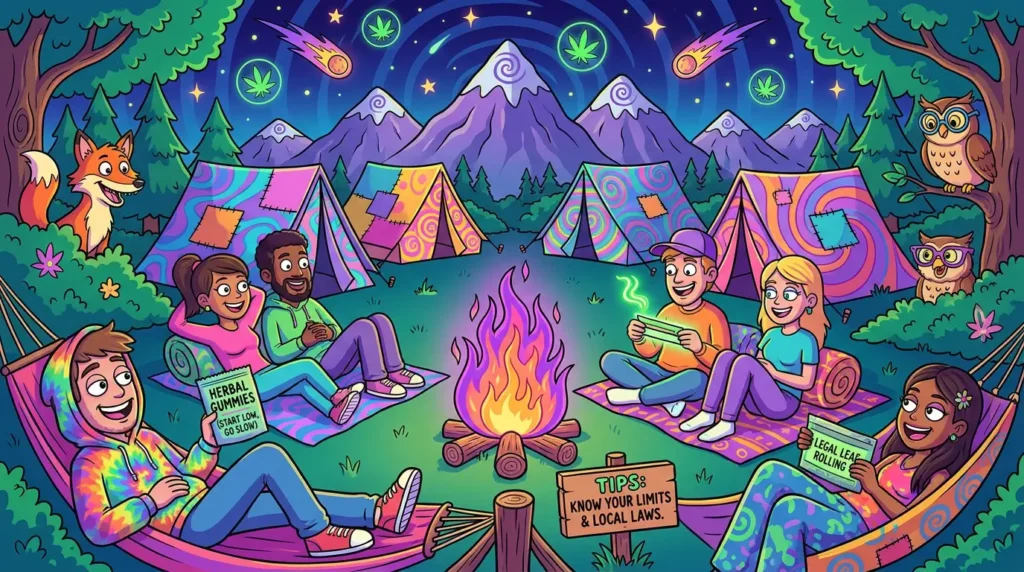
Let’s be honest: there’s a unique kind of magic that happens when you pair the serenity of the great outdoors with the right strain. The crackling of the campfire, a sky full of stars, and the gentle unwind of a high-quality product. But turning that idyllic picture into reality isn’t as simple as tossing a joint into your backpack. If you’ve ever found yourself fumbling with a lighter in the wind, worrying about the smell attracting unwanted attention from fellow hikers, or feeling completely paralyzed by the patchwork of state laws, you’re not alone. The gap between wanting a perfect cannabis and camping experience and actually executing one safely can feel like a canyon.
The truth is, the outdoors demands a different strategy. Your coffee table setup isn’t going to cut it on a mountain trail. Without the right consumption tips, the best products, and a clear understanding of the legal considerations, a weekend getaway can quickly turn into a stressful mess. That’s where this guide comes in. We’ve distilled years of field testing and regulatory deep-dives into an actionable playbook. We’re moving past the generic advice and getting laser-focused on optimizing your pack, maximizing your experience, and guaranteeing you stay on the right side of the law. The objective isn’t just recreation; it’s creating a seamless, high-return engagement with nature.
Consider this your playbook for converting a standard trip into an optimized journey. We’ll dig into the specific gear that turns casual campers into evangelists for a smarter outdoor lifestyle, the funnel of preparation that leads to a safe peak experience, and the non-negotiable rules that protect your freedom. Ready to stop guessing and start engineering your adventures? Let’s break down the anatomy of the ultimate outdoor session.
The Core Strategy: Optimizing Your Consumption Funnel Outdoors
Before we look at gear, we need to talk about behavior. In the business world, we map the customer journey through an engagement funnel. Why should your time in nature be any different? A string of bad decisions—like sparking up a pungent flower at a crowded trailhead at noon—will tank your social credibility and safety metrics instantly. You need a top-down strategy that starts the moment you leave your driveway.
Your goal is to maintain a steady, controlled lift without spiking your “overwhelm” metrics. Think of this as managing your outdoor LTV (Long-Term Value). You want to sustain a positive vibe for the entire trip, not burn out before the sunset. This requires shifting from impulsive actions to a data-driven, intuitive understanding of your environment.
Does your current packing list account for altitude changes? Have you stress-tested your gear against morning dew? If these sound like extreme considerations, trust me, they’re just basics in disguise. The altitude factor is real; a high-altitude hike combined with a potent edible hits differently than the same dose at sea level. By mapping out your touchpoints—arrival, setup, dinner, stargazing—and assigning the right tool and dosage to each, you create a high-converting experience where every moment feels earned and intentional. Ignoring this funnel strategy is the biggest leak in most campers’ relaxation efforts.
Consumption Tips: Engineering a Flawless Session in Nature
Executing a perfect plan requires adaptation. The controlled chaos of the wild introduces variables—wind, rain, fire bans, nosey neighbors—that your at-home routine never accounts for. The key metric here isn’t just “effects felt,” but “discretion maintained” and “experience maximized.” You’re aiming for a clean, frictionless interaction with your chosen products.
The Art of Discretion and Micro-Dosing
Blazing a massive joint might feel iconic, but it’s a massive liability. Smell travels incredibly far in crisp, clean air, and not everyone on the trail shares your appreciation for cannabis legalization. This is where micro-dosing becomes your sharpest tool. Rather than reaching for a full bowl, aim for a threshold dose—just enough to sharpen the colors of the leaves and deepen your appreciation for the silence, without compromising your motor skills or situational awareness.
Why this works: A lower dose keeps your cognitive function high, which is critical for navigation and wildlife safety, while removing the anxiety that can sometimes creep in when you’re far from home. Pair this with a “smoke-buddy” style personal air filter to convert visible clouds and strong scents into neutral, clean air. Your engagement with nature should be a private one.
The Wind-Proof Technique You’ve Been Missing
Torching a standard lighter in the wind is a masterclass in wasted fuel and frustration. The conversion rate from spark to hit drops to near zero. You need hurricane-proof technology. Ditch the Bic and invest in a plasma arc lighter. These are rechargeable via USB, create no butane smell, and defy gale-force winds. However, they don’t work well with traditional pipes. The optimized tech stack here is a plasma lighter paired with a high-quality hemp wick. Light the wick with the arc, then use the gentle, consistent flame of the wick to corner your bowl. This eliminates butane inhalation entirely, preserving the native terpene profile of your strain for a cleaner, more flavorful hit.
Edibles: Calculating the Delayed Conversion Window
If smoking logistics feel too complex, edibles are the obvious pivot. But this pivot comes with a caveat: the delayed conversion window. When you’re hiking, a gummy that takes 90 minutes to hit creates a timing nightmare.
The Pro Move: Time your edible intake with a specific milestone, not a clock. For example, “I’ll eat half a gummy when I find the trail marker for the waterfall.” This anchors the onset to a physical achievement. Furthermore, look for fast-acting nano-emulsified edibles. These products bypass standard liver metabolism partially, offering onset in 15–20 minutes rather than an hour. This drastically reduces the margin of error, giving you rapid feedback on whether you need more or have hit your sweet spot before you’re an hour further down a mountain.
Quick-Win Consumption Checklist for Your Next Trip
- Test Altitude Responses: Try a low dose at elevation before committing to a high-peak session.
- Secure the Scent: Double-bag all flower in smell-proof, vacuum-sealed containers.
- Hydration Conversion: Pre-allocate a “cottonmouth” water bottle strictly for post-session hydration to avoid draining your survival supply.
- Ash Sanitation: Pack a pocket ashtray (a repurposed mint tin) to leave zero trace.
Best Products: The Gear That Delivers Real Outdoor ROI
Let’s cut through the marketing noise. A lot of “outdoor gear” is just regular gear in a camouflage colorway. True utility is measured in battery life, durability, and thermal efficiency. You want products that deliver functional value, not just aesthetic clout. I’ve put countless devices through their paces, and the return on investment (measured in consistent performance) separates the vacation-savers from the junk.
The Vaporizer That Survived a Storm
You need a device that prioritizes isolated airpaths and waterproofing. While I’ve tested complex rigs, it’s the rugged resilience of certain dry herb vaporizers that truly shines. If you’re looking for the best weed pens for hiking, ignore the skinny, fragile batteries. You want a device with an IP67 or higher rating. I once watched a subpar vape short-circuit from morning dew, killing the vibe entirely. The healthiest complement to a long hike is a vape that offers precise temperature control. Lower temps preserve terpenes for an active, functional high, while higher temps can be reserved for turning in at the tent.
What to look for:
- USB-C Charging: Allows you to borrow a charge from a portable power bank.
- Dosing Capsules: Pre-load these at home to avoid fumbling with a grinder in the dirt. This keeps your intake quick, clean, and measured.
The Sleep Stack: CBN and Drops
After the fire dies down, the next conversion point is sleep. Sleeping on the ground can be brutal. This is where synergistic products shine. A product like a 2:1 CBN tincture is scientifically more effective for rest than standard edibles.
Deep Dive: Many top-tier wellness brands are now formulating CBN drops for rest, coupling them with organic MCT oil for faster absorption. Why does CBN matter? It interacts with the TRPA1 and CB2 receptors, pathways specifically linked to nociception (pain perception) and immune response. When your hips ache from the sleeping pad, CBN’s soothing properties convert a restless night into restorative sleep. Keep the bottle in your sleeping bag so your body heat keeps the oil viscous enough to dispense easily.
Terpene-Focused Topicals for Recovery
You’ve been walking for miles. Your calves are screaming. Instead of reaching for an ibuprofen, reach for a high-potency topical. Look for products that don’t just isolate minor cannabinoids but focus on the health benefits of CBG (Cannabigerol) along with cooling arnica or menthol. Unlike THC, CBG is known for interacting with the alpha-2 adrenergic receptors, which play a significant role in regulating localized inflammation and muscle tension without any psychoactive baggage. It’s a pure utility play, allowing you to hit the trail again the next day without soreness dragging down your pace.
What’s your biggest gear emergency right now? Is it finding a device that won’t die on day two, or managing pain without derailing your hiking pace? Solving that specific pain point is what separates a good trip from a heroic one.
Quick-Win Gear Checklist
- Power Source: A solar-powered battery bank is non-negotiable; it’s your lifeline for cart batteries and plasma lighters.
- The Container: A rugged, waterproof pelican-style case (like a RYOT Safe Case) contains smells and protects glass.
- Cleaning Kit: Carry pre-soaked isopropyl alcohol wipes for rapid maintenance on sticky mouthpieces.
Legal Considerations: Protecting Your Freedom from Trail to Town
This is the unsexy funnel-gate that too many outdoor enthusiasts ignore until it’s too late. We’re talking about jurisdictional friction. The United States is a checkerboard of green, yellow, and red zones. You can flip from full legality to felony possession simply by crossing a river. If you fail to optimize for legal safety, every other piece of advice in this guide is useless.
The National Park Trap
Here’s the most common high-risk scenario: You pack up in a legal state like Colorado and drive into the Rocky Mountain National Park. The second you pass that federal gate, state laws evaporate. You are now on federal land, where cannabis legalization is non-existent. Rangers enforce the Controlled Substances Act. A citation here isn’t a slap on the wrist; it can carry mandatory court appearances and hefty fines.
Is the vista worth a federal misdemeanor charge? Probably not.
Navigating State vs. Federal Jurisdiction:
- Dispersed Camping (Bureau of Land Management): Generally mirrors local laws but crackdowns are increasing near illegal grow sites.
- State Parks: Varies significantly. Some ban it outright, others turn a blind eye to discreet vaporizing, but none usually tolerate open flames related to consumption during fire season.
- Designated Campgrounds: Strictly follow the host’s rules. Private campgrounds can ban it even in legal states.
DUI and the Mobile Residence
Have you considered the legal status of your tent? Legally, an RV or camper van is often classified as a motor vehicle in a DUI context—even if you’re parked with the keys out of the ignition. Avoid any doubt by storing all products in an external, locked compartment accessible only from outside the cabin. This establishes physical separation.
The Interstate Commerce Clause
Never, under any circumstances, cross state lines with product. The metric that matters here is “zero.” Zero weight. Even if you’re driving from California to Oregon (both legal states), crossing the border is a federal line. Border patrol checkpoints exist inland, far from state borders.
Essential Cannabis & Camping Legal Checklist
- Map the Jurisdiction: Cross-reference federal land boundaries (USFS maps) with your route.
- Check Fire Bans: Open flames (joints, pipes) are often illegal during dry seasons, regardless of legal status.
- Air Travel: TSA officers must report suspected violations to local law enforcement, and their jurisdiction changes based on the airport. Don’t fly with flower.
- Proof of Purchase: In a legal state, keep the original dispensary receipt and container to prove compliance with legal possession limits.
Designing Content for Modern Search: Answer Engine Optimization
Now, why are we structuring this information in such a specific way? There’s a strategy in play designed for how you search today. A growing discipline is the concept of designing content not just for search engines ranking pages, but for answer engines providing instant answers. Think about the last time you asked your phone a hands-free question like, “Hey Siri, what’s a discreet way to vape while hiking?” You need an answer in a concise, conversational blurb.
To meet this demand, we use Answer Engine Optimization. This is the skill of designing content that responds clearly and quickly to user questions. Imagine your page functioning like that one friend who always knows how to explain complex ideas in a few simple words.
How we optimize for this:
- Clear H2/H3 structures: These act as signposts for search crawlers.
- Single-sentence definitions: Opening complex concepts with “What is X?” provides a snippet that search engines can directly scrape.
- Active voice: Instead of “The battery should be charged,” we write “Charge the battery before you leave.” Voice assistants prefer direct commands.
By building content this way, you’re not just writing an article; you’re programming a database of answers that help both people and the algorithms that serve them.
Building Trust Through Verified Experience
Search intelligence today is modeled on prioritizing genuine, demonstrated experience. Modern search evaluation looks at dual layers: classic authority and, increasingly, the tangible, hands-on proof behind the words. To stand out, you need to close the gap between theory and execution.
Think of it like a restaurant critic. Do you trust the review of someone who read a menu online, or someone who actually ate in the kitchen? To prove we’re the latter, our guidance is rooted in verifiable truth:
- Citing Verifiable Sources: When we note that CBN aids sleep, we’re referencing specific receptor pathways. When we talk about federal land law, we reference the Controlled Substances Act.
- Participation in the Topic: The gear lists aren’t theoretical. The mention of altitude adjustments comes from real-world testing of vaporizer battery draw and infusion onset times at elevation.
- The Updated Trust Manual for Search: Previously, much was made of expertise, authoritativeness, and trust. The update added a crucial “E”—Experience. We don’t just want to sound expert; we need to provide visual and textual proof of hands-on use. That’s why we detail the “vape that short-circuited from morning dew”; it’s a lesson born from a failed metric in the field, not a lab.
Disclaimer: This article is for informational purposes only and does not constitute legal advice. Laws regarding cannabis vary drastically by state, county, and federal jurisdiction. You are solely responsible for knowing and following the laws applicable to your specific destination. Always consume responsibly and never drive or operate machinery under the influence.
Frequently Asked Questions: Cannabis and Camping
Here, we answer the specific, high-intent queries that campers are searching for. These answers are scripted for direct clarity, perfect for voice assistants and quick scanning.
Can you legally smoke cannabis in a national forest?
No. Although a state might allow recreational or medical use, all National Forests are federal land. Rangers enforce federal law, which classifies cannabis as an illegal substance. Discretion is not a defense, and a federal citation can be costly.
What is the safest way to consume cannabis during a fire ban?
During a fire ban, it is illegal to strike a lighter, light a match, or spark a joint. The safest way to consume in these dry conditions is with pre-sealed edibles or high-quality liquid drops. Vaporizers with a completely enclosed ceramic heating chamber are a safer alternative to combustion, but always check the specific “Stage 2” or “Stage 3” ban rules, as some ban all electronic devices that don’t have an on/off safety switch.
How do I keep a cannabis vape charged on a multi-day hike?
This is a critical logistics question. The best solution is a lightweight, foldable solar panel with a USB-C output, clipped to the back of your pack. If hiking under tree cover, a high-capacity (20,000 mAh+) portable battery pack is essential. Optimize your setup by turning off your vape between sessions and using on-demand heating (which fires up only when you inhale) rather than session-style conduction heaters that burn battery constantly.
Do cannabis edibles hit harder at high altitude?
The cannabis itself is not “stronger” at altitude. However, the physiological effects on your body can make it feel that way. Altitude causes dehydration and lowers blood oxygen saturation. Since edibles can already cause a drop in blood pressure, the combination can lead to passing out or extreme dizziness. Always stay over-hydrated and reduce your standard dose by at least one-quarter when above 8,000 feet.
How do you eliminate the smell of cannabis from a campsite?
The smell from vaporizing dissipates in minutes, whereas smoke from joints clings to fabric and can travel hundreds of yards. Use a sealed “doggie bag” style container for your device. A personal filter (carbon-based mouthpiece) eliminates 90% of the exhaled vapor. Finally, always keep the prevailing wind direction in mind and position your session downwind of the main trail, using natural pine scents and fresh air to do the final cleaning work.
What are the health benefits of CBG for hikers?
CBG (Cannabigerol) is a non-intoxicating cannabinoid that is gaining traction among backpackers for its specific therapeutic profile. Its health benefits include potential anti-inflammatory properties that soothe muscles, and it’s celebrated for its ability to sharpen focus. Unlike THC, it directly bonds with the CB1 receptor in a way that can counteract the paranoia some experience in deep wilderness, providing a balanced, alert calmness perfect for navigating challenging terrain.
Is it safe to use cannabis while hiking alone?
Yes, with strict precautions. If you’re hiking solo, the margin for error is zero. Stick to low-dose edibles or a mild vape cartridge. Avoid high-THC flower that could impair your coordination or judgement. Always share your GPS location with a friend, carry more water than you think you need, and program emergency contacts into your phone before your first session of the day.
How should I store cannabis edibles to keep them fresh on the trail?
Heat is the enemy. High temperatures can melt gummies and degrade potency. Store edibles in a small, airtight, light-proof container kept deep inside your backpack, away from your body to avoid body heat transfer. For chocolate-based edibles in summer, a small insulated pouch with a cooling pack works wonders and prevents a sticky mess.