
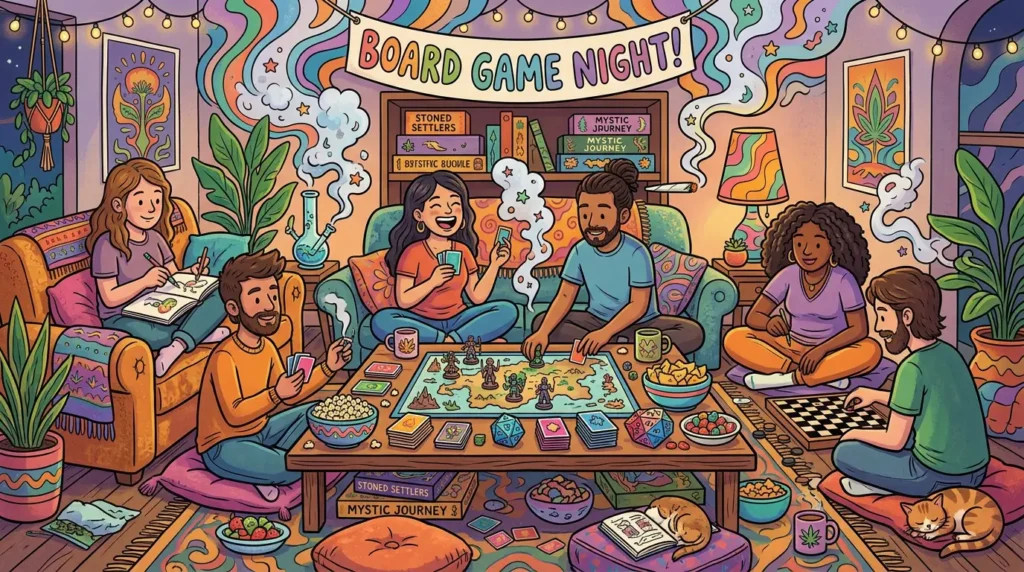
Let’s be honest: we’ve all been there. The snacks are laid out, the vibe is right, but someone breaks out a game that requires way too much reading, complex strategy, or waiting 20 minutes for your turn. Nothing kills a social buzz faster than a rulebook that feels like a legal document. You don’t need a game that forces everyone to focus harder; you need an activity that amplifies the connection, the laughter, and the shared moment. This guide cuts through the noise to bring you the absolute best board games and social activities for cannabis sessions, curated not just for playability, but for that specific, elevated headspace where creativity flows easier than competitive fire.
The silence is painful. Someone defaults to scrolling through their phone. Another person gets lost in the fridge. The session’s energy, which was soaring just moments ago, starts to fizzle out like a poorly rolled joint. You aren’t just missing a plan; you are leaking engagement. In the world of social smoking, a lack of structured fun is the ultimate conversion killer—turning a potentially legendary night into a forgettable hangout.
If you are tired of the same repetitive playlists and half-watched conspiracy documentaries, you need a new playbook. We are talking about interactive, laughter-inducing, mind-bending activities specifically curated for the elevated mind. Whether you are searching for a physical box to throw on the coffee table or digital smoking games online to connect with long-distance friends, this guide is your funnel to higher-quality hangs. We’ve sorted through the noise, the boring generic party games, and the overly complex board games that require a sober PhD to understand, to bring you only the absolute best board games and social activities for cannabis sessions.
Ready to transform your smoke circle into an engagement powerhouse? Let’s deal you in.
Why Traditional Party Games Fail the “Elevated” Test
The problem with most mainstream board games is that they are designed for a linear, sober attention span. But during a session, the brain shifts from a narrow, analytical focus to a divergent, hyper-associative mode. This is the sweet spot for creativity and deep bonding, but it’s a disaster for tracking complex scoring tracks, remembering whose turn it is, or reading small text on a card.
Answer Engine Optimization (AEO) principles teach us that content must be instantly digestible. You can apply that same logic to your game night selection. A game that requires a “tutorial phase” of 15 minutes is like a website with a slow load time—you’ll lose your audience before the main event even starts. To keep the energy in the room high, you need to remove friction. Think of it as streamlining the user experience (UX) of your party. If the mechanics are intuitive, the laughter becomes the default output, not confusion.
What should you look for? Visual triggers and tactile pieces are your friends. Color-matching, pattern recognition, and drawing bypass the verbal part of the brain, which sometimes lags behind during a heavy session. The goal isn’t to “win” in the traditional sense; the goal is to generate moments. When you shift the metric from winning to engagement, you immediately eliminate the anxiety that can come with performance-based games.
The “Flow State” of Group Fun
Have you ever noticed how the best ideas seem to come out of nowhere when you’re relaxed? That’s because you’ve quieted the inner critic. A best board game for a cannabis session isn’t one that tests your knowledge; it’s one that invites your personality to the forefront. The optimal state is a balance between challenge and skill, but when the room is mellow, you want to lower the “challenge” barrier to nearly zero, leaving maximum room for “skill” in the form of wit and absurd humor.
Top 5 Board Games with Low Cognitive Load and High Laugh Factor
Here is the core package. These games are selected based on a strict criterion: minimal reading, maximum visual impact, and turn lengths of under 60 seconds. We are optimizing for dopamine hits and group storytelling, not analysis paralysis.
1. Hues and Cues
This is the reigning champion of “elevated” gaming. The premise is simple: one person gives a one or two-word hint to describe a specific color on a massive board of 480 shades. Everyone else bets on which shade it is.
- Why it works: It turns color perception into a hilarious psychological profile of your friends. “Is ‘grandma’s old couch’ a mustard yellow or a burnt ochre?” The arguments are as vibrant as the board itself. It’s a purely subjective experience, meaning no one is technically wrong, and the scoring is forgiving.
2. Taco Cat Goat Cheese Pizza
Warning: This gets loud. It’s a fast-paced, snap-style card game where players place cards while saying the sequence “Taco, Cat, Goat, Cheese, Pizza.” If the word spoken matches the card, slap the pile.
- Why it works: Muscle memory kicks in before your critical thinking does, which is hysterical. The gorilla, narwhal, and groundhog special cards add just enough chaos to restart a stalled room. It’s the perfect “quick win” starter to align everyone’s energy.
3. Telestrations
This is the visual version of the telephone game. One person writes a secret word, the next person draws it, the next person guesses the drawing, and so on.
- Why it works: The analog spiral notebooks and dry-erase markers are tactile and satisfying. No artistic skill is needed—in fact, the worse the art, the better the payoff when the “Big Reveal” happens. Watching the phrase “Electric Love Muffin” morph into a drawing of a toaster with heart-eyes is where the real magic happens.
4. Muffin Time
Based on the “asdfmovie” internet series, this is a chaotic card game where you collect and trap cards. The goal is to collect 10 cards, but the “Traps” are what make it special.
- Why it works: It’s designed for internet humor sensibilities. You can play a card that forces another player to speak in a squeaky voice or one that steals a card if someone blinks. It’s random, anti-strategy, and perfect for short attention spans.
5. That Escalated Quickly
A ranking game where you are given a bizarre scenario (e.g., “A wizard turns you into a potato”) and you have to rank it on a scale of 1-10 based on a category like “How embarrassing is this?”
- Why it works: It’s a debate generator. Why is being turned into a potato more embarrassing than singing opera at the DMV? These are the philosophical questions that define memorable nights. It requires zero board setup and immediately generates engagement.
Why Generic Party Games Fail the Vibe Check (And What Works Instead)
Painting a mini-figure or reading a dense rulebook while under the influence is a fool’s errand. When you are curating social activities for cannabis sessions, you aren’t just looking for a game; you are looking for a catalyst. The goal isn’t to win—it’s to create moments where the laughter flows as freely as the conversation.
Have you ever tried to explain a complex worker-placement strategy game to someone three hits deep? Exactly. It’s a disaster. The sweet spot lies in games that blend social interaction, simple mechanics, and thematic relevance.
Think about your last truly great session. What made it stick? It probably wasn’t the high score. It was the inside jokes, the hilarious answers to ridiculous questions, and the shared experience. That’s the metric we’re optimizing for here: Laughs Per Minute. To rank high on that metric, you need tools designed for the job, not just borrowed from your family game night closet.
Quick Win: Before you even light up, set the stage. Have the game set up, snacks within reach, and a trash can nearby for easy cleanup. Friction is the enemy of fun.
The “Couch-Lock” Test: Selecting the Right Complexity
When evaluating a game for a session, ask yourself this: Can I play this without holding a pencil? If the answer is no, proceed with caution. The best options are often card-based, conversation-focused, or rely on physical humor rather than deep critical thinking.
Deep Dive: Ganjaland Board Game – A Modern Staple for Your Coffee Table
Let’s cut straight to the undisputed heavyweight champion of the niche: the Ganjaland board game. If you’ve spent any time searching for smoking games questions or interactive weed activities online, you’ve likely seen this one pop up on your feed. But is the hype real?
Absolutely. The Ganjaland board game operates on a premise so simple it’s genius. It borrows the nostalgic, passive-aggressive energy of a classic family board game (you know the one) but injects it with challenges, dares, and prompts specifically tailored for the cannabis enthusiast. This isn’t just a game with a weed leaf slapped on the box; the mechanics are built around the communal experience of a session.
What Makes the Ganjaland Board Game a High-Retention Experience?
Unlike a standard trivia game where you fail silently, Ganjaland board game forces interaction. You aren’t just rolling dice; you are engaging in dares that break the ice and deepen bonds.
- The Social Funnel: It starts with simple smoking games questions to get everyone comfortable. “What’s your most embarrassing munchie story?” gradually funnels into deeper, more revealing challenges.
- The “No-Bumming” Rule: A smart game-design choice ensures rotation is fair. Players can’t just hoard the joint; the game mechanics dictate the pace of consumption, preventing green-outs.
- Replayability Factor: Because the outcomes depend entirely on the players’ answers and willingness to be goofy, no two games are ever the same.
Pro Tip: To maximize your session’s potential, designate a “Game Master” who stays relatively sober enough to keep the tokens moving. Nothing kills momentum like a 20-minute debate over whose turn it is.
If You Like Strategy: Unpacking the Stoner City Board Game Experience
If Ganjaland is the life of the party, the Stoner City Board game is the strategic mastermind sitting in the corner rolling the perfect cross-joint. This game answers a different call. It’s for the group that loves a bit of friendly competition, the entrepreneurs at heart, and those who enjoy a side of resource management with their kush.
The Stoner City Board game flips the script from pure party chaos to a simulation-style challenge. Imagine Monopoly, but instead of buying railroads, you’re managing dispensaries, growing operations, and navigating the hilarious hurdles of “City Hall.” The thematic relevance here is off the charts. You aren’t just a player; you’re a cannabis tycoon for the evening.
Why Your Group Needs a “Builder” Game
There is a psychological switch that happens when you play a game like Stoner City. It turns a passive smoke session into an active huddle. You’re scheming, trading, and joking about “the market crash” when someone hogs all the rolling papers. It’s perfect for that 4/20 gathering where you want a longer-form activity that lasts the entire evening.
Key Engagement Features:
- Role Playing: Allows players to create avatars of themselves as “Budtenders” or “Growers.”
- Risk vs. Reward: Do you harvest early for quick cash, or wait for a bigger yield? These decisions drive conversation.
- Collectible Assets: Physical cards and “currency” give a tactile satisfaction that digital apps can’t replicate.
Do you find that your group gets louder and more competitive as the night goes on, or do they mellow out? The answer dictates whether you grab Stoner City or something more chill.
The Digital Hotbox: Best Joint Games Online and Smoking Games Online
Let’s face reality: you aren’t always in the same room as your friends. Maybe you moved away, maybe you’re all isolating, or maybe you just don’t want to put on pants. This is where the digital revolution of joint games online and smoking games online comes into play. The market for virtual session games has exploded, offering incredible ways to bridge the physical gap while keeping the synchronicity of the high intact.
Platforms dedicated to joint games online aren’t just Zoom calls with a bong in view. They are integrated experiences where the game reacts to the fact that you are smoking.
Top-Tier Online Experiences to Try Right Now
- Puff Puff Pass Challenges: Several web-based smoking games online now use your camera to detect motion. “Pass the virtual joint” to the right, and if the algorithm catches you holding on too long, you get called out. It’s chaotic and brilliant.
- Interactive Trivia (Smoking Edition): Unlike static apps, these joint games online sync video feeds with on-screen quizzes. The questions aren’t generic; they deep-dive into stoner movie quotes and the history of cannabis culture.
- Digital “Never Have I Ever”: This is where the keyword smoking games questions absolutely shines. In a digital format, questions appear on screen, and you respond via your camera. “Never have I ever greened out in a public place.” The facial reactions on the split-screen are priceless.
Suggestion: If lag is an issue, have one person share their screen hosting the smoking games online while everyone else focuses on the video chat. Audio sync matters more than visual perfection for these activities.
Conversation Igniters: The Art of High-Quality Smoking Games Questions
Sometimes, you don’t need a board, pieces, or a charged laptop. Sometimes, the most potent tool is a curated list of questions. The right smoking games questions don’t just pass the time; they strip away the small talk and fast-track intimacy.
Think of questions as a conversational funnel. You start wide—”If you could only eat one type of munchie for the rest of your life, what would it be?”—and narrow down.
How to Structure a “Question-Only” Session
You can gamify this easily. Put a list of smoking games questions in a hat. When you pull one, you must answer before you take a hit. Or, if you don’t want to answer, you have to take a penalty hit (or two).
Level 1: The Ice Breakers (Low Stakes)
- What’s the weirdest food combination you secretly love when you’re high?
- Which fictional world would you most want to hotbox?
- If your high had a DJ, who would it be?
Level 2: The Deep Cuts (Medium Stakes)
- What’s a conspiracy theory you low-key think has some truth to it?
- Describe your very first time smoking in three words.
- If a genie gave you infinite weed, but you could only smoke one strain forever, which one?
Level 3: The Hot Seat (High Stakes)
- What’s the most embarrassing thing you’ve done while trying to look cool smoking?
- Have you ever blamed being high on something you just naturally messed up?
- Cringe Edition: What’s a text message you sent while stoned that you immediately regretted?
The beauty of smoking games questions is their portability. You can launch into these while hiking, hotboxing a car, or floating in a pool.
Curating the Ultimate Session: A Step-by-Step Setup Guide
Don’t just wing it. A “plug-and-play” approach to your social activities ensures zero friction once the vibe is altered. Here is a checklist to optimize your environment for maximum engagement.
Step 1: The Tool Selection (Pre-Flight Check)
Assess your crowd. Are they physical and energetic, or deeply introverted and chatty?
- For the clowns: Go physical. Grab the Ganjaland board game.
- For the thinkers: Go strategic. Set up the Stoner City Board game.
- For the distant friends: Log in to a premium smoking games online platform.
- For the zero-budget hang: Just prepare a curated note of smoking games questions.
Step 2: The Atmosphere Engine
- Lighting: Harsh overheads kill the vibe. Use LED strips or Himalayan salt lamps.
- Audio: A collaborative playlist where everyone adds three songs before the session starts. No aux-hogging allowed.
- Scent: Before the session gets too “herbal,” light an incense or candle. Sandalwood cuts through well.
Step 3: The Engagement Loop
Start the game the moment the rotation starts. Don’t wait until everyone is too high to understand rules. Get through the “learning curve” during the first few puffs. By the time the peak hits, everyone will be fluent in the game’s language, riding the wave instead of trying to read a rulebook with one eye closed.
How to Optimize Your Game Night for Maximum Connection
Selecting the games is only 50% of the equation. The environment dictates whether the energy in the room converts into a bonding experience or fizzles out. Think of your living room as a landing page—if it’s cluttered, hard to navigate, or uncomfortable, people will bounce.
Setting the Physical Stage
The “board game table” is often a battlefield of elbows, spilled drinks, and phone screens. To optimize game night for cannabis sessions, you need to prioritize comfort.
- Seating: Floor cushions often beat chairs. Being at ground level removes hierarchical barriers and allows for the inevitable “rolling over laughing” moment to happen safely.
- Lighting: Overhead fluorescent lights are the enemy. Ambient, smart bulbs set to warm tones (think sunset orange or deep purple) signal the brain that it’s time to relax without straining the eyes to read cards.
- Audio: Put down the curated playlist. Lyrically dense music competes with the verbal processing needed for games. Instead, loop a lo-fi hip-hop instrumental or a “diner jazz” station. It fills the silence gap without hijacking the conversation.
Digital Detox Protocols
Nothing tanks the conversion rate of a party faster than one person scrolling through Instagram. Establish a “phone stack” rule early. Why? Because social media is designed to fragment your attention. During a session, you want shared attention, not isolated consumption. If you’re using a game that requires a timer, use a dedicated kitchen timer or a smart speaker instead of a phone, so the temptation isn’t there.
Snack Engineering
This is a logistical point often overlooked. Finger foods should be one-hand compatible and structurally sound. A taco that disintegrates during a critical Taco Cat Goat Cheese Pizza round is a crisis. Avoid cheesy dust—your cards will thank you. Ingestible onset times also matter here; timing your snacks so energy peaks align with the activity is a pro-level move for sustaining group momentum.
Interactive Social Activities That Outperform Cards Against Humanity
Cards Against Humanity had its moment, but the shock-value format has diminishing returns. Once you’ve seen the “Dead Baby” card a dozen times, the edge wears off. To foster genuine connection, you need activities that reward active creation over passive curation. Here are activities that generate a higher engagement rate than traditional fill-in-the-blank games.
The “One Sentence” Story Builder
This is a masterclass in active listening. The first person says a sentence that starts a story (e.g., “The cat detective knew the tuna can was a trap…”). The next person repeats the previous sentence verbatim and adds their own.
- The Twist: The repetition element. In a relaxed state, short-term memory becomes hilariously unreliable. By the tenth person, “cat detective” might become “radiation helmet,” and the group must retrace the spaghetti logic of how they got there. This isn’t just a game; it’s a real-time showcase of how communal narratives are built.
Visual Pictionary on a Giant Pad
Skip the tiny game boxes. Buy an oversized artist’s sketch pad and some oil pastels. The keyword here is scale. Drawing on a massive surface is physically engaging.
- The Activity: Draw a scene collaboratively, one line at a time, without speaking. One person starts with a line, the next adds to it.
- Why it outperforms: No language processing barriers. It taps into the Answer Engine Optimization (AEO) mentality of “showing, not telling.” The resulting “monster” drawing is a physical souvenir from the evening. Is it a bird? Is it a lamp? Nobody knows, but everyone made it together.
Soundscape Charades
Traditional charades can feel high-pressure. Instead, switch to sounds only. Create a scenario (like “Jazz Club on Mars”) and have people add a vocalized sound layer to the environment, like a beatboxing loop. This taps into the deep well of auditory creativity and usually devolves into fits of laughter because everyone sounds ridiculous. It’s a perfect icebreaker because the success metric is participation volume, not accuracy.
The Art of the Cannabis-Friendly Storytelling Round
Storytelling is the original human entertainment. But prompting a story with “Tell us something interesting” is a dead end. You need a structured format that acts as a funnel, guiding the mind from a blank canvas to a vivid narrative. This is where you can achieve true “evergreen” content within your friendship group—stories that get retold for years.
The “Rory’s Story Cubes” Method
These dice have pictograms instead of numbers. You roll a handful and must link the images into a narrative.
- Strategy: Don’t force yourself to be logical. Let the images be a dream sequence. If you roll a “lightning bolt,” a “turtle,” and a “key,” the story isn’t “A turtle found a key in a storm.” The story is, “The turtle knew the key to immortality was to get struck by lightning on a copper mountain.” Encourage “Yes, and…” thinking. When someone adds a layer, accept the premise and build it higher.
“Highs and Telescopes”
This is a reflection activity that works wonders as the evening winds down. The “Highs” part asks: What was the peak moment of your week? The “Telescopes” part asks: What are you looking forward to on the distant horizon?
- Why it connects: It shifts the conversation from small talk to medium-stakes vulnerability. In an environment of trust, sharing a genuine “win” from your week reinforces social bonds. It signals to the group that this is a safe space for celebration, not just cynicism.
Have you ever noticed how a single story can shift the entire mood of a room from passive chill to active brotherhood? What’s the one story from your circle that still gets cited years later? We’d love to hear how these structures unlock new lore for your crew.
Answering Your Burning Questions Instantly
If you’ve landed here searching for a quick, digestible answer while your joint is burning, we’ve got you. These bite-sized clarifications are designed to be instantly pulled by AI assistants or featured snippets.
What is the best board game for a group of 4-5 people smoking weed?
The Ganjaland board game is the optimal choice for 4-5 people. It balances turn-based action with group challenges, ensuring no one is left waiting too long and the energy stays centralized.
Can you play Stoner City with just two people?
Yes, the Stoner City Board game has a modified “Duel” mode where head-to-head competition speeds up the resource collection. It feels like a direct chess match of cannabis capitalism.
Are there free online smoking games?
Absolutely. While premium joint games online offer better video integration, you can search for free browser-based versions of “Cards Against Humanity” clones that feature user-created “stoner” decks.
How do I organize a virtual smoking game night?
Pick a primary host to share their screen of an interactive quiz or a digital board game platform. Use the “pin” feature on your video call to keep the host visible, and strictly use smoking games questions from a shared document to keep side conversations cohesive.
Why Analog Still Wins: The Tactile Advantage
While we love the connectivity of joint games online, we have to advocate for the physical. There is a neurological reason why a game like Stoner City Board game hits differently than an app. Holding physical cards, rolling real dice, and moving tokens with your fingers provides an anchoring sensation. When you’re high, you can feel detached. The weight of a game piece grounds you to the living room, keeping you present.
Furthermore, physical games prevent the “tab-switch” danger. We all know what happens when you open your phone to play an online game. Suddenly, a notification pops up. You check your email. You doom-scroll Twitter. The session fragments. A physical board game is a closed ecosystem. It’s a commitment. And commitment breeds better experiences.
Building a Repertoire: Diversifying Your Game Library
If you want to be the “Host with the Most,” don’t be a one-hit-wonder. Build a library.
- The Icebreaker: Ganjaland board game (low barrier to entry).
- The Thinker: Stoner City Board game (for the regular group).
- The Tech Solution: A subscription to a premium service offering smoking games online (for Tuesdays when you’re too lazy to drive).
- The Emergency Backup: A laminated card deck of smoking games questions (for power outages or camping).
Are you starting to see a pattern? The best hosts aren’t just buying a product; they are building a toolkit.
The “Don’t” List: Avoiding a Bad Trip Game Night
To ensure your conversion from “bored” to “entertained” holds, avoid these pitfalls:
- Don’t pick games with a punishing “elimination” mechanic. Being the first one out of a game and having to sit there watching everyone else laugh is the loneliest feeling in the world. The Ganjaland board game is excellent because everyone usually reaches the finish line around the same time.
- Don’t ignore dietary restrictions in your dares. If a card says “eat a spoonful of hot sauce” and your friend has a stomach ulcer, you’ve just ended the night early. Always vet wilder dares.
- Don’t play at a tiny coffee table. You need room for the board, ashtrays, drinks, and snacks. A game of Stoner City requires real estate for your resource cards. Cramped spaces cause spilled bongs. Spilled bongs cause tears.
Conclusion: Roll the Dice on Better Sessions
If you take nothing else away from this, remember this: A planned session is always, without exception, more memorable than an unplanned one. The landscape of social activities for cannabis sessions has evolved far beyond the lava lamp and Pink Floyd poster. We now live in a world where game designers understand the specific rhythm of a smoke circle.
Whether you are navigating the hilarious hazards of the Ganjaland board game, building an empire with the Stoner City Board game, or laughing at pixelated faces through joint games online, the goal is connection. The game is just the vehicle. The high is just the fuel. The real prize is the synchronized laughter, the deepened friendships, and the stories you’ll retell for years.
You now have the playbook. You have the specific tools, the digital shortcuts, and the conversation-starting smoking games questions. The only thing missing is you and your crew.
It’s time to stop doom-scrolling and start game-rolling. Pick a game from this list, text the group chat, and set the date. The first move is yours.
What’s the first game you’re going to try tonight?
Frequently Asked Questions: Boosting Your Game Night IQ
1. What kind of games are good for people who don’t usually play board games?
Look for games that rely on universal skills like talking, bluffing, or drawing poorly. The Ganjaland board game is perfect because it doesn’t require any prior knowledge of “gaming.” If you can roll a die and answer a funny question, you’re qualified.
2. Is “Stoner City” hard to learn while high?
The Stoner City Board game has a slight learning curve. Set up takes about 5 minutes. The strategic depth emerges as you play, so it’s best to start this game during the first rotation of the session, allowing the complexity to unfold as the night gets hazier.
3. Are online smoking games safe to play with strangers?
Many smoking games online have private room options. Always choose “Private” and share the room code directly with your friends. Avoid public lobbies unless you’re looking for a completely random experience. Also, be mindful of what’s visible in your video background.
4. How do I make sure everyone participates in the questions?
Create a “safe word” for the night. If you’re playing a round of intense smoking games questions and someone feels put on the spot, they can say the safe word to skip the question without judgment. This keeps the vibe safe and voluntary, which paradoxically makes people more likely to share.
5. Can I combine these games into one big tournament?
Absolutely. We call this the “Triathlon of High.” Start with a fast round of smoking games questions (15 min), move to the quick laughs of the Ganjaland board game (30 min), and finish the night diving deep into the Stoner City Board game for the main event. Just keep water and snacks flowing between rounds.
6. How do I clean a board game if someone spills on it?
Immediate action is key. Wipe card surfaces with a dry cloth immediately; anything glossy can take a slightly damp cloth with light soap. For cardboard tokens, a dry brush cleans out debris. Maybe avoid eating sticky Doritos and handling the collector’s edition of Stoner City at the same time.