
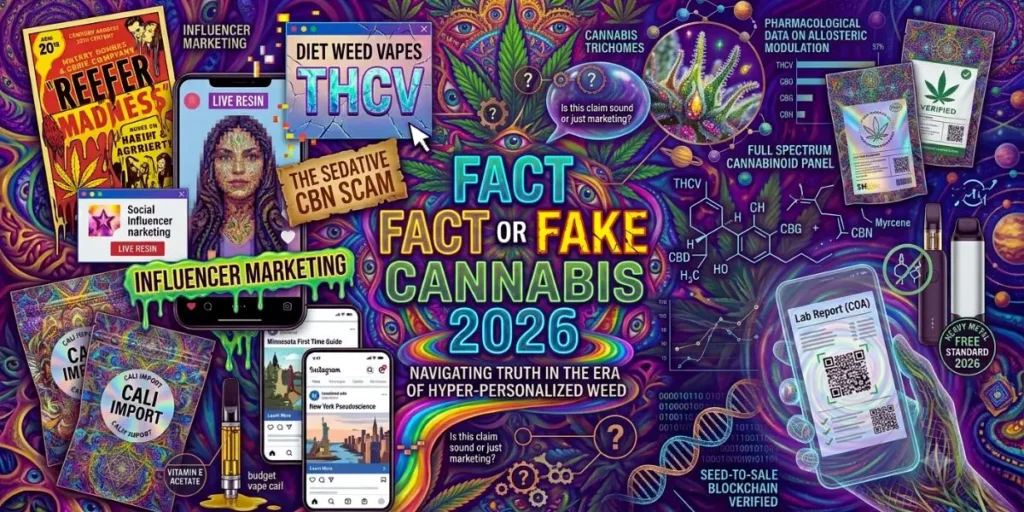
The cannabis plant has a long, complicated relationship with misinformation. The 20th century’s “Reefer Madness” propaganda was arguably the first large-scale “fake news” campaign. Now, in 2026, we find ourselves on the opposite end of the pendulum. We are no longer fighting blanket demonization; we are drowning in a flood of hyper-personalized, algorithmically-targeted claims about cannabinoids, terpenes, and cellular regeneration. The modern question isn’t “is weed evil?” but “is this specific claim about THCV, CBC, or ‘purple live resin’ scientifically sound or just a marketing hallucination?”
The cannabis industry in 2026 is a dual reality. On one side, we have unprecedented clinical research, sophisticated genetic mapping, and pharmaceutical-grade extraction. On the other, we have an unregulated wellness market where influencer anecdotes often drown out peer-reviewed data. Location-targeted advertising now customizes cannabis narratives to your specific state or country, playing on local laws and cultural anxieties. It’s time to equip ourselves with the tools to decode fact from elaborate fake.
This is your definitive 2026 guide to cutting through the smoke, understanding the molecules, and making informed decisions based on a geographic and biological truth.
The Evolution of the Narrative: From “The Devil’s Lettuce” to “The Entourage Effect”
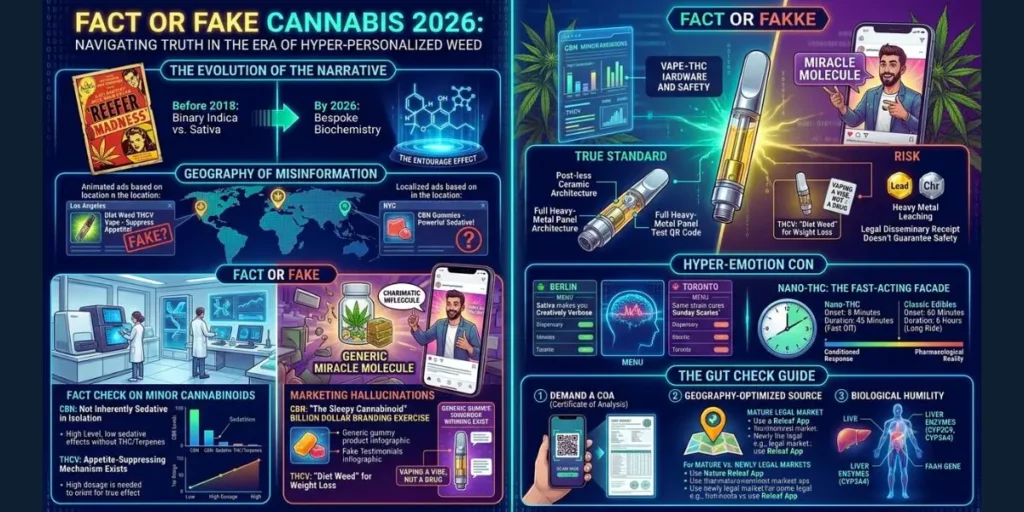
To understand modern misinformation, we must understand the historical context. Before 2018, cannabis dialogue was binary: Indica versus Sativa. In 2023, we entered the era of the “Entourage Effect,” a valid scientific theory suggesting that cannabinoids and terpenes work better together than in isolation. By late 2025 and into 2026, the conversation has fractured further. We’ve entered the age of “bespoke biochemistry.”
FACT: The Entourage Effect is scientifically plausible and supported by pharmacological data on allosteric modulation.
FAKE: The belief that a single, specific terpene profile will produce an identical, guaranteed psychological outcome for every human who consumes it.
In 2026, algorithms on platforms like TikTok and localized X (Twitter) feeds serve you content based on your state’s legal status. If you live in a newly legal state like Minnesota or Ohio, your feed is full of “How-To” and “First Time Guide” content. If you’re in a mature legacy market like Colorado or California, you’re being served advanced pseudoscience about minor cannabinoids. The geography of your IP address dictates the flavor of the misinformation you receive.
The Minor Cannabinoid Gold Rush: Miracle Molecules or Marketing Mirage?
The most contentious battlefield for “Fact or Fake” in 2026 is the explosion of minor cannabinoids. We’ve moved beyond CBD and Delta-9 THC. The market now aggressively pushes CBN for sleep, CBG for focus, THCV for weight loss, and CBD-V for autism-related irritability. But where is the line between green pharmacy and green washing?
THCV: “Diet Weed” or Metabolic Distraction?
The Claim (Location Context: Coastal Wellness Hubs): Ads in Los Angeles and Miami are saturated with THCV vape pens marketed as “diet weed,” claiming to suppress appetite and regulate blood sugar without intoxication.
The Fact Check: THCV is a CB1 receptor antagonist. Pharmacologically, antagonists block receptor activity. This genuinely suggests it could reduce the appetite-stimulating effects of THC. Furthermore, research on mice suggests improved glucose tolerance. However, the “Fake” lies in the dosage. A 2025 pharmacokinetic study confirmed that the concentrations of THCV found in a standard 0.5-gram vape cartridge are often clinically insignificant for drastic metabolic change. You are vaping a vibe, not a pharmaceutical intervention.
Verdict: The mechanism is a Fact; the widespread availability of a therapeutic dose in recreational vapes is mostly Fake.
CBN: The Sedative Scam?
The Claim (Location Context: Regions with high burnout rates like NYC and London): Marketing depicts CBN as a powerful sedative. “The sleepy cannabinoid” has become a billion-dollar branding exercise.
The Fact Check: Aged, oxidized THC degrades into CBN. There is a cultural link between “old weed” and sleepiness. However, raw CBN is not inherently a powerful sedative. A landmark 2026 review by the International Sleep Science Consortium found that CBN’s sedative effects are negligible unless paired with significant concentrations of THC or specific myrcene-dominant terpenes. In isolation, you might as well be taking a placebo. Yet, local dispensaries in New York City price CBN gummies at a 40% premium over standard edibles.
Verdict: Fake (when marketed as a standalone knockout punch); Fact (when viewed as a minor component of a full-spectrum sleep synergy).
Vape Hardware and the “Safety” Illusion (Location-Specific Risk)
In 2026, the geography of your purchase determines the safety of your lung tissue. The EVALI crisis of 2019 permanently linked vitamin E acetate with lung injury. Yet, illicit market “fake” carts continue to evolve, now deploying bio-synthesized cannabinoid converters to turn cheap CBD biomass into psychoactive “mystery oil” inside unregulated hardware.
The Heavy Metal Paradox
The Claim (Location Context: Europe vs. USA): European advertising often claims their ceramic hardware is “medical grade” and inherently safer than American “plastic” carts.
The Fact Check: The safety of a vape isn’t just the oil; it’s the metallurgy of the coil and the glass type. A 2025 study by a Colorado-based compliance lab found that even legal Californian cartridges leach heavy metals, specifically lead and chromium, when the oil sits for more than six months due to acidic degradation of the wicking metal. The “Fake” narrative is the assumption that a legal dispensary receipt guarantees a heavy-metal-free experience. The “Fact” is that hardware longevity protocols are currently under-regulated.
Verdict: Believing all legal carts are safe is Fake. Checking for brands using “post-less” ceramic architecture and full heavy-metal panel tests is the Factual safety standard in 2026.
🔥 Stack your savings. Elevate your session. 10% off $100, up to 25% off $450.
🔥 Roll into the menu and start saving. CLICK HERE!
Hyper-Emotion Con: “Strain Specific Mood Elevators”
We are fully in the era of “vibe marketing.” Dispensary menus are now pseudo-therapeutic indexes. A menu in Berlin might claim a sativa makes you “creatively verbose,” while one in Toronto claims the same genetic cross cures “Sunday Scaries.” This is the creation of a placebo narrative.
The “Sunset” vs. “Daytime” Terpene Fallacy
The Claim: Limonene is “uplifting,” Linalool is “calming,” and Beta-Caryophyllene is “anti-inflammatory.”
The Fact Check: Terpenes are indeed pharmacologically active. However, their olfactory influence (smell) creates a powerful, subjective feedback loop that overrides their receptor-level pharmacology. If you believe lavender calms you, the linalool in your joint will calm you. This is a conditioned response, not a direct pharmacological mandate.
The Fake: A budtender diagnosing your mood and prescribing a single strain with guaranteed psychological results. Without knowing your endocannabinoid tone, cortisol levels, and genetic polymorphisms (like the FAAH gene), strain-specific predictions are educated guesses dressed in lab coats.
The Fact: Cannabis is a bidirectional modulator. If you are stressed, a “sativa” might calm your anxiety, or it might induce tachycardia and panic depending on whether your amygdala is hypersensitive that day. In 2026, “Fact” is acknowledging that set and setting trump strain.
Geopolitics of Genetics: The “Black Market Ghosts”
One cannot discuss “Fake” in 2026 without addressing the genetics of the plant itself. The near-total legalization of hemp-derived THC through the 2018 Farm Bill loophole, which was still being litigated globally in 2026, has blurred the lines of identity.
The “Mendo Breath” in London
The Claim (Location Context: International City Hubs): A black market dealer in a prohibition country (like Texas or parts of Southeast Asia) sells “Cali Import” tins.
The Fact Check: Is that really “Biscotti” from a specific grower in Humboldt County? Or is it delta-8 THC-O-acetate distillate sprayed onto CBD flower grown in Oregon and vacuum-sealed into counterfeit Mylar bags purchased on DHgate? In 2026, the “Fake” product is visually undetectable from the authentic one. The packaging has holograms that look better than the legal market because counterfeiters focus on shelf appeal over safety.
The Fact: In prohibition geo-zones, you are not smoking a strain. You are smoking a chemical soup formulated to mimic a strain’s viscosity and nose. True “Fact” is verified by a seed-to-sale blockchain verification system, which is still only adopted by premium craft brands.
The Medical vs. Recreational Divide: Data-Driven Dosing
A significant “Fake” narrative persisting in 2026 is the distinction between medical and recreational cannabis as two different plants. The plant doesn’t know why you’re consuming it; your blood chemistry does.
Nano-Emulsification: The Fast-Acting Facade
The Claim (Location Context: Beverage markets in Canada and Minnesota): “Nano-THC hits in 5 minutes, metabolizing faster than alcohol.”
The Fact Check: This is a Fact. Nano-emulsification breaks down THC oil into microscopic particles that mix with water, bypassing liver metabolism (first-pass) and absorbing directly into the bloodstream. However, Fake is the claim that it mimics the duration of alcohol. A nano-shot might hit you in 8 minutes, but the psychological peak is often gone in 45 minutes, leading to re-dosing and over-intoxication. The “Fact” consumers need to know in 2026 is that bioavailability speed is inversely proportional to duration. Fast on, fast off. Slow on (classic edibles), long ride.
The Location-Optimized Guide: Sourcing Truth in Your Region
How do you verify a “Fact” in 2026 based on where you live? Sourcing requires understanding the local architecture.
If you are in a Mature Legal Market (California, Colorado, Oregon):
- The Data: Demand a COA (Certificate of Analysis) that includes the batch number matching your product’s sticker.
- The Scanner App Tip: In 2026, use the “Releaf App” or “BDS Analytics” scanner functions. If the QR code on the jar takes you to a generic landing page instead of the exact third-party lab PDF with passing pesticide and heavy metal panels, the product is Fake. Mature markets have the infrastructure; dodging it is intentional.
If you are in a Medical-Only or Newly Legal Market (Poland, UK, Ohio, Alabama):
- The Data: Here, “Fake” often hides in clinical terminology. Terms like “prescription grade” are often used illegally. If a “clinic” prescribes a product without a GMP (Good Manufacturing Practice) certification number, it is a grey-market import, likely from a European CBD extraction facility, not a true pharmaceutical entity.
- The Oil Check: Real medical cannabis in these locations is irradiated (to reduce mold) and often dry. If your medical flower is sticky, dense, and smells like a California candy shop, it has likely been illegally re-humidified, introducing potential molds, making the “medically clean” label Fake.
🔥 Stack your savings. Elevate your session. 10% off $100, up to 25% off $450.
🔥 Roll into the menu and start saving. CLICK HERE!
Conclusion
In 2026, “Fact or Fake” is no longer about government fear-mongering; it is about corporate storytelling and algorithmic bias. The most dangerous myth is that the natural origins of cannabis make it immune to the deceptions of industrial capitalism. The plant is a chemical factory; the market treats it like a branding exercise.
Your best defense is location literacy and biological humility. Understand that your endocannabinoid system is as unique as your fingerprint. Any claim—whether on a billboard in Times Square or a Telegram channel in Istanbul—that promises a universal, guaranteed, “one-size-fits-all” psychoactive or medical outcome is the clearest indicator of Fake.
True Fact in 2026 acknowledges the complexity. Real cannabis education doesn’t give you a cheat code for a “high;” it gives you the discernment to know that context, chemistry, and the honesty of your local supply chain are the only things that matter. Don’t chase the 30-second TikTok review. Chase the third-party lab report. Your brain and your lungs will thank you.
Frequently Asked Questions (FAQs)
1. How can I instantly spot a fake cannabis vape cartridge in a dispensary in 2026?
Don’t rely on packaging. Fake hardware mimics real hardware perfectly, down to the serial number. In 2026, you should check the viscosity. “Live Resin” or “Rosin” should be highly viscous and rarely move in the cart at room temp. If it flows like water, it’s cut with propylene glycol or low-quality distillate, even if the box says “premium.” The ultimate test is the “bubble test”—real live resin requires a pre-heat setting to move the bubble at all. A rapidly moving bubble is a chemical flag.
2. Is THCA flower just a legal loophole, or is it genuinely the same as marijuana?
By chemical definition, THCA flower is marijuana. Under the 2018 Farm Bill (still defining the grey market in 2026), it’s classified as hemp if the post-harvest Delta-9 THC is below 0.3%. But the moment you apply heat (a lighter or vaporizer), THCA decarboxylates into Delta-9 THC. Anyone telling you it’s a “totally different, safer, legal alternative” is selling a Fake legal narrative. It is chemically identical weed sold under a legal technicality.
3. Do “indica” and “sativa” still matter in 2026 for choosing a product?
No. The industry has largely abandoned these as biological classifiers. They are now used purely as marketing shorthand for subjective effects. Fake: Believing a sativa won’t give you anxiety. Fact: A lab-tested myrcene-rich (sedative) plant can look like a skinny-leafed (sativa) plant. Look for cannabinoid content and terpene percentages, not the morphological label.
4. Why do I get completely different effects than my friend from the same edible, even if we have the same tolerance?
This is a liver enzyme story. You have unique polymorphisms in the CYP450 family of enzymes, particularly CYP2C9 and CYP3A4. If you are a “fast metabolizer,” your liver converts Delta-9-THC into 11-Hydroxy-THC (a much more potent, psychedelic metabolite) quickly, making edibles hit you like a truck. Your friend might be a “poor metabolizer,” making the experience mild. Tolerance is a variable, but liver genetics are the Factual reason for the difference. Fake explanations involve “blood types” or “star signs.”
5. Is cannabis causing anxiety? Or is the product tainted?
Often, neither. In 2026, the “Fact” is we understand the biphasic dose-response curve much better. Low doses of THC can be anxiolytic (reduce anxiety), while medium to high doses can be anxiogenic (cause anxiety) by overstimulating the amygdala. Before you blame the product for being “sprayed” or “laced,” consider the dosage. The modern fake narrative is assuming purity equates to a non-anxious experience. Pure THC can be profoundly panic-inducing in high doses, especially without the calming buffer of CBD or linalool.
6. How does geography affect the legality of my online cannabis reading and purchases?
Location targeting is strict in 2026. If you are reading a review glowing about a “farm bill compliant” product that ships nationwide in the US, but you are based in Idaho or Kansas (where total THC is strictly prohibited), that content is geographically Fake for you. It might be legal to ship from Oregon, but illegal for you to possess. Always check your state’s 2026 updated administrative code on “total THC” versus “delta-9 only” legislation, as the server-side ad might not do it for you.