
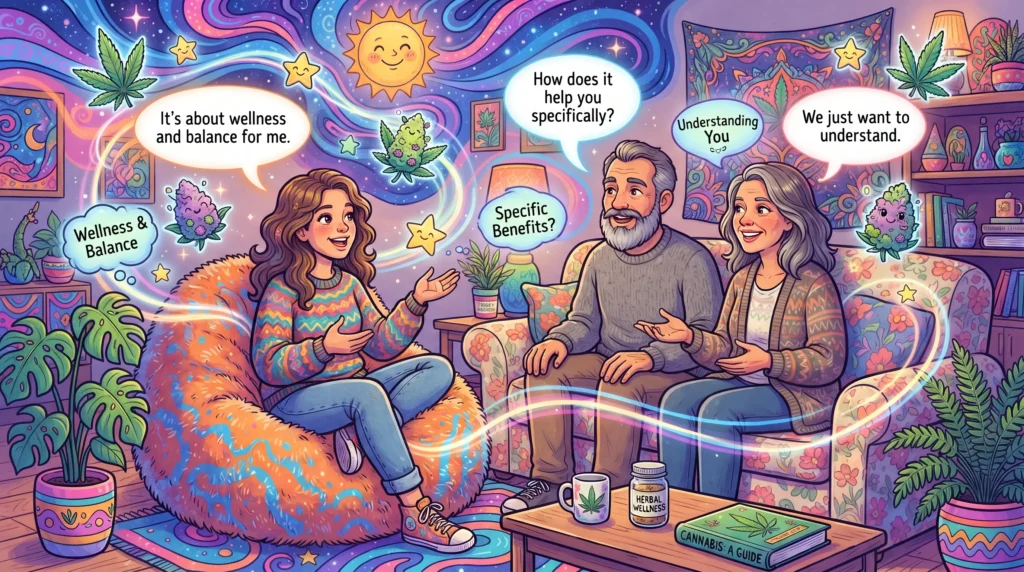
The conversation about cannabis has changed dramatically over the last decade. What was once a whispered taboo is now a mainstream topic discussed in medical journals, legislative halls, and family living rooms. However, while society has evolved, the generational divide within families often remains a chasm.
If you are an adult child who consumes cannabis—whether for medicinal relief, mental health support, or simple relaxation—telling your parents can feel like preparing for a high-stakes negotiation. You are not alone. Millions of adults struggle with the anxiety of being judged, or worse, having their parents revert to the fear-based narratives of the “War on Drugs” era.
This guide is designed to help you navigate this delicate conversation with empathy, facts, and patience. We will explore the psychology behind your parents’ potential fears, how to frame your usage, and how to bridge the gap between “Reefer Madness” and modern reality.
The Generational Divide: Understanding Where They Are Coming From
Before you can effectively communicate your perspective, you must first understand theirs. For many Baby Boomers and Gen Xers, the primary education regarding cannabis came from D.A.R.E. programs and zero-tolerance policies. They were taught that cannabis was a “gateway drug” that led to laziness, failure, and addiction.
When you tell your parents you use cannabis, they might not be listening to you. They might be hearing the echoes of their own parents warning them about the “Devil’s Lettuce.”
The “Stoner” Stereotype vs. Modern Reality
If your parents immediately imagine you lying on a couch eating potato chips and dropping out of life, they are reacting to the “stoner” caricature popularized in 90s media. However, the reality of modern consumption is often vastly different. Many users are high-functioning professionals, parents, and caregivers who use cannabis the way others use a glass of wine at the end of a long day—to unwind.
The key to opening the conversation is to reposition their paradigm. You are not asking for permission; you are asking for acceptance. You are inviting them to see you as a responsible adult who makes informed choices about their own body and well-being.
Understanding the Generational Divide
Before you open your mouth, open your mind. Your parents’ views on cannabis were shaped by decades of propaganda, criminalization, and cultural narratives that painted the plant as a dangerous gateway drug. In the 1970s, 1980s, and 1990s, anti-drug campaigns dominated media, schools, and political discourse. For many in that generation, cannabis was not just illegal—it was morally wrong.
Today, the landscape has shifted dramatically. As of 2026, dozens of U.S. states have legalized cannabis for medical or recreational use. Research from institutions like Johns Hopkins and the National Institutes of Health continues to explore its therapeutic potential. But facts alone rarely dismantle deeply held beliefs built over a lifetime.
Recognizing this gap is your first step. You are not debating a policy issue with a stranger. You are speaking with people who raised you, who may fear judgment, disappointment, or simply the unknown. Approach them not as opponents to be defeated, but as loved ones to be understood.
Timing and Setting: Choose Your Moment Wisely
You would not discuss estate planning at a birthday party, and you should not talk about cannabis during a rushed phone call or a stressful family dinner. Context matters enormously.
Pick a private, relaxed setting where everyone feels safe. A quiet afternoon at their home, a long car ride, or a peaceful walk often works better than a crowded restaurant. Ensure there are no looming distractions—turn off the television, put phones away, and make sure no one is pressed for time.
Emotional temperature matters too. If your parent is grieving, anxious, or dealing with a health crisis, this may not be the right window. Wait for a moment of relative calm when they are mentally available to absorb new information without feeling attacked.
Start With Curiosity, Not a Campaign
One of the biggest mistakes adult children make is turning the conversation into a lecture. You are not a salesperson for cannabis. You are a family member seeking mutual understanding.
Begin with questions rather than statements. Try opening lines like:
- “I have been reading a lot about how attitudes toward cannabis have changed. What was it like when you were growing up?”
- “I know this topic can be sensitive, but I would love to understand your perspective on it.”
- “Have you noticed how many states have changed their laws recently? I am curious how you feel about that.”
These prompts invite dialogue. They signal respect for your parents’ lived experience and give them space to express fears without feeling cornered. When people feel heard, they become far more willing to listen.
Share Your “Why” Honestly
If you use cannabis personally, hiding it often creates more tension than transparency. Secrets erode trust. That said, disclosure should be thoughtful, not performative.
Explain your reasons without being defensive. Are you managing chronic pain? Reducing anxiety? Enhancing sleep? Simply enjoying it responsibly in social settings? Frame your experience in terms of personal benefit and responsible use.
For example: “I started using CBD oil last year to help with my arthritis, and it has made a noticeable difference in my mobility. I wanted you to know because it is part of my wellness routine now.”
If you do not use cannabis but support legalization or medical access, explain that too. Perhaps you have seen a friend benefit from it, or you believe in personal freedom and criminal justice reform. Authenticity resonates more than rehearsed talking points.
Address Safety and Health Concerns Directly
Parents worry. It is what they do. Their concerns about cannabis usually fall into three categories: health risks, addiction potential, and legal trouble. Address each with calm, evidence-based responses.
Health Risks
Acknowledge that cannabis is not risk-free. Heavy use in adolescence can affect brain development, which is why age restrictions exist. Smoking anything carries respiratory risks, which is why many adults prefer edibles, tinctures, or vaporization. However, for responsible adult use, the risk profile is considerably lower than that of alcohol or tobacco, according to comparative studies published in peer-reviewed journals.
Addiction Potential
Cannabis use disorder is real but relatively uncommon among adults. The National Institute on Drug Abuse estimates that roughly 9% of cannabis users may develop dependence, a figure significantly lower than alcohol, nicotine, or opioids. Moderation, self-awareness, and open communication are key safeguards.
Legal Issues
If your parents live in a state or country where cannabis remains illegal, this concern is valid. Respect the law, and respect their fear of legal consequences. If they live in a legal jurisdiction, reassure them that you purchase from licensed dispensaries, avoid driving under the influence, and follow all local regulations. Responsible use and compliance go hand in hand.
Setting the Stage: Timing and Environment
The “set and setting” of your conversation is almost as important as the content.
- Choose Neutral Ground: Do not have this conversation at a family holiday dinner or a tense birthday party. Choose a quiet, private time. A weekend afternoon walk or a calm evening at home is ideal.
- Sobriety is Key: It should go without saying, but do not have this conversation while you are high. You need to be clear, articulate, and present. Likewise, if your parents are having a glass of wine or a cocktail, wait until they are clear-headed.
- Frame it as “Sharing” not “Confessing”: The tone of your voice sets the stage. If you sound guilty, they will assume you have done something wrong. Approach it with confidence: “Mom, Dad, I want to share something about my health/lifestyle that I think is important for you to know.”
Reframing the Narrative: From “My Son is a Stoner” to “My Son is Managing His Health”
One of the most painful things a parent can think is, “My son is a stoner.” This thought is usually rooted in fear that their child has failed to launch or is self-medicating into a stupor.
Your job is to dismantle that stereotype with specific, concrete evidence of your functionality.
Emphasize the “Why”
Instead of leading with, “I smoke weed,” lead with your motivation:
- For Medical Use: “I have been struggling with chronic inflammation/insomnia/anxiety. After researching and consulting a doctor, I have found that medical cannabis provides relief without the severe side effects of the pharmaceuticals I was prescribed.”
- For Mental Health: “I use it to transition from work mode to home mode. It allows me to be present with the kids instead of being stuck on my email.”
- For Lifestyle: “I prefer a low-dose edible on a Friday night instead of drinking alcohol. It helps me relax without the hangover or the empty calories.”
When you frame it this way, you are not asking them to accept a “drug habit;” you are asking them to respect your health autonomy.
🔥 Stack your savings. Elevate your session. 10% off $100, up to 25% off $450.
🔥 Roll into the menu and start saving. CLICK HERE!
Addressing Their Fears: Cannabis Facts vs. Fiction
Your parents will likely have questions. Some will be reasonable, and some will be based on outdated propaganda. Here is how to address the most common concerns with grace and authority.
Fear 1: “It’s a Gateway Drug”
This is the most persistent myth. The gateway theory posits that using cannabis leads to the use of harder drugs. However, modern research consistently debunks this. The vast majority of cannabis users do not go on to use heroin or cocaine.
Your Response: “I understand that concern, but the data has changed since the 90s. In states where cannabis is legal, opioid use has actually gone down. It’s not a gateway for me; it’s a destination. I have no interest in other substances.”
Fear 2: “You Will Ruin Your Brain”
Parents are often hyper-focused on cannabis and the teenage brain. It is true that adolescent brains are still developing and can be negatively impacted by early, heavy use. However, you are an adult. If you are over the age of 25, your prefrontal cortex is fully developed.
Your Response: “The research regarding brain development is specifically about teenagers, not adults in their 30s and 40s. I was careful not to use this when I was younger. Now that my brain is mature, the risk profile is completely different. I am using it responsibly, as an adult.”
Fear 3: “You Will Lose Your Job/Motivation”
Parents often equate cannabis with laziness. They worry you will get fired or stop caring about your goals. This is where you need to present your life as evidence.
Your Response: “I have been using cannabis for [X months/years], and in that time, I have received a promotion, paid my bills, and maintained my relationships. It hasn’t hindered my productivity; it has helped me manage the stress that was hindering it.”
The “Safe Space” Approach: Answering Unspoken Questions
Sometimes, parents don’t know how to ask what they really want to know. They might be searching the internet for terms like “How can I stop my son smoking?” because they feel helpless. By bringing the topic into the light, you remove the stigma and the secrecy, which is often the scariest part for parents.
Acknowledge the Secrecy
If you hid this from them for a long time, acknowledge it.
“I know I kept this private for a while, and I’m sorry for the secrecy. I wasn’t trying to lie to you; I just wanted to be sure I understood my own relationship with it before I tried to explain it to you.”
Discuss the “Rules of Engagement”
If you are visiting their house, respect their rules. This shows maturity.
“I know you don’t want it in your house, and I respect that. I would never bring it into your home or consume it around you. I just wanted you to know who I am when I’m at my own home.”
This level of respect often diffuses the tension immediately. It shows them that you are still the respectful child they raised, not a rebellious teenager.
What to Do When They Ask About Their Grandkids (Cannabis Facts for Teens)
If you have children, the conversation often shifts to them. Your parents might ask, “What are you going to tell the kids?” or “What if they see you?”
This is a critical moment. You need to explain that you are approaching this with logic, not recklessness.
Your Script:
“I will talk to them the same way we talk about alcohol. It is a substance for adults. It is locked away safely in our house. I plan to teach them cannabis facts for teens—that it is not a harmless toy, but a serious substance that they should not touch until their brains are developed. Just like my beer or my wine, it is off-limits.”
This shows your parents that you are taking the “parental” responsibility seriously, which lowers their anxiety about the grandchildren.
Use Stories, Not Just Statistics
Data is important, but narrative is memorable. If you know someone—a friend, a colleague, a public figure—who has benefited from medical cannabis, share their story (with permission). Personal anecdotes humanize the issue in ways that charts and graphs cannot.
Conversely, listen to your parents’ stories. They may know someone who struggled with substance abuse, and they may conflate that experience with cannabis. Do not dismiss their concern. Validate it, then gently distinguish between problematic polydrug use and responsible cannabis consumption.
Respect Their Boundaries
Here is a hard truth: you might not change their minds. And that is okay.
Your goal is not conversion. It is connection. If your parents remain uncomfortable with cannabis, respect their stance. Do not use it in their home if they object. Do not bring it to family gatherings uninvited. Do not mock their views or roll your eyes at their concerns.
Boundaries work both ways. You can request that they respect your choices as an autonomous adult, even if they do not endorse them. A mature conversation often ends not with agreement, but with a truce of mutual respect.
What If They Are Open to Learning?
Sometimes parents surprise you. If they express genuine curiosity, be ready with reliable resources. Avoid sending them to random blogs or advocacy sites that feel biased. Instead, point them toward:
- The National Institute on Drug Abuse (NIDA) for balanced, federally reviewed information
- Peer-reviewed studies accessible via PubMed
- Documentaries that present multiple perspectives
- Books by medical professionals who specialize in cannabis therapeutics
Offer to explore these resources together. Watching a documentary or reading an article as a shared activity transforms the topic from a source of conflict into a bonding experience.
Navigating Medical Cannabis Conversations
If your parent is suffering from arthritis, insomnia, neuropathy, or other age-related conditions, medical cannabis might genuinely help them. But suggesting this requires extraordinary sensitivity.
Never position yourself as their doctor. Instead, gently mention that you have read about patients finding relief and ask if they have ever discussed it with their physician. Encourage them to bring it up with a healthcare provider they trust. A doctor’s endorsement often carries far more weight than a child’s recommendation.
If they are hesitant, offer to accompany them to an appointment or help them research local medical cannabis programs. Your role is supportive, not prescriptive.
Handling the “Disappointment” Factor
For some parents, the hardest part is not the cannabis itself—it is the feeling that their child has rejected their values. This emotional layer is easy to overlook but critical to address.
Reassure them that your choices do not negate the lessons they taught you. In fact, emphasize that the values they instilled—critical thinking, personal responsibility, health consciousness—are exactly what guide your informed, measured approach to cannabis.
Say something like: “You taught me to research things thoroughly and make my own decisions. That is exactly what I did here. I did not take this lightly.”
This reframing honors their parenting while asserting your adulthood.
When to Table the Discussion
Not every conversation needs a resolution. If emotions escalate, if someone shuts down, or if the dialogue becomes circular, it is perfectly fine to pause. Say, “I can see this is a lot to process. I appreciate you hearing me out, and we can revisit this whenever you are ready.”
Walking away is not failure. It is wisdom. Some seeds take time to germinate. Your parents may need weeks or months to sit with new information before they are ready to engage again. Give them that grace.
🔥 Stack your savings. Elevate your session. 10% off $100, up to 25% off $450.
🔥 Roll into the menu and start saving. CLICK HERE!
Conclusion
Talking to your parents about cannabis is rarely a one-and-done event. It is usually a series of conversations. The first one might be emotional. The second one might be awkward. But by the tenth, you may find them asking, “So, how is that CBD cream working for your knee?”
The goal isn’t to force them to agree with your choices or to make them love cannabis. The goal is to remove the wedge of secrecy between you and to ask them to love you, the whole you, as an adult.
Be patient. They have decades of programming to overcome. But by standing in your truth, backed by science and delivered with love, you give them the opportunity to grow alongside you. And in the end, most parents just want their children to be healthy, happy, and safe.
Frequently Asked Questions (FAQs)
Here are answers to common questions both parents and adult children have regarding this complex topic.
Q1: What do you do when you catch your child smoking?
If your “child” is a teenager, this is a different scenario than an adult. For a teen, it is crucial to stay calm. Yelling or extreme punishment often leads to rebellion and secrecy. Instead, ask open-ended questions: “Why are you using this? What are you feeling?” Use this moment as an educational opportunity to discuss brain development and legal consequences. If your “child” is an adult in their late 20s, it is time to shift the dynamic from “catching” them to “discussing” it as peers. Ask them about their use rather than accusing them.
Q2: How can I stop my son smoking?
This is a search query often driven by panic. The reality is that you cannot force an adult to stop a behavior without damaging your relationship. Motivation for change must be intrinsic. Instead of trying to “stop” them, focus on opening a dialogue. Understand why they are using it. If it is for pain or anxiety, stopping may actually harm their quality of life. If you suspect they are using it to numb severe trauma or depression, encourage professional counseling rather than simply trying to take the substance away.
Q3: Is cannabis addictive?
Yes, it can be. While the physical withdrawal symptoms are generally much milder than those of alcohol or opioids (usually irritability, insomnia, and loss of appetite), psychological dependence (Cannabis Use Disorder) is real. It affects about 9% of users, rising to 17% for those who start in their teens. Moderation and mindfulness are key. If you find you cannot stop using it despite wanting to, or it is interfering with your work and relationships, it is time to seek help.
Q4: Is it disrespectful to use cannabis in my parents’ house if it’s legal in the state?
Yes, it is generally considered disrespectful if they are uncomfortable with it. Being legal does not mean it is welcome everywhere. Think of it like smoking cigarettes or eating a particularly smelly food: even if legal, you should always defer to the homeowner’s preferences. If they say no, respect that boundary without argument.
Q5: How do I explain the difference between “medical” and “recreational” to older parents?
The line is often blurry. You can explain it like this: “Many people drink a glass of red wine because they like the taste and it relaxes them (recreational). Others drink it specifically because studies show resveratrol helps heart health (medical). The substance is the same, but the intent is different. I use cannabis with a specific intent to manage my [anxiety/pain], which makes it medicinal for me.”
Q6: My parents said they are “disappointed.” How do I handle that?
Hearing “I’m disappointed” stings, no matter your age. Respond with vulnerability, not anger. Say: “I’m sorry you feel that way. Disappointment implies I failed you or myself. I actually feel like I am succeeding in taking care of myself for the first time in years. I hope in time you can see my success over your disappointment.” This shifts the measure of success from “abstinence” to “well-being.”
Q7: What is “Cannabis Use Disorder” and when should I worry?
Cannabis Use Disorder (CUD) is the medical term for problematic marijuana use. You should worry if you:
- Need more cannabis to get the same effect (tolerance).
- Experience withdrawal when you stop.
- Use more than you intended.
- Have tried to quit but failed.
- Spend a lot of time getting, using, or recovering from cannabis.
- Give up important activities to use it.
If you check several of these boxes, consider a tolerance break or speaking with a therapist.
Q8: How do I talk to my parents if they are religious and think it is a sin?
This requires a different approach. Focus on the concept of “stewardship of the body.” Many religious traditions emphasize that the body is a temple and we should care for it. You can argue that you are using a plant from nature to heal your body, rather than synthetic chemicals with dangerous side effects. “I believe God gave us plants for healing. I am trying to be a good steward of my health.”
Q9: My parents don’t believe me; they think I just want to get high. What can I say?
Stop trying to convince them with words; use actions. “You don’t have to believe my intentions right now. I will just continue to live my life and show you that I am healthy and happy. If you still think I’m a ‘lazy stoner’ after watching me live my life for a year, we can revisit this.” Time is the greatest proof.