
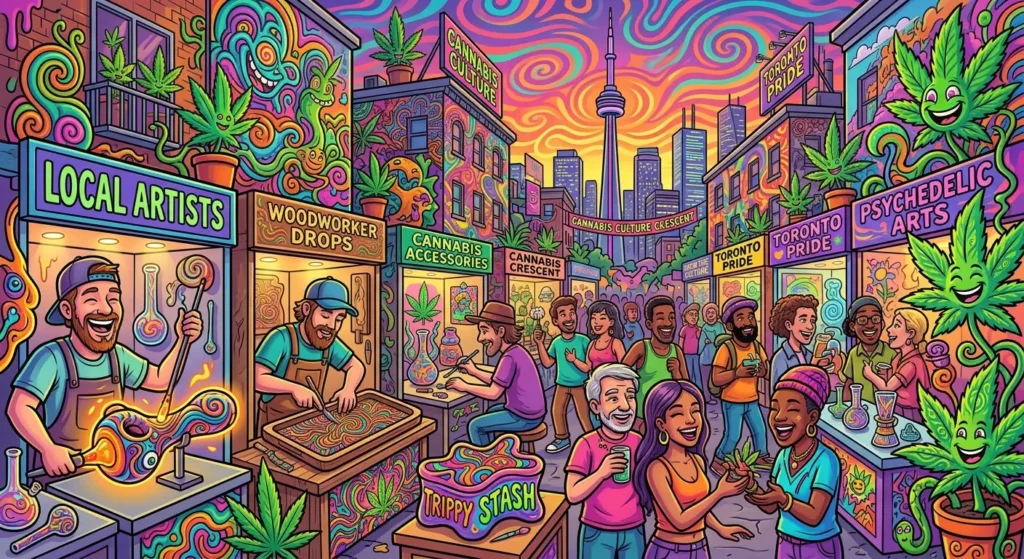
The air in Toronto has changed. It is no longer just about the pungent aroma of quality flower wafting from a backyard patio in Leslieville or a balcony in Liberty Village. There is a new sensory experience taking over the city’s cannabis culture: the cool, weighted feel of a hand-thrown ceramic pipe, the glint of a titanium nail machined to perfection, and the visual punch of a one-of-one glass rig displayed like a sculpture on a Queen West coffee table.
We have officially entered the era of the Toronto craft cannabis accessory.
Long gone are the days when a trip to the local headshop meant buying a mass-produced, neon-colored acrylic bong or a thin glass spoon pipe wrapped in bubble wrap. Toronto has cultivated a distinct ecosystem where the line between “smoking tool” and “functional art” has blurred entirely. Driven by local artisans, a thirst for individuality, and a post-legalization cultural renaissance, the city is now a hotbed for premium, handcrafted gear.
But why is this happening now, and what defines this new wave of luxury and craftsmanship in the 6ix?
The Cultural Shift: Legalization and the New Aesthetic
To understand the rise of craft accessories, we must look at the aftermath of the 2018 Cannabis Act. Before legalization, the accessory market was largely utilitarian and underground. Products were often cheap, disposable, and designed for secrecy. You bought a pipe because you needed a delivery system, not because you wanted to display it.
Legalization brought cannabis consumption out of the shadows. As consuming became normalized, the “ritual” of smoking or vaping became more significant. If you can legally grow a plant in your backyard and smoke it on your porch, why would you use a Chinese-made, mass-produced glass piece when you could use a piece of art that reflects your personality?
This shift aligns perfectly with Toronto’s existing identity as a design-forward city. From the fashion runways of Yorkville to the industrial design studios of the Junction, Toronto appreciates craftsmanship. It was only natural that this appreciation would spill over into the cannabis industry.
The Artist Economy: From Bloor Street Studios to Instagram Fame
The heart of this movement lies in the hands of Toronto’s glassblowers, ceramicists, and woodworkers. The city has a deep history of glass art, championed by institutions like the Harbourfront Centre, which has housed a glass studio since the 1970s. Many of today’s top pipe makers are graduates of OCAD University or Sheridan College’s renowned Crafts and Design program.
These aren’t just “heady glass” makers; they are artisans who view borosilicate glass as a canvas.
The Role of Social Media:
Toronto’s accessory boom is inextricably linked to Instagram. Unlike the old days where a glass blower needed a distributor to get shelf space, an artist in Parkdale can now post a photo of a freshly finished rig, tag it #TorontoGlass, and have it sold via DM within minutes.
This direct-to-consumer model has allowed for rapid iteration. Artists are no longer making 500 units of the same pipe; they are making 10 variations of a unique technique. The result is a market saturated with regional identity. Toronto glass often features colors influenced by the city’s skyline—muted greys, deep blues mirroring Lake Ontario, and neon accents reminiscent of the Yonge-Dundas Square glow.
The Rise of “Limited Drops” and Hype Culture
Toronto is no stranger to hype culture. The city lines up for Nike Dunks on Spadina, camps for Jordan releases in the Financial District, and crashes websites for Drake’s OVO merchandise. It was inevitable that this “drop” mentality would infiltrate the cannabis accessory market.
Today, the most sought-after pipes and bangers in the city aren’t sold in bulk; they are released in limited drops.
Why Limited Drops Work:
- Scarcity Creates Value: If an artist in the Distillery District announces a drop of 15 “dichroic” glass pendants, collectors know that value will hold or increase.
- The Thrill of the Hunt: For a new generation of cannabis connoisseurs, the hunt is part of the fun. Securing a piece from a “secret drop” or a limited email list provides a dopamine hit similar to winning a raffle.
- Community Building: Drops create a frenzy on Discord servers and Reddit threads. Toronto collectors form tight-knit communities, trading pieces, comparing “color pulls,” and celebrating the artists.
This model has elevated certain local artists to celebrity status within the community. Names that used to only be whispered in headshops are now emblazoned on hoodies and stickers. You will see their logos on cars parked on Ossington, a symbol of belonging to a specific subculture.
🔥 Stack your savings. Elevate your session. 10% off $100, up to 25% off $450.
🔥 Roll into the menu and start saving. CLICK HERE!
From Function to Form: The Materials Revolution
The distinction between a “craft” accessory and a mass-produced one comes down to material science and time. In Toronto, the focus has shifted to high-end materials that offer a superior experience.
1. Borosilicate Glass
While cheap glass cracks under thermal stress, Toronto glass blowers use high-quality borosilicate. This allows for thicker, more intricate designs that can withstand the heat of a torch or an enail. Artists are employing complex techniques like “fuming” (using silver and gold to create color-changing effects) and “wig-wags” (intricate line work) that require hours of meticulous labor.
2. Ceramics
Ceramic pipes and stash jars are having a massive moment in the city. Local ceramicists are using food-safe, high-fire clays to create pieces that feel more like pottery you’d find in a homeware store than a headshop. These pieces often feature organic, earthy textures and glazes, appealing to a crowd that prefers a “bohemian” aesthetic over the “scientific” look of glass.
3. Wood and Metal
For the dry herb vaporizer crowd, Toronto has seen a surge in custom woodworkers crafting bespoke stems and bodies for devices like the DynaVap or Tinymight. Crafted from stabilized maple, burl, or even reclaimed wood from old Toronto buildings, these accessories merge sustainability with luxury. Similarly, machinists are producing high-grade titanium and stainless-steel tools (pokers, tampers, and grinders) that are built to last a lifetime.
The Retail Landscape: Where to Find Craft in the City
While Instagram is the primary marketplace, several physical retail spaces in Toronto have become hubs for the craft movement.
- The Boutique Dispensaries: The best dispensaries in Toronto now curate their accessory shelves like art galleries. They stock local “House Glass” and often host “meet the artist” nights where you can watch a lampworker in action.
- Gallery Hybrids: Spaces on Dundas West and Queen East are blurring the lines between art gallery and smoke shop. You might find a $2,000 oil rig displayed next to a painting, with staff who can articulate the artistic merit of the piece beyond its function.
- The Pop-Up Market: Events like the Toronto Glass Expo or local “Sesh” meetups are crucial. These events allow collectors to feel the weight, examine the joints, and see the color shifts in person—a tactile experience that digital shopping cannot replicate.
The Future of Craft Cannabis in Toronto
What comes next for the craft accessory movement? The future looks bright, and perhaps a little more expensive.
As the “honeymoon phase” of legalization fades, consumers are becoming more educated. They are realizing that a $50 mass-produced bong made in a factory overseas is a disposable item, whereas a $300 hand-blown rig by a Toronto artist is an heirloom.
We are likely to see more collaborations between local glass artists and major Toronto brands—imagine a limited edition Blue Jays rig or a Canada Goose branded stash box. We will also see the continued gamification of the market through NFTs (Non-Fungible Tokens) that unlock physical items, a space where Toronto’s tech-savvy population is uniquely positioned to lead.
Ultimately, the rise of craft cannabis accessories in Toronto is about identity. It is about looking at your coffee table and seeing a piece that tells a story—a story of a local artist sweating over a torch, a story of a late-night drop you managed to score, and a story of a city that has finally embraced its green thumb with style.
🔥 Stack your savings. Elevate your session. 10% off $100, up to 25% off $450.
🔥 Roll into the menu and start saving. CLICK HERE!
Frequently Asked Questions (FAQ)
1. Why are Toronto craft cannabis accessories so expensive compared to regular pipes?
The price difference comes down to labor, materials, and exclusivity. A Toronto glass blower may spend 4 to 8 hours on a single piece, using high-quality American or German borosilicate glass. Unlike factory goods made by the thousands, craft pieces are often one-of-a-kind or limited editions, which commands a higher price due to the artistic value and the cost of running a small studio in the city.
2. Where can I buy limited drop accessories in Toronto?
The primary marketplace is Instagram. Follow local artists and hashtags like #TorontoGlass or #CanadianGlass. Additionally, boutique dispensaries in neighborhoods like Queen West and Kensington Market often stock local inventory. For physical events, keep an eye on the Toronto Glass Expo or local “sesh” events which frequently feature tables from local artisans selling direct.
3. Are ceramic pipes better than glass pipes?
It depends on your preference. Glass is inert and generally provides the “purest” flavor for smoking flower. Ceramic offers a unique aesthetic and tends to stay cooler to the touch than thin glass, but it can affect flavor slightly if the interior is unglazed. High-fire ceramic is perfectly safe and offers a distinct, earthy smoking experience that many Toronto users prefer.
4. Does the “limited drop” model actually increase the value of the accessory?
Yes. Similar to sneaker culture, the scarcity driven by limited drops creates a secondary market. If a popular Toronto artist drops 20 pieces and 200 people want them, the value of those pieces immediately increases. Collectors often trade or resell these pieces for a profit, especially if the artist later gains national or international fame.
5. How can I tell if a piece is “craft” and not just mass-produced?
Look for imperfections that indicate human touch, such as slight asymmetry or signature “tool marks.” Most craft artists will sign or mark their work with a logo or a “millie” (a small decorative glass cane). Check the joints (the connection points)—craft pieces usually have “ground glass joints” that are fused perfectly, whereas cheap imports often have visible seams or bubbles.
6. Are these high-end accessories legal to buy in Ontario now that cannabis is legal?
Yes. Cannabis accessories, including pipes, bongs, and vaporizers, are legal to purchase and possess in Ontario. In fact, legalization has made it easier for artists to operate legitimate businesses, pay taxes, and sell their goods openly at markets without fear of legal repercussions.
7. What are the most popular materials for craft dab rigs in Toronto right now?
Borosilicate glass remains king for dab rigs due to its heat resistance and flavor preservation. However, there is a growing niche for “terp pearls” and “inserts” made from ruby, sapphire, or quartz. These materials are prized for their ability to retain heat and vaporize concentrates efficiently without tainting the flavor.