
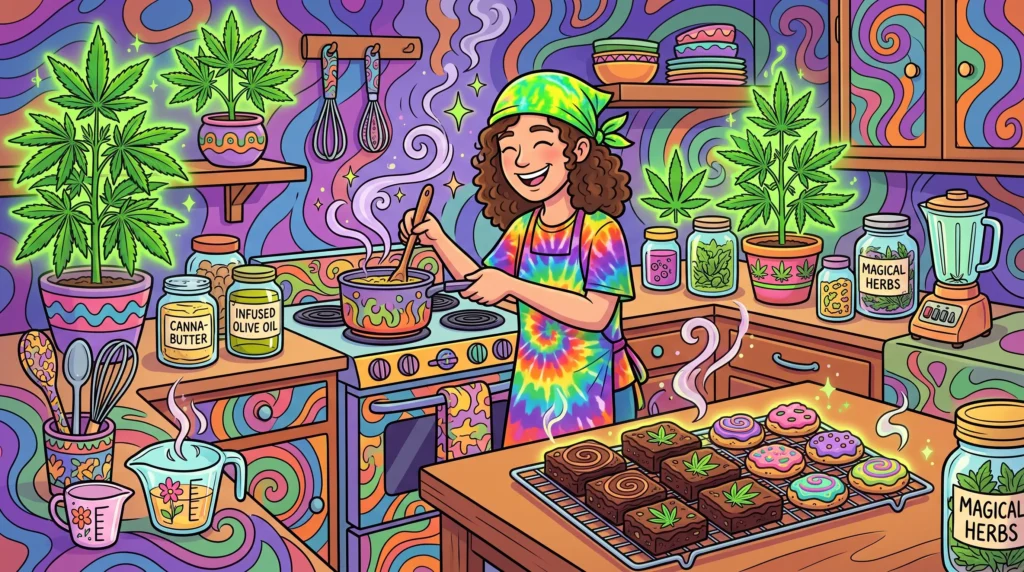
So you’ve decided to try your hand at cooking with cannabis. Maybe you’re curious about making your own edibles instead of buying them. Maybe you want more control over potency, ingredients, and cost. Or maybe you just like the idea of a brownie that actually does something.
Whatever brought you here, you’re in the right place. Cooking with cannabis at home is legal in many jurisdictions for adults who meet the age requirement and follow personal possession limits. It’s also more approachable than most people think. You don’t need a culinary degree or a laboratory. You need a few basic kitchen tools, a little patience, and a healthy respect for dosage.
This guide walks you through the entire process, from understanding why raw cannabis won’t get you high to pulling a tray of perfectly dosed brownies out of your oven. We’ll cover decarboxylation, making cannabutter and infused oils, easy beginner recipes, and the safety rules that keep this fun instead of frantic.
Let’s get cooking.
Is Cooking With Cannabis Legal?
Cooking with cannabis at home is legal in some jurisdictions, but the rules are not universal. Requirements may differ according to:
- Country.
- State, province or territory.
- Legal age.
- Possession limits.
- Whether the cannabis was legally purchased or grown.
- Whether sharing homemade edibles is permitted.
- Rules against selling or distributing cannabis products.
In the United States, cannabis laws vary by state. In Canada, federal cannabis rules coexist with provincial and territorial requirements. Do not assume that a rule from one location applies elsewhere.
Before preparing infused food, check the website of your local cannabis regulator or government authority. Pay special attention to rules concerning home production, possession, transportation and sharing.
The One Thing You Must Understand Before You Cook
Here’s the truth that trips up almost every beginner: raw cannabis doesn’t contain THC. It contains THCA, the acidic precursor that has no psychoactive effect. If you throw raw flower into a brownie mix and bake it, you’ll end up with a grassy-tasting dessert that does absolutely nothing.
To activate cannabis for edibles, you need heat. Specifically, you need a controlled, low-temperature heating process called decarboxylation (or “decarbing”). This converts THCA into THC, the compound responsible for the effects you’re looking for.
Skip this step, and your edibles will be weak, inconsistent, and frankly, a waste of good butter. Do it correctly, and everything that follows becomes predictable and potent.
What Is Decarboxylation?
Fresh cannabis flower contains mostly THCA, the acidic precursor to THC, along with smaller amounts of THC. Heating converts part of the THCA into THC through a process called decarboxylation.
This step is important because simply adding raw flower to brownie batter will not produce a predictable psychoactive effect. Without proper decarboxylation, your infusion may be weak and inconsistent.
Decarboxylation is not a guarantee of potency. The final result also depends on the flower’s laboratory-tested cannabinoid content, heating conditions, extraction method and how evenly the finished infusion is mixed.
How to Decarb Cannabis
What you need
- Cannabis flower from a legal, reputable source.
- Baking sheet.
- Parchment paper.
- Oven thermometer.
- Airtight, heat-resistant container, if preferred.
Oven method
- Preheat the oven to 240°F (115°C).
- Break the flower into small, evenly sized pieces. Avoid grinding it into a fine powder because that can make straining more difficult and increase bitterness.
- Spread the pieces evenly on a parchment-lined baking sheet.
- Heat for approximately 30–40 minutes.
- Stir gently once halfway through the process.
- Remove the cannabis and allow it to cool before beginning the infusion.
Ovens can run hotter or cooler than their displayed setting, so an oven thermometer can improve consistency. Decarboxylation also produces a strong cannabis aroma. A heat-resistant container with a loosely fitted lid may reduce the smell, but it must be used safely and according to the manufacturer’s instructions.
Do not use plastic containers that are not designed for heat. Never leave the oven unattended.
Choosing an Infusion Base
Cannabinoids are fat-soluble, which makes butter and oils common choices for homemade edible recipes.
| Infusion base | Best use | Main consideration |
|---|---|---|
| Butter | Brownies, cookies and baked goods | Easy to use but contains dairy |
| Coconut oil | Baking and no-bake recipes | Solid at room temperature |
| Olive oil | Pasta, sauces and dressings | Better for savory foods |
| MCT oil | Oil-based preparations | Use only as directed on the product label |
| Prepared dispensary oil | Recipes requiring predictable labeling | Follow the product instructions |
For beginners, butter or food-grade oil is generally easier to measure and incorporate than more advanced extraction methods. Never use flammable solvents or attempt alcohol evaporation near an open flame.
Step 1: Decarboxylation (The Non-Negotiable First Step)
Why Decarbing Matters
Decarboxylation isn’t optional. It’s the difference between “these brownies are delicious” and “these brownies are working.” The process also helps make your dosing more consistent, because you’re starting with fully activated material.
Basic Oven Decarb Method
You don’t need fancy equipment. Your regular oven will do.
What you’ll need:
- Cannabis flower (fresh, quality, ideally lab-tested)
- Baking sheet
- Parchment paper
- Oven thermometer (recommended, because many ovens run hot or cold)
Instructions:
- Preheat your oven to 240°F (115°C).
- Break up the flower into small, evenly sized pieces. Don’t grind it into a fine powder—that makes straining harder later and can add bitterness.
- Spread the pieces evenly on a parchment-lined baking sheet.
- Bake for 30–40 minutes, stirring gently once halfway through.
- Remove and let cool completely before moving to the infusion step.
A note on smell: Decarbing creates a strong cannabis aroma. If that’s a concern, you can decarb in a sealed mason jar with a finger-tight lid, then let it cool before opening.
How much flower should you decarb? A common starting point is 3.5 grams (an eighth) for a small batch, or 7–10 grams for a standard batch of cannabutter. Adjust based on the potency you want and the THC percentage of your flower.
Step 2: Choose Your Infusion Base
Cannabinoids are fat-soluble and alcohol-soluble. That means they bind to fats and oils, which is why butter and oil are the classic infusion bases.
Your main options:
- Butter (cannabutter): The most versatile choice. Works for baking, sautéing, and spreading.
- Coconut oil: High fat content, solid at room temperature, great for baking and capsules.
- Olive oil: Ideal for savory cooking, dressings, and no-bake recipes.
- MCT oil: Very high absorption, mild flavor, good for tinctures.
- Alcohol: For tinctures only—not for cooking.
For beginners, butter is the easiest place to start. Once you master cannabutter, you can make almost any baked edible recipe.
How to Make Cannabutter (Your New Favorite Skill)
This is the single most useful cannabis cooking skill you can learn. Master this, and you’ve unlocked brownies, cookies, cakes, sauces, and more.
What you’ll need:
- 1 cup unsalted butter.
- 1 cup water.
- A measured amount of decarboxylated cannabis.
- Saucepan.
- Cheesecloth or fine-mesh strainer.
- Heat-resistant storage container.
- Refrigerator-safe label.
Instructions:
- Melt the butter and water together in a saucepan over low heat.
- Add the decarboxylated cannabis and stir gently.
- Maintain a low, gentle heat for approximately 2–3 hours. Do not allow the mixture to boil.
- Stir occasionally and monitor the temperature.
- Strain the mixture through cheesecloth or a fine-mesh strainer into a heat-resistant container.
- Refrigerate until the butter solidifies on top of the water.
- Lift the butter from the container and discard the water.
- Label the butter with the date, ingredients and estimated potency.
The water helps reduce the risk of scorching and makes it easier to separate the butter later. Avoid squeezing the plant material aggressively because that can add bitterness and fine particles to the finished butter.
A slow cooker can also be used if it provides reliable low-temperature control. Always follow the equipment manufacturer’s instructions.
🔥 Stack your savings. Elevate your session. 10% off $100, up to 25% off $450.
🔥 Roll into the menu and start saving. CLICK HERE!
How to Make Cannabis Oil (Nearly Identical, Slightly Simpler)
Ingredients and equipment
- Food-grade coconut oil or olive oil.
- Decarboxylated cannabis.
- Saucepan or slow cooker.
- Cheesecloth or fine-mesh strainer.
- Dark, airtight storage container.
Method
- Combine the decarboxylated cannabis and oil.
- Heat on the lowest practical setting for approximately 2–3 hours on the stovetop, or follow the slow cooker’s instructions.
- Avoid boiling or overheating the oil.
- Strain the mixture carefully.
- Store it in a clean, airtight, light-resistant container.
- Label the container with the date, ingredients and estimated potency.
Coconut oil is popular for baking because it is solid at room temperature. Olive oil is more suitable for savory foods, sauces and dressings.
Do not assume that all infused oils have the same strength. The cannabinoid concentration depends on the starting material and the extraction efficiency.
How to Estimate THC Per Serving
Homemade infusions cannot usually be dosed with the same precision as laboratory-tested products. The following calculation provides an estimate, not a guarantee.
Basic theoretical calculation
THC theoretical total =
grams of flower × 1,000 × THC percentage
For example:
7 g of flower × 1,000 × 0.15 = 1,050 mg theoretical cannabinoid contentThat figure should not automatically be treated as 1,050 mg of finished THC. Actual available THC may be lower because of:
- Conversion losses during decarboxylation.
- Incomplete extraction.
- Cannabinoids retained in the plant material.
- Losses during filtering.
- Uneven distribution.
- Inaccurate product labeling.
A more realistic estimate can include an efficiency factor:
Estimated available THC =
theoretical THC × conversion factor × extraction efficiency
Because those factors are difficult to measure at home, treat the result as an approximation. The most reliable option is to use a legally purchased, laboratory-tested product with clear labeling.
Example per serving
Suppose your estimated infusion contains approximately 400 mg of THC in total, and you use it in a recipe cut into 16 equal servings:
400 mg ÷ 16 servings = approximately 25 mg per servingThat would be a high amount for a beginner. You could use less infused butter or oil and replace the remaining quantity with regular butter or oil.
Always mix the infusion thoroughly into the recipe before dividing it into portions. Uneven mixing can lead to different amounts of THC in individual servings.
Beginner Dosing and Timing
For someone new to edibles, a cautious starting point is 2.5 mg of THC or less. Health Canada recommends starting low and going slow, noting that edible effects may begin within 30 minutes to 2 hours and may take up to 4 hours to fully develop.canada
| Situation | Conservative approach |
|---|---|
| First-time user | Consider 2.5 mg THC or less |
| Sensitive user | Start lower or avoid cannabis |
| After the first serving | Wait before considering more |
| Unknown homemade potency | Use a very small portion |
| Strong or unexpected effects | Do not consume more |
Do not redose simply because you do not feel anything immediately. Many edible-related problems occur when someone consumes more before the first serving has reached its full effect. Official public-health guidance warns that effects can peak several hours after consumption.gov+1
Individual responses vary according to body chemistry, tolerance, food intake, metabolism, medication and the actual potency of the product.
The process is almost the same as cannabutter, but you skip the water step because oil doesn’t separate.
- Combine decarbed cannabis and oil in a saucepan or slow cooker.
- Heat on the lowest setting for 2–3 hours (stovetop) or 4–6 hours (slow cooker). Never exceed 245°F.
- Strain through cheesecloth.
- Store in a dark container.
Coconut oil is a popular choice for beginners because it’s solid at room temperature, easy to measure, and has a mild flavor that won’t overpower your recipes.
Dosing: The Part That Keeps You Sane
This is where homemade edibles get tricky. Unlike store-bought products, which are lab-tested and labeled with precise THC content, homemade infusions are estimates.
Here’s the general rule: Start low. Go slow.
For beginners, a starting dose of 2.5 to 5 mg THC is recommended. Even 10 mg—the state-recommended dose in many places—can feel overwhelming for some people.
How to estimate your dose:
If you used 7 grams of flower with 15% THC:
- 7,000 mg flower × 0.15 = 1,050 mg THC total
- If you infuse into 1 cup of butter (16 tablespoons), that’s roughly 65 mg THC per tablespoon
- A recipe calling for 2 tablespoons of cannabutter would have about 130 mg THC total
- Divided into 12 servings, that’s about 11 mg per serving
That’s on the higher side for beginners. You can always use less cannabutter and supplement with regular butter to lower the dose per serving.
The golden rule: Wait at least 2 hours before eating more. Edible effects can take up to 2–4 hours to fully kick in. The biggest mistake new users make is eating more because they “don’t feel anything yet”—and then getting hit hard an hour later.
3 Easy Beginner Recipes Using Cannabutter or Cannabis Oil
Recipe 1: Classic Cannabis Brownies
Yield
16 small brownies.
Ingredients
- 1/2 cup cannabutter, with known or estimated potency.
- 1/2 cup regular butter, if you want to reduce the concentration.
- 1 cup granulated sugar.
- 2 large eggs.
- 1 teaspoon vanilla extract.
- 1/2 cup all-purpose flour.
- 1/3 cup unsweetened cocoa powder.
- 1/4 teaspoon baking powder.
- 1/4 teaspoon salt.
- 1/2 cup chocolate chips, optional.
Instructions
- Preheat the oven to 350°F (175°C).
- Grease an 8 × 8-inch baking pan and line it with parchment paper.
- Melt the cannabutter and regular butter together.
- Whisk in the sugar, eggs and vanilla.
- Add the flour, cocoa powder, baking powder and salt.
- Stir until just combined.
- Fold in the chocolate chips, if using.
- Pour the mixture into the pan.
- Bake for 25–30 minutes, until a toothpick comes out with moist crumbs.
- Cool completely before cutting.
- Cut into 16 equal pieces and label the container clearly.
Dosing note
Calculate the estimated THC in the total amount of cannabutter used, then divide that amount by 16. If the result is too high for your audience, replace part of the cannabutter with regular butter.
Serving note: Cut into 16 small squares for a lower dose per piece.
Recipe 2: Cannabis-Infused Olive Oil Pasta
What you’ll need:
- 2 tablespoons cannabis-infused olive oil
- 2 tablespoons regular olive oil
- 2 cloves garlic, minced
- 1/4 teaspoon red pepper flakes
- 1/4 cup grated Parmesan
- 8 oz pasta (spaghetti or linguine)
- Salt and pepper to taste
Instructions:
- Cook pasta according to package directions. Reserve 1/2 cup pasta water.
- In a large pan, warm the regular olive oil over medium heat. Add garlic and red pepper flakes. Cook for 1 minute.
- Add the cannabis olive oil and stir. Do not overheat—high heat can degrade THC.
- Toss in the cooked pasta and a splash of pasta water. Stir to coat.
- Remove from heat and toss with Parmesan. Season with salt and pepper.
Serving note: This makes 2 servings. Adjust the cannabis oil ratio for your desired dose.
Recipe 3: No-Bake Cannabis Energy Bites
What you’ll need:
- 1/4 cup cannabis-infused coconut oil
- 1 cup rolled oats
- 1/2 cup peanut butter
- 1/4 cup honey or maple syrup
- 1/2 cup dark chocolate chips
- 1/4 cup shredded coconut
Instructions:
- Melt the cannabis coconut oil and peanut butter together in a microwave-safe bowl.
- Stir in honey, oats, chocolate chips, and shredded coconut.
- Roll the mixture into 12 small balls.
- Refrigerate for at least 30 minutes to set.
- Store in an airtight container in the refrigerator.
Serving note: Each bite contains roughly 1/12 of the total cannabis oil. Calculate your dose accordingly.
Safety and Legal Considerations
Legal basics:
- You must be of legal age (21+ in most U.S. states, 19+ in Canada).
- Possession limits apply. In many places, the public possession limit for dried cannabis is 30 grams.
- It is legal to make edibles for personal consumption, but not to sell or share with minors.
Safety rules:
- Label everything. Every edible should be labeled with “contains cannabis,” the date made, and estimated dose per serving.
- Store securely. Keep edibles in a locked container, away from children and pets.
- Never mix with alcohol or other drugs.
- Start with a small portion (2.5–5 mg THC) and wait at least 2 hours before considering more.
- Avoid driving after consuming edibles.
Common beginner mistakes to avoid:
- Skipping decarboxylation
- Guessing the dose instead of calculating
- Overheating the infusion, which degrades THC
- Not mixing thoroughly, leading to uneven dosing
- Poor storage and labeling
Storage and Shelf Life
Homemade edibles have the same shelf life as regular baked goods, but the cannabis infusion can affect freshness.
- Cannabutter: Refrigerate for up to 2 weeks, freeze for up to 6 months.
- Cannabis oil: Store in a dark container in the refrigerator.
- Baked edibles: Refrigerate or freeze to extend freshness. Freezing does not affect potency.
Always label and date your containers. When in doubt, throw it out.
Conclusion
Cooking with cannabis at home is a rewarding skill that gives you control over potency, flavor, and ingredients. It saves money compared to buying pre-made edibles, and it opens up a world of culinary creativity.
But it also requires respect. Respect the decarb. Respect the dose. Respect the waiting period. If you follow the steps in this guide—decarb properly, infuse patiently, calculate carefully, and start low—you’ll be making consistent, delicious, and safely dosed edibles in no time.
Your kitchen is now a cannabis kitchen. Treat it with the same care you’d treat any other kitchen where powerful ingredients are prepared. And enjoy the brownies.
🔥 Stack your savings. Elevate your session. 10% off $100, up to 25% off $450.
🔥 Roll into the menu and start saving. CLICK HERE!
FAQs
1. Can I just throw raw cannabis into my brownie mix?
No. Raw cannabis contains THCA, not THC. Without decarboxylation, your edibles won’t produce psychoactive effects. You must heat the cannabis first to activate the cannabinoids.
2. How much cannabis should I use for my first batch of cannabutter?
A common starting point is 7 grams of decarbed flower per 1 cup of butter. If you’re new to edibles, you can use less flower or use more butter to dilute the potency. You can always make a stronger batch next time.
3. How long do homemade edibles take to kick in?
Edibles can take 30 minutes to 2 hours to take full effect, and sometimes up to 4 hours. The biggest mistake beginners make is eating more because they don’t feel anything yet. Wait at least 2 hours before consuming more.
4. What’s the best oil to use for cannabis infusion?
Coconut oil is a favorite among beginners because it’s high in fat, solid at room temperature, and has a mild flavor. Olive oil works well for savory dishes, and butter is the classic choice for baking.
5. How do I calculate the THC dose per serving?
First, know the THC percentage of your flower. Multiply the grams of flower by 1,000 to get milligrams, then multiply by the THC percentage. For example, 7 grams at 15% THC = 1,050 mg THC total. Divide that by the number of servings in your recipe to get the dose per serving.
6. Can I use stems, leaves, or trim for cooking?
Yes, but they contain lower cannabinoid levels than flower. You’ll need to use more material to achieve the same potency. For beginners, starting with quality flower is simpler and more predictable.
7. How should I store my cannabutter and edibles?
Store cannabutter in the refrigerator for up to 2 weeks or freeze for up to 6 months. Baked edibles should be refrigerated or frozen and always labeled with the date and estimated dose.
8. Is it legal to cook with cannabis at home?
In many jurisdictions, yes—if you’re of legal age, making edibles for personal consumption, and staying within possession limits. Always check your local laws before you start.
9. Can I cook with cannabis oil I bought from a dispensary?
Yes. Premade cannabis oils are already decarboxylated and activated, so you can add them directly to recipes. They’re also more accurately dosed than homemade infusions.
10. What should I do if I eat too much?
Stay calm. Drink water, find a comfortable place to relax, and remind yourself that the effects will pass. Avoid consuming more cannabis or alcohol. If you experience severe symptoms like a racing heart, hallucinations, or extreme anxiety, seek medical attention.
Important: This article is for educational purposes only. Cannabis laws, product potency and individual responses vary by location and person. Verify your local regulations before preparing or consuming cannabis products. Do not use cannabis edibles if they are illegal where you live. If you have a medical condition, take medication, are pregnant or breastfeeding, speak with a qualified healthcare professional.