
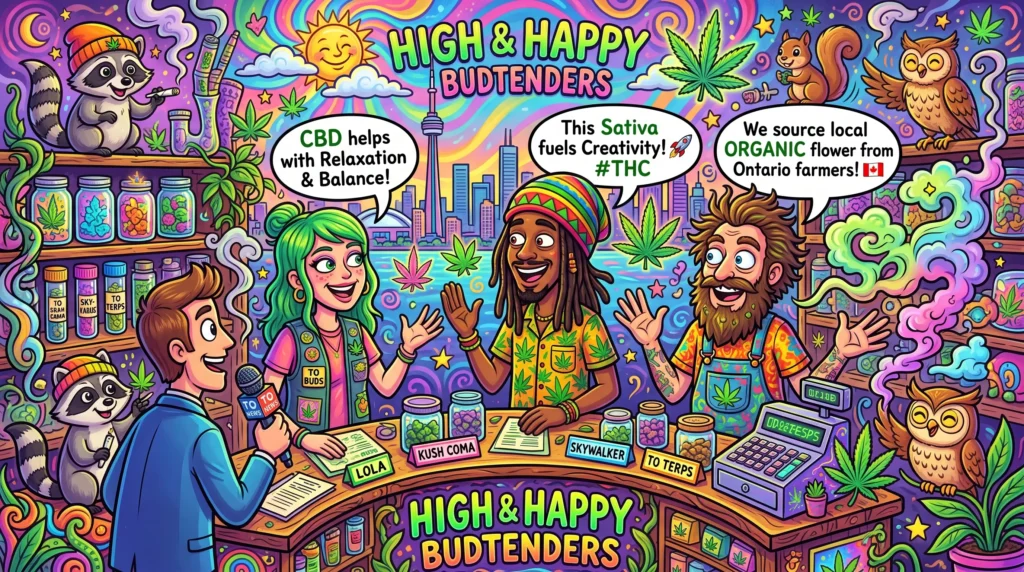
Walk into almost any of Toronto’s licensed cannabis retailers — from the indie shops lining Queen West to the sleek boutiques of Yorkville — and you’ll meet one of the most misunderstood professionals in the modern retail economy: the budtender.
Part sommelier, part pharmacist’s assistant, part therapist, and part compliance officer, budtenders occupy a genuinely unusual role. They’re the frontline of Canada’s legal cannabis industry, and in a city with hundreds of stores competing for the same customers, Toronto’s budtenders have seen it all.
We spoke with several local budtenders — names shortened for privacy, quotes edited lightly for clarity — to pull back the curtain on the profession. What follows is a candid look at what the budtender job description actually involves, what hiring managers really want, and the advice these insiders would give anyone preparing for a dispensary interview in Toronto.
The Evolution of the Toronto Cannabis Consumer
Before diving into the Q&A, it is crucial to understand how far the market has come. When Ontario’s private retail model launched in 2019, shelves were bare, and consumers were largely limited to whatever dried flower the major Licensed Producers (LPs) could supply.
“Back in 2019 and 2020, people just wanted THC, and they didn’t care about the format,” David explains. “Now, the Toronto consumer is highly educated. They are asking about specific terpene profiles, extraction methods like live resin, and the exact curing process. The gap between the casual user and the connoisseur has completely closed.”
Meet the Budtenders
Our conversations took place across three very different retail environments: a high-traffic downtown flagship, a neighborhood boutique in Leslieville, and a store in North York that skews toward an older clientele. Despite the differences, their insights converged in surprising ways.
What does a typical day actually look like?
Maya, downtown Toronto (3 years in the industry): “People imagine we’re just hanging out talking about weed all day. The reality is that cannabis retail in Ontario is heavily regulated — a big chunk of my day is compliance. Checking IDs, verifying purchase limits, logging everything correctly. The customer consultation part, which is what most people think the job is, is maybe 40% of it.”
Devon, Leslieville (5 years): “The morning shift starts with inventory counts and menu updates, because products sell out and the OCS catalogue changes constantly. Then it’s a mix of regulars who know exactly what they want and first-timers who are nervous and need twenty minutes of guidance. You have to be able to switch modes instantly.”
That dual reality — regulatory rigor paired with hospitality — defines the modern budtender job description. Anyone researching the role on job boards or browsing budtender interview questions reddit threads will notice this tension comes up constantly: candidates arrive expecting a relaxed counter-culture vibe and are sometimes surprised by how procedural the work is.
🔥REFER A FRIEND
THEY GET 10% OFF THEIR FIRST ORDER🔥
What do customers get wrong most often?
Priya, North York (2 years): “Potency isn’t everything. People walk in asking for the highest THC number on the shelf, and that’s often not what will give them the experience they actually want. My job is partly translating — what they’re describing in terms of effect, anxiety levels, tolerance, experience — into a product. That translation skill is the core of what we do.”
Maya: “Also, the 10mg edibles limit confuses people constantly. Customers from other markets, or people who used to buy illegally, expect stronger edibles. Explaining why the legal cap exists — and then helping them find something that works within it — is a daily conversation.”
The Hiring Process: What Managers Actually Look For
One of the most common questions on dispensary interview questions reddit threads is some version of: “Do I need cannabis experience to get hired?” We put it directly to a hiring manager.
A dispensary manager’s perspective
Jordan, store manager, midtown Toronto (6 years in cannabis retail): “Cannabis knowledge is teachable. Personality and judgment aren’t. When I run interviews, I’m listening for three things: can this person have a sensitive conversation about someone’s health without being weird about it, can they follow procedures precisely, and can they stay calm with a difficult customer?”
That framing reshapes how candidates should prepare. Dispensary manager interview questions tend to be behavioral rather than technical — Jordan confirmed his go-tos include “Tell me about a time you dealt with an angry customer,” “How would you handle a customer you suspect is buying for a minor?” and “What would you do if a coworker wasn’t checking IDs?”
“That last one is a trap and a test,” Jordan adds. “The answer has to be: you’d report it immediately. Compliance failures can cost us our license. I need people who understand the stakes.”
The questions candidates should expect
Drawing from our interviews, here are the budtender interview questions and answers that come up most reliably across Toronto stores:
“How do you stay educated about cannabis products?” — A strong answer mentions following LP (licensed producer) updates, reading lab results, attending brand education sessions, and keeping up with regulatory changes through AGCO and OCS announcements.
“A customer says they’ve never used cannabis and feels anxious. Walk me through how you’d help them.” — Managers want to hear a consultative process: asking about their goals, explaining onset times and dosing conservatively, recommending low-THC or balanced CBD options, and setting realistic expectations without making medical claims.
“What does responsible selling mean to you?” — This is the compliance question. The answer should cover ID verification, recognizing signs of intoxication or impairment, respecting purchase limits, and never providing medical advice.
What to Know Before Your Budtender Interview
If you’re searching for what to know for a budtender interview, our panel was unanimous: the biggest differentiator isn’t product trivia — it’s demonstrating you understand the regulatory environment.
Ontario cannabis retail operates under the Alcohol and Gaming Commission of Ontario (AGCO) and the Cannabis Licence Act. Stores must follow strict rules around ID checks, age verification, inventory tracking, and marketing. Candidates who can speak even casually about this landscape — mentioning the OCS wholesale model, the 30-gram purchase limit, or the 10mg edible cap — signal they did their homework.
“Candidates who come in and only talk about strains they’ve smoked,” Devon laughs, “versus candidates who mention the AGCO or ask about our compliance training — it’s night and day. One is a hobbyist. The other is a potential employee.”
On outfits: business casual wins
The budtender interview outfit question generates endless debate online, and the consensus from our panel is more conservative than you might expect. This is retail, and stores have distinct brand identities — but the safe move is business casual.
“Clean, put-together, no cannabis-themed clothing,” Maya advises. “I know it seems obvious, but people show up in hoodies with giant pot leaves and it reads as unprofessional. You can express personality through style once you’re hired. For the interview, look like someone a customer would trust with a purchase decision.”
Priya adds one practical note: comfortable, closed-toe shoes signal you understand the job involves long hours on your feet. Small details like that register with experienced managers.
Dispensary Interview Tips from People Who’ve Sat on Both Sides
Every budtender we spoke with had gone through the interview process themselves — many multiple times, across multiple stores. Their collective dispensary interview tips:
1. Visit the store first. Shop there as a customer before your interview. Notice the product selection, the demographic, the staff energy. Referencing a specific observation — “I noticed your staff spend a lot of time with first-time customers” — demonstrates genuine interest no rehearsed answer can match.
2. Prepare a “customer scenario” story. Behavioral questions dominate these interviews. Have two or three real stories ready: a difficult customer, a mistake you caught and corrected, a time you educated someone patiently. Structure them briefly — situation, action, result.
3. Don’t fake expertise you don’t have. “If you don’t know a strain, say so and explain how you’d find out,” says Jordan. “Customers trust honesty. So do I. The worst answer in an interview is a confident wrong answer.”
4. Ask your own questions. Strong candidates ask about training programs, compliance protocols, and what success looks like in the first 90 days. It signals you’re thinking like an employee, not just a job seeker.
5. Mention your RSA or Smart Serve-adjacent mindset. While Ontario doesn’t require budtender certification, drawing a parallel to responsible service training — showing you think in terms of duty of care — lands extremely well with managers.
The Career Reality: Growth, Pay, and Burnout
A candid note on the profession itself, because any honest budtender job description should include the harder parts.
Toronto budtenders typically earn modest base wages supplemented by tips, which vary enormously by neighborhood and store volume. Career progression usually runs toward senior budtender, keyholder, inventory or compliance specialist, and eventually management — the path Jordan took.
“It can be a real career,” Devon says, “but the turnover is high because people underestimate the emotional labor. You’re helping anxious people, educating skeptical seniors, de-escalating intoxicated customers — sometimes in the same hour. The stores that retain people are the ones that invest in training and don’t treat budtenders as interchangeable.”
Maya agrees: “The best part is genuinely helping someone — the veteran who finally sleeps through the night, the retiree who traded wine for a 2:1 CBD pen. Those moments are real. But go in with your eyes open. It’s a service job with regulatory weight on top. The people who thrive love both halves of that.”
Roundtable Q&A: What Toronto Budtenders Really Think
Question 1: What is the biggest mistake first-time dispensary shoppers make in Toronto?
David (Downtown): “The biggest mistake is walking in and saying, ‘I want your strongest weed.’ Potency isn’t everything. A 30% THC strain that lacks the right terpenes for your desired effect can lead to a really uncomfortable experience, like anxiety or paranoia. I always tell new customers to focus on the feeling they want, not just the THC percentage on the label.”
Chloe (East York): “I’d add that another mistake is ignoring the staff. People will wander the store for twenty minutes, get overwhelmed by the hundreds of SKUs, and then buy something random just to leave. We are literally here to guide you. Tell us your budget, your experience level, and how you plan to consume it. We can narrow it down to three perfect options in two minutes.”
Question 2: How has the local consumer’s palate changed over the last few years?
Maya (West End): “There has been a massive shift toward flavour and aroma. A few years ago, the ‘gas’ and ‘diesel’ skunky profiles dominated. Now, Toronto consumers are heavily leaning into complex terpene profiles. We are seeing a huge demand for fruity, creamy, and even floral strains. People are treating cannabis almost like wine or craft beer; they want to taste the notes of blueberry, vanilla, or pine. If a strain doesn’t smell incredible out of the jar, it’s getting left on the shelf.”
David (Downtown): “I’m also seeing a huge surge in the category of concentrates and vapes. Cartridges, live resin, and diamond dips used to be niche. Now, they make up a massive chunk of our daily sales. People want convenience and high flavour retention, which is why solventless extracts are flying off our shelves.”
🔥REFER A FRIEND
THEY GET 10% OFF THEIR FIRST ORDER🔥
Question 3: What is the best way to ask for a recommendation without sounding clueless?
Maya (West End): “You don’t need to know the scientific names of cannabinoids to sound like you know what you’re doing. Just use the ‘Past, Present, and Future’ method. Tell us what you’ve liked in the past (e.g., ‘I loved that pink packaging I bought last month’), what you are consuming right now (e.g., ‘I usually vape before bed’), and what you want to achieve today (e.g., ‘I need to clean my apartment and feel creative, not couch-locked’). That gives us everything we need.”
Chloe (East York): “Honestly, just be honest about your tolerance! If you only smoke once a month, tell us. There is no shame in it. We’d rather sell you a low-dose edible or a mild indica hybrid that you actually enjoy than a high-THC sativa that overwhelms you. Honesty gets you the best product.”
Question 4: Are craft cannabis brands actually worth the higher price tag in Ontario?
David (Downtown): “It depends on what you value. If you are rolling a joint to share at a bonfire, the commercial, value-tier flower is perfectly fine. It gets the job done and saves you money. But if you are a connoisseur who cares about the visual appeal of the bud, the complexity of the aroma, and a smooth smoke that doesn’t make you cough, craft is absolutely worth it. The hand-trimming and slow-curing processes used by Ontario’s craft growers make a noticeable difference in the final experience.”
🔥 Stack your savings. Elevate your session. 10% off $100, up to 25% off $450.
🔥 Roll into the menu and start saving. CLICK HERE!
Maya (West End): “I like to use the coffee analogy. You can buy a bulk bag of commercial coffee for a few bucks, and it will wake you up. But if you go to a local roaster and buy a single-origin, pour-over blend, the experience is entirely different. Craft cannabis in Ontario has matured so much. The small-batch growers are competing on quality, not just price. If you have the budget, supporting Ontario craft is always the better experience.”
Question 5: What are your go-to strain profiles for a typical Toronto weekend?
Chloe (East York): “For a Friday night, when people are coming off a long week at the office, I always recommend a heavy, creamy Indica or an Indica-dominant hybrid. Think strains with high myrcene and linalool terpenes. You want something that physically relaxes you so you can unwind on the couch and watch a movie.”
Maya (West End): “For a Saturday afternoon, especially if the weather is nice and people are heading to High Park or the Distillery District, I recommend a bright, uplifting Sativa or a balanced hybrid. Look for strains high in limonene and pinene. They provide a clear-headed, energetic buzz that makes walking around the city or going to a patio really enjoyable without making you feel sluggish.”
David (Downtown): “For Sunday resets, edibles are my go-to recommendation. A precisely dosed 5mg or 10mg THC gummy or chocolate allows people to microdose, relax, do some chores, and prep for the week ahead without the commitment of smoking. It’s the perfect low-key weekend vibe.”
Navigating Toronto’s Cannabis Neighbourhoods
One of the most fascinating aspects of Toronto’s cannabis retail scene is how it mirrors the city’s diverse neighbourhoods. The inventory and vibe of a dispensary often reflect the local demographic.
- The Downtown Core (Yorkville, Entertainment District): Shops here often carry a higher concentration of premium craft flower, luxury accessories, and high-end vapes. The consumer base here is willing to pay a premium for top-tier branding and exclusive, limited-drop strains.
- The West End (Ossington, Dundas West, Queen West): This area is the hub for the true connoisseur. Budtenders in these neighbourhoods report that their customers are highly educated, frequently asking about specific growers, curing techniques, and organic cultivation practices. Craft cannabis dominates the shelves here.
- The Suburbs (Scarborough, Etobicoke, North York): High-volume stores in these areas excel in value and variety. You will find massive selections of budget-friendly flower, multi-packs of pre-rolls, and a huge variety of edibles and beverages. These shops are the backbone of everyday cannabis consumption in the city.
- East York & The Danforth: These community-focused shops often build intense local loyalty. The budtenders here know their regulars by name and tailor their recommendations to individual lifestyles, focusing heavily on wellness, relaxation, and community integration.
The Future of Cannabis Retail in the 6ix
When asked about the future of the industry in Toronto, the budtenders were unanimous: the market is consolidating, but the consumer experience is only going to get better.
“The days of just putting weed in a bag and handing it over are gone,” David notes. “The future is education and experience. We are seeing more stores invest in continuous training for their staff, ensuring we understand the latest extraction methods and cannabinoid science.”
Maya adds, “I also think we are going to see a massive push for sustainability. Consumers are starting to ask about the packaging and the growing practices. Stores that prioritize eco-friendly brands and sustainable cultivation will win the loyalty of the next generation of Toronto consumers.”
Conclusion: The Budtender Is the Legal Industry’s Front Door
After talking with Toronto’s budtenders, one conclusion is hard to escape: for all the focus on cultivation technology, retail design, and market data, the legal cannabis industry lives or dies at the counter. The budtender is where policy meets person — where a regulated product becomes a human experience.
For consumers, that means the person across the counter deserves more credit than they typically get. And for job seekers, it means the interview process filters for exactly that: people who can combine warmth with rigor, product passion with procedural discipline.
If you’re preparing for a dispensary interview in Toronto, the advice from the people who’ve been there is refreshingly consistent. Know the regulations. Dress professionally. Prepare real stories. And remember that the job is bigger than cannabis — it’s about earning trust, one conversation at a time.
🔥 Stack your savings. Elevate your session. 10% off $100, up to 25% off $450.
🔥 Roll into the menu and start saving. CLICK HERE!
Frequently Asked Questions (FAQs)
What should I tell a budtender if I am a first-time cannabis buyer? Be honest about your lack of experience. Tell the budtender your tolerance level, how you prefer to consume (e.g., smoking, vaping, edibles), and what effects you are looking for (e.g., relaxation, energy, creativity). A good budtender will guide you toward low-THC, balanced, or gently dosed products to ensure a comfortable first experience.
Is craft cannabis worth the extra money in Ontario? Yes, if you value quality, flavour, and aroma. Craft cannabis in Ontario is typically grown in smaller batches, hand-trimmed, and slowly cured, which preserves the delicate terpenes and provides a smoother, more flavourful experience. If you are a casual consumer, commercial value brands are perfectly fine, but connoisseurs will notice and appreciate the difference in craft flower.
How do I ask a budtender for a strain recommendation? Use the “Past, Present, and Future” method. Mention a strain or product you enjoyed in the past, explain how you are currently consuming cannabis, and describe the specific feeling or effect you want to achieve today. This gives the budtender a clear profile to match you with the right product.
Do Toronto cannabis dispensaries offer loyalty programs? Yes, many private cannabis retailers in Toronto offer loyalty or rewards programs. These usually allow you to earn points for every dollar spent, which can be redeemed for discounts on future purchases. Some stores also offer sign-up bonuses or exclusive member-only sales. Always ask the budtender if they have a rewards program before you check out.
What is the difference between Indica, Sativa, and Hybrid strains? While the botanical lines are often blurred in modern cannabis, the general consensus in retail is: Indica strains are typically associated with physical relaxation, calmness, and evening use; Sativa strains are associated with uplifting, energetic, and cerebral effects, making them ideal for daytime; Hybrids are crossbreeds that offer a balanced mix of both effects. However, budtenders recommend looking at the terpene profile (the aromatic compounds) rather than just the Indica/Sativa label to predict how a strain will make you feel.
Can I return cannabis to a dispensary in Toronto if I don’t like it? Under the regulations set by the Alcohol and Gaming Commission of Ontario (AGCO), cannabis products cannot be returned or exchanged once they have left the store, due to strict health and safety protocols. This is why consulting with a budtender before purchasing is so important to ensure you get a product you will actually enjoy.
What questions are asked in a budtender interview? The most common budtender interview questions and answers focus on three areas: customer service scenarios (“How would you help a nervous first-time user?”), compliance judgment (“What if a coworker skipped an ID check?”), and product knowledge (“How do you stay current on new products?”). Expect mostly behavioral questions rather than strain trivia.
How should I dress for a budtender interview? Business casual is the safest choice for a budtender interview outfit. Clean, professional clothing — no cannabis-themed apparel — paired with comfortable, closed-toe shoes signals you understand both the customer-facing and physical aspects of the role. Store culture varies, but it’s better to be slightly overdressed than too casual.
Do I need cannabis experience to become a budtender in Toronto? No formal experience is required at most stores. Hiring managers consistently say personality, judgment, and communication skills matter more than consumption history. Product knowledge is trained on the job, and familiarity with Ontario’s regulatory framework (AGCO, OCS, purchase limits) is a stronger interview asset than strain expertise.
What should I know before a budtender interview? Know the basics of Ontario’s cannabis regulations: the OCS wholesale model, the 30-gram purchase limit, the 10mg THC cap on edibles, and ID verification requirements. Also research the specific store — visit as a customer, learn their product focus and clientele, and be ready with thoughtful questions about training and compliance.
What are dispensary manager interview questions like? Dispensary manager interview questions typically probe leadership and compliance depth: handling underperforming staff, managing inventory discrepancies, responding to an AGCO inspection, and balancing sales goals with responsible retailing. Managers are expected to model compliance culture, so expect scenario questions with high stakes.
Is budtender a good career in Toronto? It can be. The role offers a clear advancement path — senior budtender, keyholder, inventory or compliance specialist, and store management — and the Toronto market’s density of stores creates steady opportunity. However, base wages are modest and the work involves significant emotional labor, so long-term success depends on finding a store that invests in training and retention.
Can you find real budtender interview advice on Reddit? Yes — threads on budtender interview questions reddit and dispensary interview questions reddit contain genuinely useful firsthand accounts, though quality varies. Reddit is best for understanding candidate experiences and store culture; pair it with official sources like AGCO guidance for the regulatory knowledge interviews actually test.
What does a budtender job description actually include? Beyond customer consultations, the budtender job description typically covers ID verification, purchase-limit compliance, inventory management, point-of-sale procedures, product education, store merchandising, and sometimes receiving shipments. Compliance and administrative work often represents 40% or more of the role.