
Most people think the history of cannabis begins and ends with the 1960s counterculture. It doesn’t. Humans have cultivated this plant for over 10,000 years — using it for rope, medicine, paper, and ritual long before anyone ever rolled a joint. Yet entire chapters of that story were deliberately erased, distorted, or buried by propaganda.
In this article, we’ll uncover ten fascinating, little-known stories from cannabis’s past: ancient Chinese pharmacists, Viking shipwrights, a smear campaign built on racism, and a president who quietly grew hemp. By the end, you’ll see cannabis history very differently — and understand why it still shapes today’s legalization debates.
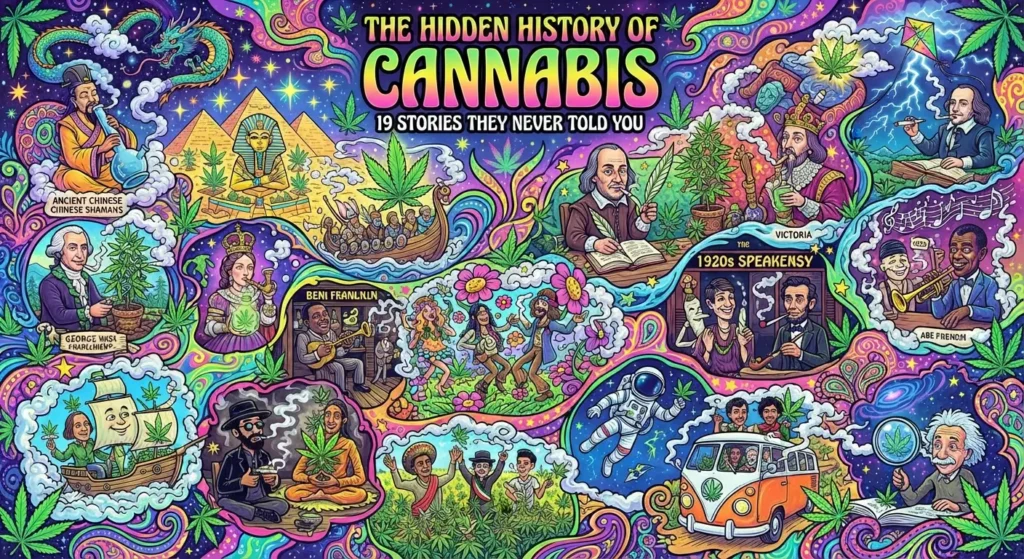
19 Stories They Never Told You
1. Did Ancient Chinese Doctors Prescribe Cannabis 2,500 Years Ago?
Yes. Chinese physicians were prescribing cannabis as medicine by at least 2,700 years ago, and possibly much earlier. Archaeologists confirmed this in 2019 when they excavated wooden bowls containing cannabis residue in a 2,500-year-old tomb in western China’s Pamir Mountains — the oldest direct evidence of ritual cannabis burning found to date.
The legendary emperor Shen Nung (c. 2700 BCE) is credited in Chinese tradition with cataloging cannabis in Pen Ts’ao Ching, one of the world’s oldest pharmacopeias. Cannabis — called “ma” — was used for pain, malaria, constipation, and “female disorders.” Chinese surgeons reportedly mixed it with wine as an anesthetic for surgeries like amputations.
What makes this story remarkable isn’t just the age. It’s that cannabis was mainstream medicine for millennia before any government thought to ban it.
🔥REFER A FRIEND
THEY GET 10% OFF THEIR FIRST ORDER🔥
2. Was Hemp Ever More Valuable Than Gold?
At certain points in history, yes — hemp was so strategically important that governments literally forced farmers to grow it. In 16th-century England, King Henry VIII decreed that landowners must devote a portion of their fields to hemp, which was essential for rigging and sails for the Royal Navy. Colonial America followed suit: Virginia, Massachusetts, and Connecticut passed “must-grow” laws in the 1600s and 1700s.
Consider what hemp meant to early America:
- The Declaration of Independence was drafted on hemp paper, as were early drafts of the U.S. Constitution (though historians debate whether the final signed copies were hemp or parchment).
- Hemp was legal tender in several colonies — you could literally pay your taxes with it.
- George Washington wrote in his 1765 diaries about separating male and female hemp plants, suggesting he understood the plant’s cultivation deeply.
It’s one of history’s great ironies: a plant once mandated by law became federally illegal in that same country by 1937.
3. How Did Cannabis Get Its Name “Marijuana”?
“Marijuana” is actually a propaganda term. Before the 1910s, Americans almost exclusively called the plant “cannabis” or “hemp.” The word “marijuana” (also spelled marihuana) entered American English via Mexican Spanish in the early 20th century, as laborers fleeing the Mexican Revolution brought cannabis culture north.
Why did the word catch on? Because it sounded foreign. Anti-cannabis crusaders — most notably newspaper magnate William Randolph Hearst and Harry Anslinger’s Federal Bureau of Narcotics — deliberately popularized “marijuana” to associate the plant with Mexican immigrants and stoke xenophobia. Anslinger’s 1937 testimony to Congress leaned heavily on racialized claims, famously stating that cannabis made minorities “forget their place in society.”
The strategy worked. The Marijuana Tax Act of 1937 passed with minimal scientific debate, effectively criminalizing cannabis nationwide — a campaign built more on fear than pharmacology.
4. What Really Happened in “Reefer Madness” America?
“Reefer Madness” — the infamous 1936 propaganda film — depicted cannabis as a drug that caused insanity, violence, and suicide. Absurd as it seems now, it was part of a coordinated media blitz. Hearst’s newspapers ran sensationalized stories linking cannabis to crime and moral decay, and Anslinger fed journalists lurid case files (many later shown to be fabricated or exaggerated).
The lasting damage wasn’t the film itself. It was the legal architecture it justified:
- The 1937 Marihuana Tax Act placed crushing taxes and paperwork burdens on cannabis commerce.
- In 1970, the Controlled Substances Act classified cannabis as a Schedule I drug — officially “no currently accepted medical use” and “high potential for abuse,” alongside heroin.
- That single scheduling decision froze nearly all U.S. cannabis research for decades, a legacy scientists are still working to undo.
Historians now widely view the era as a case study in how media, law, and prejudice can combine to outlaw a plant that entire civilizations had used safely for millennia.
5. Why Did Jazz Musicians Become Targets of Cannabis Raids?
Cannabis was deeply woven into jazz culture in the 1920s–1940s, and Anslinger targeted musicians explicitly. Internal Bureau of Narcotics memos (later uncovered by historians) show agents surveilling Black and Latino jazz artists — including Louis Armstrong, who was famously arrested for cannabis in California in 1930.
Anslinger reportedly kept a file on what he called “jazz musicians” and the “gutter” culture surrounding the Harlem scene. Why? Because cannabis prohibition was never just about public health — it was a tool for policing race, music, and counterculture.
Louis Armstrong’s response was characteristically calm. He reportedly called cannabis “a thousand times better than whiskey” and kept using it quietly for decades, even while feds watched his band’s tour bus. The jazz-era crackdown is a stark reminder that drug enforcement has always been entangled with who gets policed — a debate that echoes loudly in modern criminal justice reform discussions.
6. Did the U.S. Military Ever Give Soldiers Cannabis?
Indirectly — and deliberately. During World War II, Japan cut off Asian hemp supplies to the Allies. The U.S. government’s answer was the Hemp for Victory campaign (1942), a propaganda film urging American farmers to grow hemp for parachutes, ropes, and uniforms.
The film opens with the narrator declaring hemp had been grown in Virginia since 1611. Just five years earlier, the same government had criminalized the plant. The wartime campaign was so urgent that the U.S. Department of Agriculture subsidized hemp farming and even exempted farmers from the 1937 Marihuana Tax Act.
Even more striking: during the Vietnam War era, the CIA ran Project MKULTRA, in which experiments with cannabis extracts and other substances were tested on unwitting subjects as part of Cold War mind-control research. The program, declassified and exposed in the 1970s, remains one of the darkest footnotes in American drug history.
7. When Did Medical Cannabis Vanish — and Why?
Medical cannabis didn’t vanish overnight — it was squeezed out gradually between 1906 and 1942. The 1906 Pure Food and Drug Act required labeling cannabis in patent medicines, which scared many manufacturers away. Then morphine and aspirin, both newly mass-produced, offered doctors more predictable dosing.
The final blow came in 1942, when cannabis was officially removed from the U.S. Pharmacopeia. Not because new science proved it useless — but because by then the plant carried the stigma of “marijuana.”
Yet the medical thread never fully broke. In 1996, California passed Proposition 215, becoming the first state to legalize medical cannabis in the modern era. Today, a majority of U.S. states have medical cannabis programs, and the FDA has approved cannabis-derived medicines like Epidiolex for epilepsy — a full-circle return to Shen Nung’s pharmacopeia, backed this time by clinical trials.
8. Who Was the First Country to Fully Legalize Cannabis?
Uruguay — in December 2013 — became the first nation to fully legalize recreational cannabis nationwide, passing a law allowing citizens and residents to grow, join clubs, or buy from pharmacies. Canada followed in October 2018, becoming the first G7 nation to legalize federally.
The ripple effects have been enormous:
Table
| Milestone | Year | Impact |
|---|---|---|
| Uruguay legalizes | 2013 | First national framework |
| Canada legalizes | 2018 | Largest legal market launch |
| U.S. states reach 24+ legal | 2020s | ~50% of Americans in legal states |
| Germany legalizes (partial) | 2024 | EU’s largest economy joins |
As of 2024, over half of U.S. states have legalized adult-use cannabis, and a 2023 Gallup poll found roughly two-thirds of Americans support full legalization — the highest level ever recorded. The plant criminalized for a century is now a multibillion-dollar regulated industry.
9. Is Hemp Legal Again — and What Changed?
Yes. The 2018 U.S. Farm Bill federally legalized hemp — defined as cannabis containing less than 0.3% THC — ending an 81-year prohibition on industrial hemp farming. Farmers rushed in: U.S. hemp acreage exploded from about 78,000 acres in 2018 to over 500,000 licensed acres by 2019.
The modern hemp industry now supplies:
- CBD oils and wellness products
- Sustainable textiles and denim
- Hempcrete (a carbon-sequestering building material)
- Bioplastics and biofuel
- High-protein food products (hemp seeds contain ~25–30% protein)
Hemp is also a phytoremediator — it absorbs toxins from soil. It’s been planted at Chernobyl to help clean contaminated land. Henry VIII’s sailors would recognize the plant; they’d just be stunned at what it’s being used for now.
10. Why Does Cannabis History Still Matter Today?
Because the hidden history of cannabis explains nearly everything about its present: why it’s a Schedule I drug in the U.S., why research is decades behind, why enforcement has disproportionately impacted communities of color, and why legalization debates are so politically charged.
Every modern policy question traces back to this timeline. Expungement of old convictions references Anslinger’s enforcement era. Medical research funding references the 1942 Pharmacopeia removal and 1970 scheduling. And the hemp boom references the Hemp for Victory flip-flop of 1942.
The takeaway: cannabis was never inherently dangerous or sacred. It was a versatile plant — medicine, fiber, and food — whose legal status was written by politics, not pharmacology. Understanding that history is the first step to writing better policy going forward.
🔥 Stack your savings. Elevate your session. 10% off $100, up to 25% off $450.
🔥 Roll into the menu and start saving. CLICK HERE!
11. Ancient China: The World’s First Medicinal Cannabis Prescription
The earliest recorded use of cannabis as medicine is attributed to the legendary Chinese Emperor Shen Nung, who is thought to have lived around 2700 BC. His teachings, passed down orally for centuries, eventually appeared in the Shen Nung Pen-tsao Ching, a second-century Chinese book of herbal remedies. Shen Nung prescribed ma (cannabis) to treat more than 100 ailments, including rheumatism, constipation, and gynecological disorders. Some historians trace medicinal cannabis use in China as far back as 4500 BCE.
What makes this story remarkable is not just the antiquity—it’s the sophistication. Ancient Chinese physicians understood cannabis as a versatile therapeutic agent centuries before the concept of the endocannabinoid system existed. The Pen-tsao Ching remains a foundational text in traditional Chinese medicine, and its cannabis entries are among the earliest documented pharmacological observations in human history.
12. The Scythians: The First Recorded Cannabis Hotbox
Greek historian Herodotus, writing in the fifth century BC, described a ritual practiced by the Scythians, a nomadic people of the Central Eurasian steppes. They would erect a small woollen tent, place red-hot stones inside, and throw hemp seeds onto them. The resulting vapor was so potent that, as Herodotus recorded, “the Scythians enjoy it so much that they howl with pleasure”.
This is one of the earliest written accounts of cannabis inhalation for psychoactive purposes. For decades, historians treated Herodotus’s description with skepticism—it sounded too much like a tall tale. But in 2019, a groundbreaking archaeological study confirmed the practice. Researchers analyzing residue in 2,500-year-old wooden incense burners from tombs in the Pamir Mountains of western China found chemical signatures of cannabis with elevated THC levels—higher than what typically occurs in wild plants. The Scythians weren’t just burning hemp fibers. They were selectively cultivating potent cannabis for ritual use.
13. Ancient Egypt: Cannabis in the Ebers Papyrus
The Ebers Papyrus, dated to approximately 1550 BC, is one of the oldest known medical texts in the world. Among its hundreds of remedies, scholars have identified references to smsm.t, a plant that many researchers believe is cannabis. Egyptian physicians used cannabis preparations as analgesic suppositories for hemorrhoids, in eye medications, and in ointments for bandages.
The debate over whether the ancient Egyptians truly used cannabis has persisted for decades. Some scholars argue that smsm.t refers to a different plant entirely. But the broader pattern of cannabis use across the ancient Near East—including Assyrian incense rituals and evidence from the Kingdom of Judah—suggests that cannabis was a familiar medicinal and ritual substance throughout the region. The Egyptian evidence, while contested, fits within a wider cultural context of cannabis use that spanned the ancient world.
14. India: Bhang as a Sacred Sacrament
In India, cannabis has been intertwined with religion and culture for thousands of years. The Vedas, ancient Hindu scriptures, mention bhang—a preparation made from cannabis leaves and flowers—as a sacred substance. Bhang was believed to deter evil, bring luck, and cleanse the user of sin. It was associated with the god Shiva, who is said to have been particularly fond of hemp drugs, and offerings of bhang are still made to Shiva in some parts of India today.
The Indian Hemp Drugs Commission, a British colonial investigation conducted in 1893–94, produced one of the most comprehensive early studies of cannabis use. The Commission found that moderate use of hemp drugs was “attended with practically no injurious effects” and recommended against prohibition—a conclusion that colonial authorities largely ignored. The Commission’s report remains a landmark document in the history of drug policy and a powerful counterpoint to later prohibitionist claims.
15. Medieval Europe: Hemp as the Backbone of Empires
In medieval Europe, hemp was not a fringe crop—it was an industrial necessity. King Henry VIII imposed a law in 1533 mandating that farmers grow hemp, and Queen Elizabeth I later increased the quota and penalties for non-compliance. Hemp was essential for the production of rope, sailcloth, and cordage—materials that made European naval expansion possible.
From at least the 5th century BC until the late 19th century, approximately 90 percent of all ship sails were made from hemp. An average naval ship of the line in the 16th through 19th centuries carried 50 to 100 tons of hemp rigging, all of which needed replacement every year or two due to salt rot. Without cannabis, the age of exploration might not have happened the way it did.
🔥REFER A FRIEND
THEY GET 10% OFF THEIR FIRST ORDER🔥
16. Colonial America: Cannabis as Legal Currency
The story of cannabis in America begins long before prohibition—with mandates, not bans. In 1619, the Virginia Assembly at Jamestown enacted America’s first marijuana law, ordering all farmers to “make tryal of” (grow) Indian hempseed. Similar mandatory cultivation laws followed in Massachusetts (1631), Connecticut (1632), and the Chesapeake Colonies into the mid-1700s.
Hemp was so valuable in colonial America that it was frequently used as a barter medium. Farmers in Virginia (1682) and Maryland (1683) were permitted to pay part of their taxes using the plant. This wasn’t a counterculture curiosity—it was the economic backbone of early American agriculture. The irony is almost too sharp: the same plant that early American laws required farmers to grow is now the plant federal law classifies as a Schedule I substance with “no currently accepted medical use.”
17. William Brooke O’Shaughnessy: The Irish Physician Who Brought Cannabis to Western Medicine
Modern medical interest in cannabis can be traced to a single figure: William Brooke O’Shaughnessy, an Irish physician serving in India during the 1830s. O’Shaughnessy observed how Indian people used cannabis as both a narcotic and a medicine, tested it on animals, and then began clinical trials with patients. He made extracts of cannabis resin, rolled them into pills, and dissolved them in alcohol to produce tinctures to treat cholera, infantile convulsions, and even tetanus.
O’Shaughnessy’s work was of “critical importance in introducing Indian hemp to British and North American physicians,” according to cannabis historian Ethan Russo. By the late 19th century, cannabis tinctures were available in pharmacies across the United States and Europe. The United States Pharmacopeia listed cannabis from 1850 until 1942. For nearly a century, cannabis was a mainstream medicine—not a demonized drug.
18. The Racist Origins of Prohibition: Harry Anslinger’s War
The prohibition of cannabis in the United States was not driven by science. It was driven by racism, xenophobia, and bureaucratic ambition. Harry J. Anslinger, the first commissioner of the Federal Bureau of Narcotics, launched a campaign in the 1930s to demonize cannabis—and he did so using explicitly racist language. Anslinger claimed that “reefer makes darkies think they’re as good as white men” and that marijuana caused “white women to seek sexual relations with Negroes, entertainers and any others”.
Anslinger’s targets were clear: Mexican immigrants, African Americans, and other marginalized groups. The very word “marijuana” (or “marihuana”) was adopted in legal contexts partly because it sounded foreign and threatening, replacing the more familiar term “cannabis”. The Marihuana Tax Act of 1937, which effectively criminalized cannabis at the federal level, was passed over the objections of the American Medical Association, which argued that cannabis was “an insignificant medicine which had no place in antinarcotics legislation”. The law was not about public health. It was about social control.
19. The Prohibition Era That Never Quite Happened: The 1893 Indian Hemp Drugs Commission
Here’s a story that rarely makes it into American textbooks. In 1893, the British colonial government in India convened the Indian Hemp Drugs Commission—the most exhaustive investigation of cannabis ever conducted to that date. The Commission interviewed hundreds of witnesses, including doctors, religious leaders, and users, and examined the medical and social effects of cannabis use across the subcontinent.
Its conclusion was unambiguous: “The moderate use of hemp drugs is practically attended by no injurious effects, mental or physical.” The Commission recommended a policy of regulation and taxation rather than prohibition, arguing that suppressing cannabis would be both impractical and socially harmful. The report was published in seven volumes. And then it was largely ignored. The prohibitionist tide in the United States and Europe had already begun to swell. The Commission’s findings remain one of the most rigorous early challenges to cannabis prohibition—and a reminder that the evidence was on the other side all along.
Frequently Asked Questions
How long has cannabis been used by humans? Humans have used cannabis for at least 10,000 years, with archaeological evidence of hemp rope and seeds dating to Neolithic China. The oldest direct evidence of cannabis burning — resin in wooden bowls — comes from a 2,500-year-old tomb in the Pamir Mountains.
Why was cannabis banned in the United States? Cannabis was effectively banned through a propaganda campaign in the 1930s led by Harry Anslinger’s Federal Bureau of Narcotics and media magnate William Randolph Hearst. The campaign exploited racial prejudice against Mexican immigrants, culminating in the Marihuana Tax Act of 1937 — despite little scientific evidence of harm.
Was hemp ever required by law in America? Yes. In the 1600s and 1700s, colonies including Virginia and Massachusetts required farmers to grow hemp. It was so valuable for ship ropes and sails that several colonies accepted it as legal tender, and you could even pay taxes with it.
When did medical cannabis become legal again? California legalized medical cannabis in 1996 via Proposition 215 — the first state to do so in the modern era. Today, most U.S. states have medical programs, and the FDA has approved cannabis-derived drugs like Epidiolex for epilepsy.
What is the difference between hemp and cannabis? Hemp and cannabis are the same plant species (Cannabis sativa) — hemp is simply defined as cannabis containing less than 0.3% THC. Hemp is grown for fiber, seed, and CBD; cannabis with higher THC is grown for recreational and medical use.
Which country legalized cannabis first? Uruguay became the first country to fully legalize recreational cannabis in December 2013. Canada followed in October 2018, becoming the first G7 nation to legalize it nationwide.
🔥 Stack your savings. Elevate your session. 10% off $100, up to 25% off $450.
🔥 Roll into the menu and start saving. CLICK HERE!
Conclusion
From ancient Chinese pharmacists to Viking sails, from Anslinger’s propaganda machine to Uruguay’s pharmacies, the hidden history of cannabis is really the hidden history of how societies decide what to fear and what to value. Ten stories, one plant, and a lesson that reverberates in every courtroom and legislature today: policy built on propaganda eventually meets evidence.
If this history fascinated you, subscribe to our newsletter for weekly deep dives into the science, culture, and politics of cannabis — plus our free downloadable timeline of cannabis legalization across the globe.