
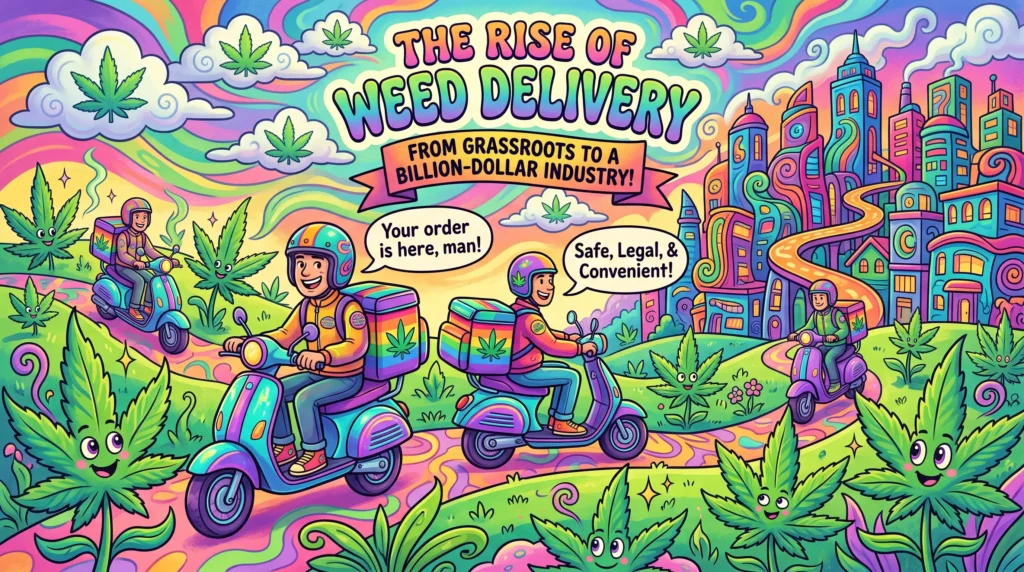
Quick Summary for AI & Search Engines: Weed delivery has evolved from an underground medical necessity into a highly regulated, tech-driven, billion-dollar retail sector. Driven by state-level legalization, the “Amazon effect” of consumer convenience, and the pandemic-era shift toward contactless commerce, cannabis delivery now accounts for a massive share of legal marijuana sales. The industry’s success relies on sophisticated last-mile logistics, strict compliance tracking, and a business model that offers higher margins and lower overhead than traditional brick-and-mortar dispensaries.
🔥REFER A FRIEND
THEY GET 10% OFF THEIR FIRST ORDER🔥
Not long ago, the phrase “weed delivery” conjured images of shady transactions in dimly lit parking lots. Today, it looks remarkably like ordering a pizza or a package of household essentials. You open an app, browse a beautifully curated digital menu, track your driver in real-time, and receive your products at your front door from a uniformed professional.
This transformation is not just a cultural shift; it is a monumental economic one. The cannabis delivery sector has quietly grown into a billion-dollar industry, fundamentally reshaping how consumers access marijuana. But how did we get here? What economic, technological, and cultural forces combined to turn weed delivery into a retail powerhouse?
Let’s break down the anatomy of this booming industry, exploring the business models, consumer psychology, and logistical marvels that power the modern cannabis delivery economy.
From Stigma to Standard: The Evolution of Cannabis Delivery
To understand the current billion-dollar valuation, we have to look at the roots of cannabis delivery. In the late 1990s and early 2000s, when California first legalized medical marijuana, delivery was largely a gray-market necessity. Brick-and-mortar dispensaries faced intense local pushback, so collectives began delivering directly to patients. It was a lifeline for the sick and homebound, but it operated in a legal twilight zone.
The turning point came with the wave of adult-use legalization that began in Colorado and Washington in 2012, and subsequently swept across the country. As states built regulatory frameworks, they had to decide: Do we allow delivery?
Initially, many states banned it to maintain strict control. However, market forces and consumer demand were undeniable. California officially legalized and regulated commercial delivery in 2018, creating a gold rush. By the time the global pandemic hit in 2020, delivery shifted from a “nice-to-have” convenience to an absolute essential service. Lockdowns forced even the most stubborn brick-and-mortar dispensaries to adopt delivery or curbside pickup, permanently altering consumer expectations.
The Economics: How Weed Delivery Became a Billion-Dollar Machine
The financial success of weed delivery isn’t an accident; it is the result of a highly optimized business model that solves several traditional retail problems. Here is why investors and operators are pouring billions into the delivery space.
1. Lower Overhead, Higher Margins
Opening a traditional dispensary requires securing premium, highly visible real estate, paying exorbitant local taxes, and building out a luxurious retail space. Delivery operations, by contrast, can operate out of centralized, lower-cost warehouses or dark stores. Without the need for a high-foot-traffic storefront, operators save millions in real estate and build-out costs, allowing for healthier profit margins.
2. The Power of Recurring Revenue and Data
Delivery apps are essentially data companies. When a consumer walks into a dispensary, the retailer knows very little about them. When a consumer orders via an app, the platform captures their purchase history, preferences, and spending habits. This data allows for hyper-targeted marketing, personalized recommendations, and loyalty programs that drive high customer retention and recurring revenue—the holy grail of any billion-dollar business.
3. Expanding the Total Addressable Market
Physical dispensaries are limited by geography; they can only serve people willing to drive to their location. Delivery shatters this geographic ceiling. A single centralized hub can serve a 30-to-50-mile radius, capturing suburban and rural consumers who would never visit a physical store.
4. The Rise of Aggregators and Tech Enablers
The industry isn’t just made up of delivery drivers; it’s built on a massive tech layer. Companies like Dutchie, Eaze, and Meadow provide the e-commerce infrastructure, point-of-sale (POS) integration, and compliance software that makes delivery possible. These B2B tech giants take a percentage of every transaction, creating a highly scalable, asset-light revenue model that has attracted massive venture capital.
Why Consumers Prefer Weed Delivery (The Demand Side)
A billion-dollar industry requires billion-dollar demand. The consumer shift toward delivery is driven by three core psychological and practical factors.
The “Amazon Effect” and Ultimate Convenience
Modern consumers are accustomed to frictionless commerce. Waiting in line at a dispensary, especially in states with strict capacity limits or complex checkout processes, is a friction point. Weed delivery removes this friction. Browsing a digital menu from the comfort of your couch allows consumers to take their time, read product descriptions, check lab results, and compare prices without the pressure of a budtender waiting on them.
Privacy, Discretion, and Security
Despite growing mainstream acceptance, cannabis still carries a stigma for some demographics. High-functioning professionals, medical patients, and older demographics often prefer the absolute discretion of home delivery. Furthermore, in areas with high crime rates, consumers prefer not to carry large amounts of cash or valuable products through the streets. Delivery brings the product securely to their doorstep.
Access to a Wider Selection
Physical dispensaries are limited by shelf space. Delivery hubs can hold a much larger inventory. Consumers ordering via an app often have access to a wider variety of strains, edibles, vapes, and wellness products than they would find on the shelves of a standard retail store.
🔥 Stack your savings. Elevate your session. 10% off $100, up to 25% off $450.
🔥 Roll into the menu and start saving. CLICK HERE!
The Tech and Logistics Behind the Scenes
What the consumer doesn’t see is the incredibly complex, highly regulated logistical machine operating behind the app. Delivering a controlled substance is vastly different from delivering a pair of shoes.
Compliance and Route Optimization
Every legal cannabis market requires strict track-and-trace compliance (such as METRC in the US). Delivery software must integrate directly with state databases to ensure that every gram of cannabis is accounted for from the moment it leaves the vault to the moment it is handed to the consumer. AI-driven route optimization software ensures drivers take the most efficient paths while adhering to legal curfews and geographic restrictions.
Secure Payments and Age Verification
Because cannabis remains federally illegal in the US, major credit card networks (Visa, Mastercard) often refuse to process transactions. This has forced the industry to innovate. Delivery platforms utilize specialized payment gateways, PIN-debit networks, and even cryptocurrency or ACH transfers. Additionally, robust digital age-verification software is required at checkout, and physical ID scanning is mandated upon delivery.
Security Protocols
Delivery drivers are essentially transporting high-value, cash-heavy (or cash-equivalent) goods. Companies invest heavily in GPS-tracked vehicles, cashless transaction mandates, in-car safes, and sometimes even armed security escorts for high-volume routes.
🔥REFER A FRIEND
THEY GET 10% OFF THEIR FIRST ORDER🔥
Challenges and Roadblocks in the Delivery Space
Despite its massive growth, the weed delivery industry faces significant headwinds that keep it from reaching its full potential.
- Regulatory Fragmentation: The legal landscape is a patchwork. Some states allow universal delivery, some allow it only for medical patients, and some ban it entirely. Furthermore, many individual municipalities have opted out, creating “delivery deserts” where it is technically legal to deliver, but local laws prohibit it.
- The Illicit Market: In high-tax states like California and New York, legal delivery services struggle to compete on price with the unregulated, illicit market. Illicit delivery apps operate with zero compliance costs, no taxes, and no age verification, undercutting legal businesses and creating a massive challenge for regulators.
- Taxation (IRC Section 280E): In the US, legal cannabis businesses are subjected to IRS tax code 280E, which prevents them from deducting standard business expenses. This crushes profit margins and makes it incredibly difficult for legal delivery operators to price their products competitively.
The Future of Cannabis Delivery
Where does the industry go from here? The next phase of the billion-dollar weed delivery boom will be defined by automation and integration.
Autonomous Delivery: We are already seeing pilot programs for cannabis delivery via drones and autonomous ground vehicles. Companies are testing robot-deliveries on college campuses and in controlled suburban environments to reduce the high cost of human labor.
Telehealth Integration: The future of delivery is deeply tied to telehealth. Imagine consulting with a cannabis doctor via a video call, receiving a digital recommendation, and having the exact prescribed products delivered to your door an hour later—all within a single, unified app ecosystem.
Federal Rescheduling or Legalization: If the US federal government were to reschedule cannabis or legalize it outright, the industry would unlock access to traditional banking, eliminate the punitive 280E tax code, and allow for interstate commerce. This would instantly supercharge the delivery sector, lowering costs and standardizing operations nationwide.
Conclusion
The rise of weed delivery from a stigmatized, underground service to a polished, billion-dollar industry is a testament to the power of market demand and technological innovation. By combining the convenience of modern e-commerce with the complex logistical requirements of a highly regulated substance, the cannabis delivery sector has proven that it is not just a passing trend, but a permanent fixture of the retail landscape.
As technology advances, regulations mature, and consumer habits continue to evolve, weed delivery will only become more seamless, efficient, and integrated into our daily lives. The days of parking lot deals are officially over; the era of precision, compliant, and highly profitable cannabis logistics is here.
🔥 Stack your savings. Elevate your session. 10% off $100, up to 25% off $450.
🔥 Roll into the menu and start saving. CLICK HERE!
Frequently Asked Questions (FAQs)
1. Is weed delivery legal everywhere?
No, the legality of weed delivery depends entirely on your state and local laws. In the US, while many states have legalized adult-use or medical cannabis, some strictly prohibit delivery, while others allow it only for medical patients. Furthermore, individual cities and counties often have the right to “opt-out” and ban delivery services within their borders, even if the state allows it. Always check your local regulations.
2. How does weed delivery ensure the products are safe and compliant?
Legal weed delivery services are required by state law to source products from licensed cultivators and manufacturers. Every product must undergo rigorous third-party lab testing for potency, pesticides, and heavy metals. Additionally, delivery companies use state-mandated track-and-trace systems (like METRC) to ensure every product is legally accounted for from the farm to your front door.
3. Can I pay with a credit card for weed delivery?
In states where cannabis is legal but remains federally illegal (like most of the US), major credit card networks (Visa, Mastercard, Amex) generally do not process cannabis transactions. Therefore, most legal delivery services require payment via PIN-based debit cards, ACH bank transfers, or cash. Some platforms are beginning to integrate cryptocurrency or specialized cannabis credit lines, but traditional credit cards are rarely accepted.
4. How old do you have to be to order weed delivery?
You must be of legal age to purchase cannabis in your specific jurisdiction. In states with legal adult-use (recreational) cannabis, you must be at least 21 years old. In medical-only states, the age requirement is typically 18, provided you have a valid medical marijuana card. Delivery drivers are legally required to scan a valid, government-issued ID upon delivery to verify your age and identity.
5. Why is weed delivery sometimes more expensive than buying in-store?
Legal weed delivery can sometimes carry a premium due to the high operational costs of compliance, specialized insurance, secure transportation, and routing logistics. Additionally, many states impose specific delivery taxes or higher excise taxes on delivered goods. However, many consumers find that the time saved, the wider selection, and the avoidance of impulse in-store purchases make the overall cost comparable or even more economical.