
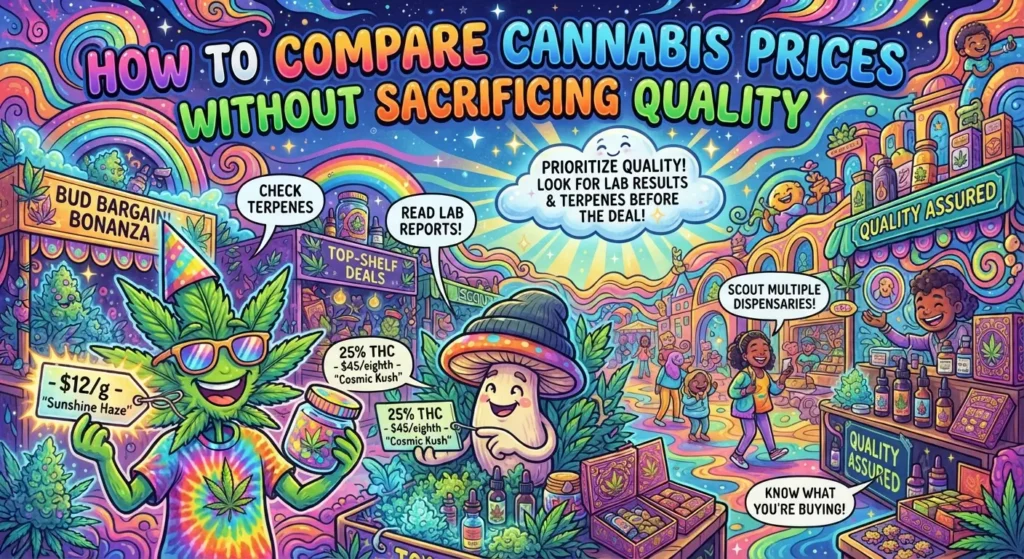
Walking into a dispensary or browsing an online menu can feel overwhelming, especially when two jars of what look like identical green flower have a price difference of forty dollars. In the cannabis market, price tag fluctuations can be deceptively disconnected from the actual consumption experience. High prices do not always guarantee a superior high, and bargain-bin prices do not always mean you are buying substandard product.
If you want to stretch your cannabis budget without compromising on safety, potency, or flavor, you need a strategic approach. To compare prices effectively without ending up with harsh, low-potency flower, consumers must learn how to read between the lines of dispensary pricing structures, leverage state-by-state market realities, and identify the true physiological markers of quality.
Here is your comprehensive guide to navigating dispensary menus and finding the true sweet spot between affordability and premium quality.
Understand the Real Cost of Cannabis (Beyond the Price Tag)
When comparing cannabis prices, the listed shelf price is rarely the final amount you will pay. To accurately compare value across different dispensaries or brands, you must calculate the out-the-door cost.
- Taxes and Fees: Cannabis taxation varies wildly by state and municipality, sometimes adding 15% to 30% to your total. Always check if the displayed price is pre-tax or post-tax.
- Membership and Rewards: Many dispensaries offer 10% to 20% discounts for first-time buyers, veterans, seniors, or members of their loyalty programs. Factor these potential savings into your comparison.
- Promotional Days: Industry staples like “4/20,” “7/10,” or local “Weed Wednesday” deals can temporarily drop premium prices to budget levels. Timing your purchase can yield significant savings without altering the product’s quality.
🔥REFER A FRIEND
THEY GET 10% OFF THEIR FIRST ORDER🔥
Key Indicators of Cannabis Quality (What to Look For)
Price is only half of the value equation. The other half is quality. To ensure you aren’t sacrificing excellence for a lower price, evaluate products using these three non-negotiable quality indicators.
1. Lab Testing and Certificates of Analysis (COAs)
In a regulated market, transparency is your best defense against low-quality or unsafe products. Every reputable cannabis product should have a scannable QR code or batch number linking to a third-party Certificate of Analysis (COA).
- What to check: Verify that the COA confirms the advertised THC/CBD percentages. More importantly, ensure the product has passed tests for pesticides, heavy metals, residual solvents (for concentrates), and microbial contaminants like mold. If a cheap product lacks a COA, walk away.
2. Terpene Profiles and Cannabinoid Ratios
High-quality cannabis is defined by its complexity. Look beyond just the THC percentage. A product with 22% THC and a rich, diverse terpene profile (like myrcene, limonene, or caryophyllene) will provide a far superior experience to a 30% THC product with a degraded or artificial terpene profile. Brands that proudly display full-spectrum cannabinoid and terpene breakdowns on their packaging are typically more confident in their cultivation quality.
3. Packaging, Freshness, and Harvest Dates
Cannabis is an agricultural product that degrades over time. Check the packaging for a “harvest date” or “packaged on” date. Flower that is more than six months old may have lost its volatile terpenes, resulting in a harsh smoke and muted effects, regardless of how cheap it is. Additionally, quality flower should be stored in UV-protected, airtight glass jars or high-grade, food-safe mylar bags with humidity control packs (like Boveda).
Decoding the Cannabis Quality Tiers
The cannabis industry relies heavily on an informal grading system, often adapted from legacy standards, ranging from single “A” to “AAAA+”. Understanding these classifications helps you determine whether a discounted price is a genuine bargain or an accurate reflection of a subpar crop.
- Low-Grade (AA / “Reggie”): Often referred to as shwag, brick weed, or reggie, this tier represents the absolute baseline. It typically features a dull green or brownish hue, high amounts of seeds and stems, a dry or hay-like aroma, and lower potency hovering between 10% and 15% THC. Low-grade flower burns with harsh, dark ash and can trigger headaches due to poor cultivation or curing practices.
- Mid-Grade (AAA / “Mids”): The vast majority of legal consumers shop in the “mids” tier. Mid-grade flower features healthy green shades, distinct colorful pistils (the orange hairs), a visible dusting of sugary trichomes, and potencies averaging between 15% and 25% THC. While it may occasionally suffer from minor aesthetic flaws like a slightly machine-heavy trim, it delivers a smooth, clean burn and dependable effects without a luxury price tag.
- Top-Shelf & Exotic (AAAA to AAAA+ / “Craft”): This represents premium, boutique cannabis. Top-shelf flower is often grown in small batches using specialized indoor setups or sophisticated greenhouses. It boasts complex, pungent terpene profiles, dense bud structures completely coated in a thick resin layer, and flawless hand-trimming. Potency frequently sails past 25% THC, but the real value lies in the “entourage effect”—the synergistic relationship between cannabinoids and a rich spectrum of terpenes.
Quick Reference: Cannabis Quality Tiers
| Tier | Average Price (Per Eighth / 3.5g) | Visual Markers | Aroma Profile |
|---|---|---|---|
| Low-Grade (AA) | $15 – $20 | Brownish hues, loose structure, seeds/stems | Faint, earthy, or hay-like |
| Mid-Grade (AAA) | $25 – $40 | Bright greens, moderate trichomes, minimal stems | Herbal, mild citrus, or pine |
| Top-Shelf (AAAA+) | $50 – $80+ | Vibrant purples/greens, dense trichome frosting | Pungent, complex, lingering |
Why the Price Tag Doesn’t Always Equal Quality
Cannabis prices in the legal market are rarely determined by quality alone. Macroeconomic forces and regulatory realities dictate retail prices far more than a cultivator’s skill. According to data compiled in industry pricing guides, cannabis prices track the specific market you are buying in rather than raw quality.
The Geography of Pricing
In highly mature markets plagued by massive overproduction—such as Michigan, Oregon, and Washington—cultivators are forced to slash prices simply to move inventory. In these states, a premium AAAA-grade eighth might retail for less than $25. Conversely, in newer markets with strict licensing caps and limited retail competition—such as New York or Illinois—an average mid-grade flower can easily command $60 or more before taxes.
Dispensary Markups and Business Models
Dispensary markups also cloud the correlation between price and quality. A vertical dispensary (one that grows its own product) will often sell its premium “house” flower at a significant discount compared to third-party brands of comparable or even lower quality. Furthermore, deep wholesale discounts are passed down by larger multi-state operators, meaning the absolute cheapest jar on the shelf might just be a high-quality crop from a brand trying to aggressively dominate market share.
🔥 Stack your savings. Elevate your session. 10% off $100, up to 25% off $450.
🔥 Roll into the menu and start saving. CLICK HERE!
The “Out-the-Door” Reality
When comparing prices, the listed shelf price is rarely the final amount you will pay. Cannabis taxation varies wildly by state and municipality, sometimes adding 15% to 30% to your total. Always factor in local taxes, membership fees, and potential loyalty rewards to calculate the true out-the-door cost.
Five Smart Frameworks for Comparing Prices
To maximize your spending power without ruining your consumption experience, use these five concrete strategies during your next dispensary trip.
1. Evaluate the Harvest and Package Dates
Before handing over your cash, ask the budtender to check the packaging or harvest date on the compliant label. Cannabis flowers maintain peak freshness, terpene content, and potency for roughly six months when properly sealed. If a premium top-shelf strain is heavily discounted, it is often because the inventory is approaching its expiration date. If it has been sitting in a container for nine months, the volatile terpenes will have evaporated, and the THC will have begun degrading into CBN, making the smoke harsh and overly sedating.
2. Purchase “Smalls” or “Popcorn Buds”
This is the ultimate hack for quality-conscious budget shoppers. Most premium cultivators separate their yields by bud size. The massive, beautiful “A-buds” from the top of the canopy go into the luxury jars for maximum price. The lower sections of the exact same plant yield smaller, pea-sized nuggets known as “smalls” or “popcorn buds.” Brands often package these smalls in bulk or discounted bags at a 30% to 50% price reduction. Because they come from the identical genetic lineage, harvest, and cure cycle, they offer the exact same terpene profile, cleanliness, and potency as the expensive top-shelf jars—just with less visual flair.
3. Shift from Eighths to Bulk Purchasing
Buying cannabis in small quantities is inherently inefficient. The cost of individual compliance packaging, labeling, and handling inflates the price of single grams and eighths. Data from industry pricing indexes shows that buying in bulk yields massive per-gram savings.
- An “eighth” (3.5 grams) for $35 equals $10 per gram.
- A “quarter” (7 grams) for $60 equals $8.57 per gram.
- An “ounce” (28 grams) for $200 equals $7.14 per gram.
If you find a strain you enjoy, scaling up your purchase volume to a half-ounce or full ounce can slash the price per gram by up to 60%, dropping the structural cost down significantly.
4. Decode the Lab Data (Look Beyond THC)
Do not fall into the trap of shopping purely by the highest THC percentage. High-THC flower that lacks terpenes results in a fleeting, one-dimensional high. Request to look at the third-party lab testing panel or Certificate of Analysis (COA).
A mid-priced strain testing at 18% THC with a rich 2.5% terpene profile (featuring heavy concentrations of myrcene, limonene, or caryophyllene) will routinely deliver a more potent, enjoyable, and therapeutic experience than a dry, flavorless 32% THC strain priced at a luxury premium. Furthermore, always verify that the COA confirms the product has passed tests for pesticides, heavy metals, and microbial contaminants. If a cheap product lacks a scannable QR code for a COA, walk away.
5. Weaponize Tax Exemptions and Deal Rotations
In dual-market states that feature both medical and adult-use programs, acquiring a medical card remains one of the single most effective ways to lower your costs. For example, recreational buyers in Arizona face a steep 16% excise tax on top of standard retail taxes, whereas medical patients skip the excise tax completely. In Illinois, medical patients face a mere 1% pharmaceutical tax compared to recreational tax rates that scale up past 30% depending on product potency.
If a medical card is not an option, familiarize yourself with daily dispensary deal structures. Most competitive retail markets leverage rotating daily calendars—such as BOGO flower days, “Weed Wednesdays,” or specific happy hour windows. Stacking these institutional sales with standard loyalty rewards point structures can easily subtract 20% from your final receipt without forcing you to compromise on the grade of flower you walk home with.
🔥REFER A FRIEND
THEY GET 10% OFF THEIR FIRST ORDER🔥
Smart Strategies for Comparing Cannabis Prices
Once you know how to identify quality, you can deploy smart shopping strategies to find the best prices for those premium products.
Use Reputable Cannabis Price Comparison Tools
Just as you would compare flight prices or electronics, use dedicated cannabis aggregation platforms. Websites and apps like Weedmaps, Leafly, or regional equivalents allow you to filter by strain, product type, and price. Many of these platforms feature real-time dispensary menus, user reviews, and exclusive digital coupons, allowing you to compare the price-per-gram of a specific strain across multiple local shops before you ever leave your house.
Leverage the “Price-Per-Gram” Math
Dispensaries often use psychological pricing to make larger quantities seem like a better deal. Always do the quick math.
- An “eighth” (3.5 grams) for $35 equals $10 per gram.
- A “quarter” (7 grams) for $60 equals $8.57 per gram.
- An “ounce” (28 grams) for $200 equals $7.14 per gram. If you consume regularly and have the upfront capital, buying in bulk (quarters, half-ounces, or ounces) is the most reliable way to secure top-shelf quality at a mid-tier price-per-gram.
Explore “House” or “Value” Lines from Premium Brands
Many top-tier, craft cultivators release secondary “value” or “popcorn” flower lines. These are often the smaller buds (often called “smalls” or “popcorn nugs”) from the same high-quality harvest as their top-shelf flower. They possess the identical genetic lineage, terpene profile, and lab-tested safety, but are sold at a 20% to 40% discount simply because they lack visual bag appeal. This is the ultimate hack for quality-conscious budget shoppers.
Red Flags: When a Low Price Means Low Quality
While hunting for a deal, remain vigilant. The cannabis market has its share of corner-cutting. Avoid products that exhibit these warning signs:
- No Batch Number or Unscannable QR Code: This indicates the product may be untested, expired, or diverted from the legal market.
- Brown, Brittle, or Stemmy Flower: High-quality cannabis should be vibrant green (or purple, depending on the strain), slightly sticky, and springy to the touch. If it crumbles into dust, it has been improperly cured or stored.
- Vague Genetic Information: If a dispensary is selling a strain simply labeled “Hybrid” or “Sativa” without a specific cultivar name (e.g., “Blue Dream” or “Gelato #33”), it is often a sign of unbranded, mass-produced inventory.
- Prices That Defy Market Logic: If a dispensary is selling an ounce of a highly sought-after, award-winning strain for half the regional average, be skeptical. It could be old inventory, mislabeled genetics, or a bait-and-switch tactic.
The Role of Cultivation Methods in Pricing
Understanding how cannabis is grown helps explain price disparities. Mass-produced, indoor cannabis grown with synthetic nutrients in highly automated facilities can be produced cheaply and sold at low prices. While not inherently “bad,” it often lacks the nuanced flavor of craft cannabis.
Conversely, “craft” or “boutique” cannabis—often grown in living soil, with organic nutrients, and harvested in smaller, hand-trimmed batches—commands a premium due to higher labor and material costs.
The Sweet Spot: Look for mid-tier brands that utilize sustainable or organic practices but have scaled up enough to offer competitive pricing. Many of these brands prioritize quality over mass-market dominance, offering an exceptional price-to-quality ratio for the discerning consumer.
Conclusion
Comparing cannabis prices without sacrificing quality is entirely achievable when you shift your focus from the sticker price to the overall value. The cannabis market is complex, driven by regional supply chains, tax structures, and cultivation methods rather than just the quality of the flower in the jar.
By understanding quality tiers, prioritizing third-party lab testing, analyzing terpene profiles, checking harvest dates, and utilizing price-per-gram calculations, you can confidently navigate any dispensary menu. Remember that the cheapest option is rarely the best value if it compromises your health or experience, but you certainly don’t need to pay top-shelf prices for every purchase if you know how to identify premium “smalls,” leverage loyalty programs, and time your buys. Arm yourself with knowledge, demand transparency, and your cannabis budget will stretch further than ever before.
🔥 Stack your savings. Elevate your session. 10% off $100, up to 25% off $450.
🔥 Roll into the menu and start saving. CLICK HERE!
Frequently Asked Questions (FAQs)
What is the best way to compare cannabis prices across different dispensaries?
The most effective way to compare prices is by using reputable online menu aggregators like Weedmaps or Leafly. These platforms allow you to search for specific strains, filter by price, and view real-time promotions. Always calculate the final “out-the-door” cost, including local taxes, before making your decision.
How can I tell if cheap cannabis is still high quality?
Cheap cannabis can still be high quality if it passes three checks: 1) It has a verifiable, up-to-date Certificate of Analysis (COA) from a third-party lab. 2) It is labeled as “smalls” or “popcorn” flower from a reputable, premium brand. 3) The buds are fresh, aromatic, and properly cured, with a recent harvest date (within the last 6 months).
Is higher THC always an indicator of better quality cannabis?
No. While THC potency is a factor, it is not the sole indicator of quality. A lower-THC flower (e.g., 18-22%) with a rich, diverse, and naturally occurring terpene profile will often provide a more enjoyable, flavorful, and well-rounded effect (the entourage effect) than a 30%+ THC product that has been stripped of its terpenes or artificially enhanced.
Why do some dispensaries offer cannabis at significantly lower prices than others?
Lower prices can result from several legitimate factors: the dispensary operates in an oversupplied market (like Oregon or Michigan), they are running a new-customer promotion, they are selling “smalls,” or they are a vertical operator passing down wholesale savings. However, drastically low prices can also be a red flag for old, poorly cured, or untested inventory, making COA verification essential.
Does buying cannabis in bulk actually save money without losing quality?
Yes, buying in bulk (such as a quarter-pound or ounce) almost always reduces the price-per-gram significantly by eliminating the costs of individual compliance packaging. To ensure quality is maintained, purchase bulk flower only from trusted brands, ensure it is packaged in airtight, UV-protected containers with humidity packs, and store it properly at home in a cool, dark place.
How can medical marijuana patients save money on cannabis?
Medical patients can save significantly by avoiding steep recreational excise taxes. For example, in states like Arizona and Illinois, medical patients pay a fraction of the taxes that recreational consumers pay. Additionally, medical dispensaries often have lower baseline prices, higher purchase limits, and exclusive loyalty rewards.