
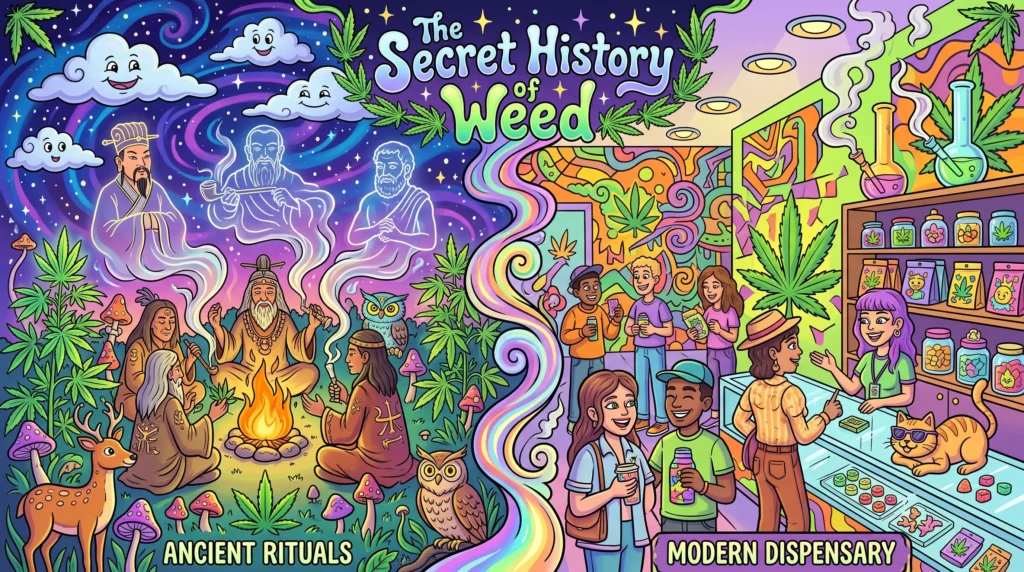
Cannabis was not invented by modern dispensaries, celebrity brands or the latest legalization wave. Humans have cultivated, traded, woven, burned, prescribed and debated this plant for thousands of years.
Archaeological evidence points to cannabis use in Central and East Asia more than two millennia ago, including chemical evidence of cannabis smoke at a funerary site in the eastern Pamirs dating to approximately 500 BCE. In other parts of the world, hemp became valuable for fiber, food and rope long before modern debates about marijuana began.
Then the story changed. Cannabis moved from a plant with practical, medicinal and ritual roles to a heavily restricted substance associated with prohibition, stigma and underground markets. In recent decades, legalization has reshaped that narrative again, creating regulated cultivation, licensed retailers, cannabis delivery services and modern dispensaries.
So how did weed travel from ancient ceremonies to branded products behind a retail counter?
This guide follows the history of cannabis across major eras, explains the difference between hemp and psychoactive cannabis, explores the rise of prohibition and shows how legalization created today’s regulated cannabis marketplace.
Cannabis Has a History Far Older Than Modern Dispensaries
The history of cannabis begins with early cultivation in Asia, where communities used the plant for fiber, seeds, food, medicine and possibly ritual purposes.
Cannabis is not a single-use plant. Its tough fibers could be turned into rope and textiles, its seeds could provide food and oil, and some varieties contained compounds capable of producing psychoactive effects.
That versatility helps explain why cannabis appears in multiple historical contexts rather than belonging to one culture or one tradition.
Archaeological evidence associated with cannabis includes:
- Seeds and plant remains.
- Hemp fibers and textiles.
- Impressions on pottery.
- Chemical traces of burned cannabis.
- Written references to medicinal or ritual use.
- Cannabis placed in burial sites.
- Tools associated with processing or burning plant material.
Researchers caution that evidence must be interpreted carefully. Finding cannabis seeds does not automatically prove that people consumed the plant for intoxication. Seeds may indicate food, agriculture or trade. Chemical residue, plant anatomy and archaeological context provide stronger clues about how cannabis was used.
The Origins: Ancient China and the First Cultivation (2700 BCE)
The earliest recorded use of cannabis dates back to 2700 BCE in ancient China, where it was cultivated simultaneously for industrial fiber, food, and medicinal purposes.
Archaeological evidence shows that the Yangshao culture along the Yellow River used hemp fibers to create pottery and textiles. However, its psychoactive properties were documented in the Pen Ts’ao Ching (The Classic of Herbal Medicine), a foundational text attributed to the mythological Emperor Shennong. The text explicitly warned that consuming too much of the plant’s flowers could cause hallucinations, but prescribed it for conditions like malaria, rheumatic pain, and absent-mindedness.
Expert Insight: The Hemp vs. Marijuana Distinction Historically, ancient cultures did not separate “hemp” (industrial fiber) from “marijuana” (psychoactive flower). They recognized Cannabis sativa as a single, versatile crop. The modern legal distinction—which defines hemp as containing less than 0.3% THC—was an arbitrary threshold created by the U.S. government in the 20th century to regulate agriculture, not a botanical reality.
Scythian Steam Baths and Indian Ascetics (1000 BCE – 500 CE)
As trade routes expanded, cannabis migrated westward to the Scythians and southward to India, where it became deeply embedded in spiritual and burial rituals.
The Greek historian Herodotus documented the Scythians (a nomadic warrior culture) using cannabis in 440 BCE. He described how they would throw hemp seeds onto red-hot stones inside closed tents, inhaling the vapor to induce euphoria and cleanse themselves after battles. Modern archaeology validated Herodotus in 1947 when Soviet excavators uncovered the Pazyryk burials in Siberia. Inside these frozen tombs, they found bronze cauldrons filled with charred cannabis seeds and a remarkably preserved pouch of high-THC cannabis flowers, proving the plant was a prized possession in the afterlife.
Simultaneously, in the Indian subcontinent, cannabis was revered as a sacred gift from the gods. The Atharva Veda (compiled around 1500 BCE) listed it as one of five sacred plants that relieve anxiety. It was consumed as bhang—a potent, spiced milk beverage—during festivals like Holi to facilitate meditation and communion with the deity Shiva.
The Hashishin and the Middle Eastern Golden Age (800 CE – 1200 CE)
During the Islamic Golden Age, cannabis evolved into hashish, becoming a staple in Middle Eastern medicine, literature, and folklore.
While the Quran prohibited alcohol, it did not explicitly ban cannabis. As the Islamic empire stretched from Spain to India, scholars translated Greek and Indian medical texts, refining the extraction of cannabis resin into hashish. The famous medical text The Book of the Foundation of the True Properties of Remedies noted its efficacy in treating epilepsy and gastrointestinal issues.
Culturally, hashish permeated literature. One Thousand and One Nights features tales of hashish-eaters experiencing vivid, time-altering dreams. It was also during this era that the infamous “Hashishin” (Assassins) sect emerged. While Marco Polo claimed they used hashish to brainwash warriors, modern historians argue this was largely Western propaganda; the sect’s actual use of the plant was likely limited to recreational or medicinal contexts rather than tactical warfare.
Western Medicine and the 19th-Century Apothecary (1839 – 1900)
Cannabis entered Western pharmacopeias in the 1840s after Irish physician William Brooke O’Shaughnessy documented its muscle-relaxant and pain-relieving properties.
While serving in India, O’Shaughnessy observed locals using cannabis to treat cholera, tetanus, and rheumatism. He conducted rigorous clinical trials (first on animals, then on human patients) and published his findings in 1839. His work sparked a massive trend in Europe and the United States. By the late 1800s, cannabis tinctures and extracts were sold over the counter in standard apothecaries.
Pharmaceutical giants like Eli Lilly and Parke-Davis manufactured and sold cannabis extracts for migraines, insomnia, and nerve pain. It is widely rumored, though heavily debated by historians, that Queen Victoria used cannabis tinctures prescribed by her personal physician, Sir Russell Reynolds, to alleviate severe menstrual cramps. Reynolds famously wrote in The Lancet that cannabis, when pure and carefully administered, was “one of the most valuable medicines we possess.”
The Criminalization Era: Propaganda, Politics, and Prohibition (1910–1937)
The global prohibition of cannabis was driven primarily by early 20th-century xenophobia, industrial lobbying, and aggressive political propaganda, rather than scientific evidence.
The turning point in the United States began with the Mexican Revolution (1910). As refugees fled north, they brought their tradition of smoking recreational cannabis, referring to it as “marihuana.” American media and politicians quickly weaponized the plant, associating it with Mexican immigrants and jazz musicians to stoke racial panic.
Harry Anslinger, the first commissioner of the Federal Bureau of Narcotics, spearheaded the crusade. Facing budget cuts after alcohol prohibition ended in 1933, Anslinger needed a new enemy. He partnered with media magnate William Randolph Hearst (who feared hemp would compete with his timber holdings for paper production) and the DuPont family (who wanted to protect their newly patented synthetic nylon and wood-pulp processes).
Anslinger launched a media campaign featuring the infamous 1936 propaganda film Reefer Madness, depicting cannabis users descending into violent insanity. This culminated in the Marihuana Tax Act of 1937, which did not technically outlaw the plant but imposed a prohibitive tax and strict regulatory framework that effectively criminalized possession and sale, pushing cannabis into the black market.
The Discovery of the Endocannabinoid System (1964–1992)
The modern medical cannabis movement became scientifically viable in 1964 when Israeli chemist Raphael Mechoulam successfully isolated and synthesized the three-dimensional structure of Delta-9 THC.
For decades, scientists knew cannabis produced psychoactive effects, but they did not understand how. Mechoulam’s isolation of THC (tetrahydrocannabinol) and CBD (cannabidiol) allowed researchers to study the plant’s compounds in isolation.
The true paradigm shift occurred in the late 1980s and early 1990s when researchers discovered the Endocannabinoid System (ECS). They found that the human body produces its own cannabinoids (endocannabinoids like anandamide) and possesses specific cellular receptors (CB1 in the brain and nervous system; CB2 in the immune system) designed to interact with these compounds. This biological revelation proved that cannabis was not merely a recreational intoxicant, but a plant that interacts with a fundamental regulatory system governing human homeostasis, pain, and appetite.
Hemp and marijuana are not entirely separate plants
“Hemp” and “marijuana” are commonly used to describe different types or uses of cannabis, but the distinction is mainly based on cultivation, chemistry and legal definitions.
- Hemp generally refers to cannabis cultivated for fiber, seed, food, oil or other industrial purposes.
- Marijuana commonly refers to cannabis cultivated for psychoactive use.
- Cannabis is the broader botanical term.
Legal definitions can vary by country and jurisdiction, particularly around THC concentration. This matters because a plant’s legal classification may depend on its chemical profile, intended use and local regulations.
🔥REFER A FRIEND
THEY GET 10% OFF THEIR FIRST ORDER🔥
Ancient Cannabis Use Included Fiber, Food and Ritual
Ancient societies used cannabis for practical purposes long before modern cannabis culture emerged.
Cannabis in early China and Central Asia
Archaeological findings place some of the earliest documented cannabis cultivation and use in regions of Central Asia and China.
Evidence from the Yanghai Tombs in present-day Xinjiang has been associated with cannabis plants dating back roughly 2,700 years. Researchers have suggested possible medicinal, psychoactive or divinatory uses, although archaeological interpretation remains cautious.
A separate study of the Jirzankal Cemetery in the eastern Pamirs found chemical evidence that cannabis was burned in wooden braziers during mortuary ceremonies around 500 BCE. The researchers concluded that cannabis smoking formed part of ritual or religious activity in the region at least 2,500 years ago.
This discovery is especially important because it provides chemical evidence of cannabis smoke rather than simply the presence of seeds or fibers.
Cannabis and the ancient steppe
The movement of people, goods and ideas across Central Asia helped spread cannabis knowledge along early trade routes.
Nomadic communities may have encountered cannabis as:
- A fiber crop.
- A medicinal plant.
- A food source.
- A trade commodity.
- A ritual substance.
- A material used in textiles and rope.
The role of cannabis likely differed from one community to another. There was no single “ancient cannabis culture.” Instead, multiple societies developed their own ways of cultivating and using the plant.
Cannabis in South Asian traditions
Cannabis has also appeared in the religious and medical history of South Asia. Historical references connect cannabis preparations with certain ritual, cultural and medicinal practices, although modern interpretations often simplify complex traditions.
Products such as bhang have been associated with particular regional and religious contexts. However, it is important not to treat every ancient reference to a plant or intoxicating preparation as definitive proof of modern-style cannabis consumption.
Historical evidence is often fragmentary. Translations vary, plant names change and later writers may interpret older practices through the lens of their own time.
Expert Insight: Ancient cannabis history is strongest when botanical evidence, chemical analysis and written records point in the same direction. A single ambiguous reference should not be treated as conclusive proof.
Cannabis Spread Through Trade and Cultural Exchange
Cannabis traveled because people traveled. Trade routes connected East Asia, Central Asia, South Asia, the Middle East, Africa and Europe, carrying seeds, fibers, knowledge and cultural practices.
The plant’s usefulness made it valuable even when its psychoactive properties were not central to its use.
Hemp as an industrial resource
Hemp fibers were useful for:
- Rope.
- Sails.
- Fishing nets.
- Clothing.
- Paper.
- Bags.
- Cordage.
- Household textiles.
Its strength and adaptability made hemp attractive to communities involved in agriculture, seafaring, transport and trade.
In many historical settings, hemp was an ordinary material rather than a symbol of rebellion. It could sit alongside flax, wool and other crops in the practical economy.
Cannabis across Africa
Historical and archaeological research also documents cannabis-related evidence in Africa. Studies have examined traces on pottery, patterns of trade and possible use among different communities across eastern and southern Africa.
As elsewhere, the evidence does not support a single universal story. Cannabis may have served different roles in different regions, influenced by local agriculture, trade networks, social customs and colonial policies.
Cannabis in Europe
In Europe, hemp was valued mainly for fiber, rope, clothing and maritime uses. Psychoactive cannabis use was less central to European industrial history than hemp cultivation.
As European empires expanded, cannabis plants, products and medical descriptions circulated through colonial networks. At the same time, European governments began classifying, regulating and eventually restricting various psychoactive substances.
That regulatory shift would later help define the modern history of cannabis.
Cannabis Entered Medical and Scientific Literature
Cannabis became part of medical discussions through a mixture of traditional knowledge, colonial observation and scientific experimentation.
During the nineteenth century, European and North American physicians showed interest in cannabis preparations for conditions such as pain, muscle spasms, sleep problems and other symptoms. Historical medical use does not automatically prove that a product is safe or effective for every modern condition, but it shows that cannabis was not always treated solely as an illicit substance.
Medical preparations varied widely in:
- Plant material.
- Potency.
- Extraction method.
- Dosage.
- Product quality.
- Storage.
- Patient condition.
Without modern laboratory testing, physicians could not reliably measure THC or CBD content. Patients may have received products with very different effects under the same name.
The rise of cannabinoid science
Modern cannabis science changed significantly when researchers began isolating and studying individual cannabinoids.
Important research developments included:
- Identification of major cannabinoids.
- Study of THC and CBD.
- Investigation of cannabinoid receptors.
- Development of standardized extracts.
- More precise laboratory testing.
- Clinical research into medical applications.
Today’s cannabis products are more chemically measurable than historical preparations, but laboratory precision does not eliminate every risk. Potency, dose, individual response, drug interactions and consumption method still matter.
🔥 Stack your savings. Elevate your session. 10% off $100, up to 25% off $450.
🔥 Roll into the menu and start saving. CLICK HERE!
Prohibition Transformed Cannabis Into a Political Issue
Cannabis prohibition did not happen everywhere at the same time or for one single reason. Laws developed through a combination of public-health concerns, political campaigns, racialized narratives, international treaties, social anxieties and changing ideas about drug control.
The result was a major shift in public perception.
Cannabis moved from:
- Agricultural crop.
- Traditional remedy.
- Industrial fiber.
- Regional intoxicant.
Toward:
- Controlled substance.
- Criminal-justice concern.
- Political symbol.
- Underground commodity.
Why prohibition matters to cannabis history
Prohibition affected more than possession laws. It shaped:
- Who could cultivate cannabis.
- Who could sell it.
- Which medical claims could be studied.
- How consumers accessed products.
- How police enforced drug laws.
- How communities experienced criminalization.
- How underground markets evolved.
The historical record is not neutral. Many older cannabis narratives were written by governments, journalists or institutions that viewed the plant through a moral, colonial or criminal lens.
A responsible history should acknowledge both the documented facts and the gaps in the record.
The role of stigma
Stigma influenced public policy, healthcare access and consumer behavior. People who used cannabis could face:
- Arrest.
- Employment consequences.
- Housing problems.
- Loss of professional opportunities.
- Family-court consequences.
- Limited access to medical advice.
- Social discrimination.
Legalization changed the legal status of cannabis in some jurisdictions, but it did not erase the effects of decades of prohibition.
Pro Tip: When discussing cannabis history, separate historical evidence from modern marketing language. “Ancient use” does not automatically mean “safe,” and “illegal” does not automatically mean “without medical or cultural history.”
Modern Cannabis Legalization Created a New Retail Model
Modern legalization replaced some underground transactions with regulated systems for cultivation, manufacturing, distribution and retail.
Canada provides one of the clearest examples. The Cannabis Act came into force on October 17, 2018, legalizing and strictly regulating cannabis for adult non-medical use. Canada became the second country in the world to legalize cannabis nationally for non-medical purposes after Uruguay.
Canada’s legal framework addressed:
- Adult possession.
- Licensed production.
- Retail sales.
- Product standards.
- Packaging.
- Labelling.
- Advertising restrictions.
- Public-health controls.
- Access to medical cannabis.
- Enforcement against unauthorized supply.
The Canadian system did not simply “legalize weed” without conditions. It created a regulated market with age restrictions, product limits and rules designed to reduce public-health and public-safety risks.
Canada’s legalization timeline
| Period | Historical development |
|---|---|
| Ancient period | Cannabis used for fiber, food, medicine and ritual purposes in parts of Asia and elsewhere |
| First millennium BCE | Archaeological evidence shows cannabis burning in Central Asian funerary contexts |
| Nineteenth century | Cannabis preparations appear in medical and scientific discussions |
| Twentieth century | Prohibition and international drug-control systems expand |
| 1999 | Canada provides legal access to dried cannabis for medical purposes |
| October 17, 2018 | Canada’s Cannabis Act legalizes and regulates adult non-medical cannabis |
| October 17, 2019 | Edibles, extracts and topicals become available under additional regulations |
| Today | Consumers can access cannabis through regulated retailers and online channels, depending on jurisdiction |
Health Canada states that legal access to dried cannabis for medical purposes began in Canada in 1999, while edible cannabis, extracts and topicals entered the regulated adult market in 2019.
How Modern Dispensaries Changed the Consumer Experience
Modern dispensaries transformed cannabis purchasing from an informal transaction into a retail experience with menus, packaging, product categories and customer education.
A contemporary dispensary may offer:
- Dried flower.
- Pre-rolls.
- Edibles.
- Beverages.
- Vapes.
- Oils.
- Capsules.
- Concentrates.
- Topicals.
- CBD products.
- Accessories.
Customers can compare products using information such as:
- THC content.
- CBD content.
- Product weight.
- Brand.
- Format.
- Ingredients.
- Lot information.
- Intended use.
- Price.
- Package size.
This level of product information is a major difference between regulated retail and many historical or illicit supply chains.
From street labels to standardized information
Underground products may have uncertain potency, inconsistent packaging or incomplete ingredient information. Regulated products are designed to provide more consistent labelling and quality controls.
That does not mean every consumer experience will be identical. Cannabis effects vary according to:
- Product potency.
- Dose.
- Consumption method.
- Tolerance.
- Body chemistry.
- Food intake.
- Other substances.
- Individual health factors.
A label can provide information, but it cannot predict exactly how every person will respond.
The rise of online cannabis retail
Online dispensaries and delivery services added another layer to the modern cannabis market.
Depending on the jurisdiction, consumers may be able to:
- Browse products online.
- Check local inventory.
- Compare prices.
- Schedule delivery.
- Choose store pickup.
- Receive age verification.
- Access product education.
In Ontario, legal delivery rules require the order to be delivered to an eligible private place and to a person who is at least 19 years old.
The modern online dispensary is therefore part ecommerce platform, part regulated retailer and part compliance system.
Legalization Did Not End the Black Market
A regulated market can expand legal access without eliminating unauthorized sales entirely.
Consumers may still encounter unlicensed sellers offering:
- Lower prices.
- Wider product menus.
- Anonymous delivery.
- Higher advertised potency.
- Products unavailable through legal retailers.
- Informal payment methods.
The risks can include:
- Uncertain product contents.
- Contamination.
- Misleading labels.
- No reliable customer support.
- No age verification.
- Unsafe packaging.
- Difficulty reporting a problem.
- Exposure to scams.
Legal retailers may not always be the cheapest option, but regulated purchasing provides stronger transparency and accountability.
The competition problem
The legal cannabis industry continues to compete on:
- Price.
- Product variety.
- Convenience.
- Delivery speed.
- Store location.
- Customer education.
- Brand identity.
- Product quality.
- Retail experience.
Canada’s Competition Bureau began a targeted review of competition in the cannabis industry in 2022 as part of the broader discussion surrounding the Cannabis Act.
This matters because legalization is not a single event. It is an evolving marketplace shaped by regulation, consumer demand, business economics and public-health objectives.
🔥REFER A FRIEND
THEY GET 10% OFF THEIR FIRST ORDER🔥
A Real-World Consumer Journey
Consider an adult customer ordering cannabis from a licensed retailer in Ontario.
Step 1: The customer checks eligibility
The customer confirms they meet the legal age requirement and has government-issued identification available.
Step 2: The customer chooses a legal retailer
They verify the retailer’s identity, product information and delivery policy rather than relying on a random social-media seller.
Step 3: The customer compares products
They review THC, CBD, package size, ingredients and total cost.
Step 4: The customer completes checkout
The retailer confirms the delivery area, payment method and estimated window.
Step 5: The customer receives the order
The delivery worker verifies the recipient’s age and completes the handoff at the eligible private address.
Step 6: The customer stores the product
The cannabis remains in its original packaging and is stored away from children and pets.
This ordinary transaction reflects centuries of historical change. A plant once burned in ancient ritual settings now moves through software platforms, regulated warehouses, product databases and retail logistics.
What the History of Weed Teaches Us
The history of cannabis offers several lessons.
Cannabis has never had only one identity
It has been:
- A fiber crop.
- A food source.
- A medicine.
- A ritual substance.
- A trade good.
- A political symbol.
- A prohibited drug.
- A regulated consumer product.
Reducing cannabis to a single category creates a distorted history.
Legal status changes faster than cultural memory
A plant can be legal in one place and prohibited in another. A product can be accepted for medical use but restricted for recreational use. A consumer may view cannabis as normal while institutions still treat it cautiously.
Law and culture rarely change at exactly the same speed.
Regulation changes the supply chain
Legalization affects what consumers see on the shelf, how products are tested, how businesses advertise and how retailers verify age.
The dispensary is not merely a modern version of a street dealer. It is the visible endpoint of a regulated supply chain involving cultivation, processing, testing, packaging, distribution and retail compliance.
History does not equal medical advice
Ancient use is evidence of human interaction with cannabis, not proof that a modern product is safe or appropriate for every person.
Consumers should separate:
- Historical tradition.
- Scientific evidence.
- Marketing claims.
- Personal experience.
- Professional medical advice.
That distinction protects readers from both sensational anti-cannabis narratives and exaggerated wellness marketing.
Case Study: How California’s Prop 215 Birthed the Modern Dispensary
The passage of California’s Proposition 215 in 1996 fundamentally rewrote cannabis commerce, transforming clandestine buyers’ clubs into the regulated modern dispensary model.
Before 1996, medical cannabis was distributed via underground networks, such as the San Francisco Cannabis Buyers Club co-founded by Dennis Peron. Peron, inspired by his partner Jonathan West who used cannabis to manage HIV/AIDS symptoms, drafted the Compassionate Use Act (Prop 215). It passed with 55.6% of the vote, making California the first U.S. state to legalize medical marijuana.
This created a legal gray area. Patients were protected from state prosecution, but the federal government still classified cannabis as a Schedule I narcotic with “no accepted medical use.” Despite federal DEA raids, storefront dispensaries began popping up across California. They operated as non-profit collectives, requiring patients to present a doctor’s recommendation. This era established the foundational blueprint for today’s dispensaries: medical intake forms, budtender consultations, and secure, retail-style environments.
The Modern Dispensary: A Multi-Billion Dollar Retail Evolution
Today’s legal dispensary operates as a highly regulated retail environment that utilizes seed-to-sale tracking, sophisticated POS systems, and strict compliance protocols to ensure consumer safety.
The transition from the “wild west” of early medical collectives to today’s adult-use megastores required massive infrastructural shifts. States like Colorado, Washington, and later Canada, implemented Metrc (or similar state-mandated tracking software) to monitor every plant from germination to final sale, effectively eliminating the diversion of legal product to the black market.
| Era | Retail Model | Consumer Experience | Regulatory Status |
|---|---|---|---|
| Pre-1996 | Black Market / Street | High risk, unknown potency, cash only. | Fully criminalized. |
| 1996–2012 | Medical Buyers Clubs | Doctor recommendation required, gray-market collectives. | State-legal, federally illegal. |
| 2012–2018 | Early Recreational | First legal storefronts, heavy taxation, limited product types. | State-regulated, lab testing begins. |
| 2019–Present | Modern Adult-Use | High-end boutique feel, delivery apps, precise microdosing. | Highly regulated, seed-to-sale tracked. |
Modern consumers now have access to lab-tested products detailing exact THC/CBD percentages and terpene profiles. The “budtender” has evolved from a counter-culture clerk into a certified retail specialist trained in pharmacology and compliance.
The Journey Continues: Next Steps for the Modern Consumer
The story of cannabis is a mirror reflecting human history—our early spiritual quests, our agricultural innovations, our political prejudices, and our scientific triumphs. From the shamanic fires of ancient Siberia to the pristine, lab-tested shelves of a modern dispensary, the plant has survived millennia of shifting cultural tides.
If you are entering the legal cannabis market for the first time, respect the plant’s complex history. Start with low-THC options, understand your local consumption laws, and always purchase from licensed, lab-tested dispensaries to ensure you are getting a safe, historically significant product.
Ready to explore the modern applications of this ancient plant? Browse our comprehensive guide on Understanding Cannabis Terpenes or use our interactive map to find a fully licensed, top-rated dispensary in your area today.
🔥 Stack your savings. Elevate your session. 10% off $100, up to 25% off $450.
🔥 Roll into the menu and start saving. CLICK HERE!
Frequently Asked Questions
When did humans first use cannabis?
Evidence suggests humans used cannabis for fiber and other practical purposes thousands of years ago. Archaeological findings in Central Asia also indicate ritual or psychoactive use by the first millennium BCE, including chemical evidence from a cemetery in the eastern Pamirs around 500 BCE.
Was cannabis used in ancient religious rituals?
Yes, archaeological evidence supports ritual cannabis use in parts of Central Asia. Chemical residues found in wooden braziers at the Jirzankal Cemetery suggest cannabis was burned during mortuary ceremonies approximately 2,500 years ago. However, ancient practices varied by region and should not be generalized to every culture.
When did cannabis become legal in Canada?
Canada’s Cannabis Act came into force on October 17, 2018. It legalized and regulated cannabis for adult non-medical use, making Canada the second country to establish national legalization after Uruguay.
When did cannabis edibles become legal in Canada?
Edible cannabis, extracts and topicals became available through Canada’s regulated framework on October 17, 2019, one year after the initial legalization of adult non-medical cannabis. These products were introduced under additional rules addressing packaging, public health and product safety.
Are modern dispensaries connected to ancient cannabis traditions?
Modern dispensaries are not direct replicas of ancient cannabis practices. They are regulated retail businesses that sell standardized products through legal supply chains. Their connection to history is broader: both reflect changing human relationships with cannabis, while the legal, scientific and commercial contexts are very different.
Final Takeaway
The history of weed is not a straight line from ancient ritual to modern dispensary. It is a long, complicated story involving agriculture, trade, medicine, spirituality, colonialism, prohibition, public health and changing consumer culture.
Ancient communities used cannabis in practical and ceremonial contexts. Later societies regulated and stigmatized it. Modern legal systems are now attempting to manage access through licensed production, product standards, age restrictions and regulated retail.
That history matters when evaluating today’s cannabis market. The label on a dispensary product may look modern, but the relationship between humans and this plant began long before online menus, delivery apps and branded packaging.