
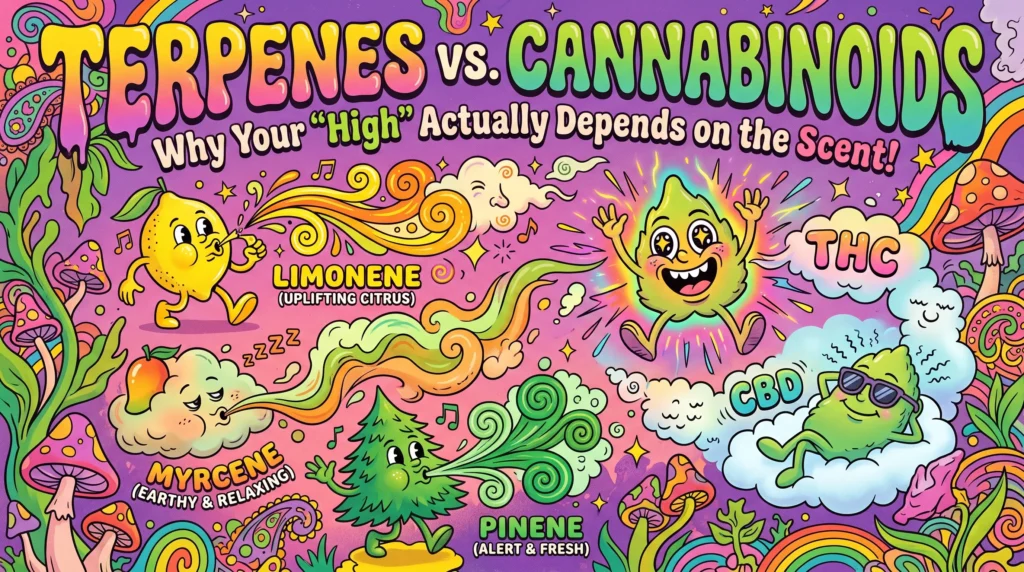
You can buy two cannabis products with the same THC percentage and have completely different experiences. One leaves you clear-headed, social, and creative; the other pins you to the couch and makes a Netflix queue feel like a major life decision.
The difference is not only THC. Cannabinoids such as THC and CBD drive much of cannabis’s intoxicating and therapeutic activity, while terpenes create the plant’s distinctive citrus, pine, diesel, floral, and earthy aromas. Together, they help explain why scent is one of the most useful—though imperfect—signals for predicting how a cannabis product may feel.
This guide breaks down terpenes versus cannabinoids, explains what research does and does not prove about the “entourage effect,” and gives you a practical framework for choosing cannabis based on aroma, cannabinoid content, and your desired experience.
What Are Cannabinoids?
Cannabinoids are naturally occurring compounds in cannabis that interact with the body’s endocannabinoid system. They are the primary chemical drivers behind intoxication, relief, appetite changes, and many of the effects people associate with cannabis.
The two most familiar cannabinoids are:
- THC (delta-9-tetrahydrocannabinol): The main intoxicating cannabinoid. It is largely responsible for the psychoactive “high.”
- CBD (cannabidiol): Non-intoxicating in typical amounts and often used for wellness-focused products, though its effects depend heavily on dose, product type, and individual response.
- CBG, CBN, CBC, and THCV: Minor cannabinoids that are receiving growing attention, although human evidence for many specific effects remains limited.
🔥REFER A FRIEND
THEY GET 10% OFF THEIR FIRST ORDER🔥
Cannabis contains more than 100 cannabinoids, but THC and CBD receive most of the attention because they are usually present in the highest concentrations.
How THC Creates a High
THC primarily activates CB1 receptors, which are concentrated in the brain and central nervous system. That interaction influences mood, perception, memory, coordination, appetite, and pain processing.
This is why a high-THC product can feel intensely psychoactive. But THC percentage alone does not tell the whole story: the same 22% THC flower can feel dramatically different depending on its terpene profile, consumption method, dose, tolerance, and setting.
Expert insight: Treat THC percentage as a measure of potential potency—not a prediction of experience. A 17% THC product with a rich, well-preserved terpene profile may feel more enjoyable and controllable than a harsh 28% THC product with minimal aroma.
What Are Terpenes?
Terpenes are aromatic compounds produced by many plants, including cannabis. They give each cultivar its recognizable smell and taste—lemon, pine, mango, lavender, pepper, fuel, or fresh herbs.
Terpenes are not unique to cannabis. Limonene appears in citrus peels, pinene in pine trees, and linalool in lavender. In cannabis, these compounds are produced in glandular trichomes, the same resinous structures associated with cannabinoid production.
| Terpene | Common aroma | Often associated with | Important caveat |
|---|---|---|---|
| Myrcene | Earthy, herbal, musky | Relaxing, body-heavy experiences | Effects vary by person and product |
| Limonene | Citrus, lemon, orange | Uplifting, mood-focused experiences | Aroma does not guarantee an energizing effect |
| Pinene | Pine, forest, rosemary | Alertness and clear-headedness | Evidence in cannabis users remains limited |
| Linalool | Floral, lavender | Calming, soothing experiences | Can be pleasant without necessarily reducing anxiety |
| Caryophyllene | Pepper, spice, clove | Warm, grounding experiences | May interact with the endocannabinoid system |
| Terpinolene | Floral, herbal, slightly fruity | Complex, layered aromas | Often found in smaller amounts |
Terpenes are responsible for much of cannabis’s sensory identity, but they are not simply “flavoring.” Research suggests they may have biological activity of their own and may influence how cannabinoids are experienced, although the precise mechanisms remain unsettled.
Terpenes vs. Cannabinoids
Cannabinoids determine much of the pharmacological intensity, while terpenes shape the sensory profile and may modulate the overall experience. Neither category alone fully explains why cannabis affects people differently.
| Factor | Cannabinoids | Terpenes |
|---|---|---|
| Primary role | Interact with the endocannabinoid system | Create aroma and flavor |
| Best-known examples | THC, CBD, CBG, CBN | Myrcene, limonene, pinene, linalool |
| Intoxication | THC can cause a high | Generally not intoxicating by themselves |
| What they influence | Psychoactivity, relief, appetite, perception | Scent, taste, and potentially effect modulation |
| Label relevance | THC/CBD percentages and cannabinoid ratios | Dominant terpenes and total terpene content |
| Practical use | Choose based on potency and desired intensity | Choose based on aroma preferences and expected experience |
The Simple Version
Think of cannabinoids as the engine and terpenes as the steering, suspension, and sound system.
THC may provide the horsepower, but terpenes influence whether the ride feels smooth, sharp, relaxing, citrusy, earthy, or overpowering. That analogy is imperfect—cannabis pharmacology is more complex than a car—but it captures the practical distinction well.
🔥 Stack your savings. Elevate your session. 10% off $100, up to 25% off $450.
🔥 Roll into the menu and start saving. CLICK HERE!
Why Scent Matters More Than You Think
Scent matters because terpenes are volatile: they evaporate easily and deliver a large amount of sensory information before you even consume a product. A citrus-forward cultivar signals limonene dominance; a pine-and-herb aroma often points to pinene; a peppery, clove-like profile can indicate caryophyllene.
Your nose is not a laboratory instrument. It cannot tell you exact percentages, and it cannot confirm whether a product was grown, stored, or cured well. Still, aroma is a valuable quality signal.
Fresh, well-preserved cannabis usually has a noticeable, layered aroma. Cannabis with little scent may have degraded terpenes due to poor storage, excessive heat, age, or improper curing. That does not automatically make it unsafe, but it can mean a less enjoyable and less predictable experience.
A Real-World Example
Imagine two customers shopping for a weekend evening product:
- Customer A wants to unwind after work without feeling mentally foggy. They may prefer a product with a floral, citrus, or pine-forward profile and a moderate THC level.
- Customer B wants deep physical relaxation before bed. They may be more interested in earthy, herbal aromas and a product with a more sedating reputation.
Neither choice is guaranteed to produce the intended result. But comparing aroma, cannabinoid content, and prior personal experience is far smarter than buying solely based on the highest THC number.
The Entourage Effect: What Is Proven?
The entourage effect is the hypothesis that cannabinoids, terpenes, and other cannabis compounds work together to produce effects different from—or stronger than—individual compounds alone. It is a compelling theory, but it is not yet fully proven in humans.
Some studies and reviews support the possibility that terpenes can influence cannabinoid-related effects. Other research has found that common cannabis terpenoids did not modify THC activity at human CB1 and CB2 receptors in laboratory models.
That means responsible cannabis education should avoid overstating the science.
- What is well established: Terpenes create cannabis aroma and flavor; cannabinoids such as THC produce intoxication.
- What is promising but unproven: Terpenes reliably amplify, reduce, or direct THC’s effects in predictable ways.
- What needs more research: Exact terpene thresholds, human dose-response relationships, and whether whole-plant effects translate consistently from lab studies to real-world use.
A 2024 systematic review noted that while exploratory research suggests terpenes may influence therapeutic benefits, potential synergy with cannabinoids remains unproven. That nuance matters—especially for consumers making health-related decisions.
Pro tip: Be skeptical of products claiming a specific terpene will “guarantee” sleep, focus, energy, or anxiety relief. Terpene labels are useful context, not a promise.
🔥REFER A FRIEND
THEY GET 10% OFF THEIR FIRST ORDER🔥
How to Read a Cannabis Label
A good cannabis label should help you understand potency, cannabinoid ratios, dominant terpenes, harvest or package date, and testing information. Read it as a profile—not a guarantee.
Look for these details:
- THC percentage: Indicates potential psychoactive strength.
- CBD percentage: Helps identify balanced or CBD-forward products.
- Dominant terpenes: Usually listed by name and sometimes by percentage.
- Total terpenes: A useful indicator of aromatic richness, though higher is not always better.
- Batch and testing information: Helps verify that the product passed required safety testing.
- Harvest or packaging date: Fresher products often retain more aroma, though storage conditions matter too.
A Practical Selection Framework
- Start with your goal. Decide whether you want relaxation, social energy, creativity, sleep support, or a low-intensity experience.
- Check THC first. If you are newer or sensitive to cannabis, begin with a lower-THC option rather than chasing maximum potency.
- Use aroma as a guide. Smell the product if legally permitted, or review dominant terpenes when shopping online.
- Consider the format. Flower, vape, edible, and concentrate products can differ substantially in onset time and duration.
- Start low and go slow. Take a small amount, wait long enough for effects to fully develop, and avoid mixing substances.
- Track your results. Note the product, cannabinoid content, dominant terpenes, dose, time, and how you felt afterward.
Actionable Steps: Build Your Personal Effect Profile
The fastest way to improve your cannabis buying decisions is to stop relying on strain names alone and start collecting your own evidence.
Step 1: Create a Simple Journal
Use a note-taking app or spreadsheet with these columns:
- Product name
- Cannabinoid profile
- Dominant terpenes
- Aroma description
- Dose
- Consumption method
- Time consumed
- Effects at 30, 60, and 120 minutes
- Negative effects
- Would you buy again?
Step 2: Compare Similar Products
Choose two products with comparable THC levels but different terpene profiles. For example, compare a citrus-forward option with an earthy, herbal option.
Use the same consumption method and a similar dose. This reduces variables and makes the comparison more meaningful.
Step 3: Evaluate the Full Experience
Do not rate a product only by how strong it feels. Rate:
- Mood
- Mental clarity
- Physical relaxation
- Social comfort
- Creativity
- Sleepiness
- Dry mouth or eyes
- Anxiety or racing thoughts
- Overall satisfaction
Step 4: Refine Your Preferences
After several comparisons, patterns usually emerge. You may discover that you enjoy limonene-rich products for daytime social use, while earthy and herbal profiles work better for evening relaxation.
That personal pattern is more valuable than a generic claim that one terpene works the same way for everyone.
Common Mistakes to Avoid
- Buying only the highest THC product. High THC can increase the risk of an uncomfortable experience, especially for newer consumers.
- Assuming terpenes alone determine the high. Dose, tolerance, consumption method, and individual biology all matter.
- Treating “indica” and “sativa” as effect guarantees. Chemical profile is often more useful than these broad labels.
- Ignoring freshness. Terpenes are volatile and can fade with heat, light, air exposure, and time.
- Assuming natural means risk-free. Cannabis can impair judgment, coordination, and reaction time. Do not drive or operate machinery while impaired.
🔥 Stack your savings. Elevate your session. 10% off $100, up to 25% off $450.
🔥 Roll into the menu and start saving. CLICK HERE!
Conclusion & Next Steps
Terpenes and cannabinoids work together to shape the cannabis experience, but they play different roles. Cannabinoids—especially THC—drive much of the high, while terpenes create the aroma and may influence how that high feels.
The smartest approach is not to worship THC percentages or blindly trust strain names. Use the full label: cannabinoid content, dominant terpenes, aroma, freshness, dose, and your own recorded experience.
Before your next purchase, choose one lower-THC product with an aroma profile you genuinely enjoy, consume a conservative amount, and track the results. Over time, that simple habit can turn random cannabis shopping into a more predictable, personalized, and satisfying experience.
FAQs
Do terpenes get you high?
Terpenes generally do not cause intoxication by themselves. However, they may influence the overall cannabis experience by contributing aroma, flavor, and potential interactions with cannabinoids such as THC.
Are cannabinoids more important than terpenes?
Cannabinoids are usually more important for intoxication because THC directly produces psychoactive effects. Terpenes are still important because they shape aroma and may modulate the experience, though human evidence remains limited.
What is the entourage effect in cannabis?
The entourage effect is the proposed synergy among cannabinoids, terpenes, and other cannabis compounds. Research suggests the concept is plausible, but it has not been conclusively proven in humans.
🔥REFER A FRIEND
THEY GET 10% OFF THEIR FIRST ORDER🔥
Why does cannabis smell different?
Cannabis smells different because each cultivar produces a unique mix of terpenes. Limonene creates citrus notes, pinene produces pine-like aromas, and myrcene contributes earthy or herbal scents.
Is a higher terpene percentage better?
Not necessarily. Higher terpene content often means a stronger aroma, but the best product depends on your preferred effects, tolerance, freshness, cannabinoid profile, and consumption method.