
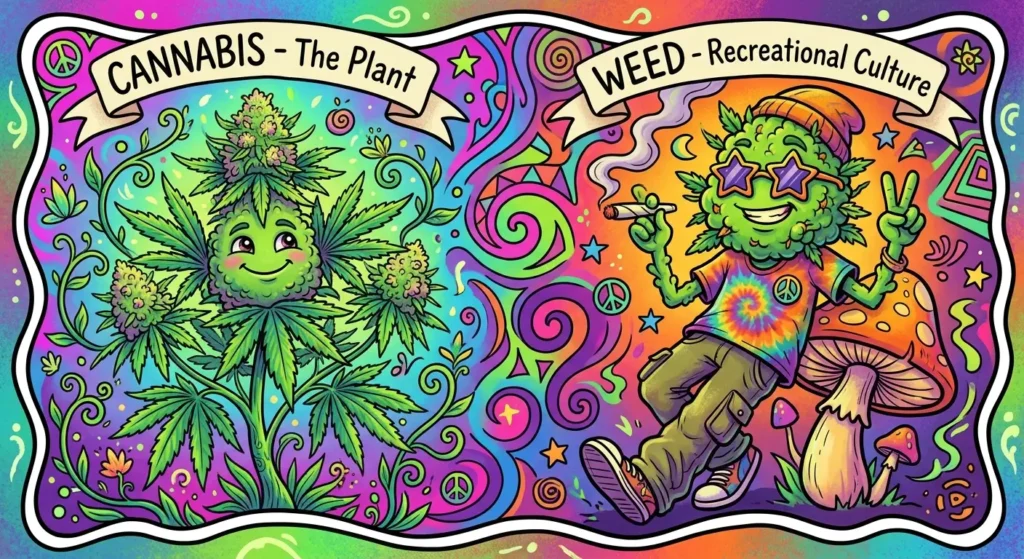
“Cannabis” sounds scientific. “Weed” sounds casual. Are they actually different products?
Usually, cannabis and weed refer to the same plant or closely related cannabis products, but the words are not interchangeable in every context. “Cannabis” is the broader, more neutral term used in medicine, science, regulation, and product labeling. “Weed” is informal slang that most often refers to dried cannabis flower containing THC.
The distinction matters because a product’s name does not tell you everything about its THC content, CBD content, strength, form, legal status, or potential effects. This guide explains what both terms mean, how they relate to marijuana, hemp, THC, CBD, and cannabis products, and what consumers should check before using or purchasing anything.
Important: Cannabis laws, age requirements, possession limits, and product rules vary by jurisdiction. This article is educational and does not replace local legal or medical advice.
Is cannabis the same as weed?
Cannabis and weed usually refer to the same plant, but “cannabis” is the broader and more formal term while “weed” is informal slang.
The cannabis plant contains many chemical compounds called cannabinoids. These include delta-9 THC, which can impair or alter perception, and CBD, which does not produce a “high” by itself. The CDC identifies “weed,” “pot,” “bud,” and “marijuana” as common names used for cannabis.
In everyday conversation, someone who says “weed” often means dried cannabis flower intended to be smoked or vaporized. However, people may also use “weed” loosely for pre-rolls, concentrates, edibles, or cannabis products generally.
“Cannabis” can describe:
- The plant itself.
- Dried flowers, leaves, stems, and seeds.
- Products derived from the plant.
- THC-containing and CBD-containing products.
- A subject discussed in health, science, agriculture, or regulation.
That is why “cannabis” usually provides more precision than “weed.”
🔥REFER A FRIEND
THEY GET 10% OFF THEIR FIRST ORDER🔥
Simple definition
Weed is a slang term; cannabis is the broader scientific and commercial term. In many conversations, they point to the same THC-containing product, but neither word alone tells you the product’s potency or effects.
What does cannabis mean?
Cannabis refers to the plant and, depending on context, products made from or containing compounds derived from it.
Health agencies commonly use “cannabis” as a neutral umbrella term. The National Institute on Drug Abuse describes cannabis as referring to dried leaves, flowers, stems, and seeds of the Cannabis sativa L. plant. It also identifies THC as an intoxicating compound and CBD as a non-intoxicating cannabinoid.
The word can appear in several contexts:
- Medical research: Studies may examine cannabis use, cannabinoids, impairment, or health outcomes.
- Retail: Legal stores may label flower, edibles, oils, capsules, and concentrates as cannabis products.
- Agriculture: Farmers may discuss cultivars, fiber, seed, hemp, and plant genetics.
- Regulation: Government agencies may define cannabis by THC concentration, intended use, or product category.
- Public health: Researchers often use cannabis to avoid relying on informal or historically inconsistent terminology.
“Cannabis” does not automatically mean a product is safe, legal, medicinal, non-intoxicating, or low in THC. The product’s cannabinoid profile and local regulations still matter.
What does weed mean?
Weed is an informal term most often used for dried cannabis flower, especially flower containing THC.
The word is common in casual speech, advertising, online searches, and popular culture. It may refer to:
- Dried cannabis flower.
- A cannabis joint or pre-roll.
- Cannabis intended for smoking or vaping.
- THC-rich cannabis generally.
- Cannabis products in a broad, imprecise sense.
Because “weed” is slang, its meaning can vary from one speaker or market to another. One person may use it only for flower. Another may use it for any cannabis product, including edibles or concentrates.
That ambiguity creates a practical problem: a product labeled or described as “weed” may not reveal its THC percentage, CBD level, serving size, extraction method, or contaminants.
For accurate product information, look beyond the nickname. Read the formal label, certificate of analysis where available, ingredient list, cannabinoid content, serving size, and local compliance information.
Cannabis vs. weed: the main differences
The main difference is terminology, not necessarily the plant itself.
| Feature | Cannabis | Weed |
|---|---|---|
| Type of term | Scientific, medical, legal, and commercial | Informal slang |
| Typical meaning | Plant and products derived from it | Usually THC-containing flower or cannabis generally |
| Precision | Broader and more precise in formal contexts | Less precise |
| Common settings | Research, healthcare, regulation, retail labels | Everyday conversation and search queries |
| Does it identify THC level? | No | No |
| Does it identify CBD level? | No | No |
| Does it guarantee a “high”? | No | No |
| Does it establish legality? | No | No |
| Can it describe edibles or oils? | Yes | Sometimes, depending on the speaker |
| Best use in educational content | Preferred | Useful as a consumer keyword or informal synonym |
The table highlights an important point: neither “cannabis” nor “weed” is a potency label. To understand a product, check its measured THC and CBD content, form, serving size, and testing information.
Is marijuana different from cannabis?
“Marijuana” is often used as a synonym for cannabis, but “cannabis” is generally the broader and more neutral term.
Many health organizations use cannabis as their preferred terminology while acknowledging that marijuana remains common in everyday language. The Cleveland Clinic explains that cannabis can refer broadly to products from the Cannabis sativa plant, while marijuana is often used for THC-containing parts or products.clevelandclinic
The distinction is not perfectly consistent. Definitions may differ between:
- Government agencies.
- Scientific papers.
- Retail regulations.
- Medical professionals.
- Consumer brands.
- Different countries and states.
Some writers also avoid “marijuana” because of the term’s complex historical and political background. That does not mean every use of the word is incorrect; it means “cannabis” is often the clearest choice for neutral, modern educational writing.
Which term should a website use?
Use cannabis when writing about science, health, regulation, product categories, or a professional audience. Include weed naturally when reflecting the language consumers actually use in search queries or conversation.
A strong article can use both without treating them as completely different substances:
“Cannabis, commonly called weed, is a plant containing cannabinoids such as THC and CBD.”
That sentence is clear for readers and search engines. It defines the entity, connects the common synonym, and avoids pretending that slang reveals product characteristics.
What is the difference between cannabis and hemp?
Hemp is a type or legal category of cannabis generally defined by its low THC concentration, although the exact threshold depends on local law.
The terms “hemp” and “marijuana” are not always botanical opposites. They may refer to plants or products classified differently because of THC content, intended use, or regulation.
Hemp is commonly associated with:
- Fiber and textiles.
- Seeds and foods.
- Industrial materials.
- CBD extraction.
- Low-THC cultivars.
Marijuana is commonly associated with cannabis products containing higher THC levels and intended for intoxicating use. However, legal definitions vary. A hemp-derived product may still contain cannabinoids and may be regulated differently from a high-THC cannabis product.
Do not assume that “hemp” means risk-free or that “cannabis” means high-THC. Read the product label and local rules.
🔥 Stack your savings. Elevate your session. 10% off $100, up to 25% off $450.
🔥 Roll into the menu and start saving. CLICK HERE!
THC, CBD, and why terminology is not enough
THC and CBD tell you more about a cannabis product’s likely effects than the words “weed” or “cannabis” do.
What is THC?
THC, especially delta-9 THC, is the cannabinoid most associated with intoxication and the feeling of being “high.” It may affect perception, attention, coordination, memory, mood, and reaction time.
A higher THC percentage or serving amount may increase the likelihood of stronger effects, but a label does not predict every individual response. Tolerance, body chemistry, product form, prior experience, and whether other substances are involved can influence the experience.
What is CBD?
CBD is a cannabinoid that does not cause a high by itself. The CDC notes that CBD can be derived from hemp or non-hemp cannabis and is not impairing on its own.cdc
That does not mean every CBD product is free from THC. Some products may contain small amounts of THC, inaccurate labels, or contaminants. Check the certificate of analysis and applicable regulatory information where available.
Why labels matter
Consider two products both described casually as “weed”:
- Product A is dried flower with high THC and very little CBD.
- Product B is low-THC flower with a higher CBD ratio.
The nickname is the same, but the cannabinoid profile and expected effects may be very different. Product names, strain names, and marketing descriptions should not replace measured laboratory information.
Are cannabis and weed used for the same products?
Cannabis is used for many product types, while weed most commonly refers to flower but may be used more broadly.
| Product | Often called cannabis? | Sometimes called weed? | What to check |
|---|---|---|---|
| Dried flower | Yes | Yes | THC, CBD, batch testing |
| Pre-roll | Yes | Yes | Total cannabinoid amount and ingredients |
| Edible | Yes | Sometimes | THC per serving and package |
| Oil or tincture | Yes | Less often | Concentration, carrier oil, dosing |
| Vape cartridge | Yes | Sometimes | Ingredients, hardware, lab testing |
| Concentrate | Yes | Sometimes | THC concentration and extraction method |
| Topical | Yes | Rarely | Intended use and cannabinoid content |
| Hemp seed product | Yes, in a broad plant sense | Usually no | Confirm it is not an intoxicating product |
The informal term may be useful in a conversation, but it is not enough for a buying decision. A responsible product description should identify the format and cannabinoid content.
Does “weed” always mean THC?
No, “weed” does not always specify THC content, although many people use it to mean intoxicating cannabis.
A slang term cannot establish:
- Whether THC is present.
- How much THC is present.
- Whether CBD is also present.
- Whether the product is hemp-derived.
- Whether the product is legal.
- Whether the product has passed laboratory testing.
- Whether the product is suitable for a particular person.
This is especially important with online listings. A seller may use “weed,” “cannabis,” “bud,” or “flower” as marketing language without providing reliable details. Look for a regulated label, batch number, testing information, and clear seller identity.
How do laws treat cannabis and weed?
Laws generally regulate the plant or its compounds rather than the slang word used to describe them.
A law may define cannabis by:
- THC concentration.
- Plant material or product type.
- Possession amount.
- Intended use.
- Manufacturing method.
- Age of the buyer.
- Location of sale or consumption.
- Medical authorization.
- Licensing status of the retailer.
The same product may be legal in one jurisdiction and prohibited in another. Even where adult-use sales are permitted, rules may restrict public consumption, driving, home cultivation, interstate transport, delivery, advertising, or possession limits.
🔥REFER A FRIEND
THEY GET 10% OFF THEIR FIRST ORDER🔥
Do not use the word “weed” in a search query as a substitute for checking local law. Official regulators and government health agencies are better sources for legal definitions than retail blogs or social-media posts.
What does the terminology mean for SEO and content creators?
Use “cannabis” for accuracy and authority, then include “weed” where it reflects real user language and search intent.
For a health, legal, or educational website:
- Use “cannabis” in the H1 and primary explanations.
- Use “weed” in a clearly defined synonym sentence.
- Explain the difference between plant, product, compound, and slang.
- Avoid implying that a keyword describes potency.
- Include THC, CBD, hemp, marijuana, flower, edible, and concentrate where relevant.
- Support health and legal claims with authoritative sources.
- Add jurisdiction-specific disclaimers.
- Avoid sensational claims such as “safe,” “harmless,” or “completely natural.”
For example, this title targets both precision and consumer language:
Cannabis vs. Weed: What’s the Real Difference?
A supporting subheading could be:
Is weed just another name for cannabis?
That structure answers the user’s question directly while preserving the broader semantic relationship between the terms.
Pro tip: Do not create separate pages for “cannabis,” “weed,” and “marijuana” if they would repeat the same explanation. A single authoritative page can cover the terminology, then link to distinct pages about THC, CBD, hemp, products, and legal rules.
A real-world labeling example
Imagine a customer sees two online listings:
Listing A: “Premium Weed”
Listing B: “Cannabis flower, 22% total THC, 0.8% CBD, batch-tested, sealed package, 3.5 grams”
Listing B provides more useful information. “Premium weed” is a subjective marketing phrase. It does not prove quality, potency, freshness, testing, or legality.
A responsible buyer would ask:
- Is the seller licensed where required?
- What is the total THC amount?
- What is the CBD amount?
- Is the result based on laboratory testing?
- What is the serving or package size?
- Are ingredients and contaminants disclosed?
- What are the local possession and use rules?
- Are age verification and delivery procedures compliant?
This example shows why terminology should be the beginning of research, not the end. The words “cannabis” and “weed” identify a general category; the label determines what is actually in the product.
Is one term better than the other?
“Cannabis” is usually the better term for accuracy, trust, and professional communication, while “weed” is useful for informal language and search intent.
Use cannabis when:
- Explaining health effects.
- Discussing scientific evidence.
- Describing legal or regulated products.
- Writing for clinicians, policymakers, or educators.
- Building a trustworthy brand.
Use weed when:
- Reflecting how consumers speak.
- Answering a specific search query.
- Explaining slang.
- Writing casual content for an adult audience.
- Connecting a question to a formal definition.
The strongest approach is not choosing one word and banning the other. It is defining both terms, using them consistently, and supplying the information that names alone cannot provide.
Conclusion and next steps
Cannabis and weed usually refer to the same general plant or THC-containing products, but they carry different levels of formality and precision. Cannabis is the broader, more neutral term used in science, healthcare, regulation, and retail. Weed is informal slang that often means dried THC-containing flower but can be used more loosely.
Neither term tells you the product’s potency, legality, safety, or expected effects. For those questions, check THC and CBD content, product type, laboratory testing, seller licensing, and local law.
If you are creating content, lead with “cannabis” for clarity and authority, then use “weed” naturally where it matches consumer vocabulary. If you are evaluating a product, ignore the nickname until you have verified the label.
🔥 Stack your savings. Elevate your session. 10% off $100, up to 25% off $450.
🔥 Roll into the menu and start saving. CLICK HERE!
FAQs
Is weed the same as cannabis?
Weed is a common slang term for cannabis, especially dried flower containing THC. Cannabis is the broader and more formal term used for the plant and its products. However, “weed” does not specify THC level, CBD content, product form, testing status, or legality.
What is the difference between cannabis and marijuana?
Cannabis is generally the broader, more neutral term for the plant and products derived from it. Marijuana is commonly used for THC-containing cannabis, although definitions vary by organization and jurisdiction. In modern health and regulatory writing, cannabis is often preferred for clarity.
Does cannabis always contain THC?
No. Cannabis products can contain different cannabinoid profiles, including THC, CBD, both, or other compounds. Some cannabis-derived products are intended to be non-intoxicating, but labels may vary in accuracy. Check the product’s laboratory results and local regulatory information before relying on its claims.
Is hemp the same as weed?
Hemp and weed both relate to the cannabis plant, but hemp is generally associated with low-THC plants or products, while weed commonly refers to intoxicating cannabis flower. The exact legal definition of hemp depends on the jurisdiction, so THC thresholds and product rules may differ.
Which term is better: cannabis or weed?
“Cannabis” is better for scientific, medical, legal, and professional writing because it is more neutral and precise. “Weed” is useful as informal language and as a search keyword. A clear article can define both terms rather than treating them as completely different substances.