
The label said “Blue Dream.” A classic Sativa-dominant hybrid, known for uplifting creativity and mild pain relief. That was the promise, anyway. So when Alex, a graphic designer with chronic migraines, picked up that jar at the dispensary, he expected a gentle mental lift to help him work through his afternoon slump. Instead, twenty minutes later, he was couch-locked, paranoid, and sweating. The “uplifting” strain had hit him like a freight train of sedation.
Was it bad luck? Did he buy a fake product? Or was the label itself lying?
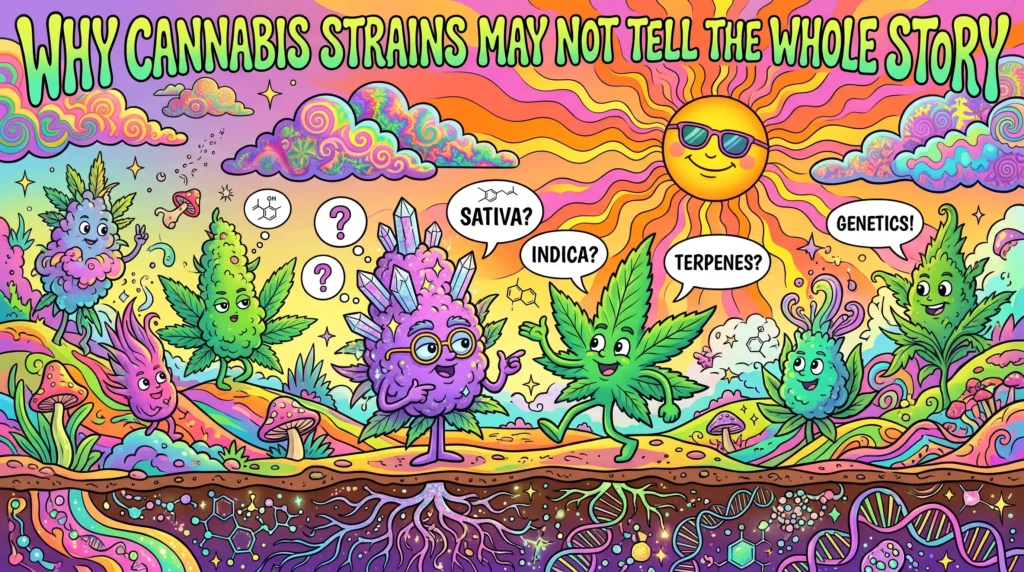
For decades, cannabis culture has been dominated by a binary myth: Indica means relax/sleep, and Sativa means energize/create. This taxonomy, born from early botanical classifications in the 1970s, persists in menus, marketing, and consumer minds despite overwhelming scientific evidence suggesting it is functionally obsolete. Today, nearly all commercially available cannabis is hybridized to the point where pure landrace distinctions are meaningless for predicting effects.
If you are still choosing your flower based solely on whether the bag says “Indica” or “Sativa,” you are navigating a complex chemical landscape with a map drawn in crayon.
This article dismantles the strain-name mythology. We will explore why genetic lineage matters less than chemical composition, how the “Entourage Effect” actually works, why extraction methods alter potency, and what you should look for instead of catchy names. By understanding the science behind the smoke—or the vape—you gain control over your experience, ensuring consistency, safety, and therapeutic efficacy.
🔥REFER A FRIEND
THEY GET 10% OFF THEIR FIRST ORDER🔥
What Is a Cannabis Strain?
A cannabis strain is a marketed name for a cannabis cultivar or product line, often based on its supposed lineage, aroma, appearance, or expected effects. Names such as Northern Lights, Sour Diesel, and Purple Haze became shorthand for particular experiences—but they are not standardized scientific classifications.
In botanical and chemical research, a more useful term is chemovar: a cannabis variety defined by its chemical profile, especially its major cannabinoids and terpenes. A chemovar classification can identify products as THC-dominant, CBD-dominant, or intermediate based on measurable compounds rather than branding.pmc.ncbi.nlm.nih+1
That distinction matters. A strain name is a label. A chemovar is a measurable chemical identity.
Why Strain Names Can Be Misleading
Strain names can be misleading because cannabis naming is largely commercial, inconsistent, and weakly tied to verified genetics or laboratory chemistry. Researchers have found that products with the same name may vary widely in cannabinoids, terpenes, and genetic ancestry.pmc.ncbi.nlm.nih+2
Several forces create that gap:
- Unregulated naming: Many strain names are not protected or standardized across producers, states, or countries.
- Clonal drift and cultivation differences: The same genetic line can express different chemistry depending on growing conditions, harvest timing, drying, curing, and processing.pmc.ncbi.nlm.nih
- Marketing pressure: A recognizable name can sell flower even when the product’s actual chemistry differs from the original variety.
- Incomplete labels: THC and CBD are commonly disclosed, but many other cannabinoids and terpenes may be absent from consumer-facing packaging.core.verisk
- Outdated Indica/Sativa thinking: The traditional Indica-versus-Sativa framework does not reliably map onto chemical composition or predictable effects.pmc.ncbi.nlm.nihExpert insight: Think of a strain name like a restaurant dish name. Two kitchens may both sell “carbonara,” but the ingredients, preparation, and final taste can differ dramatically. The name alone does not guarantee the recipe.
Indica vs. Sativa: A Flawed Shortcut
Indica and Sativa labels do not reliably predict how a cannabis product will affect you. They originated as botanical descriptions, but modern cannabis products are usually complex hybrids with undocumented backgrounds.pmc.ncbi.nlm.nih
The industry often uses these categories as effect shorthand:
| Label | Common marketing claim | What research suggests |
|---|---|---|
| Indica | Relaxing, sedating, “in-da-couch” | Often associated with higher CBD than “Sativa” labels, but the categories are inconsistent and biologically imprecise. pmc.ncbi.nlm.nih |
| Sativa | Energizing, creative, daytime use | Not a dependable predictor of terpene profile, cannabinoid ratio, or effect. pmc.ncbi.nlm.nih+1 |
| Hybrid | Balanced effects | Can describe almost anything; the term does not specify which compounds dominate. |
| Strain name | Predictable flavor and experience | Same-name products can differ substantially in genetics and chemistry. dal+1 |
A better question is not “Is this Indica or Sativa?” but “What are the dominant cannabinoids and terpenes, and how much of each is present?”
Cannabinoids: The Core Chemical Drivers
Cannabinoids are naturally occurring compounds in cannabis that interact with the body’s endocannabinoid system. The two most familiar are THC and CBD, but cannabis produces many more, including CBG, CBN, THCV, and CBC.
THC is primarily responsible for intoxicating effects. CBD is non-intoxicating, though it can still influence the overall experience and may modify how THC affects some people. The ratio between them is often more informative than a strain name.
| Chemical signal | What it may indicate | Practical takeaway |
|---|---|---|
| High THC, low CBD | Potentially stronger psychoactive intensity | Start low, especially if you are new or sensitive to THC. |
| Balanced THC:CBD | More moderate intoxication potential for many users | Often preferred by people seeking a less overwhelming experience. |
| High CBD, low THC | Little to no intoxicating effect from THC | Useful when avoiding impairment is a priority. |
| Minor cannabinoids | Additional chemical complexity | CBG, CBN, THCV, and CBC may contribute to aroma, effect, or product positioning, but evidence varies by compound. |
Cannabis contains far more than THC and CBD. Chemical analyses have identified cannabinoids alongside flavonoids, lipids, and other metabolites whose distribution varies across cultivars and plant tissues.
Short Answer: Why Strain Names Are Poor Predictors of Effects
Strain names fail to predict cannabis effects because chemical variability within a single cultivar is greater than the difference between many named strains. Factors such as growing conditions, harvest timing, curing processes, terpene preservation, and cannabinoid ratios (THC:CBD:CBG) ultimately determine the physiological impact, not the historical botanical classification of Indica or Sativa.
In short: The name tells you the heritage; the lab report tells you the experience.
The Myth of Indica vs. Sativa
The Indica/Sativa divide originated from Jean-Baptiste Lamarck’s 18th-century observations and was popularized by Ernest Small and Arthur Cronquist in the 1970s. They classified plants based on morphology: tall, narrow-leafed plants (Sativa) versus short, broad-leafed plants (Indica). Botanically, these distinctions described physical traits, not psychoactive profiles.
However, marketers seized upon this simplicity. It gave consumers an easy heuristic. “Need sleep? Buy Indica. Need energy? Buy Sativa.”
Modern genomic sequencing reveals that almost every commercial strain is a polyhybrid. Take “OG Kush,” for instance. It is often labeled Indica, yet its genetic backbone includes Thai Sativa genetics. Its effects can vary wildly depending on which phenotype was selected for breeding and how it was grown. Relying on the label is akin to assuming all red wines taste sweet because they share a color. The grape variety (Pinot Noir vs. Cabernet Sauvignon) matters, but the soil, climate, fermentation, and aging process matter more.
Expert Insight: In regulated markets, dispensaries are increasingly moving away from strict Indica/Sativa labeling due to regulatory scrutiny regarding misleading health claims. Forward-thinking retailers now prioritize “Effect-Based” categorization (e.g., Focus, Relief, Sleep) backed by terpene profiles, acknowledging that the old binary is scientifically bankrupt.
Terpenes: The Hidden Architects of Your High
If cannabinoids (like THC and CBD) are the engine of cannabis, terpenes are the steering wheel. These aromatic oils produce the scent and flavor of the plant, but they also modulate how cannabinoids interact with your body’s endocannabinoid system.
What Are Terpenes?
Terpenes are hydrocarbons produced in the resin glands (trichomes) alongside cannabinoids. Over 200 distinct terpenes have been identified in cannabis. While THC binds directly to CB1 receptors in the brain to produce intoxication, terpenes influence absorption rates, receptor binding affinity, and subjective perception.
Key Terpenes and Their Associated Effects
Instead of looking for “Sativa,” look for these dominant terpenes on the Certificate of Analysis (COA):
| Terpene | Aroma Profile | Commonly Associated With | Potential Synergistic Effect |
|---|---|---|---|
| Myrcene | Earthy, Musky, Clove | Sedation, Pain Relief | Enhances THC permeability across the blood-brain barrier; may increase “couch-lock.” |
| Limonene | Citrus, Lemon, Orange | Mood Elevation, Stress Relief | May counteract anxiety associated with high THC levels; anti-inflammatory properties. |
| Pinene | Pine, Forest Floor | Alertness, Memory Retention | May mitigate THC-induced short-term memory impairment; bronchodilator effects. |
| Beta-Caryophyllene | Black Pepper, Spicy | Anxiety Reduction, Pain | Binds directly to CB2 receptors (anti-inflammatory); unique among terpenes for cannabinoid-like activity. |
| Linalool | Floral, Lavender | Relaxation, Calm | Often found in calming strains; may reduce stress and agitation without heavy sedation. |
Alex’s “Blue Dream” disaster likely stemmed from a high concentration of Myrcene and Linalool, overriding the expected Limonene profile. Without checking the COA, he bought a chemical surprise.
Pro Tip: When shopping, ask budtenders for the top three dominant terpenes. If they cannot provide this data, or if the lab results show negligible terpene content (<0.5%), the product may be poorly cured or aged, leading to unpredictable effects.
🔥 Stack your savings. Elevate your session. 10% off $100, up to 25% off $450.
🔥 Roll into the menu and start saving. CLICK HERE!
The Entourage Effect: Synergy Over Isolation
The term “Entourage Effect” was coined in 1998 by Israeli researchers Raphael Mechoulam and Shimon Ben-Shushan. It describes the theory that cannabis compounds work better together than in isolation.
Early pharmacology focused on isolating single molecules (like pure THC distillate). However, whole-plant extracts often produce different therapeutic outcomes than isolated cannabinoids. For example, a patient using pure CBD oil for epilepsy might experience different side effects or efficacy levels compared to one using a full-spectrum extract containing CBD, trace THC, CBG, and terpenes.
Minor Cannabinoids Matter
While THC and CBD get the headlines, minor cannabinoids play supporting roles:
- CBG (Cannabigerol): Known as the “mother cannabinoid,” it may offer neuroprotective and antibacterial benefits without intoxication.
- CBN (Cannabinol): A degradation product of THC, often associated with sedative effects. High CBN content usually indicates older or improperly stored flower.
- THCa (Tetrahydrocannabinolic Acid): Non-intoxicating in raw form, it converts to THC when heated (decarboxylation). Raw juice or tinctures preserve THCa, offering anti-inflammatory benefits without the high.
Understanding the ratio of these compounds is vital. A strain with 25% THC and 1% CBN will feel significantly heavier and more sedating than one with 25% THC and 0.1% CBN, even if both are labeled “Indica.”
Cultivation Methods: Indoor vs. Outdoor vs. Greenhouse
Where and how a plant is grown drastically alters its chemical profile. Sunlight drives photosynthesis differently than artificial LED lighting, affecting terpene production and cannabinoid density.
- Outdoor Grown: Exposed to natural elements, outdoor cannabis often develops robust terpene profiles due to UV stress responses. However, it is susceptible to environmental contaminants (pesticides, mold) if not organically certified. Harvest timing is dictated by season, potentially leading to variations year-over-year.
- Indoor Grown: Controlled environments allow for precise manipulation of light cycles, humidity, and nutrients. This consistency often yields higher THC percentages and cleaner products. However, some connoisseurs argue that indoor weed lacks the complex “terroir” of sun-grown buds.
- Greenhouse/Hybrid Light Deprivation (DLH): Combines natural sunlight with supplemental lighting. Often offers a balance of cost-efficiency and quality, producing dense buds with rich aromatic profiles.
The method impacts not just potency, but purity. Indoor grows generally have lower risks of pesticide residue compared to unregulated outdoor farms, making them preferable for medical users concerned about long-term inhalation of chemicals.
Extraction Techniques: How Processing Changes Potency
For concentrates (vapes, dabs, oils), the strain name is even less relevant. The extraction method determines the final product’s character.
- CO2 Extraction: Uses pressurized carbon dioxide. It preserves a wide range of terpenes and cannabinoids, resulting in a clean, potent full-spectrum oil. Ideal for those seeking the Entourage Effect.
- Hydrocarbon Extraction (Butane/Propane): Produces shatter, wax, and budder. Highly efficient at pulling THC but can strip out delicate terpenes unless done carefully. Residual solvents must be rigorously tested for safety.
- Rosin Press: Solventless extraction using heat and pressure. Preserves the most authentic terpene profile and live cannabinoids. Considered the gold standard for purity and flavor, though yield is lower.
- Distillation: Creates near-pure THC or CBD isolate. Removes almost all other compounds. Predictable potency, but zero entourage effect. Users often add back synthetic or botanic terpenes (“re-terpenization”) to mimic flavor, which can lead to inconsistent experiences.
If you buy a vape cartridge labeled “Gelato,” check if it is distillate + added terpenes or live resin. The former may smell like Gelato but lack the nuanced complexity of the latter.
Actionable Guide: How to Shop Beyond the Label
Stop guessing. Start analyzing. Here is a step-by-step framework for selecting cannabis products based on science rather than marketing slogans.
Step 1: Demand the Certificate of Analysis (COA)
Every legal product must have a recent lab test. Look for:
- Potency Panel: Total THC, CBD, CBG, CBN percentages.
- Terpene Panel: Top 3–5 dominant terpenes and their concentrations.
- Contaminant Screening: Pesticides, heavy metals, microbial impurities (mold/bacteria), and residual solvents.
Red Flag: If the COA is older than 6 months, the product may have degraded. If it shows “Not Detected” for everything except THC, it is likely a low-quality isolate.
Step 2: Match Terpenes to Desired Outcome
Use the table above to align chemistry with goals:
- For Sleep/Pain: Seek high Myrcene (>0.5%) and Linalool. Avoid high Pinene.
- For Focus/Creativity: Seek high Limonene and Pinene. Avoid high Myrcene.
- For Anxiety Relief: Seek high Beta-Caryophyllene and moderate CBD. Avoid very high THC (>20%) if you are sensitive.
Step 3: Check the Harvest Date
Cannabis degrades over time. THC oxidizes into CBN (more sedating, less potent). Terpenes evaporate.
- Fresh Flower: Harvested within 3–6 months. Best aroma and balanced effects.
- Aged Flower: Older than 9 months. May be harsher, drier, and skewed toward CBN-heavy sedation.
Step 4: Understand Your Tolerance
Regular users build tolerance to THC. If a “mild” strain knocks you out, your tolerance may be lower than you think, or the product is unexpectedly potent. Conversely, if nothing happens, you may need a higher percentage or a different delivery method (e.g., edibles bypass first-pass metabolism differently than smoking).
Step 5: Keep a Journal
Track what you consume. Note the strain name, but more importantly, record:
- Time of day.
- Dominant terpenes (from COA).
- Subjective effects (1 hour post-consumption).
- Side effects (dry mouth, paranoia, hunger).
Over time, patterns emerge. You might discover that you respond well to Limonene-heavy sativas regardless of the strain name, or that Myrcene makes you groggy no matter the label. Data beats anecdote.
What Actually Predicts the Experience?
No single data point perfectly predicts a cannabis experience. Effects depend on the product’s chemistry, the dose, the consumption method, individual physiology, tolerance, setting, and whether other substances are involved.
But these factors are generally more informative than the strain name alone:
- THC percentage and dose — Higher THC increases intoxication risk, though potency alone does not determine quality or effect.
- CBD content and THC:CBD ratio — CBD can change the character of the experience and may reduce the intensity of THC’s psychoactive impact for some users.
- Terpene profile and concentrations — These shape aroma and may contribute to subjective differences between products.
- Consumption method — Inhalation typically produces faster onset; edibles are slower, longer-lasting, and easier to overconsume.
- Product freshness and storage — Light, heat, oxygen, and poor storage can degrade cannabinoids and terpenes.
- Individual response — Body chemistry, tolerance, hydration, food intake, sleep, anxiety, and medication interactions all matter.
The most reliable approach is to treat cannabis like any other botanical product: evaluate the measurable chemical profile, not the story attached to the jar.
A Better Way to Read a Cannabis Label
A good cannabis label should help you compare products by chemistry, not marketing. Look beyond the front-of-package name and check these details.
| Label element | Why it matters | What to look for |
|---|---|---|
| THC % or mg | Indicates potential psychoactive strength | Total THC, not just delta-9 THC, where available |
| CBD % or mg | Helps assess the THC:CBD balance | Exact milligrams for edibles, tinctures, and capsules |
| Dominant terpenes | Provides aroma and chemical context | At least the top three to five terpenes with percentages or mg/g |
| Batch number | Links package to test results | Match it to the certificate of analysis |
| Harvest or package date | Freshness signal | Recent dates and proper storage information |
| Producer and lot details | Accountability and consistency | Same brand, same cultivar, same batch matters |
| Certificate of analysis (COA) | Third-party verification | Cannabinoid potency, contaminants, and sometimes terpenes |
If a dispensary or brand cannot provide a COA, treat that as a warning sign rather than a minor inconvenience.
Case Study: The “Wedding Cake” Variance
Consider two batches of “Wedding Cake,” a popular hybrid strain.
Batch A (Dispensary X):
- THC: 22%
- Terpenes: High Caryophyllene, Moderate Limonene.
- Growing Method: Indoor, LED.
- User Report: “Uplifting, social, good for daytime parties.”
Batch B (Dispensary Y):
- THC: 28%
- Terpenes: High Myrcene, Low Limonene.
- Growing Method: Outdoor, organic.
- User Report: “Heavy body melt, sleepy, great for evening relaxation.”
Same name. Same genetic lineage. Completely different experiences. Why? Batch B had higher THC and a myrcene-dominant profile, driving sedation. Batch A had a caryophyllene/limonene mix, promoting alertness. The label “Wedding Cake” told neither user what to expect. Only the COA did.
Imagine two consumers buy flower labeled “Lemon Haze.”
- Jar A: 22% THC, 0.1% CBD, dominant terpenes limonene and pinene, bright citrus aroma.
- Jar B: 17% THC, 0.4% CBD, dominant terpenes myrcene and caryophyllene, earthier aroma with light citrus.
Both jars carry the same strain name. Yet they differ in THC potency, CBD content, terpene balance, aroma, and likely subjective experience.
This is not hypothetical. Research on strain labeling has found that same-name products can differ as much genetically and chemically as differently named products. The lesson is simple: the label is a starting point, not a guarantee.dal+1
How to Choose Cannabis More Intelligently
Use this five-step framework the next time you shop.
- Define your goal. Are you seeking relaxation, sleep support, social use, creative focus, or minimal intoxication? Your goal should guide the chemical profile—not the strain name.
- Check the THC:CBD ratio. If you want less intoxication, favor products with meaningful CBD or a lower THC dose.
- Review dominant terpenes. Compare products by limonene, myrcene, pinene, caryophyllene, linalool, and humulene rather than by Indica/Sativa labels.
- Verify the COA. Confirm batch-specific potency and contaminant screening. A COA should match the package.
- Start low and track results. Use a small amount first, wait long enough for the method’s onset—especially with edibles—and record the product details and effects.Pro tip: Build a “repeatable profile,” not a “favorite strain.” For example: “THC around 15–18%, some CBD, limonene-forward, verified COA, from a producer whose batches I have tolerated well.” That is more useful than chasing a name.
🔥REFER A FRIEND
THEY GET 10% OFF THEIR FIRST ORDER🔥
Why Chemovars May Replace Strain Names
Chemovar-based classification may eventually replace loose strain naming because it describes what is actually in the product. Instead of relying on folklore, producers and researchers can classify cannabis by measurable cannabinoid and terpene patterns.
One research team developed a chemovar indexing system based on primary and secondary terpene contents plus THC and CBD potencies. That approach produced 478 distinct chemovars, showing how much chemical diversity exists beyond simple strain categories.pmc.ncbi.nlm.nih
A chemovar-first model could improve:
- Consumer transparency: Clearer expectations about potency and aroma.
- Medical consistency: Better ability to repeat a product that worked before.
- Retail guidance: More meaningful comparisons across brands.
- Research quality: Data organized by chemistry rather than marketing names.
- Safety: More informed decisions about THC dose and impairment risk.
This does not mean strain names will disappear. They remain culturally meaningful and useful for flavor expectations. But they should be treated as descriptive branding, not scientific proof of effect.
Safety, Law, and Responsible Use
Cannabis laws vary widely by country, state, and municipality. In many places, products are legal only through licensed retailers, and medical use may require documentation or registration. Always confirm the rules where you live and purchase only from legal, regulated sources.
Cannabis can impair memory, reaction time, coordination, and judgment. Do not drive or operate machinery after using intoxicating cannabis. If you are pregnant, breastfeeding, managing a medical condition, or taking prescription medication, speak with a qualified healthcare professional before using cannabis products.
Avoid assuming that “natural” means risk-free. High-THC products, especially edibles, can produce uncomfortable experiences when dosed poorly. Start with the lowest reasonable dose and wait before taking more.
Key Takeaways
- Strain names are useful cultural labels, but unreliable scientific predictors.
- Indica and Sativa categories do not consistently match chemical profiles or effects.pmc.ncbi.nlm.nih+1
- Cannabinoids and terpenes provide more useful decision-making data than strain names.
- Same-name products can vary significantly in genetics and chemistry.pmc.ncbi.nlm.nih+2
- COAs, THC:CBD ratios, terpene data, batch numbers, and personal response tracking are more reliable tools.
- Chemovar classification offers a more evidence-based way to describe cannabis products.
Conclusion & Next Steps
The era of judging cannabis by its cover is ending. As regulations tighten and science advances, the distinction between marketing fluff and biochemical reality becomes clearer. Strain names are cultural artifacts, not clinical indicators. To navigate the modern cannabis marketplace safely and effectively, you must shift your focus from what the bag says to what the lab proves.
Embrace the complexity. Learn your terpenes. Respect the entourage. And never let a catchy name override your intuition and data.
Your Immediate Actions:
- Download the COA App: Most major labs (LeafData, BioScience) have apps that let you scan QR codes on packages to instantly view lab results.
- Ask Better Questions: Replace “Is this Indica?” with “What are the dominant terpenes in this batch?”
- Start Small: When trying a new product, especially concentrates, begin with a microdose to gauge potency independent of the strain reputation.
By taking control of the variables, you transform cannabis from a gamble into a tool.
🔥 Stack your savings. Elevate your session. 10% off $100, up to 25% off $450.
🔥 Roll into the menu and start saving. CLICK HERE!
FAQ Section
Q: Is Indica always more sedating than Sativa? A: No. Modern cannabis is predominantly hybridized, rendering traditional Indica/Sativa classifications unreliable for predicting effects. Sedation is primarily driven by terpene profiles (like Myrcene) and cannabinoid ratios (such as high CBN), not botanical lineage. Always check the Certificate of Analysis for accurate data.
Q: What are terpenes and why do they matter? A: Terpenes are aromatic compounds in cannabis that influence mood and physical sensations. They interact with cannabinoids via the “Entourage Effect,” modifying how THC affects the brain. For example, Limonene may elevate mood, while Myrcene can enhance sedation. Identifying dominant terpenes helps predict a strain’s likely impact.
Q: How can I tell if a cannabis product is fresh? A: Check the harvest date on the packaging or lab report. Fresh cannabis retains volatile terpenes and stable THC levels. Products harvested over six months ago may degrade, converting THC into CBN (causing stronger sedation) and losing aroma. Visual cues include sticky trichomes and vibrant color, but lab dates are the most reliable metric.
Q: Do concentrate strains differ from flower strains? A: Yes, significantly. Concentrates undergo extraction processes (CO2, butane, rosin) that alter chemical composition. Distillates often remove natural terpenes, requiring artificial addition, which changes the effect profile. Live resin preserves original terpenes but varies by batch. The strain name on a vape cart is less indicative of effects than the extraction method and added terpene blend.
Q: Why does the same strain affect people differently? A: Individual biology plays a massive role. Factors include metabolic rate, endocannabinoid system sensitivity, tolerance levels, and concurrent medication use. Additionally, batch-to-batch variation in growing conditions (light, nutrients, stress) causes chemical differences even within the same named strain. Personal experimentation and journaling are key to finding consistent results.