
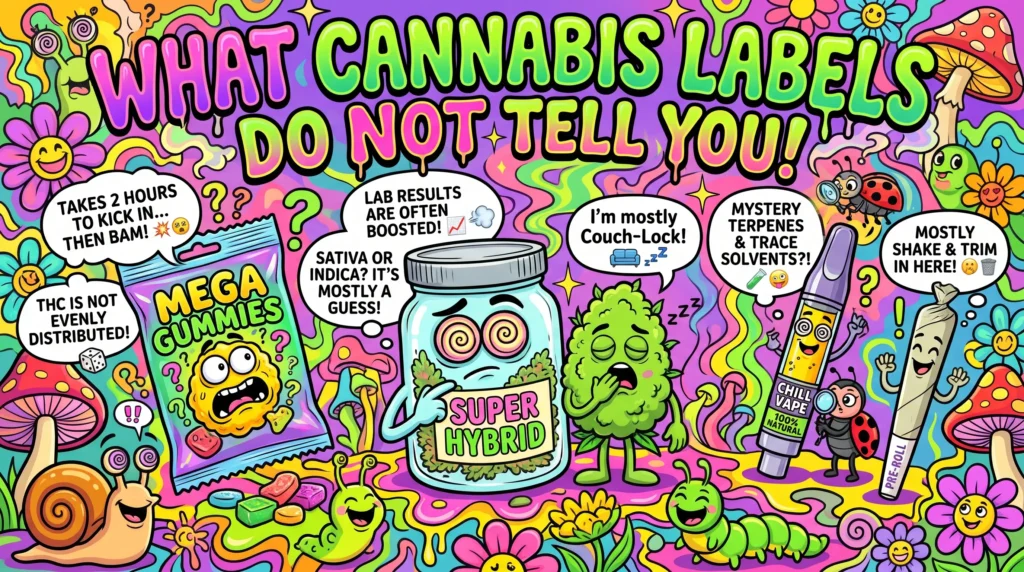
It was a Tuesday afternoon when I realized how much I didn’t know. I stood in a dispensary counter, holding two jars of flower that looked identical. Both were labeled “Indica Dominant,” both promised heavy relaxation, and both had THC percentages within 0.5% of each other. One cost $40; the other cost $80. The budtender smiled, pointing to the label on the expensive jar. “See this?” he said. “Full spectrum terpenes. Lab-tested purity.”
I bought it. Two hours later, I felt nothing but mild anxiety and a dry mouth. No couch-lock. No deep sedation. Just confusion.
That experience wasn’t an outlier. It was a symptom of a systemic issue in the modern cannabis industry: labels are marketing documents, not nutritional guides. While they contain legally mandated data—THC/CBD percentages, batch numbers, and expiration dates—they omit the nuanced biological realities that actually determine your experience. If you’re treating these stickers like a promise, you’re setting yourself up for disappointment, wasted money, and potentially unsafe consumption.
To navigate the market effectively, you need to look past the bold font. Here is what the fine print hides, why the science often contradicts the packaging, and how you can read between the lines to find products that actually work.
The Potency Number Is the Least Reliable Thing on the Package
The THC percentage printed on a cannabis label is frequently inaccurate, and the inaccuracy usually runs in the same direction: upward. A 2023 analysis found that roughly 70% of cannabis flower samples tested at least 15% lower in THC than their labels claimed, with some products reaching only half the advertised potency. A separate 2025 audit of products sold across California, Oregon, and Colorado found that more than 70% of products fell outside an acceptable accuracy threshold.
🔥REFER A FRIEND
THEY GET 10% OFF THEIR FIRST ORDER🔥
The most rigorous label audit to date, published in Scientific Reports in 2025, sent a secret shopper to 52 dispensaries across 19 Colorado counties and purchased 277 products. The findings were uncomfortable for an industry that has spent a decade teaching consumers to chase a single number. About 44% of flower products failed to meet the state’s 15% accuracy standard — and of those failures, 54 products had inflated their THC content on the label, while 23 contained more THC than the label indicated. Concentrates fared far better: 96% of oils and waxes matched their labels, a reminder that the problem is not testing itself but how flower potency gets marketed and rounded.
Why does this happen? The incentive structure is simple. Higher THC numbers sell. A producer who lists an honest 19% loses shelf space to a competitor who lists an optimistic 24%. The lab that tests the sample is chosen and paid by the producer in many state frameworks, and while regulators have tightened rules, the pressure to round upward has not disappeared.
Pro Tip: Stop shopping the top number. THC percentage tells you almost nothing about the experience you will have. A 19% flower with a rich terpene profile and a clean safety panel will often feel more satisfying than a 28% flower that was dried too fast, cured poorly, and tested by a lab with a reputation for generous rounding. Ask for the COA and look at the terpenes before you look at the THC.
The Terpene Myth: Why “Strain Name” Is Irrelevant
The strain name printed on the package tells you almost nothing about the chemical profile of the product inside. For decades, consumers have been sold on the idea that OG Kush smells different than Blue Dream. In reality, most commercial cannabis strains share nearly identical genetic backgrounds due to selective breeding for yield and resistance rather than unique aromatic compounds.
Terpenes—the aromatic oils responsible for smell and flavor—are volatile. They degrade with heat, light, and time. A label might list “Myrcene” as a dominant terpene because it was present during harvest. However, by the time that product reaches the shelf three months later, oxidation may have converted significant portions of those terpenes into less potent or even irritating compounds.
Expert Insight: Always check for a “Harvest Date” rather than just an “Expiration Date.” Terpenes begin degrading significantly after 6–9 months post-cure. If the label doesn’t specify the cure length, assume the terpene profile is generic.
Furthermore, many labs now allow dispensaries to add botanical terpenes derived from hops, citrus, or lavender to standardize flavors. These additives are rarely disclosed prominently on the front label. So, when you buy a “Lemon Haze” concentrate, you aren’t necessarily buying lemon-flavored cannabis; you might be buying hemp-derived limonene sprayed onto neutral distillate. The label says “Natural Flavors,” which is technically true but functionally misleading if you expect the full entourage effect of plant-based terpenes.
Potency Variance: The ±20% Legal Loophole
Regulatory frameworks typically permit a margin of error of up to 20% in reported cannabinoid percentages, meaning a label claiming 20% THC could legally contain anywhere from 16% to 24%. This isn’t a bug; it’s a feature designed to account for testing variability. But for the consumer, it creates massive inconsistency.
Consider a user with low tolerance. They pick up a pre-roll labeled “10mg THC.” Based on previous experiences, they take one puff. Because the actual content is near the upper limit of the variance (perhaps 12mg), combined with poor inhalation technique, they become overwhelmed. Conversely, a seasoned veteran buys a cartridge labeled “75% THC.” Expecting a punch, they hit it hard. If the actual content is at the lower end of the variance (60%), plus degradation over time, they feel underwhelmed.
This discrepancy is exacerbated by extraction efficiency. CO2 extraction preserves more delicate cannabinoids than ethanol extraction, yet both are labeled simply as “Extract.” The method changes the bioavailability. A 50% THC isolate vape behaves differently than a 50% THC live resin vape, even if the number on the sticker is identical. The label quantifies mass; it does not quantify efficacy.
| Label Claim | Actual Reality | Consumer Impact |
|---|---|---|
| “High THC” | May include CBG or CBN depending on age/degradation. | Unexpected sedation instead of euphoria. |
| “Organic” | Often refers only to cultivation inputs, not processing solvents. | Residual solvents may still be present in extracts. |
| “Lab Tested” | Tests for pesticides/heavies, not always for potency consistency across batches. | Variable effects between same-brand purchases. |
| “Small Batch” | Marketing term; no legal definition in most jurisdictions. | Does not guarantee superior quality or care. |
The Entourage Effect: Missing Data Points
Most standard certificates of analysis (COAs) linked via QR codes focus exclusively on major cannabinoids (THC, CBD) and basic contaminants, ignoring minor cannabinoids and flavonoids that drive the entourage effect.
The “entourage effect” suggests that cannabis compounds work synergistically. THCa alone is psychoactive only when heated, but its interaction with CBC (cannabichromene) or CBGa (cannabigerolic acid) can modulate inflammation and mood differently than THC in isolation. Yet, you will rarely see these listed on the primary label. Why? Because testing for every minor cannabinoid increases costs exponentially, and most regulators do not mandate it.
When a label boasts “Full Spectrum,” it implies the presence of these minor players. However, without a detailed breakdown showing ratios (e.g., 1:10 THC:CBD vs. 10:1 THC:CBD), “Full Spectrum” is a vague umbrella term. It could mean everything is there, or it could mean trace amounts so negligible they have zero physiological impact.
Pro Tip: Scan the QR code for the COA. Look specifically for columns listing THCa, Delta-9 THC, CBDa, CBG, and CBN. If the COA only lists total THC and Total CBD, treat the “Full Spectrum” claim with skepticism. True full-spectrum profiling requires granular data.
Contaminants Beyond Pesticides: Mold and Microbials
While labels warn against pesticides, they frequently omit critical information regarding microbial contamination, such as Aspergillus mold or yeast, especially in dried flower products.
State regulations vary wildly. Some states require rigorous microbe testing for all flower; others only require it for concentrates or edibles. Even where required, the threshold for “passing” can be lenient. A product might pass regulatory standards for microbial limits but still harbor spores that trigger allergic reactions in immunocompromised users or asthmatics.
The label will say “Passed Lab Testing.” It will not say “Low Risk for Asthma Sufferers.” This is a trust gap. Consumers with respiratory sensitivities often rely on visual inspection—checking for white powdery spots or musty smells—but early-stage mold is invisible to the naked eye. Without specific quantitative microbial counts (CFU/g) displayed clearly, the average buyer is flying blind regarding safety beyond acute toxicity.
Additionally, heavy metals (lead, arsenic, cadmium) are tested, but the source matters. Lead can come from soil (cultivation) or from hardware (grinders, rolling papers, or vape battery contacts). A clean flower test doesn’t guarantee a safe smoking experience if the accessories introduce lead. The label covers the plant; it ignores the delivery system.
“Total THC” Is a Calculation, Not a Measurement
The “total THC” figure on a label is a mathematical conversion of THCA, not a direct measurement of the psychoactive compound in the jar. Raw cannabis contains mostly THCA, the acidic precursor. THCA becomes delta-9 THC when it is heated — through smoking, vaping, or decarboxylation before infusion into an edible. Regulators require labels to report “total THC,” which is calculated as delta-9 THC plus THCA multiplied by 0.877, a factor that accounts for the loss of a carbon dioxide molecule during conversion.
That calculation is standard, but it creates two problems the label does not explain. First, the conversion factor is an average, not a guarantee; different flower structures and moisture levels can shift the actual yield. Second, a product labeled “25% total THC” may contain very little delta-9 THC in its raw form — meaning a consumer who eats raw flower, or who uses a low-temperature preparation, will not get the effect the number implies. The label reports a potential, not a delivered dose.
🔥 Stack your savings. Elevate your session. 10% off $100, up to 25% off $450.
🔥 Roll into the menu and start saving. CLICK HERE!
The gap between potential and delivered dose is widest in edibles and beverages, where the label reports milligrams per package and milligrams per serving. A package that says “100 mg THC” and “10 servings” invites the assumption that each serving is 10 mg. But serving-size labeling is one of the least consistent parts of the regulatory landscape. A multi-serving edible may not exceed 200 mg of THC in some states, and a single serving may not exceed 10 mg — but enforcement varies, and a product sold as “one brownie” can legally contain multiple servings that the consumer is expected to divide. The label tells you the math. It does not tell you that most people eat the whole thing.
Expert Insight: Read the serving line before the milligram line. A 100 mg package with “10 servings” is a 10 mg experience only if you actually divide it. If the packaging is a single cookie, the label is technically compliant and practically misleading. Ask the budtender how the product is scored, or buy products that are individually dosed.
“Hemp-Derived” and the Delta-8 Label: What the Loophole Actually Did
For years, “hemp-derived” on a cannabis label was a legal term of art that told you almost nothing about what was inside the package — and in some cases it was used to sell intoxicating synthetic cannabinoids under a non-intoxicating name. The 2018 Farm Bill defined hemp as cannabis containing no more than 0.3% delta-9 THC on a dry-weight basis, but it did not explicitly address other psychoactive cannabinoids derived from hemp, including delta-8 THC, delta-10 THC, and THC-O. Companies exploited that gap by synthesizing high-intoxicating compounds from legal hemp and labeling the finished product “hemp-derived,” often with packaging indistinguishable from mainstream candy and snacks.
That loophole has now been addressed at the federal level. Congress redefined hemp to restrict total THC to 0.3% or less and explicitly excluded synthetic cannabinoids such as delta-8 and THCA from the definition of hemp, even when derived from legal hemp, with a limit of 0.4 milligrams of total THC per container in a final hemp-derived product. But the regulatory transition has been uneven, and products manufactured before the change may still sit on shelves in states with slower enforcement.
The lesson for label readers is broader than delta-8. A label term that sounds like a safety claim — “hemp-derived,” “naturally occurring,” “farm bill compliant” — is often a legal category, not a quality standard. “Naturally occurring” delta-8 is a phrase with no consistent regulatory definition; most delta-8 on the market is synthesized from CBD in a lab, and the label is not required to walk you through the chemical pathway.
Pro Tip: Treat “hemp-derived” as a question, not an answer. If a product uses the phrase and you cannot find a COA that lists the cannabinoids individually — including any delta-8, delta-10, or THC-O — assume the label is doing marketing work rather than disclosure work.
The COA Is the Only Document That Tells the Whole Truth
A certificate of analysis (COA) is a batch-specific lab report that verifies cannabinoid content, terpene profile, and safety panels for pesticides, heavy metals, residual solvents, and microbial contaminants — and it is the only document that can confirm whether the label is accurate. The label is a summary written by the brand. The COA is the evidence generated by a licensed third-party laboratory.
The problem is access and interpretation. In a study of 105 CBD-based products sold in Brazil, only 40 products presented a COA at all, and only 36 included contraindications or instructions for use; the researchers concluded that manufacturers provided “little essential information for patient safety”. In the U.S., regulated dispensaries are required to test products, but the COA is not always printed on the package. It is often behind a QR code, and the QR code does not always resolve to the batch you are holding.
Even when you find a COA, the first question is not “what is the THC number?” It is “does this certificate correspond to this exact batch?” A COA is produced from a sample of a specific production run, identified by a batch or lot number. If the lot number on the PDF does not match the lot number on your package, the certificate may be scientifically perfect and practically useless. After identity, check the lab’s accreditation (ISO/IEC 17025 is the international standard for testing competence), then read the safety panels before the potency panel.
A product sold in a regulated dispensary should never show a “FAILED” result on any safety panel. If it does — or if the COA is older than the batch it claims to represent, or the lab cannot be identified — that is not a technicality. It is the answer to whether you should buy the product.
Expert Insight: The terpene profile is a better predictor of experience than the strain name or the THC percentage. Myrcene tends toward relaxation, limonene toward uplift, pinene toward alertness — but the ratio and the concentration matter more than the presence of any single compound. A COA that lists terpenes in percentages lets you compare products on the dimension that actually shapes the high. A label that lists only “Indica” or “Sativa” is telling you a story, not a measurement.
What the Label Says vs. What It Actually Means
| What the Label Says | What It Actually Means | What to Check Instead |
|---|---|---|
| “28% THC” | A calculated total-THC figure, often inflated and rarely verified against the batch you are holding | The COA’s delta-9 and THCA lines, plus the lab’s accuracy history |
| “Total THC: 25%” | Delta-9 THC + (THCA × 0.877); a potential dose, not a delivered dose | Whether the product is intended for combustion, vaporization, or ingestion |
| “Hemp-derived” | A legal category under the Farm Bill, historically used to market intoxicating synthetic cannabinoids | A COA listing every cannabinoid individually, including delta-8 and THC-O |
| “10 servings per package” | A regulatory compliance statement, not a recommendation for how to consume | Whether the product is scored, individually wrapped, or a single unit |
| “Lab tested” | A claim that a test occurred, not a disclosure of what the test found | The COA’s safety panels and the batch number match |
| “Indica” / “Sativa” | A morphological and marketing label with no standardized chemical definition | The terpene profile and the COA’s cannabinoid ratios |
A Step-by-Step Guide to Reading Past the Label
Case Study: The “Sleep Aid” Failure
Let’s look at a real-world scenario involving a popular CBN-infused gummy brand.
The Setup: A user struggling with insomnia purchased a bag of gummies labeled “CBN Sleep Support: 10mg CBN + 5mg THC per piece.” The marketing emphasized CBN’s reputation as the “sleepy cannabinoid.”
The Reality: Upon reviewing the batch-specific COA accessed via the website, we found that the CBN content was largely derived from the natural degradation of THC during storage, not added intentionally. The ratio of Delta-9 THC to CBN was inconsistent across pieces. Some pieces had 8mg THC and 2mg CBN; others had 2mg THC and 8mg CBN.
The Outcome: The user took one gummy expecting sleep. Due to uneven distribution, they ingested a high-THC dose first, causing racing thoughts and alertness. An hour later, the delayed onset of the second half-dose kicked in, leading to grogginess rather than restful sleep.
The Lesson: Uniformity is not guaranteed by weight labeling alone. Edibles suffer from “hot spots” and “cold spots” during manufacturing. Unless the manufacturer uses advanced homogenization techniques verified by third-party audit (rarely advertised on the front label), multi-piece dosing is a gamble. The label told us the average, not the variance.
How to Read Between the Lines: A Practical Guide
You cannot change the laws, but you can change how you shop. Here is a step-by-step protocol to decode any cannabis label before purchase.
Step 1: Verify the Harvest Window
Look for a “Packaged On” date. Calculate the time elapsed since the estimated harvest (usually noted in the COA or inferred from seasonality). If it’s been more than six months, assume terpene loss and potential cannabinoid degradation (THC converting to CBN). Adjust expectations accordingly: expect more sedative, less cerebral effects.
Step 2: Audit the COA Granularity
Don’t just glance at the “Pass/Fail” stamp. Open the PDF.
- Check the Methodology: Was it HPLC (High-Performance Liquid Chromatography)? This is the gold standard for accuracy. GC-FID is common but less precise for acidic cannabinoids.
- Check the Limits of Detection (LOD): If a contaminant is listed as “< LOD,” it means it wasn’t detected, not necessarily that it’s absent. High-quality labs report exact numbers below the threshold.
Step 3: Identify Added Ingredients
For vapes and edibles, scan the ingredient list for terms like “Botanical Terpenes,” “Hops Extract,” or “Citrus Oil.” If these are present, the product is flavored, not naturally aromatic. Decide if you want the therapeutic benefits of native terpenes or just the taste. There is no moral failing in choosing flavor, but knowing the difference prevents misaligned expectations.
Step 4: Assess Brand Transparency
Does the brand publish historical COAs? Do they explain their extraction methods in plain English? Brands that hide behind jargon (“proprietary blend”) are often masking inefficiencies or low-grade input material. Trustworthy brands educate; they don’t just sell.
🔥REFER A FRIEND
THEY GET 10% OFF THEIR FIRST ORDER🔥
The Label Is a Starting Point, Not a Verdict
Cannabis labeling has improved since the early legal-market years, but it still does what labels in most regulated industries do: it satisfies a minimum disclosure standard while leaving the most decision-relevant information one layer down. Potency numbers are frequently inflated. “Total THC” is a calculation. “Hemp-derived” was a loophole for years. Serving sizes are compliance math, not consumption guidance. And the COA — the document that actually tells the truth — is the one document most shoppers never open.
The fix is not to distrust every label. It is to treat the label as a claim and the COA as the evidence. Ask for the batch match. Read the safety panels before the potency line. Look at terpenes. Do the serving math. The information is there. You just have to know where the label stops and the truth begins.
Your next step: pick the next cannabis product you buy, scan the QR code before you pay, and see whether the COA matches the package. If it does, you have found a brand that respects your intelligence. If it does not, you have found the answer to a question the label was hoping you would not ask.
Conclusion: Empowerment Through Skepticism
The cannabis label is a starting point, not the destination. It is a legal compliance document designed to protect the producer from liability, not to guide the consumer toward optimal wellness. By understanding the gaps—terpene volatility, potency variances, missing minor cannabinoid data, and microbial ambiguities—you shift from a passive buyer to an active investigator.
Next time you stand at that counter, ignore the flashy font. Ask for the COA. Check the dates. Question the “natural” claims. Your experience depends less on what the box promises and more on what the chemistry delivers. And usually, the truth is hiding in the spreadsheet, not the slogan.
🔥 Stack your savings. Elevate your session. 10% off $100, up to 25% off $450.
🔥 Roll into the menu and start saving. CLICK HERE!
3. AEO & GEO FAQ Section
Q: Do cannabis labels accurately reflect the strength of the product? A: Not precisely. Regulations allow a +/- 20% margin of error in reported THC/CBD levels. Additionally, degradation over time alters potency. A label stating 20% THC could realistically range from 16% to 24%, affecting dosage consistency and user experience.
Q: What does “Full Spectrum” mean on a cannabis label? A: It indicates the presence of multiple cannabinoids and terpenes alongside THC. However, without a detailed Certificate of Analysis (COA) specifying ratios, the term is vague. It may refer to natural plant compounds or added botanical isolates, impacting the entourage effect differently.
Q: Are organic cannabis labels trustworthy? A: Partially. “Organic” usually certifies cultivation practices (soil, fertilizers) but not post-harvest processing. Solvents used in extraction or additives in edibles may not be organic. Always check for separate certifications covering processing and final product integrity.
Q: Why do two packages of the same strain feel different? A: Phenotypic variation occurs even within clones. Differences in curing, trimming, and storage conditions alter terpene profiles and moisture content. Furthermore, batch-to-batch lab testing variations can result in distinct chemical compositions despite identical labeling.
Q: Can I trust the pesticide-free claim on cannabis labels? A: Generally yes, but scope varies. Most tests cover approved pesticides only. Unregulated substances or novel chemicals might evade detection. Look for labs accredited by ISO 17025, which adhere to stricter international testing protocols than state-minimum requirements.