
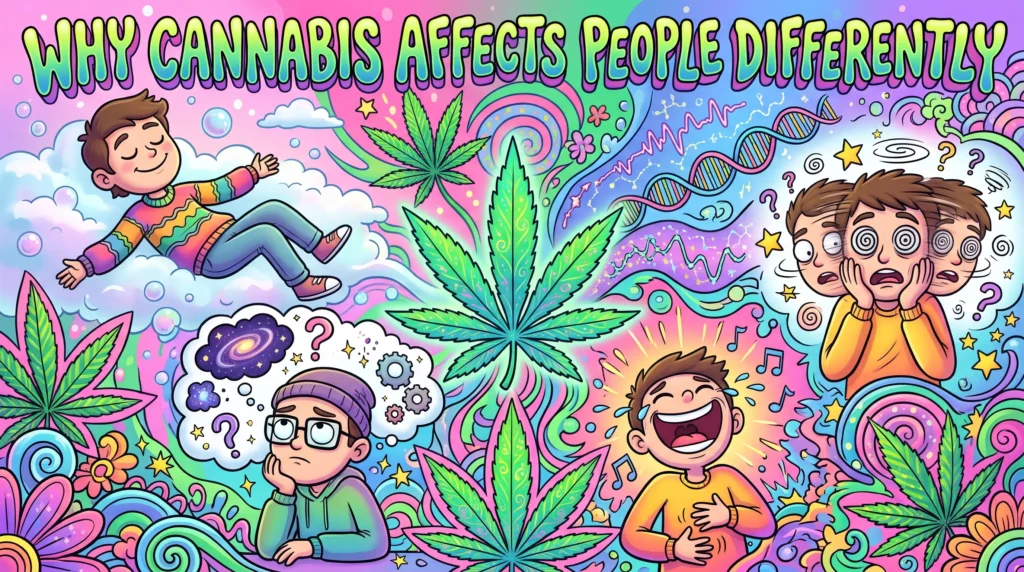
Imagine sitting on a porch with two close friends. You all order the same strain, a popular, Indica-dominant hybrid known for its relaxing properties. One friend leans back with heavy eyes, sinking into an immediate calm. The other friend starts laughing uncontrollably, feeling energized despite the strain’s reputation. And you? You feel nothing. Or worse, you feel anxious with a racing heart, staring at the ceiling and wondering if you’re broken.
This scenario is not rare; it is the norm when it comes to cannabis consumption. It begs the question that plagues many users: “Why do I get higher than my friends?” or, conversely, “Why doesn’t this affect me?” The answer does not lie solely in the plant, but also in the intricate, often invisible, machinery inside your body. We are not merely consuming THC and CBD; we are interacting with our biology.
This article explores the science behind individual variability, examining how the endocannabinoid system, genetic predispositions, metabolic rates, and psychological factors generate unique response profiles for each user. By understanding these mechanisms, you can stop guessing and start curating experiences that align with your specific physiological needs.
🔥REFER A FRIEND
THEY GET 10% OFF THEIR FIRST ORDER🔥
What Is the Endocannabinoid System and How Does It Regulate Cannabis Effects?
The endocannabinoid system (ECS) is a complex cell-signaling network present in nearly all animals, responsible for maintaining homeostasis—balance—in the body. It regulates mood, appetite, sleep, pain sensation, and immune function. When you consume cannabis, phytocannabinoids like THC and CBD bind to ECS receptors (primarily CB1 and CB2), altering cellular communication. Because the density, sensitivity, and baseline activity of these receptors vary significantly from person to person, the resulting psychoactive and therapeutic effects differ drastically. Essentially, your ECS acts as the hardware, while cannabis is the software update; if the hardware is configured differently, the software behaves differently.
To grasp why one joint creates euphoria for Person A and paranoia for Person B, we must look deeper than the flower. The ECS is not static. It fluctuates based on stress levels, diet, exercise, and even time of day. For instance, chronic stress can downregulate CB1 receptors, meaning a user might need higher doses to achieve the same effect as someone with a balanced nervous system. Conversely, acute stress might heighten receptor sensitivity, leading to an intense, overwhelming reaction from a small dose.
Genetic Variability: The Blueprint of Receptor Sensitivity
Genetics play a pivotal role in determining how robustly your ECS responds to external cannabinoids. Specific gene variants, particularly those coding for the CNR1 protein (which forms the CB1 receptor), influence binding affinity. Some individuals possess genetic mutations that make their receptors less sensitive to THC, requiring larger quantities to produce noticeable effects. Others have highly efficient receptors that react strongly to minimal exposure.
Expert Insight: In clinical observations, patients with certain polymorphisms in the FAAH gene (which breaks down anandamide, the body’s natural cannabinoid) often report heightened sensitivity to cannabis. Anandamide accumulates in their system, amplifying the entourage effect when combined with exogenous THC. This explains why some users describe a “clearer” or more potent headspace compared to peers using identical products.
Why Do Metabolism and Body Composition Alter Cannabis Potency?
Metabolic rate and body fat percentage directly dictate how long cannabis stays active in your system and how intensely it affects you. THC is lipophilic, meaning it binds to fat cells. Individuals with higher body fat percentages may store more THC, releasing it slowly over time, which can lead to prolonged but potentially muted effects initially, followed by delayed intensity. Those with lower body fat metabolize THC faster, experiencing quicker onset but shorter duration.
Furthermore, liver enzymes, specifically Cytochrome P450 isoforms, break down THC into 11-hydroxy-THC, a metabolite that is more psychoactive than THC itself. If your liver processes THC rapidly due to genetic enzyme variations, you will generate more 11-hydroxy-THC, leading to a stronger, more sedative “high.” This biochemical conversion is a primary reason why edibles often hit harder than smoked cannabis—the digestive process forces more THC through the liver before entering systemic circulation.
| Factor | Impact on Cannabis Experience | Scientific Mechanism |
|---|---|---|
| Body Fat % | Higher fat = Longer retention, slower release | THC is lipophilic; stored in adipose tissue |
| Liver Enzymes (CYP) | Faster metabolism = Stronger psychoactive peak | Conversion of Delta-9-THC to 11-OH-THC |
| Receptor Density | High density = Lower tolerance needed | More CB1 sites available for THC binding |
| Hydration Status | Dehydration = Increased perceived intensity | Reduced blood volume concentrates cannabinoids |
| Tolerance Level | High usage = Diminished effects | Downregulation of CB1 receptors over time |
Psychological Set and Setting: The Mind’s Role in Perception
Biology is only half the equation. Psychology dictates the other half. The concept of “set and setting,” coined by Timothy Leary but applicable broadly to cannabis, refers to the mindset (set) and environment (setting) in which consumption occurs. Anxiety, expectation, and past trauma can skew perception. If you believe cannabis makes you paranoid, your brain primes itself to interpret neutral stimuli as threatening, triggering a fight-or-flight response amplified by THC’s impact on the amygdala.
Conversely, a relaxed state of mind can enhance positive effects. This is where the question “Why do I get more high than my friends?” often finds its secondary answer. Perhaps your friends are seasoned veterans who have developed cognitive coping mechanisms, viewing the experience as routine. You, however, might be approaching it with novelty or apprehension, causing your sympathetic nervous system to engage more aggressively with the chemical stimulus.
The Entourage Effect: Synergy Beyond THC
Modern research emphasizes the “entourage effect,” suggesting that cannabis compounds work better together than in isolation. Terpenes (aromatic oils) and minor cannabinoids (like CBG, CBN, THCV) modulate how THC interacts with the ECS. For example, Myrcene, a common terpene, is believed to increase cell membrane permeability, allowing THC to cross the blood-brain barrier more easily. Two people smoking the same strain might have different terpene profiles in their lungs depending on how they inhale, hold, and exhale, subtly shifting the synergy and thus the intensity of the high.
The Pharmacokinetic Lottery: How Your Body Processes THC
The first reason two people react differently to the same product is simple: the THC may not be arriving at the same place, at the same concentration, or at the same speed. This is the domain of pharmacokinetics—what the body does to the drug—and the route of administration changes almost everything.
Inhalation vs. Ingestion: Two Completely Different Journeys
Inhaled THC bypasses the liver’s first-pass metabolism. It travels from the lungs into the bloodstream and reaches the brain within seconds to minutes, producing a peak plasma concentration rapidly and a psychotropic effect that peaks around 15 to 30 minutes and largely tapers within two to three hours. The bioavailability of inhaled THC is variable—roughly 10% to 35% of the administered dose—depending on puff depth, breath-hold, and device efficiency.
Oral THC takes a slower, more circuitous path. It is absorbed from the gut, travels to the liver, and undergoes extensive first-pass metabolism before reaching systemic circulation. Psychotropic effects typically begin 30 to 90 minutes after ingestion, peak around two to three hours, and can last four to twelve hours or longer. Oral bioavailability is lower and highly variable, often in the range of 4% to 12% for sesame oil or cookie formulations.
| Route | Onset | Peak Effect | Typical Duration | Bioavailability | Key Consideration |
|---|---|---|---|---|---|
| Inhalation (smoked/vaped) | Seconds to minutes | 15–30 minutes | 2–3 hours | ~10–35% | Rapid titration; effects felt and can be stopped sooner |
| Oral (edibles, capsules, oils) | 30–90 minutes | 2–3 hours | 4–12 hours (sometimes longer) | ~4–12% (variable) | First-pass liver metabolism produces more potent metabolite; delayed onset invites overconsumption |
The practical implication is enormous. A person who is accustomed to the immediate feedback of inhalation may eat an edible, feel nothing for 45 minutes, eat more, and then receive a compounded dose that arrives all at once. That is not a tolerance problem. It is a timing problem.
The Edible Effect: Why 11-Hydroxy-THC Hits Harder
When THC passes through the liver, a significant fraction is converted by cytochrome P450 enzymes into 11-hydroxy-THC (11-OH-THC) . This metabolite crosses the blood–brain barrier more readily and is considered more potent than THC itself. After oral consumption, a much larger proportion of THC is shunted toward this metabolic pathway compared with smoking, which is one reason edibles are frequently described as more “body-heavy,” longer-lasting, and more likely to produce an intense or uncomfortable experience at higher doses.
Expert Insight: The phrase “start low, go slow” is not a slogan. It is a pharmacokinetic necessity. Because oral THC can take up to two hours to peak, the correct move after an edible is to wait—not to redose because “nothing is happening.” A 2.5 mg or 5 mg initial dose, followed by a two-hour observation window, prevents most of the unpleasant surprises that send people to the emergency room.
Your Genetic Blueprint: Enzymes, Receptors, and Metabolism
Even if two people take the exact same dose by the exact same route, their bodies may dismantle that dose at dramatically different speeds. Genetic variation in metabolic enzymes and cannabinoid receptors is a major—and underappreciated—source of individual response.
CYP450 Enzymes: The Liver’s Control Panel
THC is primarily metabolized by the cytochrome P450 family, especially CYP2C9 and CYP3A4/5; CBD is metabolized largely by CYP2C19, CYP3A4, and CYP3A5. Common genetic variants in these genes can produce “poor metabolizer,” “intermediate metabolizer,” or “normal metabolizer” phenotypes.
A 2025 study of 71 oral cannabis users found that atypical variants were common: 31 participants had atypical variants in CYP2C9, 37 in CYP2C19, 6 in CYP3A4, and 15 in CYP3A5. The authors emphasized that these variants may alter THC and CBD metabolism, although clinical outcome data are still maturing. Another line of evidence indicates that the *2/*3 variants in CYP2C9 slow THC clearance and increase overall exposure to the drug.
In plain terms: a slow metabolizer may feel a standard dose more intensely and for longer, while a fast metabolizer may clear the compound quickly and report a milder or shorter experience. This is not a matter of willpower or experience. It is enzymology.
🔥 Stack your savings. Elevate your session. 10% off $100, up to 25% off $450.
🔥 Roll into the menu and start saving. CLICK HERE!
Receptor Variations: CB1 and FAAH
The primary psychoactive effects of THC are mediated by the CB1 receptor, a G-protein-coupled receptor densely expressed in the brain. Genetic variants in the CNR1 gene (which encodes CB1) and in the FAAH gene (which encodes the enzyme that degrades the endocannabinoid anandamide) have been associated with differences in susceptibility to cannabis effects and, in some studies, with addiction-related outcomes. THC is also a partial agonist at CB1, meaning it activates the receptor less fully than the body’s own endocannabinoids or synthetic full agonists; this partial agonism may contribute to a ceiling effect on certain responses and may help explain why very high doses do not produce linearly escalating euphoria in every user.
Pro Tip: If you routinely experience unusually intense or prolonged effects from modest doses—or, conversely, find that standard doses feel disappointingly mild—a pharmacogenomic panel that includes CYP2C9, CYP3A4, and CYP2C19 may offer useful context. It is not yet a routine clinical standard for cannabis, but it is a legitimate tool for the curious and the cautious.
Tolerance and the Plastic Endocannabinoid System
Tolerance is the third pillar of individual variability, and it is far more nuanced than the simple idea that “heavy users need more.”
CB1 Downregulation and Desensitization
Chronic exposure to THC leads to downregulation of CB1 receptors and desensitization of CB1-mediated signaling in the brain. Human PET imaging studies have shown that long-term cannabis smokers have reduced CB1 receptor density in cortical regions, and that receptor density can return to normal after approximately four weeks of monitored abstinence. The downregulation is at least partly epigenetic: the promoter region of the CB1 gene in chronic smokers shows hypermethylation, which reduces CB1 mRNA expression.
Why Tolerance Isn’t Uniform
Not all effects develop tolerance at the same rate. One review notes that variable downregulation across brain regions may explain why frequent users develop tolerance to some effects of THC—such as anxiety provocation and cognitive impairment—but not necessarily to its euphoric effects. A systematic review of human evidence found that regular users show behavioral and physiological tolerance, with cognitive performance showing the highest degree of tolerance and acute intoxicating, psychotomimetic, and cardiac effects showing partial tolerance.
This has a counterintuitive consequence: a person who uses cannabis daily may feel almost nothing from a dose that would overwhelm a novice, yet may still experience measurable impairment in balance or reaction time immediately after use. Tolerance changes the subjective experience, but it does not make the drug biologically inert.
Dose, Potency, and the Biphasic Effect
The same cannabinoid can produce opposite effects at different doses. This is the biphasic dose–response curve, and it is one of the most practically important concepts for anyone trying to understand their own reactions.
The Biphasic Dose-Response Curve
Low doses of THC have been associated with reduced anxiety and a mild sense of well-being, while higher doses can provoke anxiety, panic, and sympathetic nervous system activation. CBD also demonstrates biphasic properties in some assays: pure CBD may reduce pain at lower doses but lose efficacy or plateau at higher doses, whereas a full-spectrum extract containing equivalent CBD can produce a more linear, dose-proportional response. The shape of the curve is not merely academic. It explains why “more” is not always “better,” and why a dose that felt pleasant last week can feel overwhelming this week if the product’s potency or your sensitivity has shifted.
The Entourage Effect and Product Variability
Cannabis contains dozens of cannabinoids and terpenes beyond THC and CBD. The entourage effect is the hypothesis—supported by a growing but still debated body of evidence—that these compounds modulate one another’s effects. In a randomized trial of oromucosal extracts for intractable pain, a THC-predominant extract failed to separate from placebo, while a whole-plant extract containing both THC and CBD was significantly better than both. In epilepsy research, CBD-rich botanical extracts have produced higher response rates at lower CBD doses than purified CBD, suggesting that minor cannabinoids and terpenes contribute to the clinical picture.
Commercial product labels add another layer of uncertainty. Analyses of legal cannabis in the United States have found that strain labels do not consistently align with observed chemical diversity, and that labeled THC potency can diverge from measured potency. Two products called “Blue Dream” from different producers may not deliver the same cannabinoid profile. The product is a variable, not a constant.
Sex, Body Composition, and Age: The Biological Modifiers
Individual response is also shaped by stable biological traits that have nothing to do with tolerance or expectation.
Sex Differences in THC Sensitivity
Evidence suggests that females may be more sensitive to the intoxicating and misuse-related effects of THC, and some studies have documented heightened pharmacodynamic sensitivity in females relative to males. A 2024 study found that slow-metabolizer status—conferred by reduced-activity CYP2C9 or CYP3A4 alleles—was more prevalent among females with cannabis use disorder than among female controls, and that male slow metabolizers reported more negative early subjective effects. The authors concluded that genetic variation in these enzymes may have sex-specific associations with cannabis outcomes. The picture is not uniform across all studies, but the takeaway is clear: sex is a relevant biological variable, not a social afterthought.
Body Fat as a Reservoir
THC is highly lipophilic. It sequesters in adipose tissue, reaching peak concentrations in fat within several days, and is then slowly released back into circulation. Because of this sequestration, the terminal elimination half-life of THC is approximately seven days, and complete elimination of a single dose can take up to 30 days. Exercise can mobilize stored THC: one study found that exercise-induced increases in plasma THC were positively correlated with body mass index, suggesting that individuals with more body fat may release a larger bolus of dormant cannabinoid during fat burning. This does not mean that body fat determines intoxication in a simple way, but it does mean that two people with different body compositions may have different circulating cannabinoid profiles even weeks after their last use.
Age-Related Changes
Hepatic enzyme activity, body composition, and receptor density all change with age. Older adults often have a higher proportion of body fat and may metabolize drugs more slowly, which can amplify and prolong cannabis effects. This is one reason clinical guidance for medical cannabis consistently recommends lower starting doses and slower titration in older patients.
🔥REFER A FRIEND
THEY GET 10% OFF THEIR FIRST ORDER🔥
Set, Setting, and Expectancy: The Mind’s Role
Biology explains a great deal, but it does not explain everything. What a person expects to feel, and the environment in which they use cannabis, can measurably shape the experience.
Classic research on marijuana expectancy found that experienced users with a well-developed set of expectations can sometimes achieve the effects of marijuana from a placebo, and that social setting and belief interact with smaller doses of the drug. More recent work on CBD expectancy has shown that believing one has consumed CBD can alter amygdala-based neural responses to stress, independent of the pharmacological content. This is not to say that cannabis effects are “all in your head.” It is to say that the brain is not a passive receiver of a chemical signal. It is an active interpreter, and interpretation depends on context, prior experience, and belief.
A Practical Framework for Finding Your Dose
The science points toward a personalized, iterative approach rather than a one-size-fits-all rule. Here is a step-by-step framework that translates the mechanisms above into actionable practice.
Step 1: Choose your route deliberately. If you want rapid feedback and the ability to stop escalating quickly, inhalation offers faster onset and shorter duration. If you want prolonged relief or a longer experience, oral consumption is appropriate—but only with a disciplined waiting period.
Step 2: Start below your expected threshold. For oral products, a reasonable starting point for most adults is 2.5 mg to 5 mg THC, taken on a relatively empty stomach. For inhalation, one or two low-potency puffs, followed by a 10- to 15-minute pause, is a sensible calibration.
Step 3: Wait the full pharmacokinetic window before redosing. With edibles, that means at least 90 to 120 minutes. With inhalation, 15 to 30 minutes. Redosing before the peak is how most “bad trips” are manufactured.
Step 4: Record the variables, not just the dose. Note the product, the labeled potency, the route, the time of day, your recent food intake, your mood before use, and the company you were with. Over several sessions, patterns will emerge that no generic dosing chart can provide.
Step 5: Adjust one variable at a time. If you change the product and the dose and the setting simultaneously, you learn nothing. Change one thing, observe, and then decide.
Case Study: The Divergent Responses of Alex and Jamie
Let’s look at a real-world application of these principles. Alex and Jamie are college roommates in Toronto. Both are healthy, non-smokers otherwise, and buy the same 3.5g jar of “Blue Dream” from a local dispensary.
Alex consumes 0.5g via vaporizer. Within ten minutes, he feels a mild buzz, improved focus, and slight relaxation. He remains functional, able to study. Jamie consumes the same amount. Twenty minutes later, she reports dizziness, rapid heartbeat, and intense cerebral stimulation. She describes feeling “too high” and unable to concentrate.
Analysis:
- Genetic Difference: Jamie likely has a higher density of CB1 receptors or a variant of the COMT gene (affecting dopamine breakdown) that makes her more sensitive to dopaminergic spikes caused by THC.
- Metabolic Rate: Alex may have a faster basal metabolic rate, clearing THC quickly, whereas Jamie’s slower metabolism retains the compound longer, increasing cumulative exposure.
- Psychological Baseline: Alex uses cannabis recreationally without stigma. Jamie has underlying performance anxiety. The THC exacerbates her cortisol levels, creating a feedback loop of stress and intoxication.
This case illustrates that “dosage” is subjective. One gram is not equal to another gram across different bodies. Understanding this helps users titrate correctly. Instead of asking “How much should I take?”, ask “How does my body process cannabinoids?”
Actionable Steps to Navigate Your Unique Biology
If you struggle with inconsistent effects, follow this protocol to map your personal response curve.
- Track Your Biometrics: Keep a simple log. Note your weight, hydration level, recent meals, and stress score (1-10) before consumption. Correlate this with the intensity of the high reported 1 hour post-consumption. Over time, patterns will emerge. Example: You may notice you always feel overly sedated after heavy carb meals, indicating insulin-related changes in receptor sensitivity.
- Microdose Strategically: Start with 2.5mg of THC or less. Wait 90 minutes. Edibles and concentrates have delayed onsets. Rushing leads to overconsumption because the initial lack of effect tricks the brain into thinking “more is needed.”
- Rotate Strains Based on Terpene Profiles: Don’t just chase THC percentage. Look for terpenes. If you want energy, choose Limonene-rich strains. If you want sleep, pick Myrcene or Caryophyllene. Observe how your body reacts to these aromatic compounds independently of the cannabinoid load.
- Manage Tolerance Intentionally: If you find yourself needing more to feel less, implement a “tolerance break.” Stop consumption for 2–4 weeks. This allows CB1 receptors to upregulate (return to normal density), resetting your sensitivity. Most users underestimate the power of abstinence in restoring efficacy.
- Consult Bloodwork (Advanced): For medical users, discussing endocannabinoid tone with a healthcare provider can reveal deficiencies. Low anandamide levels, for instance, might suggest that CBD supplementation could help regulate your system before introducing THC, smoothing out the ride.
Pro Tip: Hydrate aggressively before and during consumption. Dehydration thickens the blood, concentrating circulating cannabinoids and intensifying side effects like dry mouth and tachycardia. Drinking water dilutes the plasma concentration, providing a smoother, more manageable experience.
Debunking Common Myths About Cannabis Sensitivity
Myth 1: “Women are always more sensitive to cannabis than men.” Reality: While estrogen can interact with the ECS, making women potentially more susceptible to certain effects during specific menstrual phases, testosterone also plays a role. Individual variation outweighs gender averages. A man with low body fat and high receptor density may be far more sensitive than a woman with higher adipose tissue.
Myth 2: “If it doesn’t hit hard, the product is bad.” Reality: Potency is relative to physiology. A low-THC strain might produce a profound effect in a naive user but none in a veteran. Quality is determined by purity and terpene preservation, not just raw force. Blaming the product for a lack of effect ignores the user’s biological context.
Myth 3: “Edibles are always stronger than smoking.” Reality: Edibles convert THC to 11-hydroxy-THC, which crosses the blood-brain barrier more efficiently. However, this depends entirely on liver function. Someone with impaired hepatic processing may experience weaker edible effects than expected, while a fast metabolizer might feel overwhelmed. It is not universally “stronger”; it is mechanistically different.
🔥 Stack your savings. Elevate your session. 10% off $100, up to 25% off $450.
🔥 Roll into the menu and start saving. CLICK HERE!
Final Thoughts: Embracing Biological Diversity
Cannabis is not a monolith; it is a mirror reflecting the complexity of human biology. The disparity in effects between friends is not a flaw in the plant, nor a failure of the user—it is evidence of the diverse ways our endocannabinoid systems maintain balance. By shifting focus from “what works for others” to “how my body responds,” you gain agency over your experience.
Stop comparing your high to someone else’s. Start listening to your physiology. Track your reactions, respect your tolerance limits, and honor the genetic lottery that defines your unique interaction with cannabinoids. When you understand why you get more high than your friends—or less—you transform cannabis from a gamble into a precise tool for wellness and recreation.
Ready to refine your regimen? Begin today by logging your next three sessions with detailed notes on set, setting, and physical sensations. Patterns will reveal themselves, guiding you toward a personalized, optimized relationship with cannabis.
FAQ Section
Q: Why do I get more high than my friends? A: This usually stems from differences in endocannabinoid system receptor density, metabolic speed, or body fat percentage. Higher CB1 receptor sensitivity or slower liver enzyme activity can amplify THC effects, making you feel intoxicated more intensely than peers with different genetic baselines.
Q: Does the endocannabinoid system change over time? A: Yes, the ECS is dynamic. Chronic use can downregulate CB1 receptors, reducing sensitivity (tolerance). Factors like stress, diet, and age also alter receptor availability. Taking breaks allows the system to reset, restoring baseline sensitivity and effectiveness of subsequent doses.
Q: Are edibles always stronger than smoking cannabis? A: Not necessarily for everyone. Edibles convert Delta-9-THC into 11-hydroxy-THC via the liver, which is more psychoactive. However, individual liver metabolism rates vary. Fast metabolizers may feel intense effects quickly, while slow processors might experience delayed, milder responses compared to inhalation.
Q: Can genetics determine how cannabis affects me? A: Absolutely. Gene variants affecting CNR1 (CB1 receptor structure) and COMT (dopamine processing) significantly influence susceptibility. These genetic markers dictate how tightly THC binds to receptors and how neurotransmitters respond, creating inherent differences in potency perception among users.
Q: Why does cannabis affect me differently on empty vs. full stomach? A: Food, especially fats, slows gastric emptying, delaying the onset of edible effects but potentially extending duration. On an empty stomach, absorption is faster, leading to a sharper spike in blood THC levels, which can cause sudden, intense highs or anxiety if unprepared.