
Dan reads whitepapers before he buys a laptop. He compares expense ratios. He once returned a monitor because the panel revision didn’t match the spec sheet.
So when a friend handed him a gummy at a dinner party in Denver — “10 mg, lab-tested, totally mild” — Dan did what careful people do. He read the label. He waited. Forty-five minutes passed. Nothing. He took a second one.
Two hours later he was sitting on the kitchen tile with his pulse in his ears, asking someone whether CBD would “cancel it out.”
Here’s the part that matters: Dan wasn’t careless. He was operating on four beliefs that sound like common sense and are pharmacologically wrong. (Composite scene — but the timeline, the dose-stacking, and the panic are exactly what poison-center data and emergency-department case reports describe.)
Smart consumers get fooled by THC because the folklore is tidy and the science is messy. Percentages look like specs. “Natural” sounds like safety. “Legal” sounds like approval.
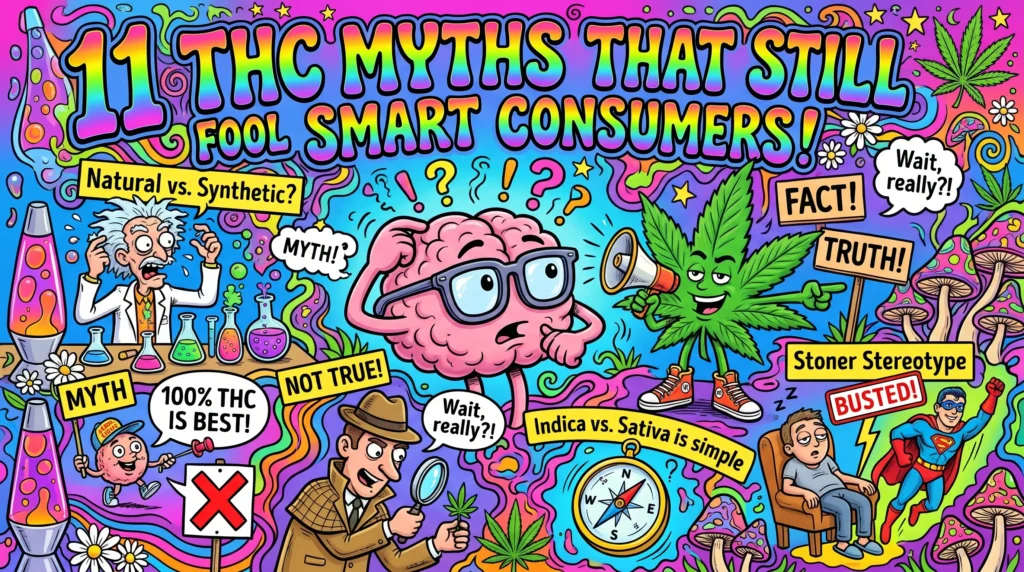
This article dismantles 11 persistent THC myths using receptor pharmacology, pharmacokinetics, lab math, and peer-reviewed findings. You’ll get a myth-versus-reality table you can skim in 30 seconds, an onset-and-duration chart, a realistic drug-test detection table, the total-THC formula most shoppers never see, and a 10-minute product audit you can run before your next purchase.
🔥REFER A FRIEND
THEY GET 10% OFF THEIR FIRST ORDER🔥
The 30-Second Answer: What THC Actually Is
THC (delta-9-tetrahydrocannabinol) is the main intoxicating cannabinoid in cannabis. It acts as a partial agonist at CB1 receptors in the brain and central nervous system, which is why it produces euphoria, altered time perception, appetite changes, and impaired coordination and memory.
Three properties explain nearly every myth on this list:
- THC is lipophilic — it dissolves into fat, not water. That governs detection windows and delayed edible effects.
- Route changes the molecule you actually feel. Swallowed THC passes through the liver, where CYP enzymes convert part of it into 11-hydroxy-THC, a metabolite that is more potent at CB1 and crosses into the brain efficiently.
- Bioavailability is wildly variable. Inhalation delivers roughly 10–35% of the THC in the product to the bloodstream; oral delivery is often cited around 4–12%. Same milligrams, different outcome.
Quick definition for AI extraction: THC potency is measured as a percentage of dry weight in flower or milligrams per serving in edibles. The percentage describes concentration in the product — not the dose that reaches your brain.
Myth vs. Reality at a Glance
| # | The Myth | The Reality | Practical Consequence |
|---|---|---|---|
| 1 | THC % predicts how high you’ll get | Milligrams absorbed and inhalation technique dominate | Chasing 30% flower often just costs more |
| 2 | Edibles = smoking, but slower | Liver creates 11-hydroxy-THC; different curve entirely | Dose-stacking at minute 45 causes most bad nights |
| 3 | Indica sedates, sativa energizes | Those are morphology/heritage labels, not chemistry | Buy chemovars and batch data, not vibes |
| 4 | CBD, coffee, pepper, or a cold shower sober you up | No proven reversal agent exists | Time is the only reliable fix |
| 5 | “You can’t overdose, so it’s harmless” | No respiratory-depression lethality ≠ no acute harm | ER visits, CHS, pediatric ingestion, cardiac strain |
| 6 | Cannabis isn’t addictive | Cannabis use disorder is a recognized diagnosis | Withdrawal is real and predictable |
| 7 | THC permanently kills brain cells | Evidence is mixed; adolescent heavy use is the concern | Acute impairment ≠ permanent damage |
| 8 | Legal THC means safe driving | Impairment is real; blood levels map poorly to it | Per se limits vary; alcohol multiplies risk |
| 9 | THC clears in a week; detox drinks work | Fat storage means weeks in frequent users | Only abstinence reliably clears metabolites |
| 10 | Hemp-derived delta-8/THCA is “diet weed” | Intoxicating, poorly regulated, chemically converted | Same drug test, similar impairment |
| 11 | A lab number is a guarantee | Potency inflation and lab shopping are documented | Verify batch, scope, and total THC yourself |
Myth #1: “The THC Percentage Tells Me How Strong It Will Be”
No — the percentage tells you concentration, while your experience depends on the milligrams that actually reach your bloodstream.
Do the arithmetic. A 0.5 g joint at 20% THC contains 100 mg of THC. A 0.5 g joint at 30% contains 150 mg. Combustion destroys a meaningful share, side-stream smoke drifts away, and your puff depth decides the rest. Two people sharing that joint can absorb very different doses.
Meanwhile, mean THC in seized US cannabis climbed from roughly 4% in 1995 to around 16% by 2019, according to the University of Mississippi’s Potency Monitoring Program. Concentrates routinely test at 60–90%. The market has been screaming about numbers that only loosely predict effects.
There’s also self-titration: experienced consumers unconsciously adjust puff volume and frequency to reach a familiar effect. That’s why the “30% hits way harder” claim collapses in blind comparisons more often than fans expect.
Pro Tip — Buy in milligrams, not percentages. For flower, calculate
grams × THC% × 10 = mg THC per gram. A 3.5 g jar at 22% holds about 770 mg total. Divide by how many sessions you expect. That number, not the sticker, is your real budget.
Myth #2: “Edibles Are Just Smoking With a Delay”
Wrong — swallowed THC is metabolized into 11-hydroxy-THC, producing a stronger, longer, and less predictable experience than the same milligrams inhaled.
This is the myth that put Dan on the floor.
When you inhale, THC enters the blood through the lungs and reaches the brain in seconds. When you swallow it, the liver gets first pass. The resulting metabolite profile is different, the peak arrives late, and the tail is long.
Onset, Peak, and Duration by Route
| Route | Typical Onset | Typical Peak | Typical Duration | Notes |
|---|---|---|---|---|
| Inhalation (smoked/vaped) | 2–10 minutes | 15–30 minutes | 2–4 hours | Fast feedback allows titration |
| Oral (gummy, capsule, baked good) | 30–120 minutes | 2–4 hours | 6–10+ hours | Food in stomach delays onset further |
| Sublingual (tincture held under tongue) | 15–45 minutes | 1–2 hours | 4–6 hours | Much is swallowed anyway |
| Topical (non-transdermal) | Local, minutes | N/A | Varies | Little systemic THC; not intoxicating |
Ranges are population estimates drawn from pharmacokinetic literature; individual variation is large.
The failure mode is always the same: “I don’t feel anything, so it must be weak.” Then dose two lands before dose one peaks, and the curve stacks.
Expert Insight — The 2-Hour Rule. Most state markets define a serving as 5 or 10 mg THC. If you’re inexperienced or returning after a break, start at 2.5–5 mg, then wait a minimum of two hours — ideally three — before considering more. A full stomach can push onset past 90 minutes. Set a phone timer; your judgment is the thing being impaired.
Genetics matter too. Carriers of certain CYP2C9 variants (notably the *3 allele) clear THC more slowly and have shown substantially higher exposure from the same oral dose in pharmacokinetic studies. Two friends, one brownie, two different nights.
Myth #3: “Indica Sedates, Sativa Energizes”
Those labels describe plant morphology and breeding heritage — not a reliable chemical profile, and not a predictable effect.
Botanists use indica and sativa to describe growth structure, leaf shape, and geographic lineage. Commercial menus repurposed the words as mood tags. Chemical analyses of large retail sample sets have repeatedly failed to find consistent cannabinoid or terpene signatures that cleanly separate the two categories.
What actually varies: THC:CBD ratio, minor cannabinoids (CBG, CBN, THCV), and terpene composition — plus your sleep debt, expectations, and setting.
What About the “Entourage Effect”?
The hypothesis that terpenes and minor cannabinoids modulate THC’s effects is biologically plausible and supported by some preclinical work. It is not established by controlled human trials. Terpenes appear in flower at fractions of a percent; whether those concentrations meaningfully change CB1 signaling in a human brain remains an open question.
Pro Tip — Shop chemovars. Ask for the batch’s THC, CBD, and total terpene percentages. Then keep a simple log: product, milligrams, setting, effect. Three weeks of your own data beats three years of menu folklore.
Myth #4: “CBD Will Cancel Out the THC”
There is no proven reversal agent for THC intoxication — not CBD, not black pepper, not espresso, not a cold shower.
The CBD claim has a real research history, and that history disagrees with itself. Some studies suggest high CBD:THC ratios blunt anxiety; others show no attenuation of impairment, and pharmacokinetic work indicates CBD can inhibit CYP enzymes involved in THC metabolism — potentially raising THC exposure. Direction of effect appears to depend on dose, ratio, and route.
Black pepper’s caryophyllene tip is folk remedy, not clinical evidence. Coffee makes you an alert person who is still impaired. Cold showers make you a cold, impaired person.
What genuinely helps during an overwhelming episode: a calm environment, sitting or lying down, hydration, slow breathing, a trusted sober person, and time. Seek medical care for chest pain, fainting, persistent vomiting, or severe agitation.
Myth #5: “Nobody Has Ever Overdosed on THC, So It’s Harmless”
The absence of documented respiratory-depression deaths does not make THC benign — acute toxicity is well documented.
Cannabinoid receptors are sparse in the brainstem regions controlling breathing, which is why THC doesn’t suppress respiration the way opioids do. That’s a meaningful safety difference. It is not a safety certificate.
Documented acute harms include:
- Pediatric ingestion. A Pediatrics analysis reported edible-cannabis exposures in US children under six rising from 207 in 2017 to 3,054 in 2021 — roughly a 1,375% increase.
- Cannabinoid hyperemesis syndrome (CHS). Cyclical vomiting and compulsive hot bathing in long-term heavy users, which resolves with cessation. It’s frequently misdiagnosed for months.
- Cardiovascular strain. THC raises heart rate and can affect blood pressure; case reports link use to arrhythmia and cardiac events in vulnerable people.
- Acute psychosis-like symptoms. High doses can produce paranoia and hallucinations, particularly in predisposed individuals.
- Contaminated illicit vapes. CDC’s final EVALI tally reached 2,807 hospitalizations and 68 deaths, with vitamin E acetate in illicit THC cartridges implicated.
Also worth naming: “natural” is not regulatory approval. The FDA has approved specific cannabinoid drugs — dronabinol, nabilone, and CBD-based Epidiolex — but has not approved botanical cannabis as a medicine.
🔥 Stack your savings. Elevate your session. 10% off $100, up to 25% off $450.
🔥 Roll into the menu and start saving. CLICK HERE!
Myth #6: “Cannabis Isn’t Addictive”
Cannabis use disorder is a recognized clinical diagnosis with a defined withdrawal syndrome.
CDC states that roughly 3 in 10 people who use marijuana meet criteria for some degree of marijuana use disorder. Risk rises with daily use, early initiation, and high-potency products.
Withdrawal is in the DSM. Symptoms typically begin within 24–72 hours of stopping, peak around days 2–6, and largely resolve over one to three weeks: irritability, anxiety, appetite loss, restlessness, cravings, and vivid dreams. Sleep disruption can linger longer.
Ask anyone who quit a nightly dab habit whether the first week felt like nothing happened.
Expert Insight — Tolerance is data. If you need more milligrams for the same effect, or you’re using to fall asleep rather than to enjoy an evening, that’s a signal worth logging — not a personality flaw. Tolerance breaks of 2–4 weeks measurably restore sensitivity for many people.
Myth #7: “THC Permanently Kills Brain Cells”
The evidence doesn’t support that claim as stated — but “no effect at all” is equally unsupported.
The famous long-term IQ-decline findings have been challenged by co-twin studies, including a 2016 PNAS analysis that found no dose-response relationship attributable to cannabis once family and genetic factors were controlled. A 2018 JAMA Psychiatry meta-analysis found small cognitive deficits in adolescent and young-adult users, with differences largely absent in groups abstinent longer than 72 hours.
The defensible summary:
- Acute impairment of working memory, attention, and learning is well established while intoxicated.
- Adolescent heavy use is associated with worse educational and cognitive outcomes; causality is contested.
- Recovery appears substantial after sustained abstinence in most studied populations.
If brain development is still underway — roughly through the mid-twenties — the risk-benefit math changes.
Myth #8: “It’s Legal, So Driving on It Is Fine”
THC measurably impairs driving-relevant skills, and legal status has nothing to do with crash risk.
Simulator and on-road studies show degraded lane control, slower reaction time, and impaired divided attention. One nuance that gets weaponized online: NHTSA’s 2015 Virginia Beach crash-culpability study found no significant elevated crash risk after adjusting for age, gender, and alcohol. That finding reflects confounding in epidemiological data — not proof of safe driving.
Two things smart consumers misunderstand:
- Blood THC is a poor impairment proxy. Because THC redistributes into fat quickly, a low blood level can coexist with impairment, and a high level can persist in tolerant users who feel fine. That’s why per se limits (often 1–5 ng/mL) and zero-tolerance rules vary so much across jurisdictions.
- Alcohol plus THC is worse than either alone, with impairment effects that compound rather than add.
Public-health guidance, including Canada’s Lower-Risk Cannabis Use Guidelines, commonly advises waiting at least 6–8 hours after inhaling and at least 8 hours — often longer — after oral use before driving, and longer still if you feel any euphoria.
Myth #9: “THC Is Out of Your System in a Week”
Detection depends on body fat, frequency, dose, and test type — and heavy users can test positive for weeks after their last use.
Standard urine screens look for THC-COOH, an inactive metabolite, typically at a 50 ng/mL immunoassay cutoff with confirmation by mass spectrometry at 15 ng/mL. Because THC is stored in adipose tissue and released slowly, chronic use accumulates a reservoir.
| Test | Occasional Use | Frequent Use | Heavy Daily Use |
|---|---|---|---|
| Urine (THC-COOH) | ~1–3 days, up to 7 | ~10–30 days | 30–60+ days |
| Blood (active THC) | ~12–24 hours | 1–2 days | Up to ~7 days |
| Saliva | ~24 hours | 24–72 hours | Up to ~72 hours |
| Hair | Up to ~90 days | Up to ~90 days | Up to ~90 days |
Illustrative ranges, not guarantees. Hair testing for THC is considered less reliable than for other drug classes.
Detox drinks mostly dilute urine — which labs flag as a diluted or invalid sample. Niacin megadoses can cause real toxicity. Small studies have even found that exercise transiently raises plasma THC in regular users by releasing stored cannabinoid.
Pro Tip — Delta-8 doesn’t dodge the test. Hemp-derived cannabinoids cross-react with standard cannabinoid immunoassays. “It was federally legal hemp” is not a defense at a workplace screening or a roadside stop.
Myth #10: “Hemp-Derived Delta-8 or THCA Flower Is Diet Weed”
These products are intoxicating, and their legal status rests on a 2018 definition written for fiber and seed — not on safety review.
The Farm Bill defined hemp as cannabis containing ≤0.3% delta-9 THC by dry weight. Two loopholes followed.
Loophole one: mass. A 5 g gummy can carry 15 mg of hemp-derived delta-9 THC and still sit under 0.3% by weight. A 10 g brownie can hold 30 mg. The percentage cap was never a dose cap.
Loophole two: chemistry. Delta-8 THC is typically produced by acid-catalyzed conversion of hemp-derived CBD. It’s a CB1 partial agonist — somewhat less potent than delta-9 in most assays, still clearly intoxicating. FDA has warned about adverse-event reports and about unknown byproducts and residual reagents from uncontrolled synthesis. THCA flower exploits the fact that THCA is non-intoxicating until heated — smoke it and you decarboxylate it into delta-9 on the spot.
Hemp law has been a moving target since 2018, with federal restrictions advancing and states repeatedly rewriting their cannabinoid lists. Verify current federal and state rules before buying, shipping, or traveling — a blog post from last year is not legal guidance.
Myth #11: “It’s Lab-Tested, So the Number Is True”
A certificate of analysis proves a sample was tested — not that your product matches it, and not that the lab was unbiased.
Independent retesting has repeatedly found retail flower labels overstating THC, sometimes by double-digit percentages. The mechanism is mundane: “lab shopping.” Producers submit samples to multiple labs and commercialize whichever result sells best. Cultivators also hand-pick the densest, most trichome-covered bud for testing.
Then there’s the math most shoppers never see.
The 10-Minute Product Audit
Step 1: Match the batch, not the brand
Scan the COA’s QR code and confirm the batch/lot ID and test date match your package. A generic “our products are tested” PDF is marketing.
Step 2: Check the lab, not just the logo
Look for ISO/IEC 17025 accreditation and a scope that covers the analytes reported. Verify the lab’s license where your state publishes one.
Step 3: Do the total-THC math yourself
The decarboxylation discount
THCA loses a carboxyl group as CO₂ when heated. The molecular-weight ratio yields the standard conversion factor 0.877:
Total THC = Δ9-THC + (0.877 × THCA)
Worked example: “28% THC” flower
A label reading 0.4% Δ9 and 26% THCA gives 0.4 + (0.877 × 26) = 23.2% total THC — not 28%. If a COA reports only THCA, or only Δ9, you’re seeing part of the picture. Ask which basis the headline number uses, and whether it’s dry-weight or as-received.
Step 4: Read the contaminant panel, not just potency
Confirm pass results for pesticides, heavy metals, residual solvents (concentrates), and microbials. Cannabis hyperaccumulates cadmium and lead from soil. Myclobutanil can release hydrogen cyanide when combusted. Immunocompromised users should care about Aspergillus.
Step 5: Convert to milligrams per serving
For edibles, ignore percentages entirely. Confirm mg THC per serving and servings per package, and check that the pieces are actually uniform.
Pro Tip — Store like a pharmacist. Original child-resistant packaging, locked, out of sight, away from candy lookalikes. Most pediatric edible exposures happen in homes where a “safe” product was left within reach.
🔥REFER A FRIEND
THEY GET 10% OFF THEIR FIRST ORDER🔥
Who Should Be Extra Cautious
Educational context, not personalized advice — but the research consensus flags these groups:
- Pregnant or breastfeeding people. Major medical bodies advise avoiding cannabis; THC passes into breast milk and is stored in fat.
- Under-25s, given ongoing neurodevelopment.
- Personal or family history of psychosis. Daily high-potency use has been associated with markedly elevated odds of psychotic disorder in case-control research (the EU-GEI study reported roughly five-fold odds in London), though association isn’t proof of causation and absolute risk stays low.
- Cardiac conditions, arrhythmia, or recent cardiac events.
- People on interacting medications — warfarin, clobazam, tacrolimus, and other CYP-metabolized drugs have documented interaction reports.
- Anyone with a history of substance use disorder, or with safety-sensitive work and drug testing.
If you’re using cannabis for a symptom — pain, insomnia, anxiety — treat it as a clinical conversation. The 2017 NASEM report found substantial evidence for some cannabinoid uses and weak or insufficient evidence for many others.
What to Do With All This
The pattern across all 11 myths is the same: a proxy gets mistaken for the thing itself. Percentage stands in for dose. “Legal” stands in for safe. “Lab-tested” stands in for verified. “Natural” stands in for approved.
Your practical takeaways:
- Dose in milligrams, and wait out the full onset window before redosing.
- Ignore indica/sativa mood tags; buy batch chemistry and keep your own log.
- Assume impairment for driving long after the high fades — especially with edibles.
- There is no sober-up hack. Plan time, setting, and a sober friend instead.
- Verify total THC with the 0.877 formula, batch-match every COA, and read the contaminant panel.
- Treat tolerance and withdrawal as information, not weakness.
Next step: bookmark the myth-vs-reality table and run the five-step audit on whatever is in your cabinet right now. If a label can’t survive ten minutes of scrutiny, that tells you more than any percentage ever will. And if you’re using THC to manage a health issue, bring the actual COA and your dose log to a clinician who works with cannabinoids — that conversation goes much better with numbers than with vibes.
🔥 Stack your savings. Elevate your session. 10% off $100, up to 25% off $450.
🔥 Roll into the menu and start saving. CLICK HERE!
FAQs
Does higher THC percentage mean a stronger high? Not reliably. Percentage measures concentration, not absorbed dose. Milligrams consumed, puff technique, combustion loss, and self-titration matter more. A 0.5 g joint at 20% THC contains about 100 mg THC; how much reaches your bloodstream varies widely.
How long should I wait before taking a second edible? Wait at least two hours, preferably three. Oral THC typically peaks between two and four hours, and food can delay onset past 90 minutes. Most bad experiences come from stacking doses before the first one peaks.
Will CBD reduce or reverse a THC high? No proven reversal exists. Human studies conflict: some show reduced anxiety at high CBD ratios, others show no benefit, and CBD may inhibit enzymes that clear THC. Time, a calm setting, and hydration remain the practical approach.
How long does THC stay detectable in urine? Occasional users usually clear within one to seven days. Frequent users often test positive for 10–30 days, and heavy daily users for 30–60 days or longer, because THC stores in body fat and releases slowly.
What is the total THC formula on a lab report? Total THC = delta-9 THC + (0.877 × THCA). The 0.877 factor accounts for CO₂ lost during decarboxylation. A label showing 26% THCA and 0.4% delta-9 equals roughly 23.2% total THC, not 28%.
Sources & Verification Basis
Findings referenced from NIDA and the University of Mississippi Potency Monitoring Program; CDC (cannabis use disorder prevalence, EVALI surveillance); FDA (delta-8 warnings, approved cannabinoid drugs); Pediatrics (pediatric edible exposures, 2017–2021); DSM-5-TR (cannabis withdrawal); PNAS co-twin cognition research (2016); JAMA Psychiatry meta-analysis (2018); Lancet Psychiatry EU-GEI case-control study (2019); NHTSA crash-culpability study (2015); NASEM, The Health Effects of Cannabis and Cannabinoids (2017); Health Canada Lower-Risk Cannabis Use Guidelines. Detection windows and onset ranges are population estimates with substantial individual variation.