
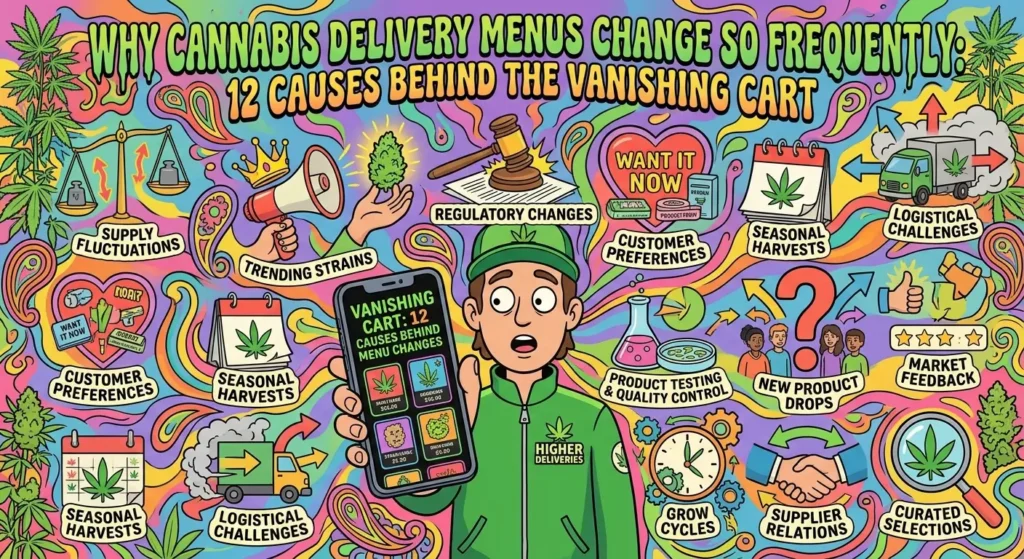
It’s 7:42 on a Friday. Marisol has filled her cart with one gram of live rosin, a two-pack of pre-rolls, and the 5 mg mints she has bought four times before. She taps “Checkout.” The page reloads. The rosin is gone—not “sold out,” just gone, as if it never existed. The mints now cost three dollars more. Marisol refreshes the page twice, sighs, and orders from a different shop.
Meanwhile, forty minutes away, nothing dramatic happened. One jar sold. A package tag hit zero. The software did exactly what it was told to do.
If you’ve ever wondered whether dispensary menus are glitchy, sloppy, or engage in bait-and-switch tactics, you’ll be interested to learn that the answer is more complex than any of those possibilities. Here’s what you’ll learn: the five systems that fight over one menu, the twelve specific triggers that rewrite it, how often each trigger fires, an eight-step shopper playbook, and the operator-side fixes that stop the churn, including the cost to you in Google and AI search visibility.
🔥REFER A FRIEND
THEY GET 10% OFF THEIR FIRST ORDER🔥
The short answer: Cannabis delivery menus change frequently because they mirror batch-level, state-tracked inventory rather than a stable product catalog. Stock is often one unit deep, every harvest arrives as a new tested batch, recalls and label corrections can delist items without notice, prices move with wholesale and promo cycles, and POS-to-marketplace syncs lag behind reality by minutes. The menu you see is a snapshot — not a promise.
Quotable definition: A cannabis delivery menu is not a catalog. It’s a live readout of a regulated inventory system, filtered through several pieces of software that don’t always agree.
What “the menu changed” actually means (five distinct events)
“The menu changed” describes five different events, and each has a different cause, cadence, and fix. Conflating them is why shoppers get frustrated and operators fix the wrong thing.
| Change type | What you observe | Usual root cause | Typical frequency |
|---|---|---|---|
| Stock-out removal | Item disappears entirely | Last unit of a package sold | Multiple times daily |
| Batch swap | Same product name, new THC %, new price | New tested batch replaces old | Weekly to monthly |
| Price-only change | Item stays, price moves | Promo, tax, margin, or wholesale shift | Daily to weekly |
| Compliance delist | Item vanishes with no restock | Recall, failed test, label hold | Occasional, sudden |
| Assortment/zone change | Whole categories appear or vanish | Different fulfillment hub, delivery zone, or shift cutoff | Per order window |
Notice something? Only one of those five rows involves anything going wrong. The rest are the normal physics of a perishable, serialized, heavily regulated product.
Why does batch-level tracking make cannabis stock so fragile?
Batch-level tracking makes stock fragile because a “product” on the menu is really a container for one or more serialized inventory packages — and when a package empties, the listing can vanish even if a nearly identical jar sits on the next shelf.
1. Every package carries its own identity
Most legal states run track-and-trace through systems like METRC or BioTrack. Each package of flower, each tray of edibles, each case of vapes gets a unique package ID tied to lab results, weight, and movement history. Retail POS platforms (Dutchie POS, Treez, Flowhub, BLAZE, Cova, and others) map sellable menu items to those packages.
Sell the last unit mapped to that tag? The item flips to zero. A different batch of the same strain from the same grower may exist — but it’s a different package with different test results, and it may not be linked to the same menu card yet.
2. Depth is shallow, so the math is brutal
A clothing store might stock 40 units of a black hoodie. A dispensary might stock one gram of a small-batch rosin, three of a niche cultivar, six of a limited edible. When depth is one, a single order is a 100% stock-out.
Simple illustration, not a benchmark: a menu with 300 SKUs where 60 have a depth of one will lose 60 listings the moment those 60 units sell — roughly a fifth of the assortment, gone, on a normal Saturday.
3. Quarantine and holds shrink visible stock
Received-but-untested intake, damaged packaging, count discrepancies, returns awaiting destruction, and items reserved for open orders all sit in inventory but aren’t sellable. Good operators hide them. That hides them from you.
💡 Pro Tip (shoppers): Sort by “newly added” instead of chasing a specific strain name. New listings are usually fresh batches with real depth behind them. A strain you bought last month may return under a slightly different name — same genetics, new batch, new label.
Why do compliance rules delete products overnight?
Compliance deletes products overnight because regulators and licensees can pull a batch from sale immediately — and a compliant retailer must reflect that pull in its live menu, not next week.
4. Recalls and failed contaminant tests
State regulators publish recall notices for failed pesticide, microbial, heavy-metal, or solvent testing, plus mislabeling and unapproved-ingredient issues. One failed test can cascade across dozens of packages and multiple retailers. When a recall lands, the responsible move is instant delisting.
5. New batch, new certificate of analysis
Every batch gets its own COA. Potency shifts with phenotype, light, harvest timing, and cure. That’s why the same strain reads 24% one month and 29% the next — not fraud, just agriculture. Several states also permit a labeling tolerance (often cited in the low-to-mid teens as a percentage range), and the exact figure is set by each regulator, so verify your state’s rule rather than assuming a universal number.
6. Label, packaging, and category corrections
Wrong net weight, a missing universal symbol, an ingredient statement error, or a product miscategorized as flower instead of concentrate — any of these can trigger a hold. Some states periodically revise rules for intoxicating hemp-derived products too, which reshuffles whole categories at once.
How do freshness and “drop culture” shrink a menu?
Freshness shrinks menus because cannabis is a perishable agricultural product with a cold chain, and because scarcity is a deliberate merchandising strategy.
7. Terpene loss and cold-chain limits
Flower dries. Terpenes evaporate. Pre-rolls go harsh. Live rosin and fresh-frozen products want refrigeration, and quality degrades when they sit warm. Edibles carry best-by dates. Reputable retailers rotate aging stock off the delivery menu — where customers can’t inspect it before buying — sooner than off the in-store shelf.
8. Limited drops and pheno hunts
Craft cultivators release single-harvest runs, experimental phenotypes, and collab drops in tiny quantities. Some sell out in hours. That’s not a bug; it’s the entire model. A menu built around drops is designed to change constantly.
9. Harvest seasonality
Outdoor and light-deprivation harvests land in autumn, then cure. That creates a rhythm: fresh-flower assortments often refresh in late winter and spring, while summer menus lean on older batches, concentrates, and manufactured goods.
🔥 Stack your savings. Elevate your session. 10% off $100, up to 25% off $450.
🔥 Roll into the menu and start saving. CLICK HERE!
Why does pricing change faster than the menu can keep up?
Pricing changes faster than menus because wholesale costs, excise structures, competitive pressure, and promo calendars all move independently — and any one of them can reprice hundreds of SKUs in an afternoon.
10. Wholesale compression and credit holds
Mature markets have seen well-documented wholesale price compression, reported consistently by industry analysts and trade press. Retailers reprice to stay competitive or to clear aging inventory. Flip side: an unpaid distributor invoice can put a brand on credit hold, and that brand’s entire lineup disappears from the menu until someone cuts a check. Boring cause. Very common.
11. Promos, bundles, and tax mechanics
Happy-hour pricing, first-time-customer discounts, loyalty tiers, and bundle logic all render differently across platforms. Excise and sales tax structures change by state and over time — and when the tax base shifts, shelf prices and out-the-door totals shift with it. Delivery fees and order minimums add another moving layer.
💡 Expert Insight (operators): Separate price from availability in your integration. When one API call updates both, a pricing audit can accidentally unpublish your best sellers. Push them on different schedules, log every change, and require approval for bulk edits over a set dollar threshold.
Why does the software stack show you a menu that isn’t real?
Your screen shows a stale menu because at least four systems sit between the shelf and your browser, and each one caches, throttles, or maps data slightly differently.
| Layer | What it controls | Typical lag (observed ranges, not guarantees) | Classic failure mode |
|---|---|---|---|
| Track-and-trace (METRC/BioTrack) | Legal package status | Minutes to hours | Package adjusted after sale |
| POS / inventory | Sellable quantity, price | Near real-time internally | Reserved stock counted as available |
| Menu / marketplace (Dutchie, Weedmaps, Leafly, Jane) | Public listing, categories | Minutes; scheduled syncs common | Cached page, orphaned SKUs, mapping drift |
| Browser / CDN cache | What you actually see | Minutes | Hard-cached menu until refresh |
12. Zone logic, driver stock, and human overrides
Three quieter culprits round out the twelve:
- Fulfillment source. Multi-location operators may serve your address from a different licensed premises than the one whose menu you browsed. Different hub, different assortment.
- Vehicle constraints. Several states cap the retail value of product a delivery vehicle may carry and require manifests. Pre-packed routes carry a subset of the menu, and end-of-shift cutoffs truncate late-night availability.
- People. Someone manually unpublishes a mispriced item, hides low-stock SKUs to avoid cancellations, or forgets to re-publish after a count. Manual overrides are the least auditable and most frequent source of “ghost” listings.
How often do cannabis delivery menus really change?
Menus change on layered cycles — minutes for stock, days for price, weeks for batches — which is why two visits an hour apart can look like different stores.
| Trigger | Realistic cadence | Shopper impact |
|---|---|---|
| Single-unit stock-outs | Many times per day | Item disappears mid-session |
| Sync/cache refresh | Every few minutes to hourly | Menu “corrects itself” after refresh |
| Promo pricing | Daily / weekly | Price moves, item stays |
| Batch rotation | Weekly to monthly | New potency, sometimes new price |
| Recalls, label holds | Unpredictable | Permanent removal |
| Seasonal assortment | Quarterly | Categories rotate |
Practical read: shop earlier in the day, earlier in the week, and confirm before you commit.
How do you shop a menu that keeps moving? (8-step playbook)
You shop a moving menu by treating it as a live inventory feed and verifying the two or three items you actually care about.
- Check the timestamp. Look for “menu updated” or “last synced.” Anything older than an hour deserves a phone call.
- Build your cart in one sitting. Long idle sessions invite stock-outs mid-checkout.
- Anchor on categories, not strain names. “Half-gram live resin cart, indica-leaning” survives batch swaps. A specific phenotype name often doesn’t.
- Confirm the two must-haves by text or call. Sixty seconds of confirmation beats a canceled order at 9 p.m.
- Pre-authorize substitutions. Say yes to same-brand, same-format, same-potency-band swaps. Say no to guesses.
- Read the COA details, not just the headline THC. Ask for packaged-on date and terpene profile. Chasing one number is how people end up disappointed by a great product.
- Order before the cutoff. Late-night menus are the most truncated, because routes are packed and shifts end.
- Use back-in-stock alerts. Most platforms support them. Drops reward people who get notified, not people who refresh.
💡 Pro Tip: If an item vanishes and never returns across several weeks, check your state regulator’s recall list. Most disappearances are stock-outs — but permanence is a signal worth reading.
What should operators fix first? (Illustrative walkthrough)
Operators should fix stock accuracy and sync architecture first, because those two cause the majority of avoidable menu churn — pricing and compliance changes are largely non-negotiable.
Here’s a composite scenario, illustrative rather than a measured study. A mid-size delivery retailer runs ~400 SKUs, syncs to two marketplaces on a fixed schedule, and lets budtenders manually hide items. Cancellations cluster on shallow-depth concentrates.
The sequence that works:
- Audit depth. Flag every SKU with sellable quantity ≤ 2. That list is your churn engine.
- Set buffer thresholds. Auto-unpublish at a safety buffer instead of at absolute zero, so the menu stops overselling.
- Move from polling to event-driven updates where your POS supports webhooks; keep scheduled syncs as a reconciliation sweep.
- Make product cards batch-aware. One durable product page, with batch data (potency, COA, packaged-on) as attributes that update — not a new listing every harvest.
- Kill unlogged manual overrides. Role-based permissions plus an audit trail. If someone hides a SKU, the system records who and why.
- Publish a substitution policy at checkout, with potency bands and format rules.
- Instrument it. Track stock-out cancellations per 100 orders, sync latency, and share of SKUs at depth ≤ 2 weekly.
🔥REFER A FRIEND
THEY GET 10% OFF THEIR FIRST ORDER🔥
What “good” looks like
| Metric | Before discipline | After discipline (target direction) |
|---|---|---|
| Stock-out cancellations | Reactive, unmeasured | Tracked and trending down |
| Sync latency | Fixed, long intervals | Event-driven with reconciliation |
| Manual overrides | Unlogged | Permissioned + audited |
| Batch handling | New SKU per batch | Durable page, updated attributes |
What does menu churn cost you in search and AI visibility?
Menu churn costs you rankings and AI citations when every stock-out deletes a URL — you burn accumulated links, create crawl churn, and hand generative engines nothing stable to quote.
This is the part most dispensaries miss. Three rules, aligned with mainstream search guidance:
- Keep the URL alive. For temporary stock-outs, retain the page, set
Offer.availabilitytoOutOfStockin Product structured data, and surface alternatives plus a back-in-stock signup. Don’t 404 or 410 a page that will return in nine days. - Stabilize the durable layer. Category and strain-family pages (“live resin delivery in [city]”) should persist while individual batches rotate beneath them. Rank the durable page; let the volatile SKUs live inside it.
- Write for extraction. Clear definitions, explicit entities (licensed retailer, batch, COA, package ID), dated facts, and self-contained answer paragraphs are what AI Overviews and assistants lift. Vague marketing copy gets skipped.
One caution worth stating plainly: publish only pages for real products, real inventory, and real service areas. Thin location variants for towns you don’t deliver to are doorway pages, and they age badly.
🔥 Stack your savings. Elevate your session. 10% off $100, up to 25% off $450.
🔥 Roll into the menu and start saving. CLICK HERE!
Your next move
Menus aren’t broken. They’re honest about a supply chain that’s serialized, perishable, tested batch by batch, priced in a volatile market, and rendered through four layers of software.
Remember three things: depth is often one unit deep; a new batch is legally and chemically a new product; and the page you see is minutes behind the shelf.
- If you’re a shopper: confirm your two must-haves, pre-approve substitutions, and turn on back-in-stock alerts today.
- If you’re an operator: pull your depth-≤2 report this week, set stock buffers, and stop deleting out-of-stock URLs. Those three changes fix most of the pain.
21+ only. Cannabis remains federally illegal in the U.S.; rules vary by state and locality. Never transport products across state lines. Verify specifics with your state regulator — this article is educational, not legal advice.
FAQs
Why does an item disappear from my cannabis delivery cart at checkout? Most delivery menus reserve stock when an order is packed or manifested — not when you add it to your cart. If someone buys the last unit first, the next sync removes it. Refresh the menu, then confirm by text.
How often should a licensed dispensary update its online delivery menu? Best practice is automated POS-to-menu syncing every few minutes, ideally event-driven, plus a manual audit before each delivery window opens. Shops with many single-unit SKUs need near-real-time updates; scheduled hourly polling reliably oversells shallow inventory.
Why does the same strain show a different THC percentage each week? Each harvest is a separate tested batch with its own certificate of analysis. Genetics, lighting, harvest timing, and curing shift cannabinoid output, so new batches mean new numbers. Compare terpene profiles and packaged-on dates rather than chasing one percentage.
Does a product vanishing from a menu mean it was recalled? Usually not. Stock-outs, batch depletion, credit holds, and pricing audits cause most removals. Recalls are a smaller share and appear in state regulator notices with batch or package identifiers. Check the regulator’s recall list before assuming a safety issue.
Should dispensaries delete product pages when items sell out? No. Keep the URL live, mark Offer.availability as OutOfStock in structured data, and recommend alternatives with a restock alert. Deleting pages discards accumulated links and rankings, then forces re-indexing every time that batch or product returns.