
It’s 9:47 p.m. on a Tuesday. You’re fourteen miles from the dispensary where you bought a live rosin cartridge last week, and it’s sitting in your cart right now — thumbnail, potency label, price, everything. You tap checkout.
“Delivery unavailable at this address.”
Meanwhile, your friend lives nine miles from that same store, on the other side of a road that happens to be the municipal line. Same brand. Same batch. Same state. Her cart goes through.
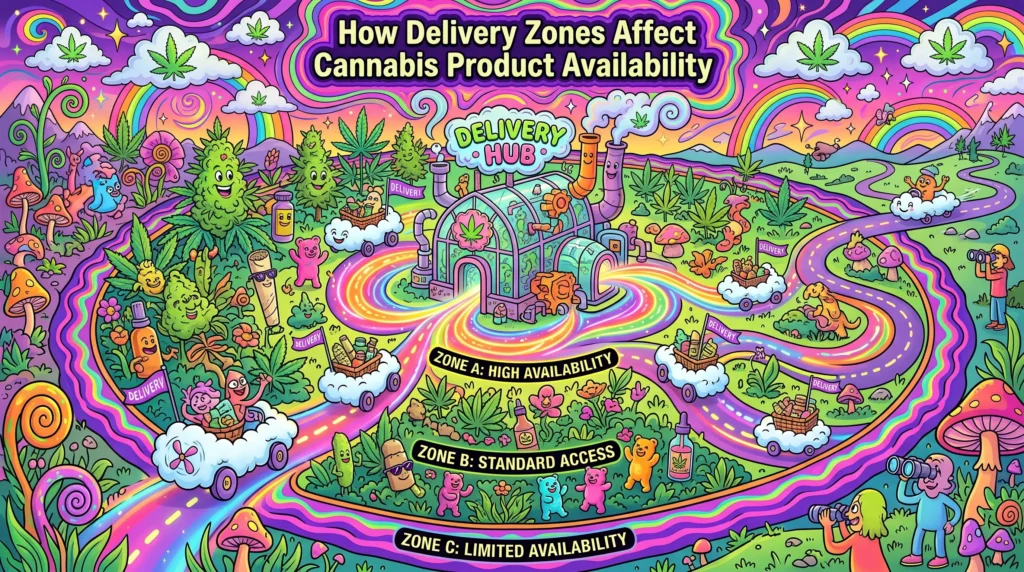
Nothing is broken. Nobody sold out. You just ran into a delivery zone — the invisible border that decides which cannabis products exist for you, and which ones are only pictures on a screen.
Most shoppers assume availability is about stock. It’s usually about geography. And once you understand how these borders get drawn — by state law, by city ordinance, and by a dispatcher building routes at 4 p.m. — you can predict your menu before you ever open it.
Here’s what you’ll learn:
- What a cannabis delivery zone actually is, and who has the authority to draw it
- The three stacked boundaries that override every store’s map
- Why the same brand is in stock twelve miles away and unavailable at your door
- Which product categories disappear first as you move outward
- A step-by-step playbook for getting the widest legal menu at your address
- An operator-side look at geofence accuracy, menu syndication, and zone economics
Quick answer: A cannabis delivery zone is the geographic area a licensed retailer is legally permitted and operationally willing to serve. It filters availability three ways: which licensed hub can reach you, that hub’s live inventory, and which products survive route limits like value caps, order cutoffs, and cold-chain handling.
Regulatory snapshot: November 2026. Cannabis rules shift often. Verify specifics with your state regulator and retailer before ordering. Adults 21+ or registered medical patients only, in markets where cannabis is legal.
The Legal Rule That Anchors Everything: Same Store, Same Shelf
In Ontario, a cannabis delivery order must originate and be fulfilled from the same licensed retail store, using products stored on-premises at that location. The Alcohol and Gaming Commission of Ontario (AGCO) states this explicitly: delivery orders must be placed with a specific store location, and the products must come from that store’s on-site inventory. Third-party courier delivery is prohibited, and the store cannot operate predominantly as a delivery business.
This single rule explains most of the availability variation that delivery customers experience. A service advertising “Oakville delivery” is not pulling from a shared regional pool. It is pulling from one store’s physical backroom, subject to that store’s purchasing decisions, storage capacity, and sell-through rate. If the store did not buy the product, no zone can make it appear.
The rule also means delivery zones are downstream of inventory allocation, not upstream of it. A retailer decides what to stock based on the demand patterns it observes across its entire customer base — in-store shoppers, curbside pickup, and delivery orders combined. Zones then determine which of those stocked products reach which addresses. The sequence matters: inventory first, zone filter second.
Expert Insight: When a delivery menu feels thin compared to what a store advertises in-person, the gap is usually not a technical glitch. It reflects the AGCO’s same-store fulfillment requirement. The delivery zone is showing you what that specific store has on its shelf right now, filtered through the zone’s eligibility rules.
The Three Delivery Models and What Each Does to the Menu
Cannabis delivery operates on three fulfillment models — hub-and-spoke, dynamic vehicle delivery, and hybrid — and each model produces a different menu depth and availability pattern for the customer. The model a retailer chooses is a design decision, not a regulatory requirement, and it shapes zone-level availability more directly than most buyers realize.
Hub-and-Spoke: Full Catalog, Longer Windows
In a hub-and-spoke model, inventory stays at the licensed store, and every order is picked, packed, and dispatched from that single location. Because the full catalog is physically on the shelf, customers can shop the store’s entire menu — but delivery windows are longer, since every order starts from the same point.
This is the default model for most Ontario retailers serving surrounding delivery zones. It produces the widest possible availability within a given store’s inventory, but it also means the menu you see is the store’s full menu, unfiltered except by zone eligibility and real-time stock levels. If a product sells out in-store, it disappears from the delivery menu too, because there is no separate delivery reserve.
🔥REFER A FRIEND
THEY GET 10% OFF THEIR FIRST ORDER🔥
Dynamic Delivery: Faster, but a Deliberately Limited Menu
Dynamic delivery turns the vehicle itself into an inventory location: the car or van leaves the store pre-packed with a curated selection and serves a geofenced zone from what is already on board. Delivery times drop sharply because the product is already nearby, but the catalog is limited to what fits in the vehicle.
This model is less common in Ontario than in mature U.S. delivery markets, but it illustrates the trade-off clearly: speed and menu breadth pull in opposite directions. A dynamic vehicle might carry the top 40 SKUs that drive most delivery revenue, which means niche categories — high-CBD flower, specific edible formats, newer concentrate formats — may not appear in that zone at all, even if the store stocks them. The zone’s menu is not a subset of the store’s menu by accident. It is a subset by design.
Hybrid: Two Menus, One Zone
Hybrid delivery lets a customer choose between a fast “express” menu drawn from nearby vehicle inventory and a scheduled “full menu” drawn from the store’s entire catalog. This captures both impulse buyers and considered basket shoppers, but it requires software that can present two availability states without double-committing inventory.
In practice, hybrid models produce the most confusing zone-level availability for consumers. A product may be “available” on the full menu but invisible on the express menu, or vice versa, depending on which vehicle serves the zone and what it loaded that morning. Understanding which menu you are browsing is the difference between a frustrating checkout and a predictable one.
How Zone Filtering Works Behind the Menu
Zone filtering happens before the customer sees a product list: the delivery address is checked against configured zone boundaries, and the menu is populated only with products eligible for that address. In modern cannabis e-commerce systems, this is called address-gated browsing or dynamic menu filtering. The customer enters an address; the platform checks it against delivery zones; the menu reflects what is available to that specific location, including zone-specific pricing, fees, and minimums.
This is not a trivial technical detail. It means two customers in the same city can see different menus at the same moment, from the same retailer, without either of them doing anything unusual. One address falls inside a zone served by a vehicle carrying a limited express inventory; another falls inside a full-catalog zone fulfilled from the store. The menus diverge because the zone logic dictates what inventory source is exposed.
Ontario retailers commonly define zones by postal code prefix or a radius measured from the licensed store. One Toronto-area retailer lists specific postal codes (L3P, L3R, L3S, L3T, and others) as its service area, while another describes a 15-kilometre radius around participating shops. The zone boundary is a business decision, but its effect on availability is mechanical: if your address falls outside the zone, the menu may not load at all; if it falls inside an express-only zone, the menu loads but shows only what the serving vehicle carries.
Pro Tip: Before assuming a product is “out of stock” across a delivery service, check whether your address is being routed to an express menu rather than a full-catalog menu. If the service offers scheduled delivery alongside same-day delivery, the scheduled option often unlocks the store’s broader inventory.
What Is a Cannabis Delivery Zone?
A cannabis delivery zone is the mapped service area — defined by law and by logistics — inside which a licensed retailer may drop cannabis at a consumer’s address. It is not a marketing radius. It’s a compliance boundary with a business plan layered on top.
Three separate authorities draw it, and they don’t always agree.
The three stacked boundaries
1. The state line (hard stop). Cannabis remains federally controlled, and moving it across state lines is a federal offense even when both states have legal markets. Oregon cannot mail to Washington. Massachusetts cannot ship to New Hampshire. The U.S. Postal Service does not accept marijuana, and major private carriers prohibit it in their terms of service. Any website promising nationwide “cannabis shipping” is either selling a different legal category (hemp-derived products, which carry their own state restrictions) or operating outside the law.
2. The municipal opt-out (patchwork). Many states let cities and towns ban cannabis storefronts. Whether that ban also blocks delivery varies — and it has been litigated. California’s statewide regulations have permitted licensed retailers to deliver to physical addresses across the state, including in cities that prohibit storefronts, a position some municipalities have challenged. Massachusetts ties delivery to municipal consent and specific license types. New York has allowed licensed retailers to deliver statewide while letting towns opt out of retail locations. Washington has historically barred general adult-use home delivery. Same plant, wildly different maps.
3. The retailer’s polygon (the practical limit). Inside whatever the law allows, the business draws its own line based on drive time, drop density, driver safety, and insurance. This is the boundary that quietly cuts your menu in half.
Radius circles vs. drive-time polygons vs. ZIP codes
Not all zones are drawn the same way, and the method changes your experience:
- Radius circle: “15 miles as the crow flies.” Simple, dumb. A river, a mountain pass, or a bridge closure can turn 12 miles into 55 minutes.
- Drive-time polygon: “45 minutes of real road time.” Fairer, and increasingly common in dense metros.
- ZIP-code list: Cheap to implement, notorious for false positives. ZIP boundaries follow mail routes, not neighborhoods — so one side of a street gets served and the other doesn’t.
- Address-level geocoding: Rooftop-accurate, best experience, still trips on new subdivisions, rural route addresses, and apartment complexes.
Pro Tip: If checkout rejects an address you know is inside the advertised zone, suspect a geocoding error before you assume a legal ban. Call the store and ask them to validate your rooftop address manually. In my experience reviewing zone complaints, ZIP-centroid mismatches and unmapped new construction account for a large share of “false” rejections — not regulation.
Why Does the Same Brand Show In Stock Twelve Miles Away?
Because availability is decided at the hub, not the brand — and each hub carries a different slice of the catalog. Cannabis inventory is licensed, tracked, and physically parked in one building. Your address unlocks that building’s shelf, not the state’s.
Here’s what actually thins the menu as you move outward:
- Hub-level inventory. A chain with three stores may stock 600 SKUs downtown, 400 in the suburbs, and 240 at the edge. Multi-state brands ship state-specific packaging and testing labels, so cross-border rebalancing isn’t an option.
- Distribution and exclusivity. Small-batch growers allocate. A limited flower drop might land at two stores in a metro — both inside the core zone.
- Vehicle value caps and cash risk. States limit the retail value of cannabis a driver may carry, and drivers can’t restock mid-route the way a pizza driver refills sodas. Expensive concentrates get reserved for dense routes or pickup.
- Order cutoffs and batching. Outer zones often get one consolidated run, or two delivery days a week. Popular SKUs sell out at the hub before your route is built.
- Order minimums and fees. Tiered minimums aren’t arbitrary — they cover the labor cost of a 40-minute round trip.
- Cold chain and heat. Chocolate edibles and cannabis beverages behave badly in a hot van in July. Some operators restrict them seasonally in far zones.
- Legal delivery hours and ID rules. State-set delivery windows, in-person ID verification, and adult signature requirements compress how many drops fit in a shift.
🔥 Stack your savings. Elevate your session. 10% off $100, up to 25% off $450.
🔥 Roll into the menu and start saving. CLICK HERE!
Typical zone-tier patterns
Illustrative patterns common in mature U.S. markets — not universal, and not a quote from any specific retailer.
| Zone tier | Typical shape | Order minimum | Fee pattern | Cutoff pattern | What tends to drop off |
|---|---|---|---|---|---|
| Tier 1 — Core | 0–5 mi / ≤15 min drive | $30–$50 | $0–$5 | 30–60 min before close | Almost nothing; limited drops included |
| Tier 2 — Mid | 5–12 mi / 15–30 min | $50–$75 | $5–$10 | 90–120 min before close | Small-batch allocations, heavy glass beverages |
| Tier 3 — Outer | 12–25 mi / 30–60 min | $75–$150 | $10–$20, or free over a threshold | Batched routes, fixed delivery days | High-value concentrates, cold-chain edibles, new SKUs |
| Tier 4 — Unserved | Outside the polygon | N/A | N/A | N/A | Entire menu; pickup only where legal |
Expert Insight: The most misunderstood restriction is “pickup only” on premium concentrates. Shoppers read it as elitism. It’s usually arithmetic: one $90 rosin jar occupying a large share of a driver’s legal carry value, on a route with three drops, is a worse compliance-and-risk trade than four $45 orders in the core zone.
Which Legal Boundaries Override Every Store’s Map?
Some addresses are unservable no matter how generous a retailer’s radius is, because a higher authority says no.
| Boundary type | Who controls it | Effect on product availability | How to verify |
|---|---|---|---|
| State line | Federal law + state regulators | No interstate delivery or shipping, period | State regulator guidance |
| Municipal opt-out | City/county ordinance | Storefront bans; delivery may or may not be allowed | Municipal code + regulator bulletins |
| Federal land | Federal jurisdiction | National parks, military bases, federal buildings: prohibited | Ask the retailer; land-status maps |
| Tribal land | Tribal + federal jurisdiction | Varies by nation and compact; often refused | Contact the retailer and tribal authority |
| Address type | State rules + property policy | Dorms, hotels, shelters, public housing often ineligible | Retailer FAQ + state regulation |
| Driver/route limits | State rules + operations | Value caps, delivery hours, ID checks → some SKUs pickup-only | Retailer delivery policy page |
Notice the pattern: the further your address sits from ordinary residential infrastructure, the narrower your legal menu. Rural routes, gated communities without access codes, RV parks, and campus-adjacent housing all fail more often — not because of stock, but because of verification.
Which Products Vanish First in Outer Zones?
Availability degrades in a predictable order. Learn this sequence and you’ll never be surprised at checkout again.
- Limited and small-batch drops — allocated to flagship hubs first.
- High-ticket concentrates (live rosin, hash, premium carts) — vehicle value caps and cash risk.
- Temperature-sensitive edibles and beverages — heat, breakage, weight.
- Bulky, low-margin items — cases of beverages on a 90-minute round trip lose money.
- Brand-new SKUs — outer hubs get them weeks later, if ever.
- Medical-only formulations — high-potency or specific ratio products may require patient registration your account doesn’t have.
The stable survivors? Mainstream flower, mid-tier vapes, shelf-stable gummies, and house brands. Which is exactly why shoppers in outer zones often describe the menu as “generic.” It isn’t a taste problem. It’s a logistics filter.
Two numeric guardrails also shape what fits in one order, regardless of zone: many adult-use markets cap edibles at 100 mg THC per package, with 5 mg or 10 mg per serving depending on the state, and California’s adult-use daily limit is 28.5 g of flower and 8 g of concentrate. Registered medical patients frequently get higher limits and different tax treatment — but the same geographic boundaries.
How Do You Get the Widest Legal Menu at Your Address?
You can’t move a boundary. You can stop guessing which side of it you’re on.
- Verify the license first. Look the retailer up in your state regulator’s public license search. If it isn’t listed, nothing else matters.
- Enter your full address before browsing. Not your ZIP. Address-first filtering removes phantom inventory — the single biggest source of cart abandonment in zoned delivery.
- Read the delivery policy page, not the homepage banner. Look for four things: zone list or map, order minimum, cutoff time, delivery days.
- Compare two or three licensed hubs that serve you. Menus differ by hub, not by chain. A brand missing at one may sit on another’s shelf six miles away.
- Shop before the cutoff, not before closing. Outer-zone routes are built early. A 6 p.m. order for a 7 p.m. close is often already too late.
- Split delivery and pickup deliberately. Concentrates and limited drops for pickup; flower and gummies for delivery. One trip, full menu.
- Confirm eligibility details. Matching government ID, an adult present, a residential address, an access code for gated buildings, and a payment method the driver actually accepts (PIN debit or ACH — not major credit cards).
- If you’re a patient, register properly. Medical status can unlock additional retailers, higher possession limits, and different pricing — inside the same zone rules.
Pro Tip: Ask one question and you’ll learn more than any menu filter: “Which hub fulfills my address, and what time do you build that route?” The answer tells you your real catalog and your real deadline in one sentence.
Illustrative Scenario: One Metro, Three Addresses, Three Menus
The following is a modeled composite built from common industry zone patterns. It is not measured data from, or a description of, any named business.
Picture a licensed retailer with a flagship store downtown and a suburban satellite. The flagship carries roughly 450 active SKUs; the satellite carries 280.
| Address | Zone assignment | Fulfilling hub | Effective menu | Minimum | Delivery days |
|---|---|---|---|---|---|
| Downtown loft, 2 mi | Tier 1 | Flagship | ~450 SKUs, including drops | $40 | Daily |
| Suburb, 11 mi, opted-in town | Tier 2 | Satellite | ~280 SKUs, no allocations | $65 | Daily |
| Rural edge, 22 mi | Tier 3 | Satellite | ~180 SKUs, shelf-stable only | $100 | Tue / Thu |
Same state. Same chain. Same Tuesday. The rural shopper sees 60% fewer products — and never receives a notification explaining why. Multiply that gap across a metro and you get the real phenomenon behind the search query: delivery deserts, where legal access exists on paper and barely exists in practice.
For Operators: Stop Letting Zones Cannibalize Your Catalog
Zone-driven availability loss is measurable, and most of it is fixable without redrawing a single boundary.
- Fix geocoding before expanding radius. Rooftop validation and drive-time polygons outperform ZIP lists. Track a Geofence False-Positive Rate: failed address validations ÷ total checkout attempts.
- Publish zone-aware menus. Suppress out-of-zone SKUs instead of displaying them as unavailable. Phantom inventory trains customers to distrust your menu.
- Track Zone Menu Coverage (ZMC): served SKUs ÷ hub SKUs, per tier. There’s no public national dataset for this — which means the operators who measure it internally hold a real edge.
- Allocate deliberately. Push a small share of premium drops to outer hubs, or run a scheduled “drop day” route so far-zone customers get predictable access.
- Watch drops per labor hour, not order count. Three tight drops beat six scattered ones. Zone tiering should reflect that math openly.
- Make zone data crawlable. Keep an informational service-area page in plain HTML — real towns served, real minimums, real cutoffs — with accurate
areaServed/GeoShapestructured data. Gate the purchase flow, not the facts. - Build one honest service-area page, not fifty. Auto-generating a page per town you don’t actually serve is a doorway-page pattern that risks search penalties and burns customer trust the moment checkout fails.
Expert Insight: The highest-ROI fix I’ve seen isn’t a bigger radius. It’s an accurate one. A retailer serving 18 miles with clean address validation and a published cutoff will out-convert a competitor advertising 30 miles and rejecting a third of checkouts.
Why Distance Changes What’s on the Shelf, Not Just What’s on the Truck
Delivery zones affect availability indirectly as well as directly: distance from the store shapes turnover speed, and turnover speed shapes product freshness and menu rotation. Dispensaries stock inventory based on demand patterns from the customers who actually order. A store serving a dense, frequently ordering zone turns over flower faster, which generally means fresher batches and quicker restocks. A store or zone with slower demand may hold the same batches longer, and customers in that zone are more likely to encounter older product or picked-over selections.
This is the availability problem that does not show up on a menu. A product can be listed as “in stock” and still be weeks older than the same SKU at a busier location. Zone-level demand influences how often a store reorders, which in turn influences whether the zone’s customers see new drops or the tail end of a previous purchase.
The practical consequence for buyers is that menu depth and menu freshness are different metrics, and delivery zones affect both. A zone with a wide menu but slow turnover may offer more SKUs but less reliable quality on perishable categories. A zone with a narrower menu but high turnover may offer fewer choices and better average freshness. Neither pattern is universal, but the relationship between zone demand and inventory rotation is consistent enough that experienced buyers learn to read it.
Delivery Model Comparison: What Availability Looks Like in Each
| Delivery Model | Inventory Source | Menu Breadth in Zone | Typical Speed | Best For | Availability Trade-off |
|---|---|---|---|---|---|
| Hub-and-Spoke | Store shelf | Full store catalog, filtered by real-time stock | Longer windows | Buyers who want the widest selection | Slower dispatch; no separate delivery reserve |
| Dynamic (Vehicle) | Pre-packed vehicle | Limited to what the vehicle carries | Fastest | Impulse orders, top-SKU buyers | Niche categories may never appear |
| Hybrid | Vehicle + store | Two menus: express and full | Varies by menu chosen | Buyers who want speed or selection | Availability depends on which menu the zone exposes |
A Step-by-Step Guide to Diagnosing Zone-Level Availability
Step 1: Confirm which zone your address falls into before browsing the menu. Enter your postal code or full address into the delivery checker. If the service does not offer a pre-browse zone check, treat that as a signal: you may be browsing a menu that will reject your order at checkout.
Step 2: Identify whether the menu you see is express, full, or hybrid. Look for language like “same-day,” “express,” “scheduled,” or “full menu.” If two delivery options appear, compare the product lists. The difference between them is the zone-level availability gap in plain sight.
Step 3: Check the store’s in-person menu against the delivery menu. If the store publishes both, the delta tells you what the zone filter is removing. A product available in-store but absent from delivery is not necessarily out of stock — it may simply be excluded from the fulfillment path serving your address.
Step 4: Pay attention to restock timing, not just current listings. A zone that receives deliveries from a store with a weekly restock cycle will show a narrower menu late in the week than a zone served by a store that restocks more frequently. Ask the service, or check the menu on different days, before concluding that a category is unavailable.
Step 5: Verify the licensed store behind the zone. AGCO rules require licensed retailers to display their authorization number, store name, and store address on their online platforms. If the service cannot identify the store fulfilling your zone, you cannot verify what inventory the zone is actually drawing from — and that uncertainty is itself an availability risk.
🔥REFER A FRIEND
THEY GET 10% OFF THEIR FIRST ORDER🔥
What This Means for Buyers in Opt-Out Towns
In municipalities that have opted out of cannabis retail storefronts, delivery zones become the only legal access channel, which makes zone-level availability the entire market. Oakville is the clearest Ontario example: with no licensed stores inside town boundaries, every legal delivery arrives from a store in a neighbouring municipality, and the AGCO’s same-store fulfillment rule means the Oakville zone’s menu is whatever that outside store has on its shelf.
The result is a structural availability gap that has nothing to do with consumer demand inside the opt-out town. A store in Mississauga or Burlington allocates inventory based on its entire customer base, and the Oakville zone receives a filtered view of that allocation. If the store’s buying patterns skew toward its local in-store customers, the Oakville delivery menu may feel narrower than the town’s population would justify. This is not a failure of the delivery service. It is the predictable outcome of separating the point of sale from the point of consumption by a municipal boundary.
Buyers in these markets benefit from comparing multiple delivery services rather than committing to one, because each service draws from a different licensed store with a different inventory position. A product missing from one zone’s menu may be available in another zone served by a store that stocked it more aggressively. The comparison is not about brand preference. It is about which store’s shelf your zone is allowed to see.
Key Takeaways and Next Steps
Delivery zones affect cannabis product availability through three interlocking mechanisms: legal fulfillment rules that tie every order to a single store’s on-premises inventory; operational models that determine whether a zone sees a full catalog or a curated vehicle menu; and demand-driven turnover that shapes how fresh and how deep that inventory runs.
Your next step is to stop treating the delivery menu as a store-wide catalog and start treating it as a zone-specific view. Enter your address before you browse. Compare express and full menus when both are offered. Check whether the service discloses the licensed store fulfilling your zone. And if you live in a town without storefronts, rotate between services until you find the zone whose inventory position actually matches what you want to buy.
The menu is not the market. The zone is.
Your Next Move
Delivery zones aren’t a glitch in cannabis e-commerce. They’re the product of three forces stacked on top of each other: federal prohibition on interstate movement, local control over commercial cannabis, and the plain economics of putting a driver in a van for eight hours.
Remember four things:
- Your address, not your preference, decides your menu.
- Inventory lives at the hub — compare hubs, not brands.
- Premium and perishable products disappear first as distance grows.
- Cutoff time matters more than closing time.
So do this tonight: look up your retailer in the state license database, enter your full street address before you browse, and write down the cutoff time for your zone. Three minutes of setup, and the “unavailable at this address” surprise mostly stops happening.
Running a dispensary? Audit your geofence false-positive rate and publish an accurate zone table this week. Clarity converts better than coverage.
🔥 Stack your savings. Elevate your session. 10% off $100, up to 25% off $450.
🔥 Roll into the menu and start saving. CLICK HERE!
FAQs
Can a dispensary deliver cannabis across state lines if both states are legal? No. Crossing state lines with cannabis remains a federal offense regardless of state law, and USPS and major carriers prohibit shipping it. Licensed delivery operates only within the issuing state’s borders, subject to state and municipal rules.
Why do I see products online that I can’t order at my address? Because many menus display a hub’s full catalog before validating your address. Your location may fall outside the delivery polygon, be served by a different hub, or fail address-type rules. Enter your street address first to filter accurately.
Do cannabis delivery zones affect prices, minimums, and fees? Yes, commonly. Retailers tier zones by distance or drive time, raising order minimums and fees outward to cover route labor. Base product prices often stay consistent, but outer zones may lose access to promotions, drops, and bulk items.
Can I get cannabis delivered to a hotel, dorm, or college campus? Often not. Many markets restrict delivery to eligible residential addresses, and dorms, hotels, shelters, and public housing are frequently excluded. Federal property — including bases and national parks — is off-limits. Confirm address eligibility with the retailer before ordering.
Does a medical card expand my delivery options? Sometimes. Registered patients may access medical-only retailers, higher possession limits, additional formulations, and different tax treatment. But geographic boundaries — state lines, municipal rules, federal land, and the retailer’s service polygon — apply to patients and adult-use customers alike.