
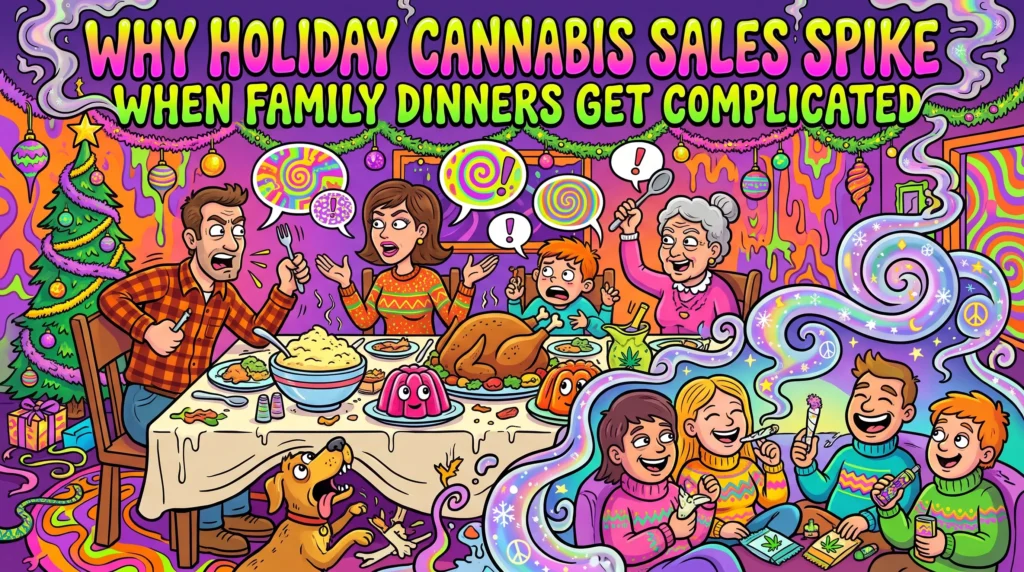
At 4:40 p.m. on the Wednesday before Thanksgiving, the line at a suburban Michigan dispensary wrapped around the beverage cooler. There were three budtenders. One ID checker. A manager was quietly moving the “express pickup” sign to the front counter.
I asked the woman at the register what she was shopping for. She didn’t say “sativa.” She didn’t say “highest THC.”
She said: “Something that will help me get through my father-in-law’s monologue without saying anything I’ll regret in December.”
The next customer asked for almost the same thing. The next customer asked for a four-pack of 3 mg seltzers, a tin of 2.5 mg mints, and two pre-rolls “for the porch, after the dishes.”
Nobody in that line was planning a party. They were buying a buffer.
Multiply that scene across roughly two dozen adult-use states, and you’ll see the strangest peak on the cannabis retail calendar: a holiday named after a color, anchored to a turkey and driven almost entirely by family friction.
Quick answer: Holiday cannabis sales spike because Thanksgiving compresses predictable emotional stress into a fixed, universally shared date. Buyers stock up before the gathering and favor low-dose, low-odor, shareable formats. The industry calls the Wednesday before Thanksgiving Green Wednesday — routinely one of the highest-grossing days in U.S. cannabis retail.
What you’ll learn here: what Green Wednesday actually is, how big the reported lift is, the five behavioral drivers behind the spike, which product formats win the holiday basket, what the alcohol-substitution evidence really says, and a seven-step operator playbook plus a worked inventory model.
🔥REFER A FRIEND
THEY GET 10% OFF THEIR FIRST ORDER🔥
What Is Green Wednesday, and How Big Is the Spike?
Green Wednesday is the Wednesday before U.S. Thanksgiving, and it routinely ranks among the top one or two sales days of the year for legal cannabis retailers — often trading places with 4/20.
The term spread through delivery platforms and dispensary marketing in the mid-2010s, borrowing the retail logic of Black Friday and Cyber Monday. The mechanism is different, though. Black Friday is about gifts. Green Wednesday is about anticipation.
The entity block, plainly stated
- What: A demand peak in legal cannabis retail, driven by pre-holiday stock-up purchasing.
- When: The Wednesday immediately before the fourth Thursday of November (U.S. Thanksgiving).
- Where: Licensed adult-use and medical dispensaries across U.S. state-legal markets, plus Canadian retailers around their own holiday calendar.
- Who: A mix of routine consumers restocking and infrequent, older, or lapsed consumers re-entering the category.
- Why: Fixed-date family gatherings create predictable stress, extended free time, and a social setting where heavy drinking carries obvious costs.
What industry trackers have reported
Cannabis analytics firms Headset and BDSA publish holiday retail analyses each year. Across multiple years, their reporting has pointed in a consistent direction:
- Green Wednesday sales run well above a baseline Wednesday, with reported lifts ranging from solid double digits to near-doubling, depending on market maturity, promotional intensity, and year.
- In several years, Green Wednesday has out-earned 4/20 in total retail dollars — because 4/20 skews toward deals and discounted flower, while Green Wednesday skews toward higher-ticket, multi-item baskets.
- Edibles, beverages, and vapes tend to over-index during holiday weeks relative to their baseline category share.
Pro Tip — Treat percentages as perishable. Never publish a holiday stat without a year and a source attached. “Green Wednesday sales rose X%” is meaningless without “according to [firm], in [year], across [states].” Mature markets like Colorado and Michigan behave nothing like newly launched ones. Refresh your figures annually or your article quietly becomes misinformation.
Table 1: The U.S. cannabis demand calendar
| Peak | Timing | Primary Demand Driver | Basket Signature |
|---|---|---|---|
| Green Wednesday | Day before Thanksgiving | Anticipatory stock-up + family stress management | Multi-category, low-dose edibles, beverages, vapes |
| Thanksgiving Day | Fourth Thursday of Nov | Reduced hours, last-minute runs | Small, urgent, short-queue purchases |
| Christmas–New Year week | Late Dec | Gifting, parties, time off, NYE substitution | Beverages, pre-roll multipacks, giftable formats |
| 4/20 | April 20 | Cultural celebration | Deal-heavy flower, concentrates, high volume |
| 7/10 | July 10 | Concentrate culture (“OIL” inverted) | Dabs, cartridges, extract accessories |
| Summer holiday weekends | Memorial Day, July 4, Labor Day | Travel, outdoor social use | Pre-rolls,便携 beverages, disposables |
Patterns are directional and synthesized from publicly reported industry analyses; verify current-year figures before citing.
Why Does Family Dinner Stress Convert Into Retail Demand?
Family gatherings assemble a rare combination that reliably moves product: a known deadline, predictable emotional labor, and a room where getting visibly drunk is a bad idea.
That’s the whole engine. But it has five distinct pistons.
1. Anticipatory coping beats day-of panic
People don’t shop for stress they’re currently in. They shop for stress they can see coming. Behavioral researchers describe this as anticipatory coping — preparing for a forecasted demand on your patience. The Wednesday timing isn’t accidental. It’s the last comfortable window before the airport pickup, the grocery run, and the 6 a.m. turkey.
Green Wednesday isn’t a celebration holiday. It’s a logistics holiday.
2. The discretion premium
A guest bathroom vape hit is invisible. A bong rip in Grandma’s garage is a family event. Odor, paraphernalia, and visible intoxication all carry social cost at a mixed-generation table — so buyers pay for formats that don’t announce themselves.
3. The “one drink” ceiling
Plenty of adults want something, but not the version of themselves that four glasses of wine produces around a politics conversation. Low-dose THC products get positioned — by consumers, not by regulators — as a way to take the edge off without losing the plot. That’s a perception, not a clinical claim, and it deserves the asterisk.
4. Time abundance
Four days off. No commute. A couch. Extended unstructured time is one of the most dependable predictors of consumption across every recreational category, from streaming to snacks to spirits.
5. Re-entry permission
Holidays give lapsed consumers a socially acceptable reason to try again. “It’s the holidays” is a permission slip. This is why the holiday buyer mix skews newer — and why budtender education time per transaction goes up exactly when the line is longest.
Expert Insight — The coping caveat matters. Substance-use research consistently distinguishes social/celebratory motives from coping motives, and coping-driven use is more strongly associated with problematic patterns. A responsible article about this spike has to say the quiet part: buying cannabis specifically to endure emotional distress is a pattern worth watching in yourself, not a lifestyle hack. Retailers who acknowledge that build more trust than ones who wink at it.
Which Products Win the Holiday Basket?
Shareable, low-dose, low-odor, precisely dosed formats win the holiday basket — because the occasion rewards discretion and control, not potency.
Table 2: Format fit for a family gathering
| Format | Typical Onset | Typical Duration | Discretion | Dose Control | Holiday Fit |
|---|---|---|---|---|---|
| Low-dose gummies / mints (2.5–5 mg THC) | 30–120 min | 4–8+ hrs | High | High (unit-dosed) | Strong — but timing must be planned |
| Cannabis beverages (2–5 mg THC) | ~10–45 min (formulation-dependent) | 2–4 hrs | High (looks like seltzer) | High (per can) | Strong — social ritual replacement |
| Vape cartridge / disposable | 1–10 min | 1–3 hrs | Medium (vapor dissipates) | Medium (puff-titrated) | Strong — fast, adjustable, exit-friendly |
| Pre-rolls | 1–10 min | 1–3 hrs | Low (odor, requires going outside) | Medium | Moderate — the “porch break” purchase |
| Flower (smoked) | 1–10 min | 1–3 hrs | Low | Low–Medium | Weaker in mixed-generation settings |
| Concentrates / dabs | Seconds–minutes | 1–3 hrs | Very low (rig, torch, smell) | Low for novices | Weak — wrong tool for this occasion |
🔥 Stack your savings. Elevate your session. 10% off $100, up to 25% off $450.
🔥 Roll into the menu and start saving. CLICK HERE!
Onset and duration are population-level approximations from public-health and pharmacology literature; individual response varies substantially with tolerance, body composition, food intake, and product formulation.
Notice the pattern? The holiday basket rewards discretion, not potency. That single sentence explains more about November category mix than any strain-leaf diagram.
Pro Tip — Edible math ruins dinners. Delayed onset is the classic holiday failure mode. Someone eats a gummy at 3 p.m., feels nothing at 4:15, eats another, and spends dessert discovering both. Public-health guidance in regulated markets is consistent: start low (many states define a single serving as 5–10 mg THC, and novices are often advised to start at or below that), then wait at least two hours — ideally longer — before considering more. Also: a huge meal plus alcohol plus THC stacks sedation. Turkey’s tryptophan gets blamed for that; the wine and the portion sizes deserve most of the credit.
Is Cannabis Actually Replacing Holiday Alcohol?
Partly — and the evidence is messier than the headlines suggest.
Three things are simultaneously true:
- Cultural normalization is measurable. Gallup’s trend polling has found the share of U.S. adults who report smoking marijuana roughly doubling over the past decade, to the point where it has edged past cigarette smoking in its surveys. Pew Research Center has found majority support for legalization across medical and recreational use.
- Substitution is real for some consumers. The “California sober” pattern and Dry January adjacency show up in beverage-category momentum and in consumer self-reports.
- Co-use is also real, and riskier. Research on simultaneous alcohol–cannabis use links it to higher impairment and more adverse outcomes than either substance alone. THC can raise peak alcohol effects; alcohol can increase THC absorption. Two “calm” drinks and a gummy is not a harm-reduction strategy.
So the honest framing for an article like this: cannabis is competing for the same occasion, not simply replacing the bottle. Retailers who market it as a safe swap are making a claim they cannot support.
Who Is Driving the Holiday Spike?
The holiday surge leans harder on infrequent, older, and returning buyers than on daily heavy consumers — which changes everything about staffing and service design.
Daily consumers already have a jar. They restock on their normal rhythm. The incremental holiday revenue comes from people whose purchase frequency is measured in months, plus gift-adjacent and occasion-driven buyers.
Practical consequences operators feel in their bones:
- Longer consultations. New buyers ask about mg, onset, and “will I be weird at dinner.” That’s a 6-minute conversation, not a 90-second one.
- Higher basket diversity. Three categories in one transaction instead of one category twice.
- More decision anxiety. Which is why pre-built bundles and clear mg labeling convert better than a 400-SKU wall.
- More returns to the counter. “This didn’t work” is often a timing or dose-education gap, not a product defect.
The Operator Playbook: 7 Steps to Capture Holiday Demand Without Wrecking Compliance
Capturing Green Wednesday is an operations-and-visibility problem, not a discounting problem — and every lever has a regulatory edge.
Step 1: Fix your holiday hours everywhere, first
The highest-intent local query of the week is “dispensary open Thanksgiving.” Update Google Business Profile hours (including special/holiday hours), Apple Business Connect, Bing Places, your site footer, and your menu platform. Inconsistent hours cost you both rankings and trust.
Step 2: Build one canonical holiday hub — not forty thin pages
One strong, genuinely useful /green-wednesday page with real offer details, dates, hours, and FAQ beats a sprawl of near-duplicate city pages. Doorway pages are a liability in this vertical, not a shortcut.
Step 3: Own the channels you’re allowed to own
Paid search and major social platforms restrict or prohibit cannabis promotion. That makes email, SMS (with proper consent), GBP posts, loyalty apps, and licensed directories your load-bearing channels. Build the list in September, not November.
Step 4: Merchandise for the occasion, not the strain
Build three bundles: The Long Dinner (low-dose edibles + beverage), The Porch Break (pre-roll multipack), The Guest Room (discreet vape + mints). Label everything in mg per serving and per package.
Step 5: Staff to the queue, not the average
Model transactions per hour, then add an ID checker and a preorder runner. Push online ordering hard — a 35% preorder share can cut perceived wait time dramatically.
Step 6: Train budtenders on the four questions
“When do you want to feel it? How long do you need it to last? Who else is in the house? What else are you drinking?” Those four questions prevent nearly every bad holiday experience — and they’re compliance-safe.
Step 7: Audit the copy before it ships
No therapeutic claims (“cures anxiety,” “treats insomnia”) — FDA warning letters in this space are a matter of public record. No imagery appealing to minors. No consumption depictions where state rules forbid them. Check your state’s audience-composition requirements for any paid placement, and keep the documentation.
Pro Tip — Measure the right five things. Transactions/hour, average wait time, bundle attach rate, low-dose SKU sell-through, and new-vs-returning ratio. Then check Search Console for holiday-query impressions and GBP direction requests. That’s your year-over-year playbook, written in your own data instead of someone else’s press release.
Worked Example: Modeling a Green Wednesday Inventory Plan
The following is an illustrative planning model, not reported results from a named business. Substitute your own baselines.
Assumptions (single store, mature market):
- Baseline Wednesday: 400 transactions × $75 average order value = $30,000
- Planning lift: transactions +65%, AOV +12% via bundle attach
- Modeled Green Wednesday: 660 × $84 = ≈$55,400
Inventory translation:
- Baseline low-dose edible units: 180 → modeled 2.6× = 468 → order ~540 units (15% buffer)
- Beverage four-packs: baseline 40 → modeled 3× = 120 → order ~140
- Pre-roll multipacks: hold baseline depth; redirect capital toward low-dose and beverage SKUs
Labor translation:
- Peak window 11 a.m.–7 p.m.: 5 budtenders + 1 preorder runner + 1 door/ID
- Express lane dedicated to prepaid orders only
The insight buried in the math: the lift isn’t mostly more customers. A meaningful slice is category migration — the same shopper trading a $45 eighth for a $28 tin plus a $22 four-pack. Buy for the basket, not the headcount.
What Smart Consumers Do Differently at the Holiday Table
A good holiday experience with cannabis is mostly planning, manners, and storage — not product selection.
- Legal first. 21+ in adult-use markets, licensed retailer, within state possession limits. Crossing state lines or flying with cannabis remains federally illegal, full stop.
- Time it backwards. Working backward from an edible’s 30–120 minute onset is the single highest-leverage decision you’ll make.
- Don’t stack. Alcohol + THC + a heavy meal is a sedation pile-up, and impairment for driving multiplies.
- Never dose another person without their explicit knowledge and consent. Spiking a relative’s brownie is not a prank; it’s poisoning, and it’s prosecuted as such.
- Lock it up. Brightly packaged gummies in a purse at a house full of toddlers and dogs is the most preventable emergency of the week. Child-resistant packaging is not child-proof.
- Check medications. THC and CBD interact with drugs metabolized by liver enzymes, including some sedatives and blood thinners. Older relatives should ask a pharmacist, not a budtender.
- Read the room. Some households don’t want it in the house. Asking is free.
This section is general public-health information, not medical advice. Talk to a licensed clinician about your own situation.
🔥REFER A FRIEND
THEY GET 10% OFF THEIR FIRST ORDER🔥
The Takeaway, and What to Do Next
The spike isn’t really about cannabis. It’s about a culture that has scheduled its most emotionally loaded four days of the year and then gone shopping for a coping tool — legally, in public, with a receipt.
Three things worth remembering:
- Green Wednesday is anticipatory, not celebratory. That’s why its basket looks nothing like 4/20’s.
- Discretion and dose control beat potency in every family-setting purchase.
- The honest version of this story includes the caveat: coping-motivated use deserves scrutiny, co-use with alcohol raises risk, and no product makes a difficult relative easier to love.
If you run a dispensary: audit your holiday hours across every listing today, then build your bundle merchandising and staffing model against your own transaction data — not a vendor’s average.
If you’re a consumer: plan your timing, halve your instinct, and put the gummies somewhere the kids can’t reach.
If you’re building content in this vertical: cite the year, name the source, add a medical reviewer to anything touching health, and let your competitors publish the stale percentages.
🔥 Stack your savings. Elevate your session. 10% off $100, up to 25% off $450.
🔥 Roll into the menu and start saving. CLICK HERE!
FAQ SECTION
What is Green Wednesday in cannabis?
Green Wednesday is the Wednesday before U.S. Thanksgiving and one of the busiest days in legal cannabis retail. Buyers stock up ahead of family gatherings, favoring low-dose edibles, beverages, and vapes. Industry analysts have repeatedly ranked it near or above 4/20 in total sales.
Is Green Wednesday bigger than 4/20?
In several years, yes — by total retail dollars. Analyses from cannabis data firms have shown Green Wednesday out-earning 4/20, because 4/20 skews toward discounted flower while Green Wednesday drives larger, multi-category baskets. Rankings vary by year and by state market maturity.
Why do edibles and cannabis drinks sell more during the holidays?
They’re discreet, unit-dosed, and socially unobtrusive. A 3 mg seltzer looks like a seltzer; a gummy tin looks like candy. Family gatherings penalize odor and visible intoxication, so shoppers shift toward formats that offer precise dosing without announcing consumption.
How long should I wait before taking a second edible?
Public-health guidance in regulated markets advises waiting at least two hours — often longer — before considering more, because onset ranges from 30 to 120 minutes and effects can last 4–8 hours or more. Premature redosing causes most bad experiences.
Can I bring cannabis to a family gathering in another state?
No. Transporting cannabis across state lines remains federally illegal, even between two legal states, and flying with it violates federal law. Purchase within the state you’re visiting, from a licensed retailer, and consume privately where permitted.