
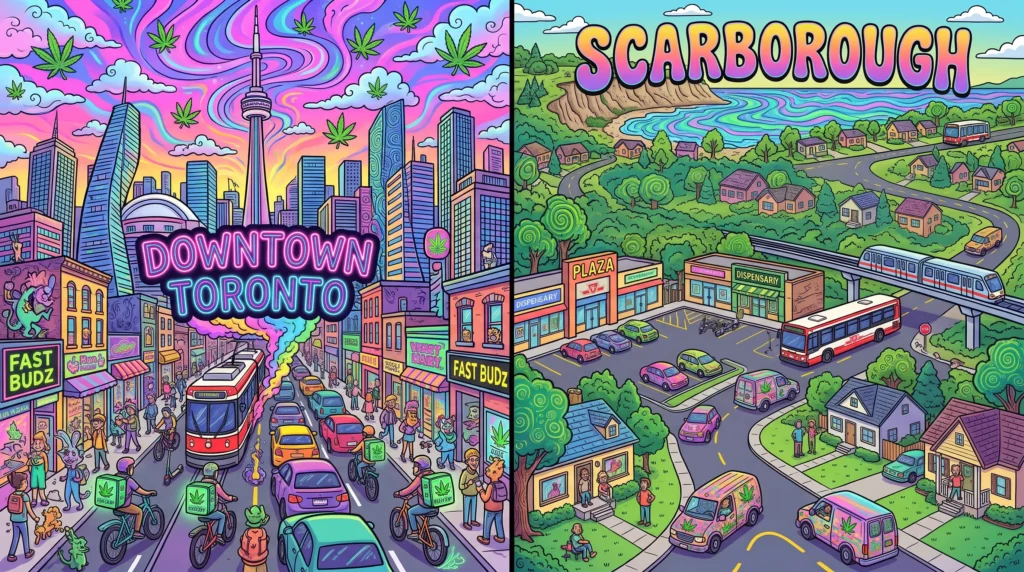
Imagine two Friday nights. Same city. Same 8:41 p.m. timestamp. Same legal framework. One person is on the 27th floor of a condo near King and Bathurst, thumb hovering over the checkout button. The other person is in a bungalow off Kingston Road near Morningside, already having taken off their shoes for the night. They both tap “Place Order” within sixty seconds of each other.
The downtown order receives a lobby call before 9:20 p.m. At 10:05, the Scarborough order still shows “driver assigned.”
Nobody made a mistake. No customer service representative made an error. One address is located in the densest cluster of licensed cannabis retailers in Canada. The other is located about 25 kilometers east, in a district spanning 188 square kilometers, where stores are located in major plazas instead of on every block.
That’s the whole story, and almost nobody explains it properly.
This guide breaks down exactly how cannabis delivery differs between downtown Toronto and Scarborough. It explains why ETAs diverge, why minimums and fees change once you cross Victoria Park Avenue, how condo concierges quietly add fifteen minutes to delivery times, what the handoff rules actually require, and how to confirm that a delivery service is licensed before handing over your ID. You’ll receive a side-by-side comparison table and a step-by-step ordering guide. You will also learn the citywide rules that apply to every address in the 416 area code.
Quick answer: Downtown Toronto weed delivery is usually faster and cheaper to trigger because licensed stores are dense and trips are short — often 30–60 minutes by bike or car. Scarborough orders typically run 60–120 minutes by car, with higher order minimums, batched runs and earlier evening cutoffs. Both are fully legal for adults 19+ when fulfilled by an AGCO-licensed retailer.
Why Does One City Produce Two Completely Different Delivery Experiences?
Because delivery speed is a function of distance to the nearest licensed store, not of neighbourhood quality, service tier or luck. Three variables do most of the work.
Store Density Is the Variable Nobody Puts on the Map
Downtown wards — Spadina–Fort York, University–Rosedale, Toronto Centre — hold the tightest concentration of authorized cannabis stores in the province. Queen West, the Entertainment District, Yonge-Dundas, the Annex, Church-Wellesley: in some stretches you can walk past three storefronts in ten minutes.
Scarborough’s licensed stores are real, legal and often excellent. They’re simply spread along Kingston Road, Lawrence Avenue East, Ellesmere, Markham Road and the Scarborough Town Centre orbit. Fewer stores, far more ground.
🔥REFER A FRIEND
THEY GET 10% OFF THEIR FIRST ORDER🔥
Do the math and the ETA gap stops being mysterious. A downtown courier might be 900 metres from your lobby. A Scarborough driver may be 11 kilometres away, and you might be stop four on the run.
Expert insight: Before you order, ask the dispatcher one question: “Which store is fulfilling this?” Then look that address up. The store’s location — not the website’s Toronto branding — predicts your wait almost perfectly.
The 25-Kilometre Reality
Scarborough Town Centre to Yonge and Dundas is roughly 25–30 kilometres depending on route. Off-peak, that’s a 30–45 minute drive. On a Friday at 6 p.m., with the DVP crawling and the 401 collectors doing their impression of a parking lot, it can double.
Downtown orders never touch that arithmetic. They fight a different enemy: streetcars, construction hoarding, one-way grids, event traffic spilling out of Scotiabank Arena, and paid parking that makes drivers circle instead of stop.
Bike Versus Car Isn’t a Detail — It’s the Business Model
Short downtown trips work on e-bikes and on foot. Cheap per trip, nimble in traffic, no parking hunt. That economics supports low minimums and small orders.
Scarborough runs on cars. Cars mean fuel, insurance, parking, and — critically — batching. A driver rarely makes one drop. They make five, in a loop, and your address might sit at the end of it.
Downtown Toronto vs. Scarborough Weed Delivery: Side-by-Side
Here’s the comparison in one extractable block. Ranges reflect commonly reported patterns in the Toronto market, not guarantees — always confirm the live figures at checkout.
| Factor | Downtown Toronto (core) | Scarborough | Root cause |
|---|---|---|---|
| Licensed store density | Very high; walkable options | Lower; plaza-based, wider spacing | Foot traffic, rents, retail zoning |
| Typical courier mode | E-bike, foot, car | Car, almost exclusively | Trip distance + parking |
| Commonly quoted ETA | ~30–60 minutes | ~60–120 minutes | Distance and batching |
| Order minimum pattern | Often lower (~$30–$50) | Often higher (~$50–$75+) | Cost per delivery trip |
| Delivery fee pattern | Low, or free above a threshold | Flat fee or higher free-delivery threshold | Driver time and fuel |
| Handoff location | Lobby / meet-at-door concierge dance | Front door or driveway | Building stock |
| Main delay trigger | Events, rush hour, condo access | 401/DVP traffic, snow, route batching | Different bottlenecks |
| Late-night availability | More late-open stores, later cutoffs | Earlier cutoffs, fewer late options | Store hours + drive time |
| Assortment skew | Fast turnover, curated drops, pre-rolls | Larger formats, value SKUs, deeper stock | Store footprint + demand mix |
| Best fallback | Walk in or curbside pickup | Planned pickup or OCS mail order | Density again |
How Do Fees, Minimums and ETAs Shift Once You Cross Victoria Park?
They shift because the retailer is absorbing a longer, more expensive trip — and that cost has to land somewhere.
Three mechanics explain nearly every pricing difference you’ll see:
- Threshold engineering. “Free delivery over $X” isn’t generosity; it’s a margin calculation. A $40 threshold works on a 1.2 km bike run. It rarely works on a 14 km drive, so the threshold climbs.
- Batching windows. Suburban orders are frequently grouped. Your quote may say “60–120 minutes” because the driver leaves on the half hour, not on your click.
- Cutoff times. A store closing at 10 p.m. downtown can accept a 9:15 order. A Scarborough fulfilment point with a longer average drive may stop accepting delivery orders an hour or more before close.
Pro tip: Check whether the free-delivery threshold applies to your subtotal after discounts and before tax. Loyalty points and promo codes quietly drop carts below the line, and a “free” delivery becomes a $9 delivery. Ask, or read the fine print once and screenshot it.
One more nuance worth knowing: prices for legal cannabis are broadly comparable across the city because every licensed store buys through the same provincial wholesale channel. Downtown’s advantage is competition — more stores chasing the same customer tends to mean more aggressive promos. Scarborough’s advantage is often format and stock depth, not sticker price.
Why Do Condo Concierges Slow Downtown Deliveries Down?
Because the legal handoff requires a human being with valid ID, and a high-rise lobby is full of humans who are not you.
Ontario’s retail rules do not permit an unattended drop. No leaving it behind the planter. No “concierge will sign for it.” The person receiving must be an adult, 19 or older, with ID checked at the moment of transfer.
That single rule collides with downtown building design:
- Locked-by-default towers. Many concierges won’t buzz couriers to residential floors. You go down.
- Elevator waits. Twenty-seven floors, two cars, one of them out of service. Add eight minutes.
- Buzzer fatigue. Older walk-ups near Kensington and the Annex have buzzers that reach a landline nobody uses.
- Meet-at-curb culture. Drivers double-parking on a bike-lane-lined King Street will ask you to come out. Fine — if you’re ready.
🔥 Stack your savings. Elevate your session. 10% off $100, up to 25% off $450.
🔥 Roll into the menu and start saving. CLICK HERE!
Scarborough’s low-rise stock flips the friction. A driveway handoff takes ninety seconds once the car arrives. The delay is entirely in getting the car there.
Expert insight for condo dwellers: Put your buzzer code and “meet in lobby — I’ll come down” in the delivery notes, then watch your phone. Most “late” downtown orders are actually drivers waiting in a lobby for six minutes while the customer assumes the ETA is a promise.
What Does Scarborough’s Retail Geography Mean for Selection?
It generally means bigger boxes, deeper stock and a different mix — not a worse one.
Downtown stores are often compact. Small footprint, high rent, high turnover. That favours fast-moving categories: pre-rolls, popular dried flower formats, beverages, and quick inventory churn on new drops.
Scarborough stores more often have square footage and parking. That tends to show up as broader shelf depth, larger value formats, and staff who have time for a real conversation instead of a queue-management sprint.
Two practical implications:
- Chasing a specific niche cultivar or a limited drop? Downtown’s dense network gives you more chances that someone has it — and pickup is a short walk or streetcar ride.
- Stocking up on a known favourite? A Scarborough store may hold more of it, and a planned pickup beats paying a suburban delivery threshold you didn’t want to hit.
Is the Delivery Service You’re Looking at Actually Legal?
If it’s fulfilled by an AGCO-licensed Ontario retailer or by the Ontario Cannabis Store, yes — otherwise, no. Toronto has both markets operating side by side, and the unlicensed ones advertise aggressively.
Run these five checks before you order:
- Find the licence, not the logo. Search the AGCO’s public registry of authorized cannabis retail stores. A licence number on a footer means nothing until it matches a real record.
- Confirm the fulfilling store’s address. Legitimate operations name a physical Ontario store. “Serving the entire GTA 24/7” with no address is a tell.
- Look for the excise stamp on arrival. Legal Canadian cannabis carries a CRA cannabis excise stamp marked for Ontario, plus standardized Health Canada labelling and THC/CBD content.
- Expect an ID check, every time. A service that advertises “no ID needed” is telling you it isn’t operating inside the regulated system.
- Sanity-check payment and pricing. Licensed retailers use mainstream payment processing and issue receipts. E-transfer-only, cash-only, no receipt, prices far below the legal market — that combination points to the grey market.
Why care? Regulated product comes with mandatory testing and labelling, a real receipt, a complaints path, and predictable dosing information. Unlicensed product comes with none of that, and no recourse when something is wrong.
Medical cannabis is a separate lane. Patients registered with federally licensed sellers receive product by mail across the whole city — downtown and Scarborough alike. Different channel, different rules, same geography-agnostic delivery.
Step-by-Step: How to Place an Order That Arrives When They Said It Would
This method works at any Toronto address. It takes about four minutes and removes most of the avoidable failure points.
- Verify the retailer first. AGCO registry lookup, thirty seconds. Do it once per store, then save the result.
- Identify the fulfilling location. Map it. Downtown address near you = short trip. Store 12 km away = plan for batching.
- Read the delivery terms before you build a cart. Minimum, fee, free-delivery threshold, cutoff time, and whether the estimate is a window or a target.
- Build the cart to the threshold deliberately. Check post-discount subtotal. Don’t add a product you don’t want just to save a fee you could avoid with pickup.
- Write notes that solve the actual obstacle. Buzzer code, lobby meet-up, driveway, side door, “call don’t text.” Specific beats polite.
- Have ID physically in hand. Not a photo. Not a wallet in another room. Valid government-issued photo ID proving 19+.
- Stay reachable for the full window. Unknown-number calls are the driver. Answer them.
- Inspect at the door. Intact seal, Ontario excise stamp, correct items, receipt.
- Store it properly. Child- and pet-inaccessible, out of sight, in original labelled packaging.
Pro tip: In Scarborough, order before the evening rush, not during it. A 6:30 p.m. order competes with the 401 at its worst. A 4 p.m. order often beats its own estimate. Downtown, the inverse applies — post-rush orders after 7:30 p.m. frequently move fastest.
Two Friday Nights: An Illustrative Walkthrough
The timelines below are illustrative composites built from commonly reported Toronto delivery patterns, not a single measured test. They show where minutes actually go.
| Clock | Downtown condo (King & Bathurst area) | Scarborough house (Kingston & Morningside area) |
|---|---|---|
| 8:41 p.m. | Order placed; store 1.1 km away | Order placed; store 11 km away |
| 8:46 p.m. | Packed, courier assigned | Packed, added to a 3-stop run |
| 8:55 p.m. | Courier en route by e-bike | Driver departs after second pickup |
| 9:05 p.m. | Arrives; concierge won’t buzz up | Stop one delivered |
| 9:14 p.m. | Customer meets in lobby, ID checked | Stop two delivered |
| 9:31 p.m. | Done — 50 minutes | Arrives at driveway |
| 9:34 p.m. | — | ID checked at door, done — 53 minutes |
Notice what happened. The Scarborough order finished only three minutes later — because the dispatcher batched efficiently and the driveway handoff was instant. Distance sets the floor; execution decides the outcome. A badly managed downtown order can lose to a well-run suburban one.
What Rules Apply Everywhere in Toronto, Regardless of Postal Code?
The legal constants don’t change at Victoria Park. These apply in Malvern and in the Entertainment District identically:
- 19+ to buy, possess or receive. ID is verified at handoff. No adult present, no delivery.
- 30 grams of dried cannabis (or equivalent) in public. That’s the federal public possession ceiling.
- No unattended drops. The transfer happens person to person.
- Four plants per residence for home cultivation in Ontario — subject to lease and condo rules, which can be stricter.
- Consumption limits. Ontario’s smoke-free legislation restricts smoking and vaping cannabis in vehicles, on restaurant patios, in indoor common areas and near schools and playgrounds. Condo bylaws and leases can restrict it further, including on balconies.
- Never drive impaired. Federal impaired-driving offences plus Ontario administrative penalties apply. Delivery existing is not a reason to consume and drive.
- Edibles: legal Canadian packages are capped at 10 mg THC per package, and Health Canada advises that effects can take 30 minutes to two hours to begin. Waiting beats re-dosing.
- No sales to anyone who appears intoxicated — retailers are required to refuse, and that includes at your door.
How Do Weather, Events and Construction Change the Calculus?
Seasonally, and asymmetrically.
Winter punishes Scarborough harder. Snow clearing on side streets, longer drives in poor conditions, and couriers who reasonably slow down. Downtown’s short e-bike trips suffer too, but a 1 km trip in a snowstorm is still a 1 km trip.
Summer events punish downtown harder. Concerts, playoff runs, film-festival closures and street festivals turn a fifteen-minute run into forty. Scarborough barely notices a Leafs game.
Construction hits both differently: downtown loses lanes and sidewalks; Scarborough loses arterial capacity on Kingston Road and around transit work. And postal disruptions are the shared wildcard — mail-order cannabis has been periodically delayed by labour action, which is precisely when local store delivery earns its keep.
Which Channel Should You Use? A Simple Decision Table
| Your situation | Best channel | Why |
|---|---|---|
| Downtown, need it tonight, small order | Licensed store courier or walk-in pickup | Density makes both fast and cheap |
| Scarborough, need it tonight | Licensed store delivery, ordered early | Beats the rush and the batching queue |
| Scarborough, stocking up, no urgency | OCS mail order or planned store pickup | Avoids per-trip delivery economics |
| Chasing a niche or limited product | Call downtown stores; arrange pickup | More doors to knock on |
| Registered medical patient | Your federally licensed seller by mail | Geography-neutral channel |
| Any address, any service, no verifiable licence | Don’t order | No testing, no receipt, no recourse |
Step-by-Step: Choosing the Right Delivery Setup for Your Address
The right delivery choice is not “downtown service” versus “Scarborough service.” It is a short checklist that starts with your postal code and ends with a realistic time window.
- Enter your postal code first, before browsing menus. Zone eligibility is binary. A retailer that does not cover your address cannot deliver to you regardless of menu or price.
- Confirm the same-day cutoff for your specific zone. Cutoffs differ by store and sometimes by zone. One Scarborough service cuts off at 8:00 p.m. ; a downtown retailer takes last orders at 10:15 p.m. . Ordering after cutoff means next-day delivery, not a faster courier.
- Compare the fee against the minimum, not in isolation. A $9.77 flat fee with no minimum is excellent for a small order. A $15 fee on a $40 minimum is a meaningful surcharge unless your cart clears the free-delivery threshold at $80.
- Build one consolidated cart if you are outside the core. Scarborough and edge-of-zone addresses benefit most from clearing the free-delivery threshold in a single order. Two separate small orders in the same evening will usually cost more in fees than one larger cart.
- Write building instructions as if the courier has never been there. Downtown condo handoffs and Scarborough multi-unit addresses both fail on unclear access. The courier must hand the order to a 19+ person with ID and cannot leave it unattended.
- Order before the evening rush if timing matters. The 5 p.m. to 8 p.m. window is the heaviest volume period across the city; ordering in the early afternoon is the single easiest way to move your delivery toward the fast end of the quoted window.
The Bottom Line
Downtown Toronto and Scarborough are not running the same delivery playbook at different speeds. They are running different logistics models under the same provincial rules. Downtown wins on speed, cutoff flexibility, and courier density — a 20 km radius packed with orders and bike couriers produces one-hour delivery as a routine outcome, not a marketing promise. Scarborough wins on flat-fee optionality and no-minimum access, but it asks you to respect the zone map, order earlier, and consolidate your cart.
🔥REFER A FRIEND
THEY GET 10% OFF THEIR FIRST ORDER🔥
The practical takeaway is simple. If you are downtown, optimize your building instructions — the road is not your bottleneck. If you are in Scarborough, optimize your postal-code fit and order timing — the map is your bottleneck, not the menu. Check your zone, check the cutoff, clear the free-delivery threshold in one cart, and the two areas start to feel much less different than the wait times suggest.
Next step: enter your postal code into two or three licensed retailers’ delivery checkers side by side. Compare the all-in cost — product plus fee minus any threshold waiver — for a cart you would actually order. That number, not the advertised delivery window, is the one that should decide where you buy.
Your Next Move
The gap between a 40-minute delivery and a 100-minute delivery in Toronto isn’t a service tier. It’s store density, trip distance, batching decisions and building access — four things you can now see and plan around.
Three takeaways worth keeping:
- Downtown wins on speed and low thresholds. Scarborough wins on stock depth, easy handoffs and larger formats.
- The handoff rules are identical citywide: adult present, ID verified, nothing left unattended.
- Licence verification is the only check that matters before you pay. Everything else is optimization.
So do this now, while you’re thinking about it: open the AGCO’s authorized cannabis retail registry, look up the two or three licensed stores closest to your address, and save their delivery minimums, cutoff times and phone numbers in a note. Next Friday at 8:41 p.m., you’ll be the person who ordered from the right store — not the one refreshing a tracker.
Nineteen plus only. Consume responsibly, store it safely, and never drive impaired.
🔥 Stack your savings. Elevate your session. 10% off $100, up to 25% off $450.
🔥 Roll into the menu and start saving. CLICK HERE!
FAQ Section
Is weed delivery legal in both downtown Toronto and Scarborough?
Yes. Adults 19+ can legally receive cannabis delivery anywhere in Toronto from an AGCO-licensed retailer or the Ontario Cannabis Store. Location doesn’t change legality. The retailer’s licence does — verify it in the AGCO’s public registry before ordering.
How long does cannabis delivery take in Scarborough compared to downtown Toronto?
Downtown orders commonly arrive in 30–60 minutes; Scarborough orders typically take 60–120 minutes. The difference comes from store density, driving distance and batched delivery routes — not service quality. Confirm the live estimate at checkout, since traffic and weather shift both.
Can a driver leave cannabis with my concierge or at my door?
No. Ontario requires a person-to-person handoff with ID verification confirming the recipient is 19 or older. Unattended drops and concierge signatures aren’t permitted. In condos, expect to meet the courier in the lobby yourself.
Why is the delivery minimum higher in Scarborough?
Longer trips cost more. Scarborough deliveries usually travel farther by car and get batched with other stops, so retailers raise order minimums or free-delivery thresholds to cover driver time and fuel. Downtown’s short bike trips support lower minimums.
Is the OCS or a local licensed store faster in Toronto?
A nearby licensed store is usually faster for same-day needs, especially downtown. OCS mail order suits planned purchases and broader selection, with delivery times measured in business days rather than minutes. Postal disruptions can extend those timelines.