
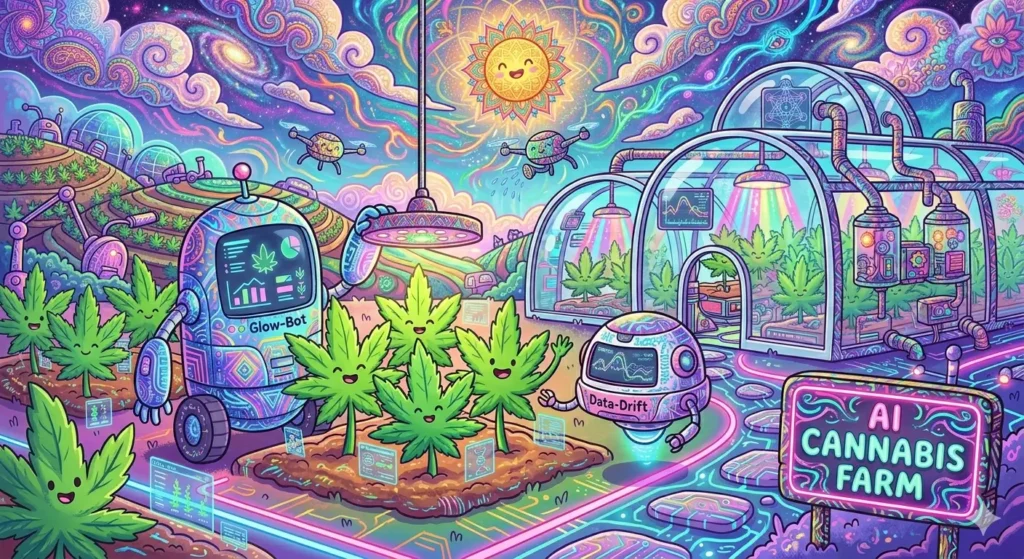
Have you ever walked into a grow room and felt that gut-wrenching uncertainty—wondering if you are overwatering, under-lighting, or missing a pest infestation until it is too late? For decades, cannabis cultivation relied on “green thumbs” and folklore. But the margin for error is shrinking, and the demand for consistency is skyrocketing.
What if you could predict a plant’s needs before it shows a single yellow leaf? That is exactly what AI-powered cannabis cultivation offers. By integrating machine learning into your grow strategy, you stop guessing and start knowing. Whether you are a commercial cultivator looking to protect your return on investment or a home grower chasing potency, this guide will show you how algorithms are rewriting the rulebook.
How does machine learning change the way you grow? Let’s dig into the science, the software, and the soil.
What Is AI-Powered Cannabis Cultivation?
In simple terms, AI-powered cannabis growing refers to the use of machine learning algorithms and sensor networks to automate and optimize the entire plant lifecycle. Instead of relying solely on static timers or manual observation, an AI system learns from thousands of data points—temperature, humidity, root zone pH, light spectrum, and even leaf color—to make real-time decisions.
Think of it as a co-pilot for your garden. You tell the system your goal (e.g., high THC or high terpenolene), and the AI adjusts the environment to hit that target.
Why does this matter for your business? Because consumers and dispensaries no longer buy “good weed.” They buy specific effects, flavors, and safety profiles. Consistency is the currency of the modern cannabis market, and machine learning is the mint.
The Core Benefits of Machine Learning in a Grow Room
Before we dive into the “how,” let’s look at the “why.” Adopting AI isn’t just about tech hype; it delivers tangible, measurable outcomes.
1. Reduced Operational Costs (Up to 30%)
Energy is the second-largest expense in indoor cultivation (after labor). Machine learning algorithms analyze historical energy usage and weather patterns to optimize HVAC and lighting schedules. For example, an AI might pre-cool a room before peak electricity pricing hours, saving you thousands per month.
- Question for you: Are you currently running your lights at full power even when the VPD is out of range, wasting energy on inefficient photosynthesis?
2. Increased Yield Per Square Foot
By maintaining perfect environmental conditions 24/7, AI-powered cannabis facilities report yield increases of 15-25%. The AI learns the exact “sweet spot” for each strain, reducing the lag time between harvests.
3. Labor Efficiency
Your team spends less time dialing in sensors and more time on high-value tasks like training and harvesting. One cultivator told us, “It’s like having a PhD in plant physiology watching my crop while I sleep.”
How AI Optimizes Environmental Controls
This is where machine learning truly shines. A human can check a hygrometer once an hour. An AI checks it every second.
VPD Management
Vapor Pressure Deficit (VPD) is the relationship between temperature and humidity. If your VPD is wrong, your stomata close, and your plants stop eating. AI-powered cannabis systems automatically adjust humidifiers, dehumidifiers, and heaters to maintain a perfect VPD curve from clone to harvest.
Dynamic Lighting
Forget static dimmers. Machine learning models analyze photosynthetic rates and adjust light intensity and spectrum dynamically. If the AI detects early signs of light stress (via leaf temperature cameras), it dims the LEDs instantly.
- Case Study: A Colorado facility used machine learning to reduce light-induced bleaching by 90% while increasing average THC by 3%.
CO2 Injection Optimization
Why pump CO2 during lights-off? AI stops waste by synchronizing CO2 release only with peak photosynthetic periods, improving your conversion of electricity into plant mass.
Predictive Analytics: Stopping Pests and Mold Before They Start
The difference between a good grower and a great one is reaction time. The best growers treat problems before they appear. AI-powered cannabis makes this possible through predictive analytics.
How does it work? The AI is trained on thousands of images of powdery mildew, spider mites, and botrytis. When a camera spots a single speck of PM on a lower leaf (invisible to the naked eye), you get an alert.
Real-world example: A Canadian LP (Licensed Producer) integrated machine learning with their HVAC system. The AI detected a humidity micro-cluster forming in a corner of the room and triggered localized fans. They stopped a potential mold outbreak that could have destroyed $500,000 worth of product.
- Question for you: How much revenue would you lose if a hidden mold outbreak wiped out your next harvest?
Machine Learning for Cannabinoid and Terpene Profiling
We are moving from “high THC wins” to specific effect engineering. Do you want a relaxing “couch-lock” or a creative, energetic high? AI-powered cannabis can help you profile your harvest for specific outcomes.
By analyzing spectral data (light reflected off leaves), machine learning models can predict THC and terpene percentages without destructive lab testing every week. This allows growers to harvest at the exact peak of ripeness.
The data doesn’t lie: A 2024 study published in Frontiers in Plant Science confirmed that machine learning algorithms could predict cannabinoid concentrations with over 90% accuracy using only hyperspectral imaging.
Furthermore, when you pair this with smart contracts on a blockchain, you create an immutable record of quality. A dispensary can scan a QR code and see that the AI-powered cannabis in the jar was tested, harvested, and cured under optimal conditions.
Integration with Blockchain for Supply Chain Transparency
While machine learning optimizes the grow, blockchain secures the story. Consumers are demanding “farm-to-bowl” transparency. By integrating AI-powered cannabis cultivation data with a distributed ledger, you provide proof.
- Seed to Sale: Every time the AI adjusts a nutrient or logs a temperature, that data is hashed onto the blockchain.
- Anti-Counterfeit: It becomes impossible to pass off black-market weed as your premium brand because the digital fingerprint doesn’t match.
- Compliance: Regulators love immutable logs. It makes audits instantaneous.
A word of caution: Ensure your blockchain solution is carbon-neutral, or you risk negating the energy savings from your AI.
Common Mistakes to Avoid When Adopting AI
Jumping into AI-powered cannabis without a plan is a recipe for frustration. Here are three errors we see regularly:
- Garbage In, Garbage Out: If your sensors are uncalibrated, your machine learning model learns the wrong patterns. Always validate your hardware first.
- Ignoring the Human Element: AI is a tool, not a replacement. You still need a human to reset a breaker, clean a filter, or smell for issues a camera can’t detect.
- Over-reliance on Cloud AI: If your internet goes down, can your local controller keep running? Always opt for hybrid systems that operate offline.
Quick Wins: Low-Cost AI Tools for Beginners
You don’t need a million-dollar facility to start. Here are three quick wins to implement AI-powered cannabis today:
- Smart Sensors (e.g., Pulse Pro or Trolmaster): These use basic machine learning to send push notifications when your VPD drifts. (~$300)
- Automated Drip Systems (e.g., Growlink): These learn your plants’ drinking patterns. If the run-off EC is rising, the AI reduces the next feeding. (~$500)
- IPM Cameras (e.g., Petoi or Grove AI): Affordable cameras that run edge-based machine learning to spot yellow sticky traps and count fungus gnats. (~$150)
Question for you: Which of these three quick wins would solve your biggest headache right now?
Conclusion: The Future of the Green Rush Is Intelligent
We have left the era of “bag seed luck.” We are now in the era of AI-powered cannabis. By leveraging machine learning, you transform your grow from a chaotic biological experiment into a predictable, efficient manufacturing process. You protect your engagement with the market by delivering consistency, and you maximize the customer lifetime value by turning casual buyers into loyal fans of your specific terpene profiles.
Machine learning doesn’t just save you money on electricity; it saves your harvest from ruin. It gives you back your weekends because you aren’t driving to the warehouse at 2 AM to check a humidistat.
Are you ready to stop guessing and start growing with precision?
If you found this guide valuable, share it with a fellow cultivator who is still using pen and paper. Subscribe to our newsletter below for weekly deep dives into cannabis tech, and leave a comment—we’d love to hear how you are using machine learning in your garden.
Frequently Asked Questions (FAQs)
1. Is AI-powered cannabis cultivation legal?
Yes, in jurisdictions where cannabis is legal for medical or adult use. The AI controls the environment, not the chemical synthesis. However, always check local regulations regarding automated control systems.
2. Do I need to know how to code to use machine learning in my grow?
No. Most commercial solutions (like AgEye or Cannalytics) offer drag-and-drop dashboards. You don’t program the AI; you train it by telling it what “good” looks like.
3. Can machine learning help me breed new strains?
Absolutely. AI analyzes genomic data to predict which crosses will produce specific traits (e.g., high CBG or resistance to powdery mildew). This cuts years off traditional breeding cycles.
4. How does blockchain improve the value of my AI data?
It creates trust. When you integrate AI-powered cannabis data with blockchain, buyers and regulators cannot alter the history. It proves you actually grew the product you claim to have grown.
5. What is the initial investment for a commercial AI system?
Entry-level systems start at $2,000 for small rooms, while full-scale machine learning integration for a 10,000 sq ft facility can range from $25,000 to $100,000, usually recouped within 6-12 months via energy savings.
6. Can AI predict the exact harvest date?
Yes, with high accuracy. Machine learning models track trichome development and pistil browning, often predicting the optimal harvest window within a 2-day margin of error.
7. Does AI work for outdoor cultivation?
Yes, though it is harder. Machine learning helps predict weather events (rain, frost) and schedules automated light deprivation tarps or row covers proactively.
8. What happens if the AI makes a mistake?
Reputable systems have “fail-safe” modes. If a sensor glitch occurs, the AI-powered cannabis controller reverts to a standard environmental baseline (e.g., 75°F, 60% RH) until a human overrides it.