
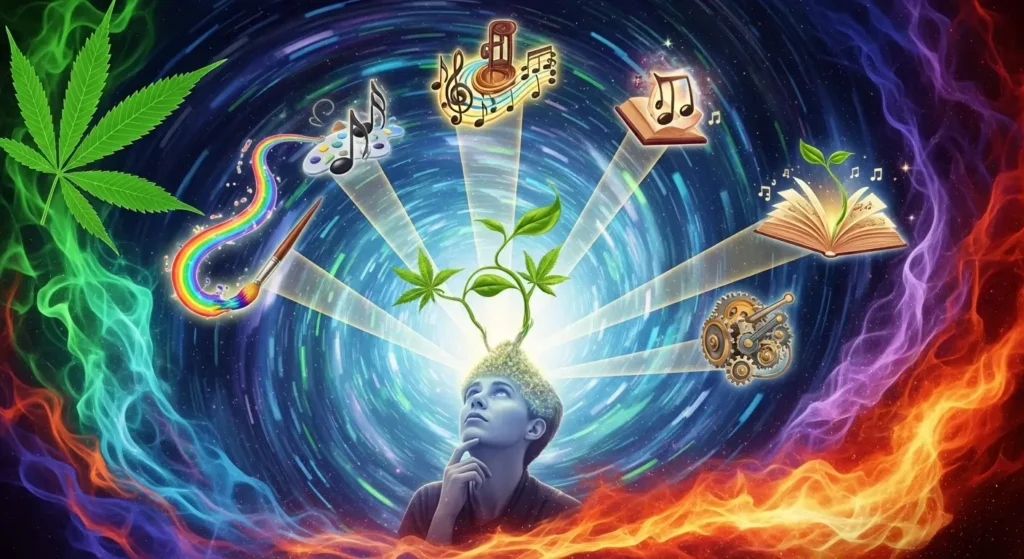
The image is iconic: a musician lost in a riff, a painter deeply focused on a canvas, or a writer typing furiously into the night, all supposedly fueled by cannabis. From Steve Jobs’ famous quote about marijuana making him “relaxed and creative” to countless modern artists and entrepreneurs, the link between weed and creativity feels embedded in our culture . This widespread belief prompts a fundamental question that many artists, professionals, and curious minds ask: Does smoking boost creativity? The answer, as cutting-edge science reveals, is far more complex—and arguably more disappointing for advocates of the “creative high”—than the enduring myth suggests. While a puff might make you feel more inventive, the hard data indicates it’s unlikely to turn you into a creative genius. In fact, highly potent cannabis has been shown in clinical studies to impair divergent thinking, a core component of creativity .
This article delves beyond anecdotal reports and pop culture lore to explore the rigorous scientific research on cannabis and creative thinking. We’ll dissect how different types of creativity are measured, examine the nuanced dose-dependent effects, and confront the critical gap between perception and performance. Our goal is to provide a clear, evidence-based perspective to help you make informed decisions, whether you’re an artist seeking inspiration, a professional problem-solver, or simply someone fascinated by the mind’s potential. The journey reveals that the relationship between weed and creativity is less about unlocking hidden genius and more about understanding a delicate—and often impairing—interaction with your brain’s chemistry.
Understanding Creativity: It’s Not One Thing
Before we can ask if weed impacts creativity, we must define what creativity is. Scientists don’t view it as a single, magical trait. Instead, they break it down into measurable cognitive processes, primarily through two key types of thinking:
- Divergent Thinking: This is the “brainstorming” mode of thought. It involves generating a broad array of ideas, solutions, or possibilities from a single starting point. When you’re asked to think of as many uses for a brick as possible, you’re using divergent thinking. It’s characterized by fluency (number of ideas), flexibility (variety of ideas), and originality .
- Convergent Thinking: This is the “problem-solving” mode. It requires narrowing down options to find the single, correct, or best solution to a well-defined problem. Solving an algebra equation or a riddle relies on convergent thinking .
These two processes engage different neural pathways and can be independently affected by substances, mood, and environment. When people wonder, “Does smoking boost creativity?” they are typically hoping for a boost in divergent thinking—the free-flowing, idea-generating kind.
How Cannabis Interacts with the Creative Brain
The primary psychoactive compound in cannabis, delta-9-tetrahydrocannabinol (THC), interacts with the brain’s endocannabinoid system, influencing regions critical for thought and perception, like the prefrontal cortex .
The proposed link to creativity often centers on two effects of THC:
- Dopamine Release: THC can stimulate the release of dopamine in the brain’s striatum, a neurotransmitter associated with pleasure, reward, and motivation . A moderate dopamine boost can enhance cognitive flexibility and the “flow” of ideas.
- Reduced Inhibitory Control: THC can temporarily lessen the brain’s top-down executive control and self-monitoring . While this might quiet the “inner critic” that stifles ideas, it also impairs functions like focus and working memory.
This creates a potential paradox: the same mechanism that might unleash a flood of ideas could also weaken your ability to critically evaluate, connect, and execute them effectively.
The Dose-Dependent Reality: A Little vs. A Lot
Here is where the science gets critical. The impact of cannabis on creativity is not a simple “yes” or “no”; it is profoundly dose-dependent. The findings from a key 2014 randomized, controlled study illustrate this perfectly .
Table: Dose-Dependent Effects of Cannabis on Creative Thinking
| THC Dose | Effect on Divergent Thinking | Effect on Convergent Thinking | User Perception |
|---|---|---|---|
| Low Dose (e.g., ~5.5mg THC) | No significant impact or mild, inconsistent enhancement. | Potential minor impairment or no impact. | May feel relaxed and slightly more open-minded. |
| High Dose (e.g., ~22mg THC) | Significant impairment. Generates fewer and less original ideas. | Clear disruption of focused problem-solving. | May feel “spaced out,” with a clouded mental fog. |
| Placebo | Baseline performance. | Baseline performance. | Varies; no pharmacological effect. |
This research concluded that highly potent cannabis actually impairs divergent thinking . The “sweet spot,” if it exists, appears to be very low and highly subjective. For every anecdote about a creative breakthrough, there is laboratory evidence showing that intoxication often hinders the cognitive processes required for genuine innovation.
The Critical Divide: Feeling Creative vs. Being Creative
Perhaps the most revealing insight from recent research is the stark difference between perception and reality. You may genuinely feel more creative while using cannabis, but objective measurements often tell a different story.
A pivotal 2022 study published in the Journal of Applied Psychology found that while cannabis-induced joviality (a positive mood) made participants rate their own ideas and the ideas of others as more creative, it did not lead to an increase in actual creative output . The ideas weren’t objectively better or more novel; the participants’ perception of them was simply biased.
This explains the persistence of the myth. Cannabis alters your subjective experience—it can make thoughts feel more profound, connections seem more meaningful, and the creative process more enjoyable. This positive, expansive feeling is easily mistaken for enhanced creativity itself. As summarized in a Harvard Business Review analysis, the empirical evidence suggests users feel more imaginative, but this doesn’t translate to measurably improved performance .
The Cognitive Trade-Offs and Risks
Pursuing a creative high comes with tangible cognitive costs that can sabotage the very process you’re trying to enhance.
- Working Memory Impairment: Working memory is your brain’s scratchpad—it holds information in mind for immediate use. A landmark 2025 study, the largest of its kind, used brain imaging on over 1,000 adults and found that heavy recent cannabis use was associated with reduced brain activity and worse performance on working memory tasks . This is catastrophic for complex creative work that requires holding multiple concepts simultaneously.
- Executive Function Decline: This umbrella term includes planning, organization, sustained attention, and decision-making. A comprehensive review of cannabis research notes that THC intoxication impairs these higher-order functions, which are vital for moving from a raw idea to a finished product .
- The “Tortured Artist” is Not a Formula: Some speculate that negative moods fuel creativity. However, a 2017 thesis examining the interaction of cannabis use frequency and induced mood (positive, negative, neutral) on creativity found no significant link between a negative mood state and enhanced creative output .
A Practical Guide: If You Choose to Experiment
If, after considering the evidence, you still wish to explore the relationship between cannabis and creative thinking personally, a strategic and cautious approach is essential. The goal is to minimize harm while honestly assessing any potential benefit.
1. Prioritize a Microdosing Mindset:
The science is clear: high doses impair. If you experiment, start with an extremely low dose of a product with known potency (e.g., a 2.5mg edible or a single, small inhalation). The alleged “benefits” for creativity, if any, are reported at the very lowest end of the spectrum .
2. Curate Your Setting (Set and Setting):
Creativity is fragile. Don’t introduce cannabis into a chaotic, stressful, or unfamiliar environment. Be in a safe, comfortable, and private space with your tools ready. Your mindset (“set”) should be calm and intentional, not anxious or escapist.
3. Have a Clear Pre-Intoxication Plan:
Do not expect the substance to give you ideas. Instead, come to the session with a specific, manageable creative challenge already in mind (“brainstorm character names,” “sketch thumbnails for a painting,” “play with chord progressions in G major”). Use any altered state to explore this pre-defined space, not to search for a starting point.
4. Implement a Sobriety Buffer for Critical Work:
Absolutely separate the generative phase from the evaluative and execution phases. Use a notepad or recorder to capture ideas while intoxicated. Then, return to evaluate, refine, and execute those ideas only when completely sober. Research confirms that being high biases your judgment and leads to overestimating the quality of ideas .
5. Honestly Audit Your Results:
After a week, review what you produced. Compare the raw ideas generated during a cannabis session to those generated sober. Which led to more usable, original, and developed work? Let your personal data, not the cultural myth, guide your future choices.
The Neuroscience of Cannabis: How THC and CBD Interact With Your Brain
Cannabis contains over 100 cannabinoids, but the two most discussed in relation to creativity are tetrahydrocannabinol (THC) and cannabidiol (CBD).
- THC is the primary psychoactive compound. It binds to cannabinoid receptors (CB1) densely located in brain regions governing memory, focus, and executive function—like the prefrontal cortex. This interaction reduces inhibitory control and can stimulate dopamine release, which influences motivation and perception.
- CBD is non-intoxicating and is thought to modulate the effects of THC, potentially reducing anxiety and paranoia. Some advocate for a balanced THC/CBD ratio for a clearer, more focused experience.
The theory is that by reducing top-down inhibitory control, THC might temporarily weaken the brain’s internal critic. This can feel like a lifting of mental barriers, allowing for a freer flow of associations—potentially aiding divergent thinking. However, this same mechanism can sabotage the focused, critical analysis required for convergent thinking and refining ideas.
What the Research Reveals: A Clear-Eyed Look at the Data
So, what does the controlled, peer-reviewed science actually tell us? The findings challenge many popular beliefs.
1. The Critical Role of Dosage
A pivotal 2014 study published in Psychopharmacology provides stark evidence. Researchers administered low (5.5mg THC) and high (22mg THC) doses of vaporized cannabis to regular users. The result? The high-dose group performed significantly worse on a divergent thinking task than both the low-dose and placebo groups. The study’s conclusion was clear: “highly potent cannabis actually impairs divergent thinking”.
This establishes a fundamental rule: Microdosing may have a place, but high doses are counterproductive for creative cognition.
2. The Feeling vs. The Fact
Multiple studies highlight a crucial disconnect. A 2017 study in Consciousness and Cognition found that while sober cannabis users self-reported higher creativity, their superior performance on a convergent thinking test was explained by their personality traits (higher openness to experience), not cannabis use itself.
Similarly, a 2022 review noted that cannabis might increase “joviality” and the perception that one’s ideas are creative, without objectively improving the ideas themselves. This means cannabis may change how you feel about your ideas, not the quality of the ideas.
3. The Impact on Different Creative Tasks
The research consensus points to a mixed and dose-dependent impact:
- Divergent Thinking (Idea Generation): Low to moderate THC doses may show subtle, temporary enhancement or no effect. High doses consistently impair performance.
- Convergent Thinking (Problem-Solving): THC intoxication typically impairs or shows no benefit for this focused, analytical type of thinking.
- Verbal Fluency: Some studies note mild improvement with low doses, but results are inconsistent.
A Practical Guide: Navigating Cannabis for Creative Pursuits
If you choose to explore cannabis within your creative process, an intentional and informed approach is essential. Here’s a practical framework.
Step 1: Know Your “Why” and Set an Intention
Are you seeking to overcome a initial blank-page barrier, or are you trying to execute a detailed, technical plan? Remember, cannabis is better suited for the initial, exploratory phases (divergent thinking) and is a known hindrance for the execution phase (convergent thinking).
Step 2: Start Low, Go Slow, and Prioritize Ratio
This is the golden rule.
- Choose a Low-THC Product: Opt for products with clear labeling. A balanced 1:1 THC:CBD ratio is often recommended for beginners, as CBD can temper the anxiety and mental fog associated with THC.
- Method Matters: Inhalation (flower, vaporizer) offers quick onset, allowing you to gauge effects in minutes. Edibles have a delayed and prolonged effect, making dose control harder and potentially leading to an uncomfortably long or intense experience that stifles productivity.
Step 3: Create the Right Container for Your Session
Don’t just consume and hope for inspiration. Structure your approach:
- Prepare Your Tools: Have your notebook, sketchpad, or instrument ready before you consume.
- Consume a Minimal Dose: Inhale a single, small puff or take a low-dose edible (e.g., 2.5mg THC). Wait 15-20 minutes to assess the effect fully.
- Engage Immediately: As you feel the effects, begin your creative activity. Capture everything without judgment.
- Review Sober: The most critical step. Set your raw ideas aside and revisit them later when sober. This is when you’ll use your convergent thinking to edit, refine, and identify which ideas truly have merit.
Step 4: Be Aware of the Risks and the Law
- Cognitive Health: A 2022 systematic review of medical cannabis noted that while low-to-moderate doses often have minor cognitive impacts, long-term use may still adversely affect cognitive functioning.
- Legal Status: You must understand your local laws. As of 2025, cannabis is legal for recreational adult use in 24 states and Washington D.C., and legal for medical use in 40 states. However, it remains illegal at the federal level. Use interactive maps from sources like DISA to check your specific state’s status.
Table: Quick Reference Guide to Cannabis & Creativity
Conclusion: Creativity is an Inside Job
The romantic notion of cannabis as a key to the creative kingdom is compelling, but it is not supported by robust scientific evidence. The search for a substance that reliably increases creativity often overlooks the truth: sustainable, high-quality creative work is built on cognitive foundations that cannabis tends to undermine—sharp working memory, sustained focus, and critical executive function.
The consistent finding from modern research is that weed does not make you more creative; it makes you feel differently about your creativity, and often for the worse in terms of actual output . The most reliable path to enhanced creativity remains the unglamorous, substance-free work of consistent practice, skill development, curiosity, and creating the conditions for your brain to do its best work.
True creative breakthroughs are less about chemically altering your mind and more about showing up, doing the work, and trusting the capabilities of your sober, magnificent brain.
Frequently Asked Questions (FAQs)
Does smoking boost creativity?
The evidence suggests it does not boost objective, measurable creativity. While low doses may make you feel more relaxed and open-minded, clinical studies show that higher doses of THC actively impair divergent thinking, a core component of creativity. Any perceived boost is more likely a change in mood and self-perception rather than an actual improvement in creative output .
Does weed impact creativity?
Yes, but often negatively. Weed impacts creativity in a dose-dependent and task-dependent manner. It can disrupt the focused, convergent thinking needed for problem-solving and, at higher doses, hinder the free-flowing, divergent thinking needed for brainstorming. It also impairs working memory, which is crucial for connecting complex ideas .
What weed is good for creative thinking?
No specific strain has been scientifically proven to enhance creative thinking. Anecdotal reports from some artists suggest sativa-dominant strains (like Sour Diesel or Jack Herer) are preferred for their potentially more uplifting, cerebral effects. However, this is highly subjective. The critical factor is extremely low THC dosage, as high potency is directly linked to impaired performance. Products with a balance of THC and CBD might help moderate intensity for some users .
What drug increases creativity?
There is no reliable, safe, and legal drug proven to increase true creativity. While microdosing psychedelics is an area of anecdotal interest, robust clinical evidence is lacking. Stimulants like caffeine may improve focus and stamina for creative work but don’t enhance originality. The most effective “boosters” are non-pharmacological: sleep, exercise, mindfulness, and exposure to novel experiences. The search for a creativity pill is fraught with risk and often leads to cognitive impairment rather than enhancement.
Does smoking weed help you come up with more ideas?
The science is mixed. While some users feel a freer flow of ideas, controlled studies show that only very low THC doses might have a subtle effect, and high doses actually impair the brain’s ability to generate diverse ideas (divergent thinking).
Can CBD make you more creative without the high?
There is no direct evidence that CBD enhances creativity. However, by potentially reducing anxiety and stress, CBD might indirectly create a mental environment where creativity can flourish more easily for some individuals.
Are creative people more likely to use cannabis?
Research indicates that cannabis users often score higher on the personality trait of “openness to experience,” which is correlated with creativity. This suggests a pre-existing personality link, not that cannabis use causes someone to become creative.
What’s the biggest mistake people make when using cannabis for creativity?
Using too high a dose. A high-potency dose is proven to impair the cognitive processes needed for creative thinking, leading to brain fog and incoherence instead of breakthrough ideas.
Is it safe to use cannabis to overcome writer’s block or artist’s block?
It can be a risky strategy. While it might provide a temporary psychological shift, it can also become a crutch. Relying on an external substance for creative work can hinder the development of intrinsic motivation and discipline. It’s generally safer to explore other block-breaking techniques first, like free-writing, changing your environment, or taking a walk.
Disclaimer: This article is for informational purposes only and does not constitute medical or legal advice. Cannabis laws vary by location, and its use can carry health risks. Always consult with a healthcare professional regarding substance use.