
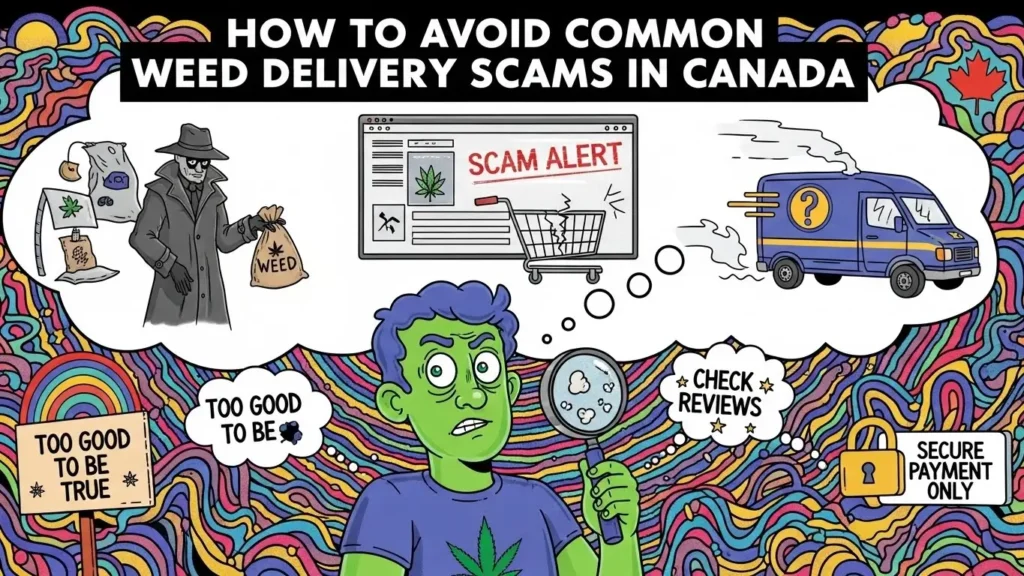
Picture this: you’ve found a fantastic deal on your favorite strain from a slick-looking online store. You place your order, send the payment, and wait excitedly for your discreet weed delivery in Canada. Days turn into weeks, but your package never arrives. When you try to contact customer service, the email bounces back, and the website has vanished. You’ve just become another victim of the sophisticated scams plaguing the online cannabis market.
You’re not alone. With over 60% of Canadian cannabis consumers now purchasing online for its undeniable convenience, the shadowy world of illicit operators has grown just as fast . These fraudulent sites use professional web designs, fake licensing badges, and enticing “too-good-to-be-true” prices to mimic legitimate retailers, leaving thousands of Canadians out of pocket and at risk .
This guide is your comprehensive shield. We’ll cut through the confusion, arming you with actionable knowledge to identify, avoid, and report the most common weed delivery scams. By learning to navigate the Canadian online cannabis landscape safely, you can confidently enjoy the convenience of legal, lab-tested products delivered right to your door.
Understanding the Canadian Cannabis Landscape: Legal vs. Illegal Markets
Since national legalization, Canada has developed a unique dual market: the strictly regulated legal sector and a persistent, sophisticated illegal one . Understanding this distinction is your first and most crucial line of defense.
The Legal, Licensed Framework: Licensed online dispensaries operate under the federal Cannabis Act and provincial regulations. This means every step—from cultivation and lab testing to packaging and delivery—is monitored for your safety . Legal retailers must prominently display their license number, which you can verify against official provincial lists . Their products undergo mandatory third-party testing for potency and contaminants like pesticides and heavy metals, with results available via a Certificate of Analysis (CoA) .
The Illicit, High-Risk Market: Illicit operators exist purely to exploit this new market. They bypass all regulatory costs and safety checks, allowing them to offer seductively low prices. The risks, however, are substantial:
- Health Hazards: Products may be contaminated with banned pesticides, mold, or harmful additives .
- Financial Fraud: These sites are fronts for credit card theft and identity fraud . Payments via untraceable methods like gift cards or certain cryptocurrencies are a major red flag.
- No Recourse: If your product is mislabeled, never arrives, or makes you sick, you have absolutely no consumer protection .
Ask yourself: Am I willing to trade the guaranteed safety, accurate labeling, and legal protection of the regulated market for a slightly lower price that could cost me much more in the end?
Top 5 Weed Delivery Scams and How to Spot Them
Scammers are inventive, but their schemes often follow familiar patterns. Here are the most common weed delivery scams to watch for.
1. The “Ghost Dispensary” Website Scam
This is the most prevalent scam. Criminals create a professional-looking website overnight, stock it with stolen images of premium cannabis, and offer unbelievable bulk weed deals. After collecting payments (often only via Interac e-transfer), they disappear, sometimes only to re-emerge under a different name.
Red Flags:
- No Verifiable License: The site lacks a license number or displays a fake one.
- Unsecure Payment: They only accept irreversible methods like e-transfer, wire transfer, or cryptocurrency with no buyer protection .
- Fake Contact Info: The listed address is a P.O. box, the phone number is disconnected, and the email is a generic @gmail or @yahoo account .
2. The “Product Bait-and-Switch” Scam
You receive a package, but the product inside doesn’t match the description. Premium AAAA-grade flower turns out to be low-quality shake, moldy trim, or synthetically sprayed biomass . These operations thrive because once you open the package, disputing the transaction becomes incredibly difficult.
Red Flags:
- No Lab Results: The site does not provide accessible, batch-specific Certificates of Analysis (CoA) from a third-party lab .
- Vague Descriptions: Product listings lack detailed information on strain genetics, cannabinoid percentages, or terpene profiles.
- Suspiciously Low Prices: As experts note, high-quality flower has a real production cost. An ounce priced 50% below the standard market rate is almost certainly a scam or dangerously low quality .
3. The “Fake Delivery & Tracking” Scam
You receive a tracking number, but it never updates, shows false “delivery attempted” notices, or is for a completely different postal code. The seller blames the courier and stalls until you give up.
Red Flags:
- Slow or Fake Tracking: A legitimate tracking number from Canada Post or a reputable courier should activate within 24 hours .
- Blames the Shipper: The seller is overly eager to blame postal services and unwilling to initiate a trace or investigation themselves.
- No Customer Service: When you report the issue, emails go unanswered, and phones are not in service.
4. The “Age Verification Bypass” Scam
Any legitimate business will rigorously verify your age at checkout and upon delivery, as required by law. A site that advertises “no ID needed” or promises to ship without age verification is explicitly operating illegally and is a major scam warning .
5. The “Social Media & Messaging App” Trap
Scammers increasingly operate through Instagram, Telegram, or WhatsApp, offering “fire deals” directly in your DMs. These transactions have zero protection, and once you send payment, the seller can block you instantly.
Red Flags:
- No Business Website: The seller operates solely through private social media channels .
- Pressure to Act Fast: They use high-pressure tactics like “flash sales” or “last pound left.”
- Payment to Personal Accounts: They request payment sent to a personal e-transfer email or PayPal “Friends & Family.”
Your Anti-Scarm Action Plan: A Step-by-Step Verification Checklist
Before you click “checkout,” follow this definitive checklist. Treating your online cannabis purchase with the same diligence as any other major online transaction is the key to safety.
Step 1: Verify the Dispensary’s Legal License
This is non-negotiable.
- Find the License Number: Look for a provincial retail license number (e.g., Ontario’s “RSLA” number) on the website’s footer or “About Us” page.
- Cross-Check Officially: Do not trust the badge on their site. Go directly to your provincial cannabis authority’s website (e.g., the AGCO in Ontario) and use their authorized retailer search tool to verify the license is active and in good standing .
- Check for HTTPS: Ensure the website URL begins with
https://(the “s” stands for secure) and has a padlock icon in the address bar .
Step 2: Scrutinize Product Quality & Transparency
Legitimate retailers are proud of their product quality and testing.
- Demand Lab Reports: Look for a clear link to a Certificate of Analysis (CoA) for the specific product batch. The report should be from an independent lab (not an in-house one) and show testing for THC/CBD potency, terpenes, and contaminants .
- Examine Packaging (Upon Delivery): Legal cannabis must arrive in child-resistant, plain packaging with a standardized excise stamp and health warning . If it arrives in a Ziploc bag or branded mylar bag, it’s from the illicit market.
Step 3: Ensure Secure Payment & Discreet Delivery Protocols
- Use Protected Payment Methods: Opt for credit cards or secure payment gateways that offer fraud protection and chargeback rights. Be extremely wary of sellers who only accept cash, wire transfers, or cryptocurrency .
- Understand the Delivery Process: A legal retailer will have a clear process for discreet, tracked shipping and will require age verification with a government-issued ID upon delivery . The driver should not hand over the package without this step.
Step 4: Research Reputation & Reviews
- Look Beyond the Website: Search the dispensary’s name alongside keywords like “reviews,” “scam,” or “legit” on forums like Reddit or trusted review platforms.
- Check the BBB: Look for complaints on the Better Business Bureau (BBB) website .
- Assess Customer Service: Test their responsiveness. Legitimate businesses have functional, professional customer service channels .
Pro-Tip: Bookmark this checklist or save it on your phone. Run through it for every new online dispensary you consider.
What to Do If You’ve Been Scammed
If you suspect you’ve fallen victim to a weed delivery scam, act quickly:
- Document Everything: Save screenshots of the website, product listings, order confirmations, all communication, and payment receipts.
- Contact Your Financial Institution: Immediately report the fraudulent transaction to your bank or credit card company. You may be able to dispute the charge and recover your funds.
- Report to Authorities:
- Canadian Anti-Fraud Centre (CAFC): Report the scam online at antifraudcentre-centreantifraude.ca.
- Local Police: File a report with your local police detachment.
- Provincial Regulator: Report the illicit operation to your provincial cannabis regulator (e.g., AGCO, BC LCRB).
- Warn Others: Consider posting about your experience (without sharing personal details) on community forums to prevent others from being scammed.
Conclusion: Empower Yourself as a Safe Consumer
Navigating the world of mail order weed in Canada in 2025 offers incredible convenience but demands informed vigilance. The difference between a safe, satisfying experience and a costly, risky scam boils down to the due diligence you perform before clicking “buy now.”
Remember, supporting the legal market isn’t just about following the law—it’s about investing in your own safety, product quality, and the integrity of an industry built on regulation and transparency. You hold the power to shut down scam operations by starving them of customers.
Ready to shop with confidence? Use this guide as your blueprint. Share it with friends, bookmark it for future reference, and always remember: if a deal seems too good to be true, it almost certainly is. Your perfect, peace-of-mind purchase from a licensed, reputable retailer is out there.
Frequently Asked Questions (FAQs)
What is the single most important step to avoid weed delivery scams?
The most critical step is to verify the dispensary’s legal license against your provincial government’s official authorized retailer list. Never trust a license badge on a website alone; always cross-check it with the official database .
Are cheap bulk weed deals always a scam?
Not always, but they are a massive red flag. While licensed retailers offer bulk discounts, prices that are drastically (e.g., 40-50%) below the standard market rate for premium products are a classic indicator of a scam or of products that are contaminated, mislabeled, or of very poor quality . Legitimate value comes from first-time customer discounts, bundle deals, and loyalty programs from verified sellers.
How can I tell if lab results (Certificate of Analysis) are fake?
Check for these details: 1) Third-Party Lab Name: The report should be from an independent, accredited laboratory. 2) Batch-Specific Data: The batch number on the report must match the number on the product you receive. 3) Comprehensive Testing: It should list cannabinoid potency (THC/CBD), terpenes, and confirm the absence of pesticides, heavy metals, and microbial impurities . Vague or generic-looking documents are a warning sign.
Is it safe to buy weed from sellers on social media?
No, it is highly risky. Transactions through Instagram, Telegram, or WhatsApp have zero buyer protection. These platforms are rife with scammers who disappear after payment. Always purchase from a licensed dispensary with a legitimate, secure website and transparent business practices .
What should I do if my delivery requires no signature or ID check?
This is a major red flag and illegal under Canadian law. Reputable, licensed delivery drivers are required by law to check a government-issued ID to verify the recipient is of legal age before handing over the package . A delivery without this step means the service is operating outside the legal framework.