
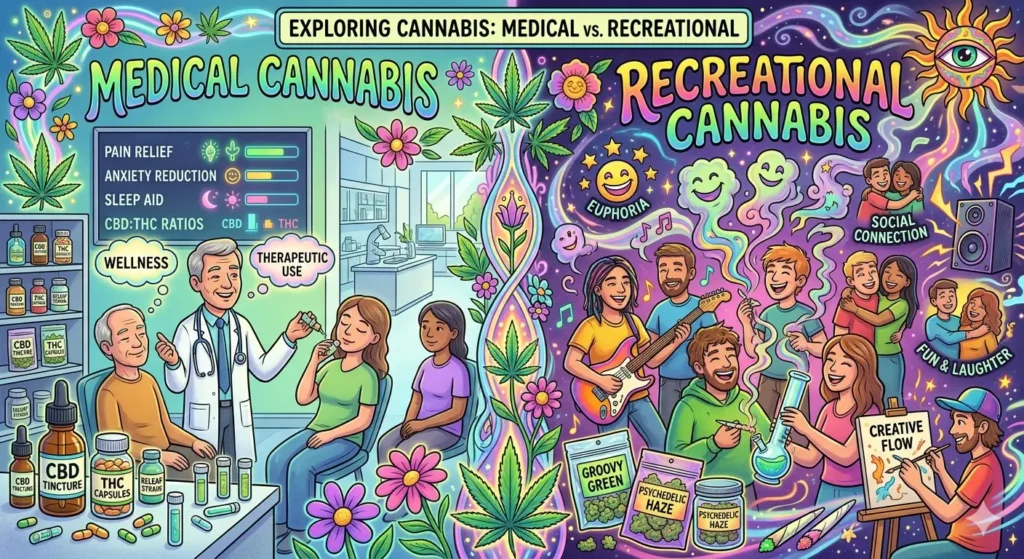
So, you walk into a dispensary for the first time. The lights are bright, the glass cases are full of jars labeled with whimsical names like “Purple Punch” or “Sour Diesel,” and the person behind the counter asks you a seemingly simple question: “Are you here for medical or recreational?”
If you’ve ever found yourself frozen in that moment, unsure how to answer, you are not alone. The landscape of cannabis has changed rapidly. What was once a single, stigmatized plant has now split into two distinct markets. Choosing the wrong path isn’t just about price; it’s about your health, your legal protection, and the experience you are about to have.
Understanding the Medical vs. Recreational Cannabis divide is the first step to becoming a savvy, safe, and empowered consumer. Are you looking to manage chronic pain and anxiety, or are you simply looking to unwind on a Friday night? The answer dictates everything. In this guide, we’ll cut through the noise, explore the nuances of potency, price, and legality, and help you navigate the shelves like a pro.
What is Medical Cannabis? A Focus on Treatment
Medical cannabis is cannabis that is prescribed or recommended by a licensed healthcare provider to treat a specific medical condition. Unlike its recreational counterpart, the journey here begins with a diagnosis. Think of it as moving from “I want to feel good” to “I need to feel better.”
The goal of medical cannabis isn’t necessarily to get “high,” but to utilize the plant’s therapeutic compounds—primarily THC (tetrahydrocannabinol) and CBD (cannabidiol) —to alleviate symptoms.
The Role of the Medical Card
To access medical cannabis, patients typically need to register with their state’s program. This involves a consultation with a doctor who certifies that the patient has a qualifying condition, such as:
- Chronic pain
- PTSD (Post-Traumatic Stress Disorder)
- Cancer-related symptoms (nausea, appetite loss)
- Epilepsy and seizure disorders
- Multiple Sclerosis
Why does this matter? This process adds a layer of oversight. A doctor helps determine the proper dosage and ratio of THC to CBD, ensuring the patient avoids unwanted side effects like paranoia or excessive sedation. It transforms cannabis from a recreational substance into a regulated pharmaceutical tool.
What is Recreational Cannabis? A Focus on Experience
On the other side of the counter, recreational cannabis (often called “adult-use”) is for the consumer who is 21 or older and wishes to purchase cannabis for enjoyment, relaxation, or social enhancement. No doctor’s note is required.
When you buy recreational cannabis, you are purchasing a product designed primarily for its psychoactive effects. The market is driven by flavor profiles (terpenes), potency (THC percentage), and consumption methods like pre-rolls, vapes, and edibles. It’s the difference between buying a bottle of wine to pair with dinner (recreational) versus being prescribed a specific medication by a cardiologist (medical).
Medical vs. Recreational Cannabis: The 5 Key Differences
Let’s get into the details. If you are standing in a dispensary or browsing a menu online, these are the factors that will impact your wallet and your well-being.
1. Legal Framework and Requirements
The most immediate difference in the Medical vs. Recreational Cannabis debate is the barrier to entry.
- Medical: Requires a state-issued medical marijuana card. This involves a doctor’s visit, paperwork, and often an annual renewal fee. It offers legal protections that recreational use does not, such as higher possession limits and, in many states, protection from employment discrimination.
- Recreational: Requires a valid government ID proving you are over 21. It is easier to access initially but comes with stricter purchasing limits and higher taxes.
2. Potency and Product Selection
Have you ever wondered why the medical side of the store seems to have more “boring” looking bottles while the rec side has the flashy bags of flower?
- Medical: Products often have a balanced ratio of CBD to THC. High-CBD strains are common because they provide anti-inflammatory benefits without the intense psychoactive “high.” Medical menus frequently feature tinctures, transdermal patches, and suppositories—products designed for symptom relief rather than intoxication.
- Recreational: Here, the focus is often on maximizing THC. You’ll see strains boasting 25%+ THC content. The goal is euphoria, creativity, or relaxation. Edibles in the recreational market often come in high-sugar formats (gummies, chocolates) with higher doses per package.
3. The Cost Factor: Taxes and Savings
This is where the decision often hits the wallet hardest.
- Medical: Because it is classified as healthcare, medical cannabis is usually exempt from the high excise taxes imposed on recreational sales. In states like California or Colorado, recreational taxes can exceed 20-30%, while medical patients pay only standard sales tax. Additionally, many dispensaries offer “med-only” discounts, loyalty programs, and higher purchase limits.
- Recreational: You pay a premium for the convenience of skipping the doctor’s appointment. Those taxes fund public programs and infrastructure, but they add up quickly.
4. Purchase Limits
- Medical: Patients typically have a higher “possession limit.” For example, a medical cardholder might be able to purchase up to 2.5 ounces of flower per month (or more with a doctor’s waiver), whereas a recreational user is capped at 1 ounce per transaction.
- Recreational: Limits are strictly enforced by the state. If you are hosting a party, you might find yourself making multiple trips (legally) if you only have a recreational license.
5. Age and Access
- Medical: Available to minors in many states with parental consent and a qualifying condition (such as severe epilepsy). This allows parents to access life-changing treatments for their children.
- Recreational: Strictly 21+.
Navigating the “Gray Area”: Why Consumers Switch Between Markets
It is not uncommon for a consumer to hold both a medical card and purchase recreationally. In fact, many patients start with recreational cannabis, realize they are spending too much on taxes, and then take the step to get their medical card to save money.
However, there is a catch. Is medical cannabis “stronger”? Not necessarily. While medical products are often more focused on therapeutic outcomes, the raw flower can sometimes be identical to what is sold on the recreational shelf, just priced differently.
Ask yourself: Are you buying this to manage a health condition, or are you buying it to enjoy a weekend getaway from stress? Your answer determines whether the extra step of obtaining a card is worth the long-term savings.
The Science of Cannabinoids: THC vs. CBD
To truly grasp Medical vs. Recreational Cannabis, you need to understand the two main characters in this story: THC and CBD.
- THC (Tetrahydrocannabinol): This is the psychoactive compound. It’s what gives you the “high.” In the recreational market, high THC is king. In the medical market, THC is used for pain relief, insomnia, and appetite stimulation, but it is often balanced with CBD to mitigate anxiety.
- CBD (Cannabidiol): Non-psychoactive. It is the go-to for medical patients dealing with inflammation, anxiety, and seizures without the euphoric effect.
A Quick Reference for Consumers
| Feature | Medical Cannabis | Recreational Cannabis |
|---|---|---|
| Primary Goal | Symptom relief / Treatment | Enjoyment / Relaxation |
| THC/CBD Ratio | Often balanced (1:1, 2:1 CBD:THC) | High THC, low CBD |
| Taxes | Low (medical exemption) | High (20-30% excise tax) |
| Access | Requires doctor’s recommendation | 21+ ID only |
| Product Types | Tinctures, patches, suppositories | Flower, edibles, vapes |
How to Choose What’s Right for You
Making the choice between Medical vs. Recreational Cannabis isn’t just about following the law; it’s about aligning your purchase with your personal goals. Let’s break it down into simple scenarios.
You Should Consider Medical Cannabis If:
- You have a chronic condition: If you suffer from arthritis, migraines, or PTSD, a medical card allows you to consult with a pharmacist who specializes in cannabis.
- You are a heavy user: If you consume daily, the tax savings from the medical market can save you hundreds of dollars a year.
- You are sensitive to THC: Medical menus offer high-CBD options that are hard to find on the recreational side. If you want the benefits without the anxiety, medical is your lane.
- You need employer protection: In some states, having a medical card prohibits employers from firing you for a positive drug test if you are not impaired at work.
You Should Consider Recreational Cannabis If:
- You are a casual user: If you only smoke occasionally at social gatherings, the hassle of renewing a medical card every year probably isn’t worth it.
- You are visiting from out of state: Medical programs are residency-based. Tourists cannot obtain a medical card in most states; they must purchase recreationally.
- You want variety: Recreational menus often have a wider selection of exotic, high-THC strains and novelty items (like infused pre-rolls and craft sodas) that medical-only dispensaries may not carry.
A Word on Safety and Responsible Use
Regardless of which path you choose, responsibility is key. A common mistake new consumers make is assuming that because they have a medical card, they can drive under the influence, or that because a product is “recreational,” it is harmless.
Always start low and go slow. This is the golden rule of cannabis consumption. If you are trying an edible from the recreational cannabis market, which may contain 10mg of THC, start with half or even a quarter of the dose. The same applies to medical cannabis; just because a tincture says “extra strength” doesn’t mean you need the full dropper on day one.
The Future of Cannabis: Blurring the Lines
As legalization spreads, the rigid lines between Medical vs. Recreational Cannabis are starting to blur. We are seeing a phenomenon called “Cannabis as Wellness.” More and more recreational users are seeking out products with terpene profiles designed for focus or energy, essentially using recreational products for functional, health-oriented purposes.
Conversely, medical programs are becoming more consumer-friendly, allowing for home delivery and streamlined digital applications.
Question for you: As the industry evolves, do you think the distinction between medical and recreational will eventually disappear, or will it remain essential for patient safety?
Frequently Asked Questions (FAQs)
Q: Is medical cannabis cheaper than recreational?
A: Yes, significantly. In most states, medical cannabis is exempt from the high state excise taxes levied on recreational products. Patients often save 20-30% on their total bill compared to recreational buyers.
Q: Can I buy recreational cannabis with a medical card?
A: Yes, but it depends on the dispensary. Some dispensaries are “medical-only,” some are “recreational-only,” and some are “hybrid” (serving both). If you have a medical card, you should always purchase through the medical system at a hybrid store to save on taxes. If you buy recreational, you will pay recreational prices even if you have a card.
Q: Which is stronger, medical or recreational weed?
A: This is a common misconception. Potency depends on the strain, not the label. Recreational cannabis often markets high-THC flower (25%+), while medical cannabis focuses on balanced ratios. However, medical patients often have access to higher-dose edibles (e.g., 100mg per package vs. 10mg per package in rec) due to higher tolerance levels.
Q: Can I use my out-of-state medical card in another state?
A: It depends on reciprocity laws. States like Nevada, Arizona, and Oklahoma often accept out-of-state medical cards, allowing you to shop in their medical system. However, states like California and Colorado do not; out-of-state visitors must purchase recreationally.
Q: Do I need a medical card to buy CBD?
A: No. Hemp-derived CBD (with less than 0.3% THC) is federally legal and sold in gas stations and health food stores. However, if you want CBD-rich cannabis flower (which contains more than 0.3% THC and higher therapeutic levels of other cannabinoids), you typically need a medical card in states where recreational is not yet legal, or you can find it on the recreational shelf in adult-use states.