
You notice it the way you notice a coworker who stopped showing up to meetings. One Tuesday in early December, you leave the office and the sky is already the colour of wet concrete, the wind is coming off Lake Ontario like it has a personal grudge, and the streetcar is nine minutes away in a snow squall. By the time you get home, your boots are salt-stained and your soul wants a blanket.
So you do what a lot of Torontonians do. You visit a licensed shop, point at the bag with the biggest THC number, and say “that one.”
Two hours later you’re horizontal, mildly paranoid, and deeply invested in a documentary about deep-sea squid—when what you actually wanted was to bake something and watch a hockey game without falling asleep in the second period.
That mismatch is the whole problem. Winter cannabis isn’t about potency. It’s about fit.
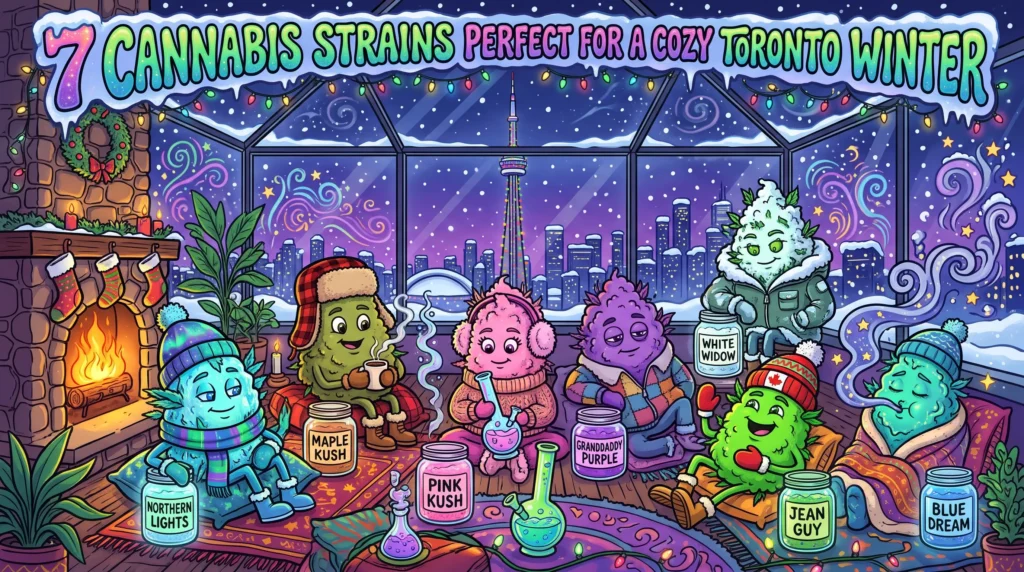
Here’s what this guide gives you: seven strains that genuinely suit a Toronto winter, the terpene logic behind each pick, a terpene-to-temperature chart for dry herb vapes, the legal rules that actually apply inside city limits, a storage routine for forced-air apartments, and a step-by-step snow-day plan so your evening goes the way you pictured it.
🔥REFER A FRIEND
THEY GET 10% OFF THEIR FIRST ORDER🔥
Quick Answer: The 7 Best Winter Strains at a Glance
For a cozy Toronto winter, choose heavier, myrcene- and caryophyllene-forward cultivars for evenings, one bright terpene-forward sativa for dark afternoons, and one CBD-dominant option for clear-headed days. Here’s the shortlist:
| # | Strain | Type | Commonly listed THC* | Typical dominant terpenes | Best winter moment |
|---|---|---|---|---|---|
| 1 | Pink Kush | Indica-dominant hybrid | 18–28% | Myrcene, caryophyllene, limonene | Snowstorm lockdown, nowhere to be |
| 2 | Northern Lights | Indica | 16–24% | Myrcene, caryophyllene, pinene | Quiet weeknight, low-aroma condo session |
| 3 | Granddaddy Purple | Indica | 17–25% | Myrcene, caryophyllene, linalool | Late evening, wind-down |
| 4 | Wedding Cake | Indica-leaning hybrid | 20–28% | Caryophyllene, limonene, myrcene | Baking, hosting two friends |
| 5 | Blueberry | Indica-dominant | 15–24% | Myrcene, pinene, caryophyllene | Blanket + movie marathon |
| 6 | Jack Herer | Sativa-dominant | 15–24% | Terpinolene, pinene, caryophyllene | 4 p.m. darkness, cleaning, creative work |
| 7 | ACDC / Cannatonic (CBD-forward) | CBD-dominant or 1:1 | 0.3–8% THC, 6–20% CBD | Myrcene, pinene, caryophyllene | Sunday crossword, clear head |
Ranges reflect what Ontario menus commonly show for these lineages, not a guarantee. Read the label on the actual package. Two bags named “Pink Kush” from two producers can differ by ten percentage points and smell like entirely different plants.
Pro Tip — Buy the label, not the name. In Canada’s legal market, cultivar names are marketing shorthand, not botanical standards. Sort by lineage + dominant terpenes + THC/CBD ratio. If a shop or the OCS listing shows a terpene breakdown, that’s the most useful column on the page.
What Actually Makes a Strain “Winter-Worthy”?
A winter strain is one whose cannabinoid ratio and terpene profile match a low-stimulation, indoor evening—not simply one with high THC. Three variables decide the outcome, and potency is only the loudest of them.
First, some vocabulary that makes you a sharper shopper. “Strain” is a colloquial term. Researchers prefer cultivar (a cultivated variety) or chemovar (a plant grouped by its chemical profile). A chemovar is defined by what’s in it—cannabinoids and terpenes—rather than by a name somebody printed on a mylar bag.
Second, the working model most budtenders use:
THC sets the volume. Terpenes set the tone.
That sentence is a heuristic, not established pharmacology. The “entourage effect”—the idea that terpenes meaningfully modulate cannabinoid effects in humans—is plausible and actively studied, but human evidence remains limited. Treat terpene-based recommendations as experienced pattern-matching, not a prescription.
Third: set and setting, which in Toronto in January is doing more work than you think. Grey skies, minus-fifteen windchill, a clanking radiator, and three weeks of cancelled plans change how a session lands. A racy sativa that felt fantastic at a July beach can feel like a bad idea in a dark apartment on a Tuesday.
The Terpene Cheat Sheet for Cold Months
| Terpene | Aroma | Approx. boiling point† | Commonly reported character | Winter pairing |
|---|---|---|---|---|
| Myrcene | Mango, musk, ripe fruit | ~166–168 °C | Heavier, “couch-adjacent” | Snow day, oversized sweater |
| β-Caryophyllene | Black pepper, clove | ~130 °C | Warm, spicy, grounding | Chili on the stove, hockey night |
| Linalool | Lavender, floral | ~198 °C | Soft, calming | Bath, dim lamps, no phone |
| Limonene | Citrus peel | ~176 °C | Brighter, lifted | Grey afternoon, baking |
| α-Pinene | Pine forest | ~155 °C | Crisp, alert | Evergreen candle, tidying up |
| Terpinolene | Pine, apple, lilac | ~186 °C | Energetic, “buzzy” | Sunday reset, playlist-making |
†Approximate values at atmospheric pressure, widely cited in vaporizer guidance. Real-world release depends on your device, grind and draw.
Notice something? The warm, spicy, sleepy end of that chart is exactly what winter asks for. That’s not mysticism—it’s aroma matching mood, the same reason you want cinnamon in December and mint in July.
The Seven Strains, Explained Properly
1. Pink Kush — The Snowstorm Special
Pink Kush is the unofficial mascot of Ontario’s legal indica shelf: an OG Kush–descended, indica-dominant hybrid that regularly tests in the twenties. Expect sweet vanilla over gas and pepper, with myrcene and caryophyllene usually leading. The flavour is sweet candy-earth with a gassy undertone, and the room-filling aroma is part of the experience—opening a fresh jar in a small Toronto apartment is its own small ceremony.
Why it fits: When the city shuts down and you’re not going anywhere, this is a commitment strain. Plan for the couch. Plan for snacks. Do not plan for a productive evening. The effect builds gradually, stays for a while, and leaves the body warm and heavy without the disorienting head rush that some high-THC indicas produce.
Watch-out: It’s routinely one of the higher-THC options on the menu. If your tolerance is modest, one or two inhalations and a genuine pause. Not “one more because nothing happened yet.”
Cozy pairing: A slow-simmered stew, a heated throw, and a Leafs game you don’t have opinions about.
2. Northern Lights — The Discreet Classic
Northern Lights is an old-school indica with Afghani heritage, bred in the Pacific Northwest before becoming a Dutch coffee-shop staple. Earthy, piney, faintly sweet—and notably less loud than a gassy modern hybrid. The terpene story is myrcene-forward, with caryophyllene and limonene rounding out the profile. That combination translates to a physical heaviness that arrives gradually and a mental quiet that makes it easier to put the phone down and actually sleep.
Why it fits: That low-aroma profile matters in a Toronto condo where the hallway shares ventilation and your building’s rules are stricter than provincial law. Ontario-grown versions in the 25–26% THC range have become a winter staple for customers who want predictability after a slushy commute and a long day of fluorescent office lighting.
Watch-out: “Low smell” is not “no smell.” Combustion still announces itself. A dry herb vape with a sploof-style filter reduces odour; it doesn’t erase it.
Cozy pairing: A quiet weeknight, a documentary you’ll actually remember, and the specific satisfaction of knowing the wind chill outside is someone else’s problem.
3. Granddaddy Purple — The Wind-Down
GDP (Purple Urkle × Big Bud, popularized in California in the early 2000s) is grape-sweet, purple-flecked and unapologetically sedating in most batches. Myrcene plus linalool is a soft landing. It does two things unusually well: it melts physical tension, and it makes food taste better. In a Toronto winter, those two effects are not trivial. They are a small, reliable source of warmth in a season that offers very little of it.
Why it fits: 10 p.m., snow ticking against the window, you want the day to end. THC typically lands in the 17–22% range for legal market versions, making it more approachable than Pink Kush or OG Kush for consumers who want sedation without a potency slap.
Watch-out: Don’t treat it as a sleep medication. Evidence on cannabis and sleep is mixed; THC can suppress REM sleep, and regular users often report rebound insomnia and vivid dreams when they stop. Occasional use is a different animal from nightly dependence.
Cozy pairing: A bath, dim lamps, and no phone within reach.
4. Wedding Cake — The Social Hybrid
Wedding Cake (Triangle Kush × Animal Mints) brings caryophyllene-led pepper under vanilla frosting. Indica-leaning, but usually less flattening than Pink Kush. The terpene trio of caryophyllene, limonene, and myrcene produces relaxation without muteness—a euphoric body calm that makes conversation easier, food more interesting, and a board game or a long-overdue catch-up feel genuinely good rather than obligatory.
Why it fits: Winter hosting. Two friends, a casserole, cards on the table. It tends to leave conversation intact. Toronto’s cannabis lounge culture has leaned into this kind of strain for exactly that reason: people want to be relaxed and present, not sedated and absent.
Watch-out: Frequently 24%+ THC. If you’re sharing, say the number out loud. Genuinely—the single best harm-reduction move in a group session is announcing the potency before anyone starts.
Cozy pairing: A snowed-in evening with friends, a good dinner party, and the strain equivalent of warmth without performance.
5. Blueberry — The Flavour Pick
Blueberry traces to breeder DJ Short’s work in the 1970s and remains one of the most recognizable flavour profiles in cannabis: actual berry, not “berry” as a euphemism for sweet. Myrcene leads, with pinene and caryophyllene in support. THC typically lands in the 15–24% range, making it one of the more approachable indicas on this list.
Why it fits: This is a sensory strain for a sensory season. If your winter joy is a good blanket, a good drink and a good film, Blueberry plays along instead of stealing the show. It’s not a sleep hammer and it’s not a social engine—it’s a flavour-forward, gently sedating companion for a movie marathon or a long, unhurried evening.
Watch-out: Pair it with a hot drink—non-alcoholic. Mixing cannabis and alcohol raises impairment and can increase THC absorption. Skip the combo.
Cozy pairing: A blanket, a film you’ve seen before, and a pot of tea.
6. Jack Herer — The Antidote to 4 p.m. Darkness
Not everything in winter is an evening. Jack Herer—a Sensi Seeds sativa-dominant classic named for the activist author—leans terpinolene and pinene: pine, citrus, forward motion. THC commonly lands between 15–24%, and the effect is cerebral, alert, and gently energizing without the racing-heart edge that some strong sativas produce.
🔥 Stack your savings. Elevate your session. 10% off $100, up to 25% off $450.
🔥 Roll into the menu and start saving. CLICK HERE!
Why it fits: From early November to early January, Toronto’s sun sets before 5 p.m. Some afternoons you need to do something in the dark, not surrender to it. Jack Herer is a strain for cleaning the apartment, making a playlist, finishing a creative project, or taking a walk through a quiet neighbourhood while the snow is still clean. It’s not a sleep strain. It’s a “remember that the season has texture beyond the couch” strain.
Watch-out: Sativa-dominant, terpinolene-forward cultivars are the ones most often described as anxiety-provoking by sensitive users. Low dose. Daytime. Not on an empty stomach with three coffees in you.
Cozy pairing: A Sunday reset, a playlist, and the specific pleasure of doing something in the dark instead of surrendering to it.
7. ACDC or Cannatonic — The Clear-Headed Option
CBD-dominant flower (ACDC-type chemovars) or balanced 1:1 cultivars (Cannatonic-type) deliver flavour, ritual and aroma without the intensity. Legal Ontario menus stock these; they’re just never on the “strongest THC” banner. THC ranges from 0.3–8%, with CBD between 6–20%.
Why it fits: Sunday. Crossword. Roast chicken. You want the ritual of a session without losing the afternoon. CBD-forward flower is also the most practical option for consumers who want the ceremony and sensory experience of cannabis without the cognitive load—a useful tool for functional days when you still want to feel clear.
Watch-out: CBD is not inert. It interacts with liver enzymes and can affect levels of certain medications, including some blood thinners and anti-seizure drugs. Ask a pharmacist—it’s a two-minute conversation.
Cozy pairing: A clear-headed afternoon, a crossword, and the pleasure of staying functional while still participating in the ritual.
Three More Strains Worth Knowing
The seven above cover the full winter toolkit, but three more from the broader Ontario rotation deserve a place in your awareness:
Blue Dream (sativa-dominant hybrid, 18–22% THC, myrcene/pinene/caryophyllene) delivers cerebral stimulation alongside full-body relaxation—a useful daytime option when motivation is low but you don’t want the sharper edge of Jack Herer. OG Kush (hybrid, 22–28% THC, myrcene/limonene/caryophyllene) is the classic transition strain: calming enough for evening, with enough limonene lift to dissolve the accumulated stress of a dark commute. Gelato (balanced hybrid, 20–24% THC, caryophyllene/limonene/humulene) sits between social and sedated—a flexible early-evening strain for nights when the plan isn’t fixed.
None of these are mandatory. They’re simply the next ring of options if the core seven don’t quite match your particular winter.
How to Buy Legally in Toronto (Without Guessing)
Adults 19+ in Ontario can buy cannabis from AGCO-licensed retail stores or online through the Ontario Cannabis Store (OCS), which is the province’s legal online channel. That’s the whole map.
The rules worth memorizing:
- Age: 19+ in Ontario. Sharing with anyone underage is illegal, full stop.
- Possession: up to 30 g of dried cannabis (or equivalent) in public.
- Legitimacy check: look for the Canadian excise stamp and the OCS/licensed-retailer provenance. Unlicensed delivery apps and “same-day weed” Instagram accounts operate outside the regulated supply chain—no testing, no accountability.
- Edibles: legal packages cap at 10 mg THC per package. Anything above that isn’t a legal product.
- Home grow: up to four plants per residence in Ontario, not per person.
- Where you can consume: broadly where tobacco smoking is allowed, with big exclusions under the Smoke-Free Ontario Act—enclosed public places and workplaces, vehicles being driven, school grounds and adjacent areas, playgrounds, restaurant and bar patios. Condo and rental rules can be stricter still. Check current City of Toronto and provincial guidance, plus your lease.
- Driving: impaired driving is a criminal offence. Ontario applies zero-tolerance rules to young and novice drivers. Canadian public-health guidance commonly suggests waiting at least six hours after inhaling and eight or more after edibles—longer if you still feel anything.
Expert Insight — The “winter blues” trap. Seasonal low mood is real, and it’s tempting to medicate it. Cannabis is not an established treatment for seasonal affective disorder or depression, and heavier use is associated with worse mood outcomes in some populations. If the grey is genuinely flattening you, talk to a clinician. Light therapy and structured daytime activity have far stronger evidence behind them than any bag on a dispensary shelf.
Cold-Weather Craft: Storage, Devices and Dry Air
Toronto winters are brutally dry indoors, and dry air degrades flower faster than almost anything else you’ll do to it. Forced-air heating and radiators can pull indoor relative humidity into the twenties. Your stash is not exempt.
Practical fixes:
- Store at 55–62% relative humidity in an opaque, airtight glass jar with a two-way humidity pack. Cool, dark, upright.
- Never in the freezer. Condensation and trichome brittleness are a bad trade.
- Never on the windowsill “because it’s cold out there.” Light destroys cannabinoids.
- Grind before, not after. Cold, dry flower shatters into dust; a coarse grind vapes more evenly.
- Hydrate. Dry air plus cannabis’s well-known dry-mouth effect equals a scratchy throat by morning. Water, not another drink.
Format Comparison for a Night In
| Format | Typical onset | Typical duration | Cozy rating | Main caution |
|---|---|---|---|---|
| Dry herb vape | 1–10 min | 2–4 h | High—flavour, dose control | Device temp changes the profile |
| Smoked flower | Seconds–10 min | 2–4 h | Medium | Combustion, odour, cold air on lungs |
| 510 vape cart | 1–5 min | 1–3 h | Medium | Often very high THC; easy to overshoot |
| Edible (≤10 mg pkg) | 30 min–2 h (up to 4) | 4–12 h | High, if you plan ahead | Delayed onset causes stacking |
| Sublingual oil | 15–45 min | 3–6 h | Medium-high | Measure with the syringe, not your eye |
Pro Tip — The 90-minute rule. The most common edible mistake in Canada isn’t taking too much. It’s taking a second dose at minute forty because “it’s not working.” Set a timer for 90 minutes minimum. Do nothing until it rings.
A Step-by-Step Snow-Day Plan
Here’s a composite walkthrough—an illustrative sequence built from patterns commonly described by Ontario budtenders and consumers, not a single documented individual.
The scenario: a Saturday in late January. Roughly a metre of snow has fallen this season, tomorrow’s forecast says more, and the plan is a night in with a partner.
- Wednesday — shop by profile, not potency. Choose one myrcene-forward indica (Northern Lights) and one CBD-dominant flower. Skip the 30% bag.
- Friday — set up the jar. Humidity pack, opaque glass, cupboard away from the radiator.
- Saturday, 3 p.m. — CBD session while it’s still light-ish. Cooking prep, playlist, apartment tidied. Head intact.
- 5:30 p.m. — dinner started, phones on the charger. Set and setting are doing half the work.
- 8 p.m. — two inhalations of Northern Lights at ~185 °C. Then wait fifteen minutes before deciding anything.
- 8:20 p.m. — assess. Comfortable? Stop there. The goal is a cozy evening, not maximum effect.
- 10:30 p.m. — water, humidifier on, jar sealed. Nothing left within reach of kids or pets, nothing on the balcony, no car keys touched.
The outcome that makes this work: the total dose stayed low because it was paced, and the evening had a structure before the cannabis entered it. Reverse those two things and you get the squid-documentary night.
🔥REFER A FRIEND
THEY GET 10% OFF THEIR FIRST ORDER🔥
How to Build a Winter Rotation, Not Just a Strain List
The most useful winter cannabis strategy is not finding a single “best” strain; it is building a small rotation that covers the season’s different emotional and physical demands. A practical Toronto winter rotation looks like this: one sleep anchor (Northern Lights or Pink Kush), one social/evening hybrid (Wedding Cake or Gelato), one daytime lift (Jack Herer or Blue Dream), and one transition strain (OG Kush) for the hours when the day needs to end but the evening has not quite begun. Granddaddy Purple sits alongside the sleep anchor as a comfort option for nights when the goal is not sleep specifically but the simple pleasure of feeling warm and heavy and unhurried. Blueberry and ACDC round out the rotation as flavour and CBD options respectively.
That structure prevents the two most common winter cannabis mistakes: over-relying on the heaviest indica on the menu until tolerance climbs and the effect flattens, and using a sativa at 9 p.m. because the jar was already open, then wondering why sleep will not arrive. Toronto’s legal market and dispensary culture make this kind of rotation accessible; the work is in matching the strain to the moment rather than defaulting to whatever is closest to the couch.
Key Takeaways and Your Next Move
Match the chemovar to the evening. Keep one bright option for the 4 p.m. dark and one CBD-forward option for functional days. Read terpene lists before THC percentages. Store your flower like it’s a spice, not a souvenir. And keep the whole thing inside Ontario’s legal lines—19+, licensed source, 30 g public limit, no driving.
Winter here is long. It’s also, if you plan it right, unusually good at being quiet.
Your next step: Open the OCS menu or walk into a licensed Toronto shop, filter for the terpene profiles in the chart above, and pick two products—one for evenings, one for daylight—instead of one bag with the biggest number. Then start low, wait longer than feels necessary, and let the snow do the rest.
🔥 Stack your savings. Elevate your session. 10% off $100, up to 25% off $450.
🔥 Roll into the menu and start saving. CLICK HERE!
FAQ Section
What is the best cannabis strain for a cold winter night in Toronto?
Pink Kush and Northern Lights are popular choices for cold nights in Toronto: indica-dominant, myrcene-forward, and widely stocked by licensed Ontario retailers. Both commonly test between 16% and 28% THC, so start with one or two inhalations and wait fifteen minutes before deciding whether to consume more.
Is it legal to buy cannabis in Toronto?
Yes, for adults 19 and older. Buy from AGCO-licensed stores or the Ontario Cannabis Store online, the province’s legal online channel. Public possession is capped at 30 g of dried cannabis or equivalent. Legal edible packages contain no more than 10 mg THC.
Do terpenes actually change how a strain feels?
Terpenes shape aroma and flavour, and many users report they influence effects—the proposed “entourage effect.” Human evidence remains limited, so treat terpene-based picks as informed guidance rather than proven pharmacology. THC dose still drives most of the intensity.
Can I smoke cannabis on my Toronto condo balcony?
It depends. Ontario permits cannabis consumption roughly where tobacco smoking is allowed, but condominium declarations and leases can prohibit it entirely, and enclosed common areas are off-limits under the Smoke-Free Ontario Act. Check your building’s rules before consuming.
Does cannabis help with winter blues or seasonal depression?
Cannabis is not an established treatment for seasonal affective disorder, and heavier use is linked to worse mood outcomes in some groups. Light therapy, daytime activity and clinical care carry stronger evidence. Speak with a healthcare provider rather than self-treating.
Why are winter strains usually indica-dominant?
Winter is physically slower and more indoor-focused, so consumers generally want body warmth, sedation, and mental quiet rather than sharp daytime energy. Myrcene-heavy indicas deliver that effect profile consistently, which is why they dominate cold-weather rotations—though a sativa like Jack Herer remains useful for dark afternoons.