
Think you know cannabis? Maybe you do. But after decades of prohibition, shifting laws, and a surge in scientific research, there’s a lot more to this plant than most people realize—whether you’ve been smoking for years or you’re just getting curious.
Whether you are a daily connoisseur, a weekend enthusiast, or someone who just recently legalized your local cannabis habits, there is always more to learn about the plant. Cannabis is not just a recreational substance; it is a complex botanical marvel with a rich history, profound biological effects, and a rapidly evolving cultural footprint.
As the industry matures and science catches up to centuries of anecdotal evidence, the veil of mystery surrounding weed is lifting. To help you become a more informed consumer, we have compiled a comprehensive list of fascinating, science-backed, and historically significant facts about cannabis.
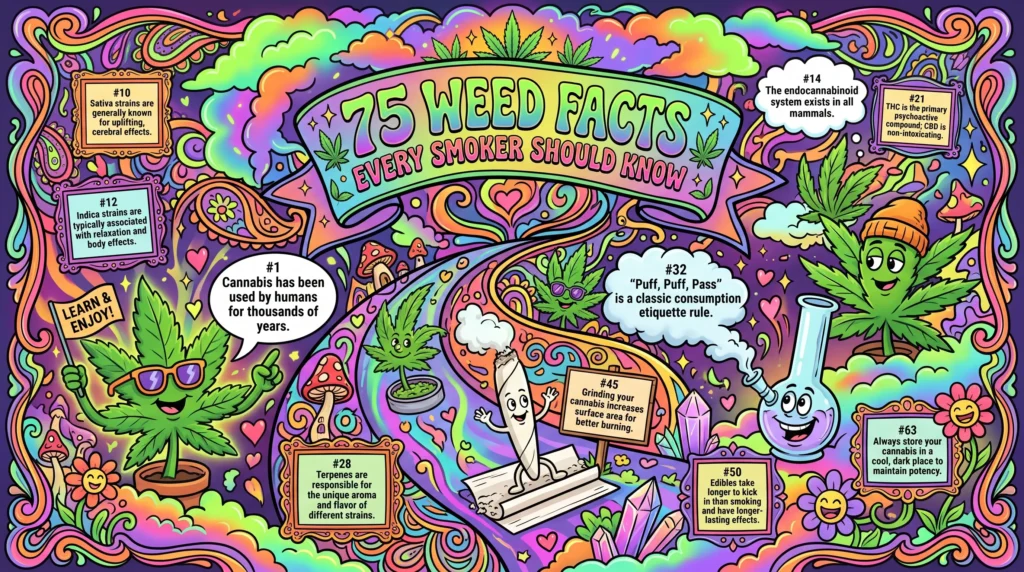
Here are 75 weed facts every smoker should know, broken down by the science, history, consumption, and the future of the plant.
The Science and Biology of Cannabis
Understanding what you are smoking goes a long way in understanding how it affects your body. The biology of cannabis is incredibly complex.
1. Your body already produces its own cannabinoids. You aren’t just introducing foreign chemicals into your system; you are interacting with your own biology. The human body has an Endocannabinoid System (ECS) that produces endocannabinoids. These natural compounds help regulate mood, sleep, appetite, and memory. The phytocannabinoids in weed (like THC and CBD) simply mimic these natural compounds to interact with your ECS receptors.
2. Terpenes dictate the “vibe” just as much as THC. Many smokers chase high THC percentages, but terpenes are the unsung heroes of the cannabis experience. These aromatic compounds (like myrcene, limonene, and pinene) do more than make weed smell good; they actively modulate the effects of THC. This is why a 20% THC strain high in myrcene might make you sleepy, while a 20% THC strain high in limonene might make you feel energized.
3. The “Entourage Effect” is scientifically validated. Isolated THC or CBD doesn’t work the same way as the whole plant. The entourage effect refers to the synergistic interaction between cannabinoids, terpenes, and flavonoids. When consumed together, these compounds enhance each other’s therapeutic benefits and mitigate negative side effects, proving that whole-flower cannabis is greater than the sum of its parts.
4. CBD doesn’t just “cancel out” THC. A common myth is that CBD neutralizes the psychoactive effects of THC. In reality, CBD modulates the high. It changes how THC binds to receptors in the brain, which can reduce anxiety and paranoia, but it doesn’t simply erase the psychoactive experience. It smooths out the ride.
5. Cannabis and hops are botanical cousins. If you love craft beer and weed, you share a common botanical thread. Both cannabis and hops belong to the Cannabaceae family. They share similar leaf structures and produce analogous aromatic compounds, which is why brewers frequently use cannabis terpenes (or actual hemp) to flavor IPAs.
6. You cannot fatally overdose on cannabis alone. While consuming too much THC can result in an incredibly uncomfortable experience (often called “greening out”), it is physiologically impossible to fatally overdose on cannabis alone. This is because the cannabinoid receptors in the brainstem—the area that controls breathing and heart rate—are largely devoid of CB1 receptors, meaning THC cannot shut down your vital functions.
History and Culture of the Plant
Cannabis has walked alongside humanity for millennia. Its history is intertwined with agriculture, medicine, and complex social policies.
7. Cannabis has been used by humans for over 10,000 years. Long before it was smoked for recreational purposes, ancient cultures in Asia utilized the plant. The oldest known piece of human technology is arguably a cannabis fabric fragment dating back to roughly 8,000 BCE. It was primarily used for making rope, textiles, and paper.
8. The word “marijuana” has problematic origins. While many still use the term casually, “marijuana” is a Mexican Spanish slang term that was popularized in the 1930s by Harry Anslinger and the Federal Bureau of Narcotics to associate the plant with Mexican immigrants and incite racial panic. Today, the industry and advocates prefer the scientifically accurate term “cannabis.”
9. The U.S. government forced farmers to grow hemp during WWII. In a bizarre historical twist, after initially taxing and restricting hemp, the U.S. government launched the “Hemp for Victory” campaign during World War II. The military desperately needed hemp for ropes, parachutes, and uniforms, temporarily legalizing its cultivation to support the war effort.
10. George Washington and Thomas Jefferson grew hemp. Many historical figures, including several U.S. Presidents, cultivated hemp. However, it is crucial to note that they were growing industrial hemp for fiber and seed, not the high-THC flower cultivated for smoking. The psychoactive varieties were not the agricultural focus of early American farming.
11. Cannabis was an early pioneer in the environmental movement. Long before modern sustainability became a buzzword, hemp was recognized for its eco-friendly properties. It requires significantly less water than cotton, grows densely (choking out weeds without herbicides), and returns nutrients to the soil, making it one of the most sustainable crops on the planet.
12. The first recorded legal restriction on cannabis was in the 13th century. While modern prohibition is often associated with the 20th century, the Sufi order in Egypt banned the use of cannabis in the 1300s. It was one of the earliest recorded instances of a society attempting to legally restrict the consumption of the plant.
Consumption, Effects, and the Human Body
How you consume weed changes how your body processes it. Understanding these mechanics helps you tailor your experience.
13. Edibles hit differently because of the liver. When you smoke weed, THC enters the bloodstream through the lungs and goes straight to the brain. When you eat an edible, THC is processed by the liver, which converts it into 11-hydroxy-THC. This metabolite is significantly more potent and crosses the blood-brain barrier more easily, resulting in a stronger, longer-lasting, and more body-heavy effect.
14. Tolerance builds fast, but it drops fast. Heavy daily smokers will notice their tolerance skyrocketing as their brain’s CB1 receptors downregulate (become less sensitive). However, because these receptors reset relatively quickly, taking just a 48-to-72-hour “T-break” (tolerance break) can significantly lower your tolerance and restore the potency of the effects.
15. The “munchies” are driven by your sense of smell. THC doesn’t just make you hungry; it actually enhances your olfactory (smell) senses. By binding to receptors in the olfactory bulb, THC makes food smell more intense and appealing, which in turn stimulates the appetite center in the hypothalamus.
16. Secondhand weed smoke won’t get you high. You can sit in a room with someone smoking a joint without worrying about catching a contact high. Unless you are in a completely unventilated, airtight space (like a small car with the windows rolled up) for an extended period, the ambient THC in secondhand smoke is far too diluted to cause psychoactive effects.
17. Combustion creates toxins, but not carcinogens at the same level as tobacco. While smoking anything introduces tar and carbon monoxide into your lungs, studies have shown that cannabis smoke does not contain the same levels of carcinogenic compounds as tobacco smoke. Furthermore, cannabis smokers typically consume far less plant material per day than tobacco smokers. Still, vaporizing or consuming edibles remains the healthiest route.
18. Cannabis affects memory formation, not memory recall. THC temporarily impairs the brain’s ability to form new short-term memories while you are high. However, it does not erase your long-term memory or prevent you from recalling things you learned before consuming. Once the THC leaves your system, your ability to form new memories returns to normal.
The Industry, Law, and Future of Cannabis
The modern cannabis landscape is a multi-billion-dollar industry that is constantly evolving alongside shifting legal frameworks.
19. Hemp and weed are the exact same plant. Legally speaking, the only difference between hemp and marijuana is the THC concentration. Under the 2018 U.S. Farm Bill, hemp is defined as cannabis containing 0.3% THC or less by dry weight. If the plant tests at 0.31%, it is legally classified as marijuana. Botanically, however, they are identical.
20. Cannabis is a “bioaccumulator.” Cannabis plants are incredibly efficient at pulling heavy metals and toxins out of the soil—a process called phytoremediation. While this makes it great for cleaning up contaminated land, it also means that if it is grown in dirty soil with pesticides or heavy metals, those toxins will end up in the final smokable product. This is why third-party lab testing is non-negotiable.
21. The legal market is heavily taxed. Depending on your state or country, legal cannabis can be subject to excise taxes, local municipal taxes, and standard sales taxes. In some regions, the total tax rate on legal weed exceeds 30%, which is a primary reason why the illicit, unregulated market still thrives on price alone.
22. Cannabis can be used to create bioplastics. Cellulose from the hemp plant can be used to manufacture bioplastics. These plastics are biodegradable, significantly stronger than traditional petroleum-based plastics, and represent a massive potential breakthrough for sustainable manufacturing and packaging in the coming decades.
23. A single plant can yield thousands of seeds. If a female cannabis plant is pollinated by a male, it will divert its energy from producing resinous flowers to producing seeds. A single healthy, pollinated plant can produce anywhere from 2,000 to 5,000 seeds, ensuring the survival of the species in the wild.
24. The industry is a massive job creator. Despite facing federal banking hurdles and high taxes, the legal cannabis industry has been one of the fastest-growing job sectors in the United States. It employs hundreds of thousands of people across cultivation, retail, logistics, tech, and compliance, often outpacing national job growth averages.
25. Federal research is finally catching up. For decades, researchers were restricted to studying only cannabis grown by a single facility at the University of Mississippi, which often featured low-THC, outdated genetics. Today, the DEA and federal agencies are expanding the number of registered growers and researchers, paving the way for comprehensive, large-scale clinical trials that will finally unlock the full medical potential of the plant.
Weed Is Stronger Than Ever Before
1. Is weed stronger now than in the 70s? Yes—dramatically.
This is one of the most well-documented facts in cannabis science. Testing by the DEA and NIDA over the past several decades shows that average THC levels in seized marijuana rose from roughly 1–3% in the 1970s to 15–25% (and sometimes higher) in legal-market products today. That’s a multi-fold increase in potency over 50 years.
2. How strong was weed in the 70s? Barely comparable to today’s flower.
Most of what circulated in the 1970s was imported “brick weed”—compressed, often degraded cannabis that had lost potency during long smuggling journeys. Combine that with natural genetics of the era, and you’re looking at a product that’s a fraction of the strength of a modern top-shelf strain.
3. How strong was weed in the 80s? Still mild by today’s standards.
THC levels crept up slowly through the 1980s, typically landing in the 3–4% range for average street weed. The big jump came in the 1990s and 2000s, when selective breeding and indoor cultivation techniques really took off.
4. Why is weed stronger now? Selective breeding and better cultivation.
Modern growers deliberately select and cross strains for high THC (or high CBD) content, grow in controlled indoor environments, and use techniques that maximize resin production. It’s essentially agricultural science applied to an ancient plant.
5. Today’s concentrates are on another level entirely.
Flower potency is one thing, but concentrates like wax, shatter, and live resin routinely test at 60–90% THC. That’s a fundamentally different product than anything available even 20 years ago—and it’s why dosing caution matters more than ever.
🔥REFER A FRIEND
THEY GET 10% OFF THEIR FIRST ORDER🔥
Who’s Smoking, and How Much?
6. How many people smoke weed in the world? Hundreds of millions.
UN estimates suggest that more than 200 million people worldwide used cannabis in recent years, making it one of the most widely consumed psychoactive substances on the planet—second only to alcohol and tobacco in popularity.
7. Are more people smoking weed? The trend is clearly upward.
Global usage rates have climbed steadily over the past two decades, driven largely by legalization, destigmatization, and easier access. In the United States, the percentage of adults who report using cannabis has roughly doubled since the early 2000s.
8. Cannabis use over time tells a fascinating story.
Prohibition-era usage was underreported due to stigma, but the general arc is clear: usage dipped in the 1980s during the “Just Say No” era, climbed steadily from the 1990s onward, and accelerated sharply after the first states legalized recreational use in 2012.
9. Older adults are the fastest-growing user group.
One of the most surprising trends of the past decade: adults over 55 are increasingly turning to cannabis, particularly for sleep issues, chronic pain, and arthritis—often replacing or reducing prescription medications.
10. Legalization changes who buys, not just how many.
In legal markets, regulated dispensaries draw in demographics that would never have visited a street dealer—professionals, parents, retirees. Legalization converts curious non-consumers into customers by making access safe and socially acceptable.
5 Recent Scientific Findings About Weed
11. Science is finally catching up after decades of restrictions.
For most of the 20th century, cannabis research was severely hampered by prohibition. That’s changed rapidly. Here are five significant findings from recent years:
First, studies increasingly suggest cannabis compounds may help certain patients manage chronic pain, and some patients have successfully reduced opioid use under medical supervision.
Second, CBD has shown promise in treating specific forms of childhood epilepsy, leading to the first FDA-approved cannabis-derived medication (Epidiolex).
Third, research on THC and sleep is nuanced—cannabis may help people fall asleep faster, but heavy long-term use may disrupt sleep architecture and suppress REM sleep.
Fourth, brain imaging studies indicate that adult-use cannabis affects areas involved in memory and attention primarily while intoxicated, with the degree of long-term impact still actively debated among researchers.
Fifth, a growing body of evidence links high-potency cannabis to increased risk of anxiety and, in vulnerable individuals, psychosis—particularly with products above 15–20% THC or heavy concentrate use. This is arguably the most important public-health finding of the decade.
12. Your endocannabinoid system was named after the plant.
Here’s a fun one: the human body’s endocannabinoid system (ECS)—which regulates mood, appetite, sleep, pain, and memory—was discovered because of cannabis research. Scientists named the system’s receptors “cannabinoid receptors” and later named the body’s own signaling molecules “endocannabinoids.” The plant came first; the biology was named after it.
Health, Safety, and Smarter Consumption
13. Edibles hit differently—literally.
When you eat cannabis, your liver converts THC into 11-hydroxy-THC, a metabolite that crosses the blood-brain barrier more easily and produces stronger, longer-lasting effects. That’s why a 10mg edible can feel more intense than smoking the same amount of THC. Always start low and go slow.
14. “Start low, go slow” is real pharmacology, not just a slogan.
Because edible onset takes 30 minutes to 2 hours, impatient consumers often take a second dose too soon—and then both doses hit at once. It’s the single most common bad experience with cannabis, and it’s entirely avoidable.
15. Weed can’t kill you through overdose—emphasis on through overdose.
There are no confirmed cases of a fatal THC overdose in humans. That said, cannabis isn’t risk-free: impaired driving, underlying mental health conditions, and extremely high-potency products all carry real dangers. “Not lethal” doesn’t mean “not dangerous.”
16. THC stays in your system far longer than the high.
The high from smoked cannabis peaks within 30 minutes and fades in 2–4 hours, but THC metabolites can be detectable in urine for days (occasional users) to a month or more (daily users). This matters for drug testing—and it’s a big reason workplace cannabis policy is being reconsidered.
17. Secondhand smoke exposure is much weaker than with tobacco.
Studies show that under normal, ventilated conditions, brief exposure to secondhand cannabis smoke is unlikely to produce significant impairment or positive drug tests. Unventilated, extreme exposure is a different story—but a whiff at a concert won’t affect you.
The Plant Itself
18. Cannabis is one of the oldest cultivated crops on Earth.
Humans have grown cannabis for at least 5,000–10,000 years, using it for fiber (hemp), food (seeds), medicine, and ritual. It appears in ancient Chinese, Indian, and Middle Eastern texts.
19. There are over 100 cannabinoids—and THC is just one.
CBD, CBG, CBN, THCV—the plant produces a whole family of compounds, each with distinct effects. Researchers are only beginning to understand how they interact, an effect known as the “entourage effect.”
20. Terpenes do more than make weed smell good.
Those pine, citrus, and diesel aromas come from terpenes—aromatic compounds that may influence the type and quality of your high. Myrcene is associated with sedation, limonene with uplift, pinene with alertness. The strain’s terpene profile may matter as much as its THC percentage.
21. Indica vs. sativa is a rough guide, not a science.
The classic “indica = couch lock, sativa = energy” framework oversimplifies things. In reality, a strain’s chemical profile (cannabinoids + terpenes) predicts effects better than its botanical lineage. Use the labels as a starting point, not gospel.
Legality and Culture
22. Cannabis is legal somewhere, illegal somewhere—often on the same street.
In the U.S., state and federal law directly conflict: cannabis remains federally illegal while many states permit medical or recreational use. Meanwhile, Canada fully legalized it in 2018, and a growing number of countries have decriminalized or medicalized it. Know your local laws before traveling with any product.
🔥 Stack your savings. Elevate your session. 10% off $100, up to 25% off $450.
🔥 Roll into the menu and start saving. CLICK HERE!
23. The “420” origin story is surprisingly mundane.
“420” traces back to a group of California high school students in 1971 who met at 4:20 p.m. to search for a rumored hidden cannabis crop. They never found it, but the code stuck—and spread globally.
24. Hemp and marijuana are the same species.
Both are Cannabis sativa. The legal distinction is purely chemical: hemp contains 0.3% THC or less (by dry weight), while marijuana exceeds that threshold. Same plant family, different legal categories.
25. Cannabis prohibition is barely a century old.
Before the early 1900s, cannabis was legal nearly everywhere and used in common medicines. Prohibition was driven more by politics, racism, and fear-mongering campaigns than by science—something historians broadly agree on today.
The Science Behind the Plant
1. Cannabis evolved roughly 28 million years ago on the eastern Tibetan Plateau.
This isn’t a guess. Pollen studies have traced the plant’s origins to a specific region in Central Asia, and it’s been growing wild there for millions of years. The plant you’re smoking today is a distant descendant of something that predates humans by a long shot.
2. Humans have been cultivating cannabis for at least 12,000 years.
We started growing it for fiber and grain long before anyone figured out you could smoke it. Early cultivation was all about rope, clothing, and paper—the psychoactive properties came later.
3. The earliest solid evidence of smoking weed for fun dates back about 2,500 years.
Archaeologists found wooden braziers in the Pamir Mountains of western China with unusually high THC residue, suggesting mourners were inhaling psychoactive fumes during rituals around 500 BCE. Before that, wild cannabis strains were too weak to get you high.
4. THC levels in modern weed are dramatically higher than they used to be.
In the 1990s, average THC content hovered around 3–4%. Today, it’s common to find flower testing at 15–25%. That’s not a small jump—it’s a completely different experience. If you’re still dosing like it’s 1995, you’re probably overdoing it.
5. Scientists have identified over 100 cannabinoids in the cannabis plant.
THC and CBD get all the attention, but the plant produces hundreds of other compounds, including cannabichromene (CBC), cannabigerol (CBG), and cannabinol (CBN). Research into these minor cannabinoids is still in its infancy, but early findings suggest they have their own unique therapeutic potential.
6. The “entourage effect” is real—and it explains why full-spectrum products feel different.
The entourage effect is the idea that cannabis compounds work better together than they do alone. A 2023 study found that 12 different terpenes enhanced THC’s activation of CB1 receptors when combined, supporting the idea that the whole plant matters more than any single compound.
A Brief History of a 12,000-Year Relationship
7. Cannabis is a close relative of hops—the plant used to make beer.
They belong to the same botanical family, Cannabaceae, and hops is actually the closest living relative of cannabis. In fact, you can graft hops onto cannabis roots, though the results are more interesting than useful.
8. The Scythians got high in tents and “howled with pleasure.”
Greek historian Herodotus described Scythian ritual cannabis use around 450 BCE: they’d erect a woolen tent, place red-hot stones inside, throw hemp seeds on them, and inhale the smoke. His exact words were that they “howl with pleasure”. Some things never change.
9. A Chinese physician used cannabis as anesthesia for surgery in the second century.
Hua T’o, a legendary Chinese doctor, reportedly anesthetized patients with a mixture of “hemp-boiling-compound” and wine before performing abdominal surgery. Cannabis as medicine isn’t a modern invention—it’s ancient.
10. Cannabis was grown in colonial America—and it was mandatory in some places.
English settlers brought hemp to Jamestown in 1611, and it became an important crop in North America. Some colonies even required farmers to grow it. The plant that’s now associated with counterculture was once a cornerstone of colonial agriculture.
🔥REFER A FRIEND
THEY GET 10% OFF THEIR FIRST ORDER🔥
The Modern Cannabis Landscape: Numbers Don’t Lie
11. More Americans smoke weed than cigarettes.
Gallup’s 2026 data shows 17% of U.S. adults smoke marijuana, while only 11% smoke cigarettes. That’s a historic shift. Weed is now more mainstream than tobacco.
12. Cannabis use has more than doubled since 2013.
When Gallup first started tracking marijuana smoking in 2013, only 7% of adults reported doing it. Today, it’s 17%. The cultural normalization of cannabis is happening faster than almost anyone predicted.
13. Roughly 1 in 5 people who use cannabis develop a use disorder.
This is a fact that doesn’t get enough attention. Cannabis use disorder is real, and about 20% of users experience it. It doesn’t mean weed is evil—it means it’s a drug with real dependency potential, and pretending otherwise doesn’t help anyone.
14. Microdosing cannabis is more common than microdosing psychedelics.
About 9.4% of U.S. adults—roughly 24 million people—have tried cannabis microdosing. That’s nearly twice the rate of psilocybin, LSD, or MDMA microdosing. People are figuring out that less can be more.
15. The global cannabis market is projected to hit $86.6 billion by 2031.
From $45 billion in 2026 to nearly double that in five years. This isn’t a niche industry anymore—it’s a legitimate economic force.
Terpenes: The Aromatherapy of Cannabis
16. Terpenes are the compounds responsible for weed’s smell—and they affect your high.
Scientists have found hundreds of terpenes in cannabis. Myrcene smells musky and is found in mangoes. Limonene is citrusy. Linalool is floral and found in lavender. These aren’t just flavor notes—they interact with your endocannabinoid system.
17. Linalool might help with sleep and stress.
Research suggests linalool has sedative and anxiolytic properties. If you’ve ever noticed that certain strains make you sleepy while others keep you alert, terpenes are a big part of the reason why.
18. Beta-caryophyllene is the only terpene known to bind directly to cannabinoid receptors.
Most terpenes influence your high indirectly. Beta-caryophyllene—the peppery compound in black pepper—actually binds to the CB2 receptor, which is involved in immune function and inflammation. It’s a rare case of a terpene doing cannabinoid-level work.
19. Limonene may reduce THC-induced anxiety.
A Johns Hopkins study found that when THC was mixed with D-limonene, participants felt less anxious than when they took THC alone. The more limonene present, the lower the anxiety. If strong weed makes you paranoid, a citrus-heavy strain might be a better fit.
The Endocannabinoid System: Your Body’s Hidden Network
20. Your body has its own cannabinoid system—and it’s been there your whole life.
The endocannabinoid system regulates mood, memory, appetite, sleep, and pain perception. It’s named after cannabis because scientists discovered it while studying how THC works. You have natural cannabinoids called anandamide and 2-AG that bind to the same receptors THC does.
21. THC doesn’t just get you high—it interacts with specific receptors in your brain.
CB1 receptors are heavily concentrated in the central nervous system, which is why THC affects things like memory, coordination, and mood. CB2 receptors are more localized to immune cells. This receptor system is why cannabis has such a wide range of effects.
22. The endocannabinoid system might be why some people are more sensitive to weed than others.
Everyone’s receptor density, enzyme activity, and natural endocannabinoid levels are slightly different. That’s why your friend can smoke a whole joint and feel fine while you take two hits and need to sit down.
Common Myths Debunked
23. Indica and sativa labels don’t mean what you think they mean.
This is probably the most persistent myth in cannabis culture. Mounting scientific evidence suggests there are no consistent chemical or genetic differences between “indica” and “sativa” that predict how they’ll make you feel. The labels originated from plant appearance, not effects. What actually matters is the cannabinoid and terpene profile.
24. Smoking weed isn’t “safer” than smoking cigarettes—it’s just different.
Breathing any kind of smoke exposes your lungs to harmful chemicals. Cannabis smoke contains many of the same irritants and carcinogens as tobacco smoke. The risks aren’t identical, but the idea that weed smoke is harmless is simply wrong.
25. You can’t overdose on weed—but you can definitely overdo it.
There’s no lethal dose of THC that a human can realistically reach. But that doesn’t mean too much weed is harmless. Greening out—nausea, dizziness, panic, and vomiting—is real and deeply unpleasant. Today’s potent strains make it easier than ever to take too much, especially with edibles.
The Bottom Line
Cannabis is a plant with a 10,000-year relationship with humanity, yet we’re only now starting to truly understand it. It’s stronger than it’s ever been, more popular than it’s ever been, and more scientifically studied than ever before.
Whether that excites you or makes you cautious depends on how you approach it. The smartest consumers today treat cannabis like any other powerful substance: they know the facts, respect the potency, dose deliberately, and buy from licensed, lab-tested sources. If you do that, you’ll get everything this remarkable plant has to offer—without the surprises.
Stay curious, stay informed, and smoke responsibly.
🔥 Stack your savings. Elevate your session. 10% off $100, up to 25% off $450.
🔥 Roll into the menu and start saving. CLICK HERE!
Conclusion
Cannabis is far more than just a way to unwind on a Friday night. It is a complex plant with a profound impact on human biology, a rich and sometimes controversial history, and a rapidly modernizing future. By understanding the science of terpenes, the mechanics of the endocannabinoid system, and the realities of the modern legal market, you transition from being a casual user to an informed connoisseur.
As the industry continues to evolve and research expands, the facts surrounding weed will only become more fascinating. Whether you prefer a perfectly rolled joint, a precisely dosed edible, or a high-tech vaporizer, knowing your plant ensures a safer, more enjoyable, and more mindful experience.
Frequently Asked Questions (FAQs)
To further optimize your understanding of cannabis, here are direct answers to the most common questions asked by consumers.
What is the difference between Indica and Sativa?
Historically, Indica was associated with relaxing, body-heavy effects, while Sativa was linked to energizing, cerebral effects. However, modern botanical science shows that these terms primarily describe the physical structure of the plant (broad leaves vs. narrow leaves) rather than the chemical effects. Today, experts recommend choosing strains based on their specific terpene and cannabinoid profiles rather than just the Indica/Sativa label.
How long does THC stay in your system?
The detection window for THC depends heavily on the frequency of use and the type of drug test. For a single use, THC may be detectable in urine for 3 to 5 days. For chronic, daily smokers, it can be detected in urine for 30 days or more. Blood tests typically detect THC for 1 to 2 days, while hair follicle tests can detect it for up to 90 days.
Is it safe to mix cannabis with tobacco?
Mixing cannabis with tobacco (often called a “spliff”) introduces the highly addictive and carcinogenic properties of tobacco into your smoking experience. While it can provide a unique nicotine buzz, it significantly increases the risk of respiratory issues and creates a physical nicotine dependency that many cannabis users prefer to avoid.
Why do some strains make me paranoid?
Paranoia and anxiety from cannabis are usually linked to high levels of THC combined with a lack of balancing terpenes or CBD. If a strain has massive THC but lacks calming terpenes like myrcene or linalool, it can overstimulate the amygdala (the brain’s fear center). To avoid this, opt for strains with a balanced THC-to-CBD ratio or those rich in calming terpenes.
Can I fly with cannabis if I have a medical card?
No. Even if you are traveling between two states or countries where cannabis is fully legal, it is strictly illegal to bring cannabis on an airplane or through airport security. Airports and airspace are governed by federal law, and federal agencies (like the TSA and FAA) do not recognize state-level medical or recreational cannabis laws.
Is weed stronger now than in the 70s?
Yes, significantly. Average THC content rose from roughly 1–3% in the 1970s to 15–25% or more in today’s legal-market flower, thanks to selective breeding and modern cultivation techniques.
How strong was weed in the 70s and 80s?
Weed in the 1970s typically tested around 1–3% THC, and in the 1980s around 3–4%. Much of it was imported brick weed that had degraded in transit. Today’s flower is several times more potent.
How many people smoke weed in the world?
International estimates suggest more than 200 million people used cannabis in recent years, making it one of the most widely used substances globally after alcohol and tobacco.
Are more people smoking weed than before?
Yes. Global usage has trended upward for two decades, with U.S. adult usage roughly doubling since the early 2000s and accelerating in states that have legalized.
What are the most important recent scientific findings about weed?
Key findings include promising evidence for chronic pain management and epilepsy treatment with CBD, nuanced sleep effects, potential risks of high-potency products for mental health, and growing evidence about the endocannabinoid system’s role in the body.
How long does THC stay in your system?
Occasional users typically test positive for 3–7 days, while daily users can test positive for 30 days or more—long after the high has worn off.
Are edibles stronger than smoking?
Per milligram of THC, yes. Edibles convert THC into 11-hydroxy-THC in the liver, which produces stronger, longer-lasting effects. That’s why low doses (5–10mg) are recommended for beginners.
Is it possible to overdose on weed fatally?
No confirmed fatal THC overdoses exist in humans. However, consuming too much can cause severe anxiety, paranoia, and discomfort—especially with high-potency products and edibles.