
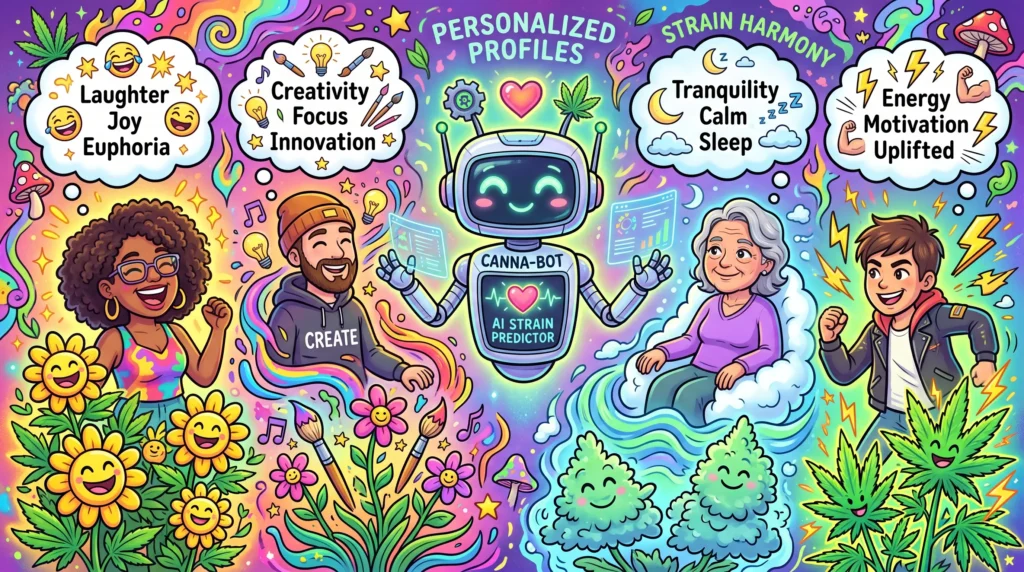
The short answer: Yes, AI can predict the ideal cannabis strain for you, but not through magic. It does so by analyzing complex chemical profiles, mapping your unique biological feedback, and utilizing machine learning algorithms to move far beyond the outdated “Indica vs. Sativa” binary.
For decades, finding the right cannabis strain felt like a game of trial and error. You would walk into a dispensary, tell the budtender you wanted something “relaxing but not too sleepy,” and hope for the best. Today, artificial intelligence is changing the game. By combining data science with cannabinoid research, AI-driven platforms are personalizing the cannabis experience with unprecedented accuracy.
But how does it actually work? Is it reliable? And can a machine really understand your unique endocannabinoid system? Let’s break down the science, the technology, and the reality of AI in cannabis personalization.
The Death of the Indica vs. Sativa Binary
To understand why AI is necessary, we first have to look at the flaws in traditional cannabis classification. For years, consumers were told a simple rule: Sativa gets you high and energized; Indica puts you on the couch and to sleep.
Modern science has proven this is largely a myth. The physical shape of the plant (which is what Indica and Sativa originally referred to) has very little to do with how it affects your brain. A “Sativa” strain can make you sleepy, and an “Indica” strain can give you laser focus.
The actual effects of cannabis are determined by its chemovar—its specific chemical makeup, including cannabinoids (like THC, CBD, CBG) and terpenes (the aromatic compounds that also dictate effects). Because no two harvests are exactly alike, relying on a strain’s name or its Indica/Sativa label is incredibly inefficient. This is exactly where AI steps in to bring order to the chaos.
🔥REFER A FRIEND
THEY GET 10% OFF THEIR FIRST ORDER🔥
The Struggle Is Real: Why Choosing a Cannabis Strain Feels Overwhelming
Walk into any licensed dispensary today and you’ll face a wall of options that would intimidate a sommelier. Estimates suggest there are tens of thousands of cannabis strains in circulation, and the number keeps growing as breeders release new hybrids every year. Back in 2016, industry observers were already counting around 30,000 strain types on the market — a figure that made consistent, replicable results nearly impossible for medical users to achieve through trial and error alone.
Compounding the confusion, two strains with identical THC percentages can produce completely different experiences. One may leave you sedated on the couch; the other may have you cleaning the garage at midnight. The difference lies in the plant’s full chemical fingerprint — cannabinoids, terpenes, and dozens of other compounds working together.
This is exactly the kind of messy, high-dimensional data problem that artificial intelligence was born to solve. But how well does it actually work?
How AI Strain Recommendation Technology Actually Works
Strip away the marketing language and most AI cannabis platforms rely on a few core ingredients:
1. Cannabinoid and Terpene Data
Rather than focusing on strain names — which are often more about branding than botany — serious AI tools analyze the molecular profile of each product. The most sophisticated platforms track at least six major cannabinoids (THC, CBD, CBG, CBN, CBC, and THCV) alongside terpene concentrations. PotBot, one of the earliest AI-driven medical cannabis apps, was built specifically to move patients “away from the thousands of strain names that are mainly just marketing or branding indicators” and toward cannabinoid values backed by peer-reviewed research.
2. Your Inputs
You tell the system who you are and what you want: your experience level, your goals (sleep, pain relief, creativity, social energy), any symptoms you’re targeting, preferred consumption method, and sometimes your tolerance. PotBot’s onboarding, for example, asks for demographic information, cannabis usage history, ailment, and desired effect.
3. Machine Learning from Real-World Outcomes
This is where AI separates itself from a simple filter. Apps like Releaf and Strainprint let users log their actual experiences — what they consumed, how much, and how it made them feel. Over time, the algorithm learns patterns: people with your symptom profile who responded well to strains with high myrcene and moderate THC, for instance. The more data the system ingests, the sharper its predictions become. Leafly and Weedmaps similarly leverage enormous databases of strain reviews and ratings to power their recommendation engines.
4. Continuous Research Ingestion
Some platforms function as living literature reviews. PotBot’s AI engine was designed as a “data pipeline” that continuously pulls in new peer-reviewed studies and maps cannabinoid findings onto available products — an approach grounded in the idea that recommendations should follow evidence, not anecdote.
The Science Behind the Algorithm: How AI Predicts Your Strain
AI doesn’t just guess; it calculates. To predict how a specific cannabis flower, vape, or edible will make you feel, AI platforms rely on three core data pillars.
1. Mapping the Endocannabinoid System (ECS)
Every human has an Endocannabinoid System, a complex cell-signaling network that regulates sleep, mood, appetite, and pain. AI algorithms are trained on clinical data regarding how different cannabinoids interact with your CB1 and CB2 receptors. By inputting your specific symptoms (e.g., chronic pain, anxiety, insomnia), the AI cross-references your needs with the receptor-binding affinities of various cannabinoids.
🔥 Stack your savings. Elevate your session. 10% off $100, up to 25% off $450.
🔥 Roll into the menu and start saving. CLICK HERE!
2. The Terpene Profile Matrix
Terpenes are the secret sauce of the cannabis experience. They modify the effects of THC through the “entourage effect.” AI databases are loaded with gas chromatography and mass spectrometry lab results.
- If you need focus, the AI looks for high pinene or limonene.
- If you need deep sleep, it searches for heavy myrcene or linalool profiles.
- If you need pain relief without heavy intoxication, it targets specific beta-caryophyllene ratios.
3. Machine Learning and User Feedback Loops
This is where the AI gets truly “smart.” Platforms like Strainprint or various dispensary-specific apps use collaborative filtering. When you log your experience after consuming a specific product (rating your pain levels, mood, and side effects), the AI updates its predictive model. Over time, the algorithm learns your unique biological quirks. It realizes that while 90% of people feel energized by a certain terpene profile, you feel sleepy. It then adjusts future recommendations specifically for your biology.
How AI-Powered Cannabis Apps Work in the Real World
If you are using an AI-driven cannabis recommendation tool today, the user journey generally looks like this:
- The Intake Phase: You input your medical or recreational goals, your tolerance level, your preferred consumption method (flower, edible, tincture), and any past negative experiences (e.g., “I get paranoid with high THC”).
- The Database Match: The AI scans thousands of lab-tested products available in your specific legal market. It filters out products that don’t meet your chemical criteria.
- The Recommendation: The app suggests 2 to 4 specific products, explaining why it chose them (e.g., “Recommended because it has a 1:1 THC:CBD ratio and high myrcene, which aligns with your goal of reducing muscle spasms”).
- The Feedback Loop: After you consume the product, the app prompts you to log the results. The AI uses this data to refine your personal “biological profile.”
The Limitations: Why AI Isn’t 100% Perfect Yet
While AI is a massive leap forward, we must approach it with realistic expectations. As an expert in this space, I always remind users that biology is messy, and AI has a few blind spots.
- Batch Inconsistencies: AI relies on lab testing data. However, if a dispensary is selling a batch of cannabis that wasn’t tested, or if the lab results are slightly off from the actual flower in the jar, the AI’s prediction will be flawed.
- The Entourage Effect is Still a Mystery: While we know terpenes and cannabinoids work together, the exact mathematical formula of the entourage effect is not fully understood by science yet. AI can only predict based on the data we currently have.
- Individual Metabolism: Two people can consume the exact same strain and have completely different reactions based on their liver enzymes, diet, and even hydration levels. AI can predict the most likely outcome, but it cannot guarantee it.
- The Placebo Effect: Human psychology plays a massive role in cannabis consumption. If you believe a strain will make you relaxed, your brain may actually induce relaxation. AI cannot quantify the placebo effect.
How to Get the Best Results from AI Cannabis Tools
To get the most out of AI-driven cannabis personalization, you need to be an active participant. Here is how to optimize your experience:
- Be Brutally Honest: When logging your effects, don’t just say “it was good.” Rate your anxiety, pain, and energy levels on a scale of 1-10. The more granular your data, the smarter the AI becomes.
- Stick to Lab-Tested Products: AI is only as good as the data it’s fed. Only use these tools to recommend products that come with verified Certificates of Analysis (COAs).
- Track Your Tolerance: AI can help you build tolerance breaks. If the algorithm notices you are needing higher doses to achieve the same effect, it can suggest a lower-THC alternative or remind you to take a break.
- Update Your Goals: If your reason for using cannabis changes (e.g., you switch from using it for sleep to using it for daytime creativity), update your profile immediately so the AI can recalibrate.
🔥REFER A FRIEND
THEY GET 10% OFF THEIR FIRST ORDER🔥
Final Thoughts: The Future of Personalized Cannabis
Can AI predict the perfect cannabis strain for you? It can certainly predict the most highly probable perfect strain, saving you time, money, and the discomfort of unwanted side effects.
We are moving away from the era of guessing and into the era of precision cannabis. By leveraging machine learning, terpene profiling, and real-time user feedback, AI is transforming cannabis from a recreational guessing game into a highly personalized wellness tool. While it may never replace the advice of a qualified medical professional, it is undeniably the best tool we have for navigating the complex, chemical-rich world of modern cannabis.
🔥 Stack your savings. Elevate your session. 10% off $100, up to 25% off $450.
🔥 Roll into the menu and start saving. CLICK HERE!
Frequently Asked Questions (FAQs)
1. Can AI really predict how a specific strain will make me feel?
Yes, but it is based on probability, not absolute certainty. AI analyzes the chemical profile (cannabinoids and terpenes) of a strain and cross-references it with clinical data and thousands of user reviews to predict how it will affect you. Because individual biology varies, it predicts the most likely outcome based on your unique data profile.
2. Is the Indica vs. Sativa classification completely useless now?
From a scientific and chemical standpoint, yes. The physical shape of the plant does not dictate its effects. Modern AI and data-driven platforms rely on the “chemovar” (the chemical profile) rather than the Indica/Sativa binary. However, you will still see these terms used in dispensaries for marketing and historical familiarity.
3. What kind of data do AI cannabis apps use to make recommendations?
AI cannabis apps use a combination of data points:
- Lab testing data (THC, CBD, and minor cannabinoid percentages).
- Terpene profiles (the aromatic compounds that influence effects).
- User-reported data (symptoms, desired effects, and past experiences).
- Clinical research regarding how specific compounds interact with the human endocannabinoid system.
4. Are AI cannabis recommendation tools medically verified or FDA-approved?
No. Currently, AI cannabis apps are considered wellness and lifestyle tools, not medical devices. They are not FDA-approved to diagnose, treat, or cure any medical conditions. If you are using cannabis for a specific medical condition, you should always consult with a certified cannabis doctor or healthcare provider alongside using AI tools.
5. How long does it take for an AI app to learn my personal preferences?
Most AI platforms begin making highly accurate, personalized recommendations after just 3 to 5 logged sessions. The more consistently you log your consumption and rate your effects, the faster the machine learning algorithm adapts to your unique biological responses.