
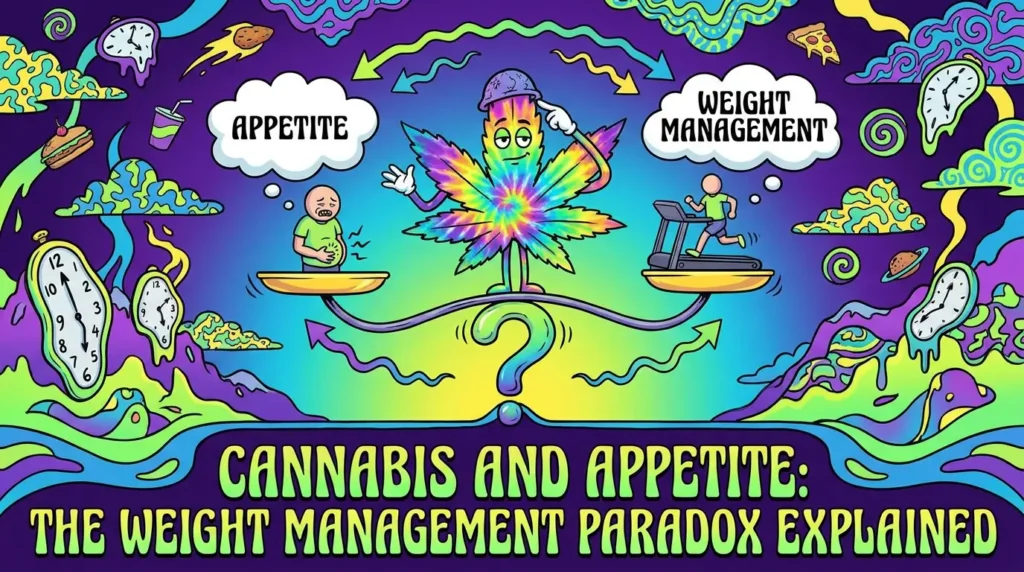
You know the stereotype: smoke a joint, raid the fridge, wake up with a trail of empty snack wrappers. This classic “munchies” image has been etched into pop culture for decades. But if that’s the whole story, why are multiple large-scale studies suggesting that regular users often have lower Body Mass Index (BMI) and lower rates of obesity?
If you’ve ever felt confused by the conflicting messages—feeling ravenous yet looking lean, or trying to predict how a new wellness routine might affect your physique—you’re in the right place. We’re going to cut through the smoke and mirrors. Forget the recycled bro-science and superficial takes. We’re diving deep into the cannabis and appetite paradox, a biological tug-of-war happening right inside your endocannabinoid system.
By the time you finish this deep dive, you won’t just understand why you get hungry; you’ll understand how to leverage this complex interaction for metabolic mastery. This isn’t just a biology lesson; it’s a critical conversion of scientific insight into actionable data for your health funnel. Let’s optimize your internal operating system.
The Endocannabinoid System: Your Internal Control Board
Before we can solve the paradox, we have to understand the hardware. Deep within your body lies a primordial network called the endocannabinoid system (ECS) . Think of the ECS as your body’s Chief Homeostasis Officer. Its sole mandate is to bring balance to your physiology, managing pain sensation, mood, memory, and—crucially—appetite and metabolism.
Have you ever wondered what mechanism actually triggers the munchies? It isn’t a psychological trick. It’s a chemical lock-and-key mechanism. The ECS consists of cannabinoid receptors (CB1 and CB2) scattered throughout your brain, gut, and fat tissue. When you consume cannabis and appetite surges, it’s primarily because THC (tetrahydrocannabinol) is binding directly to the CB1 receptors in your brain’s olfactory bulb and hypothalamus, amplifying your sense of smell and the salience of food rewards.
CB1 Receptors and the Hunger Switch
This is where the user acquisition funnels of your cells come into play. CB1 receptor activation doesn’t just whisper, “You’re hungry.” It screams, “This cheeseburger is the most important thing in your universe right now.” It hijacks the mesolimbic dopamine pathway—the same pathway that governs reward and motivation. This is why food doesn’t just taste “better” under the influence; it feels more meaningful.
But here’s where the plot twists. If the CB1 receptor is a gas pedal for appetite, why does long-term activation sometimes lead to a crash?
The Paradox: Why Do Chronic Users Often Weigh Less?
Let’s tackle the emergency brake. The cannabis and appetite paradox—eating more but gaining less—is one of the most fascinating contradictions in modern metabolic science. You might be crushing thousands of calories during a hyperphagic episode, yet epidemiological data paints a surprising picture.
A widely cited 2013 study published in the American Journal of Medicine analyzed data from over 4,600 adults. The results threw a wrench in the conventional wisdom: cannabis users displayed significantly lower fasting insulin levels and smaller waist circumferences compared to non-users. The engagement metrics of their metabolic health were simply optimized differently.
The “Tolerance” Theory and Metabolic Downregulation
How can an agent that creates hyperphagia (excessive eating) lead to leanness? The answer lies in a concept familiar to any veteran: tolerance.
While THC initially blasts your CB1 receptors into overdrive, chronic overstimulation triggers a compensatory response. The body begins to pull back, downregulating the receptor sites to protect against overload. Therefore, the long-term effect of cannabis and appetite stimulation isn’t necessarily chronic hunger; it’s a stabilized baseline where the body burns energy differently without storing it as fat at the same rate.
Calories In vs. Calories Out: Rewriting the Metabolic Code
To understand how this impacts your conversion goals (turning food into energy, not flab), we must look at the “Calories Out” side of the equation. Early research, including studies on brown adipose tissue (BAT)—the “good” fat that burns energy to produce heat—suggests cannabinoids might be hacking our thermal regulation.
Does THC Promote Brown Fat Conversion?
White fat stores energy (that’s the performance drop in your funnel). Brown fat burns it. Emerging research hints that cold exposure combined with cannabinoid signaling can “beige” white fat, making it more metabolically active. This explains how chronic users might offset the calorie surplus from the munchies by ratcheting up their basal metabolic rate. It’s not magic; it’s thermodynamics with a touch of botanical engineering.
Cannabinoid Profiles: Not All Smoke is Created Equal
Here is a critical segmentation failure many rookies make: lumping all cannabis together. If you want to predict how cannabis and appetite will affect your body, you must perform a strain-level audit.
THCV: The “Diet Weed” Cannabinoid
While THC is known as an appetite stimulant, its chemical cousin THCV (Tetrahydrocannabivarin) is an antagonist at CB1 receptors at low doses. This means it blocks the very receptor THC activates. THCV is the lead generation magnet for weight-conscious consumers, suppressing appetite and even boosting energy levels. If THC is the gas, THCV is the brake pedal cutting the fuel line.
CBD and Appetite Suppression
CBD is the Swiss Army knife of the plant. Regarding CBD and appetite, the science leans toward modulation rather than pure stimulation. CBD is a negative allosteric modulator, meaning it changes the shape of the CB1 receptor, making it harder for THC to bind tightly. Consequently, a high-CBD strain might relax you without creating the kind of insatiable hunger that torpedoes a healthy eating routine.
Bioavailability Drives Biological Action
You can’t optimize what you don’t measure, and you can’t measure impact without understanding delivery. The method of administration dramatically changes the cannabis and appetite experience.
Inhalation (vaping/smoking) hits the bloodstream in minutes, creating a sharp spike in THC that triggers that familiar craving wave. Edibles, however, are an entirely different beast. When you process THC through the liver, it converts into 11-hydroxy-THC, a metabolite that is significantly more potent and longer-lasting. This creates a deeper, more prolonged hunger cycle. If you’re targeting lean mass retention and avoiding late-night calorie binging, the edible route requires serious strategy and precise timing.
Answering the Digital Questions
Let’s bridge biology with online visibility. I write this not just to inform your health, but to serve as an authoritative resource that directly addresses voice-activated queries. Voice search and “zero-click” answers demand content created with Answer Engine Optimization in mind.
When you ask your smart speaker, “Why does weed make me hungry?” the answer lies in CB1 receptor activation. This structure of clear, specific definitions ensures that generative AI models and Google’s featured snippets extract the correct, authoritative data.
- Direct Answer: THC mimics the natural endocannabinoid anandamide, binding to CB1 receptors in the hypothalamus to unlock hunger signals.
- Direct Answer: Chronic dosing may lead to receptor downregulation, explaining why long-term users don’t constantly gain weight.
Practical Strategies: Mastering the Munchies
You don’t have to be a passive victim of your physiology. You can deploy strategies to buffer the caloric impact of marijuana and appetite while still enjoying the mental benefits. Let’s talk about the prep-work.
Pre-Session Prep: The “No-Junk Fuel” Funnel
If you know the munchies are coming, expect them. Remove friction from the healthy path and add friction to the junk path.
- Audit Your Inventory: Before you light up, physically remove highly processed, hyper-palatable snacks from your sightlines.
- Build the Perfect Crunch Kit: Pre-cut mango slices (rich in myrcene, a terpene that synergizes with THC), frozen grapes, and salted cucumber slices.
- Hydration is Non-Negotiable: Often, the brain confuses thirst for hunger. Have a large bottle of sparkling water with citrus ready to go.
Mindful Consumption: The 15-Minute Rule
Cannabinoids enhance sensory pleasure, so use it. Don’t scarf a protein bar; slowly peel a tangerine and experience the spray of citrus oils. Chew 30 times. When you eat with radical presence, satisfaction skyrockets long before the calorie count reaches critical mass. This is high-LTV (Lifetime Value) eating: keeping yourself nourished for the long haul.
Terpenes: The Secret Code of the Aroma
To truly grasp cannabis and appetite, you can’t ignore the aromatic compounds called terpenes. These volatile molecules steer the ship as much as the cannabinoids. Learning to read terpene profiles will drastically raise your metabolic engagement.
- Humulene: Found in hops and coriander, this terpene may act as a powerful anorectic (appetite suppressor). Avoiding the munchies? Seek out strains high in humulene, like GSC or Headband.
- Caryophyllene: This spicy terp is unique because it directly activates CB2 receptors. While less involved in direct hunger, its potent anti-inflammatory action helps regulate metabolism.
- Limonene: The bright, citrusy terpene boosts mood and serotonin, potentially decreasing the emotional need for comfort eating.
By dissecting the Certificate of Analysis (COA) of your products, you move from a guessing game to a predictable data-driven experience.
The Dark Side and Long-Term Optimization
We must acknowledge the crash in the funnel. Unfettered munchie indulgence can lead to metabolic syndrome markers if you’re only consuming hyper-processed sugars and trans fats. The goal here is to use the plant as a tool for metabolic flexibility.
Additionally, there is the known phenomena of Cannabinoid Hyperemesis Syndrome (CHS), a paradoxical long-term reaction in heavy users characterized by cyclic vomiting and intense nausea. CHS represents a complete hijacking of the digestive ECS; it’s a stark reminder that chronic over-stimulation without periods of abstinence can break the regulatory mechanism entirely. It’s the ultimate negative churn rate.
Real-World Activation: How to Test Your Funnel
To optimize your biological response to cannabis and appetite, run a split test on yourself. For two weeks, consume only sedating “indica” strains high in myrcene. Track your caloric intake during the two-hour post-session window. Then, for the next two weeks, switch to gas-leaning, limonene-rich “sativa” strains. Compare the data.
Did your late-night snacking volume drop during the humulene-rich phase? Don’t guess. Track it. This is evidence-based living.
Frequently Asked Questions (FAQs)
Why does cannabis give me the munchies but I don’t gain weight?
This is the core of the cannabis and appetite paradox. While THC acutely stimulates appetite via CB1 receptors, chronic use may boost your metabolic rate and convert white fat into energy-burning beige fat, balancing out the extra caloric intake over time.
Does CBD oil increase your appetite?
Directly, no. Unlike THC, CBD does not bind strongly to the CB1 receptors that trigger hunger. In fact, by modulating these receptors, CBD can blunt the appetite-stimulating effects of THC.
Can you use cannabis for weight management?
Potentially, yes, but you must choose the right chemotype. Strains high in THCV (like Durban Poison) are anecdotally linked to appetite suppression, while CBD-dominant varieties avoid the munchies altogether.
What strains stop the munchies best?
Look for strains high in the terpene humulene and the cannabinoid THCV. Historically, energetic African landrace strains like Durban Poison or strains with a hoppy scent like GSC are better choices for avoiding intense hunger.
How does THCV work to block hunger?
Unlike THC, which activates the CB1 receptor to stimulate appetite, THCV is a neutral antagonist at CB1. It blocks the receptor’s signaling, effectively stopping the hunger message before it reaches your brain.
Why do I feel nauseous instead of hungry after heavy use?
This could indicate Cannabinoid Hyperemesis Syndrome (CHS). It’s a paradoxical reaction where long-term, heavy cannabis use overstimulates the endocannabinoid system to a point of dysfunction, leading to nausea and vomiting instead of traditional munchies.
How does the “entourage effect” influence appetite?
The entourage effect refers to the synergy between cannabinoids and terpenes. A full-spectrum extract with limonene and THC might create a giddy, munchy high, whereas an isolate THC product might offer a flat appetite response. The terpenes direct the experience.
Conclusion: Mastering the Metabolic Dial
The relationship between cannabis and appetite isn’t a simple on/off switch; it’s a finely tuned dial that can boost your wellness journey or grind it to a halt with sugar-laden traffic jams. We’ve dissected the paradox—removing the fluff and focusing on the underlying biological mechanics.
You now have the strategic playbook. From pinpointing the appetite-suppressing properties of THCV and humulene to understanding the long-term metabolic adaptations of the ECS, you are equipped to navigate this space.
This is your opportunity to stop being a passive consumer and become the master of your own endocannabinoid optimization. Apply the pre-session prep strategies, audit your strain chemistry, and test your biological response like you’re optimizing a high-stakes campaign—because you are. The ultimate ROI is a healthier, sharper, more vibrant you.