
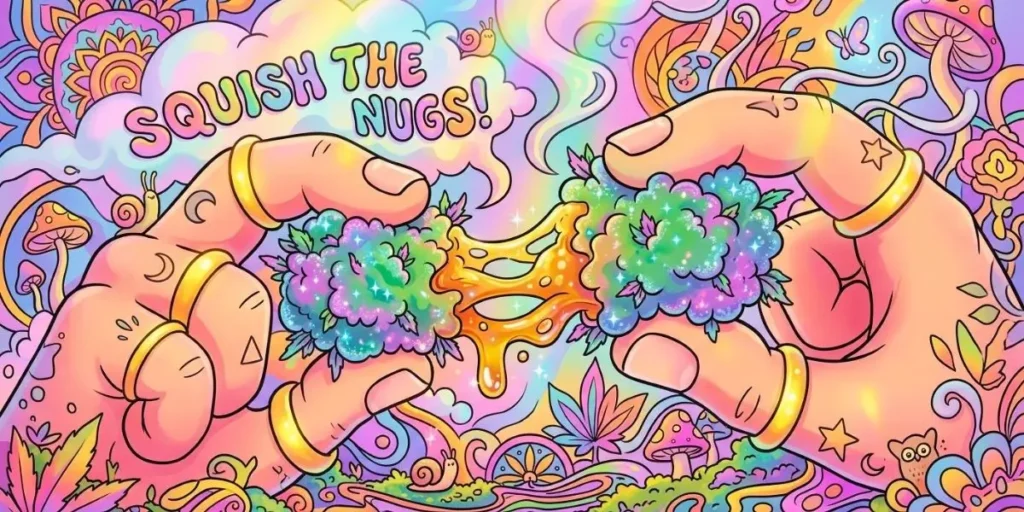
You are lying in bed, phone in hand, half-watching a muted video. Then the algorithm serves you something unexpected: a pair of manicured fingers slowly pressing into a dense, frosty cannabis bud. The sound is crisp but soft—a gentle crunch of trichomes giving way, a sticky separation of sugar leaves, a whispered exhale from the creator. Before you know it, your shoulders drop, your jaw unclenches, and you have watched the same ten-second clip three times.
Welcome to the world of nug squish videos, the latest subgenre of cannabis ASMR that has quietly become one of the most hypnotic corners of weed culture online.
What started as a niche curiosity has evolved into a legitimate content category. Creators across TikTok, YouTube, and Instagram are building audiences not by getting high on camera, but by treating cannabis as a sensory object. The focus is not on consumption. It is on texture, sound, and the strangely meditative quality of handling the plant.
What Is ASMR, and Why Does Cannabis Fit So Naturally?
ASMR stands for Autonomous Sensory Meridian Response, a term coined in 2010 by Jennifer Allen to describe the tingling, euphoric sensation some people experience in response to specific auditory or visual stimuli.
Common triggers include whispering, tapping, crinkling, soft scratching, and slow, deliberate hand movements. For those who are sensitive to it, ASMR can induce deep relaxation, reduced anxiety, and even sleep.
The cannabis plant, with its sticky resin, crystalline trichomes, and pliable structure, happens to be an almost perfect ASMR prop. When a creator gently squeezes a fresh nug between their fingers, the sound is unique: part crunch, part squish, part sticky peel. It is tactile. It is intimate. And for viewers who already associate cannabis with calm, the pairing feels almost inevitable.
Some video creators are combining their twin passions of ASMR and cannabis into soothing videos for their viewers. Thanks to the calming and euphoric nature of cannabis, the pairing seems to make sense.
What Are ‘Nug Squish’ Videos?
“Nug squish” videos combine two powerful trends:
- ASMR (Autonomous Sensory Meridian Response) — content designed to trigger relaxing, tingling sensations through sound and visuals.
- Cannabis education and appreciation — showcasing bud quality, density, aroma, and cure through tactile demonstration.
In these clips, creators gently squeeze or roll cannabis flowers while capturing the subtle crunch, squish, or pop sounds. The result? A oddly satisfying experience that’s both educational and entertaining .
Why This Trend Is Taking Off
Several factors explain the rapid growth of cannabis ASMR content:
- Sensory storytelling: Cannabis is inherently sensory — aroma, texture, flavor, effect. ASMR lets creators communicate quality without saying a word.
- Algorithm-friendly format: Short, loopable, sound-driven videos perform exceptionally well on TikTok and Reels, where watch time and replays drive reach .
- Low-barrier entry: You don’t need fancy equipment — just a decent microphone, good lighting, and quality flower.
- Educational angle: Viewers learn to identify well-cured, dense, terpene-rich buds by how they sound and feel, not just how they look.
What the Sound Tells You About Quality
Experienced growers and consumers know that a bud’s texture and sound reveal a lot about its cure and freshness:
- Firm with slight rebound = ideal humidity (55–62% RH), proper cure, preserved terpenes.
- Crumbly or dusty = over-dried, lost terpenes, harsher smoke.
- Spongy or mushy = excess moisture, risk of mold or bud rot .
The “squish test” isn’t new — but turning it into ASMR content is a fresh way to educate while entertaining.
Opportunities for Cannabis Brands and Creators
For blogs, dispensaries, and influencers, this trend opens several doors:
- Differentiation: Few cannabis creators in Latin America are producing ASMR content in Spanish. Early adopters can own this niche.
- Engagement boost: ASMR videos typically see higher watch time, saves, and shares — key metrics for algorithmic growth .
- Monetization potential: Integrate affiliate links for grinders, humidity control, storage jars, or vaporizers alongside your content.
- Cross-platform strategy: One video can be repurposed for TikTok, Reels, YouTube Shorts, and embedded in blog posts for SEO.
How to Create Your Own Cannabis ASMR Content
Ready to test the trend? Here’s a quick starter guide:
- Invest in a decent mic: USB mics like the Blue Yeti or Fifine K669 work well for beginners.
- Focus on lighting: Natural light or a softbox makes buds look vibrant and detailed.
- Keep it educational: Explain what viewers are hearing — “This crunch means the outer layer is properly cured.”
- Stay compliant: Avoid showing consumption or paraphernalia that could trigger platform restrictions. Focus on the flower itself and the sensory experience .
- Experiment with formats: Try “strain sound comparisons,” “cure quality tests,” or “satisfying squish compilations.”
From Joint Rolling to Nug Squishing: How Cannabis ASMR Evolved
Cannabis content has existed on the internet for decades, but its aesthetic has shifted dramatically. Early weed videos were functional: how to roll a joint, how to use a bong, strain reviews shot under harsh lighting. The goal was information or entertainment through intoxication.
Cannabis ASMR represents a different impulse entirely. The genre borrows from the broader “satisfying content” movement—videos of kinetic sand being sliced, soap criss-crossed with a knife, or floral foam crumbling under pressure.
In this context, the cannabis bud becomes another satisfying object. The nug squish specifically—pressing a finger or thumb into the center of a dense flower cluster until it compresses and releases—produces a sound profile that sits somewhere between stepping on fresh snow and peeling dried glue from your fingers. It is oddly specific, deeply textured, and endlessly repeatable.
Other popular formats within cannabis ASMR include:
- Grinding sounds: The rhythmic turn of a metal grinder, followed by the soft shower of ground flower.
- Jar tapping: Fingernails lightly drumming against glass containers filled with buds.
- Resin pulling: Slowly separating sticky concentrate from parchment paper.
- Rolling rituals: The crinkle of papers, the soft pack of a joint, the lick and seal.
- Dispensary roleplay: A creator whispers through a simulated consultation, showcasing products with soft-spoken reverence. One Canadian YouTuber’s cannabis roleplay video has garnered half a million views.
The Psychology Behind Why Nug Squish Videos Hit Different
To understand the appeal, you have to look past the plant and focus on the brain. ASMR triggers are believed to activate regions associated with social bonding, relaxation, and reward. For many viewers, the experience is not about cannabis at all—it is about the predictability and gentleness of the content.
Gen Z, in particular, has embraced ASMR as a coping mechanism. Facing academic pressure, social media saturation, and economic uncertainty, young adults are turning to ASMR for stress relief and sleep aid.
The community aspect matters too. Fans connect through comment sections, sharing their favorite sounds and recommending creators who “get the tingles right.”
When cannabis enters the equation, it adds a layer of cultural familiarity. For consumers who already use weed to unwind, watching a nug squish video creates a kind of vicarious relaxation. The brain associates the visual and auditory cues with the calming ritual of preparing cannabis, even if no consumption happens on screen.
There is also a novelty factor. Cannabis is still federally illegal in the United States and heavily regulated in many jurisdictions. Seeing it handled openly, beautifully, and without stigma feels transgressive in a gentle way. It normalizes the plant as an everyday object worthy of aesthetic appreciation.
Where the Trend Lives: TikTok, YouTube, and Instagram Reels
The nug squish phenomenon did not emerge from a single platform. It has cross-pollinated across social media, with each site offering a slightly different flavor of content.
TikTok is where the trend moves fastest. Short-form nug squish clips—often set to lo-fi beats or entirely silent except for the squish itself—rack up millions of views. The platform’s algorithm favors content that keeps users watching on loop, and a satisfying ten-second squish is perfectly engineered for that behavior. The #asmr hashtag on TikTok has garnered over 469 billion views, and niche cannabis ASMR tags are growing daily.
YouTube remains the home of long-form cannabis ASMR. Creators upload 20- to 60-minute videos featuring extended squish sessions, dispensary roleplays, and “smoke with me” whisper sessions. YouTube’s monetization policies around cannabis are restrictive, so creators often walk a fine line—focusing on the sensory experience rather than explicit consumption or purchase links.
Instagram Reels has become a discovery engine. High-production clips of frosty buds being slowly compressed under studio lighting circulate through weed-centric accounts, often cross-posted from TikTok. The visual appeal of trichomes catching light as a nug is squished translates beautifully to Reels’ vertical format.
Reddit hosts the community discussions. Subreddits like r/ASMR and r/trees occasionally intersect when users share their favorite cannabis ASMR creators or debate whether the genre counts as “real” ASMR. The consensus tends to be: if it triggers tingles, it belongs.
The Aesthetic of the Nug: Why Visuals Matter as Much as Sound
A great nug squish video is not just about audio. It is about the visual poetry of the plant itself.
Creators have developed an almost cinematic language around cannabis ASMR. Macro lenses capture the sparkle of trichomes. Soft ring lights eliminate harsh shadows. Hands are moisturized, nails are clean, and backgrounds are neutral—beige linens, raw wood, marble slabs. The goal is to present cannabis as a luxury good, a wellness product, an art object.
This aesthetic choice is deliberate. By stripping away the stoner stereotypes—blacklight posters, Bob Marley flags, red-eyed chaos—these creators are redefining how cannabis is seen online. The plant becomes something you admire with the same reverence you might bring to a Japanese tea ceremony or a skincare unboxing.
The squish itself is the climax of this aesthetic. The compression reveals the bud’s density and moisture content. The release shows its resilience. Slow-motion captures the trichome heads wobbling like tiny glass orbs. It is plant pornography in the most literal, nonsexual sense: an obsession with the physical beauty of the organism.
Is Cannabis ASMR Just a Trend, or Is It Here to Stay?
Every viral content format faces the same question: longevity. Is nug squish ASMR a fleeting dopamine hit, or does it have staying power?
The evidence suggests the latter. ASMR as a whole has proven remarkably resilient. Since 2009, when WhisperingLife uploaded the first ASMR video to YouTube, the genre has grown from a whispered curiosity to a global industry.
There are now over 500,000 ASMR-dedicated channels and more than 25 million videos on the platform.
Cannabis ASMR benefits from two tailwinds. First, cannabis legalization continues to expand across North America, reducing stigma and increasing the pool of consumers who view the plant as a normal part of life. Second, the wellness industry has fully embraced both ASMR and CBD as tools for anxiety and sleep. The convergence feels less like a coincidence and more like an inevitable cultural overlap.
Moreover, the content is endlessly renewable. Every harvest brings new strains with different densities, textures, and trichome structures. A nug squish video of a fluffy Sativa hits differently than one of a dense Indica. The genre has built-in variety.
🔥 Stack your savings. Elevate your session. 10% off $100, up to 25% off $450.
🔥 Roll into the menu and start saving. CLICK HERE!
The Controversies and Challenges
No trend is without friction. Cannabis ASMR creators face unique hurdles that their mainstream counterparts do not.
Platform restrictions are the biggest obstacle. TikTok, YouTube, and Instagram all have policies against promoting drug use or selling controlled substances. Creators must be careful not to link to dispensaries, mention prices, or explicitly encourage consumption. Many use euphemisms—”herbal medicine,” “plant medicine,” “frosted broccoli”—to avoid algorithmic suppression.
Monetization is another challenge. YouTube’s Partner Program can demonetize videos that feature cannabis, even in jurisdictions where it is legal. Patreon and subscription platforms have become lifelines for creators who want to produce full-time.
Community gatekeeping exists too. Some purist ASMR viewers argue that cannabis content is a “gimmick” that distracts from legitimate triggers. Others worry that normalizing cannabis ASMR could expose minors to drug-related content. Creators typically address this by age-restricting their videos and including disclaimers about responsible use.
Finally, there is the question of authenticity. As the genre grows, corporate cannabis brands have begun sponsoring ASMR creators or producing their own branded squish content. The line between organic creativity and stealth marketing is getting blurrier. Savvy viewers can usually tell when a nug is being squished for love versus when it is being squished for a paycheck.
How to Explore Cannabis ASMR Responsibly
If you are curious about dipping your toes into the nug squish waters, here are a few tips:
Start with sound-only content. Some of the best ASMR experiences come from audio-focused creators who prioritize microphone quality over visuals. Close your eyes and let the squish do the work.
Use headphones. ASMR is a binaural experience. A good pair of earbuds or over-ear headphones will capture the stereo separation that makes the tingles happen.
Curate your feed. The algorithm will serve you more of what you watch. If you engage thoughtfully with high-quality creators, you will train your feed to prioritize substance over clickbait.
Support independent creators. Many cannabis ASMRtists are operating on shoestring budgets, investing in cameras and microphones out of pocket. A like, a comment, or a Patreon subscription goes a long way.
Know your limits. ASMR does not affect everyone the same way. In some people, it causes feelings of irritation and anger rather than relaxation.
If you find yourself annoyed rather than soothed, that is completely normal. Move on to a different genre.
From Forums to the Front Page
The origins of the nug squish trend can be traced back to cannabis review forums and Instagram pages dedicated to “bud porn”—a term used to describe high-resolution photography of cannabis flowers. Reviewers often “squeeze” buds on camera to demonstrate their density and freshness.
The migration to platforms like YouTube and TikTok happened when creators realized these demonstrations had a secondary effect: they were deeply relaxing to listen to. By combining macro lenses with high-sensitivity microphones, creators began to emphasize the sounds of the flower. Suddenly, a quality control test became a therapeutic audio experience.
The Psychology of Sound: Why It Works for ASMR Fans
ASMR is characterized by a tingling sensation that typically begins on the scalp and moves down the back of the neck and upper spine. It is triggered by specific auditory or visual stimuli. Common triggers include whispering, tapping, scratching, and the crinkling of paper.
The ‘nug squish’ fits perfectly into the “crinkle and crunch” category of ASMR triggers.
The “Crunch” Factor
A well-cured cannabis bud possesses a unique physical property: it is brittle on the outside but sticky and malleable on the inside. When compressed, the dried outer leaves and the resinous trichome heads create a faint, high-frequency crackling sound. This is distinct from the sound of crumpling paper or plastic; it is organic, unpredictable, and soft.
Psychologically, unpredictable sounds require more attention from the listener. While white noise is steady and drowns out thought, ASMR sounds like the nug squish engage the auditory cortex just enough to distract from anxious rumination without causing stress. The sound is quiet enough to be non-threatening, yet detailed enough to keep the listener “hooked.”
Visual Triggers and the Role of Macro Videography
It isn’t just about the sound; it’s the visual synergy. Creators often use 4K macro lenses to film these videos. The viewer can see the tiny, mushroom-like structures called trichomes glistening like sugar crystals. When the fingers press down, the viewer sees the resin stretch and web between the fingers—a visual representation of stickiness and potency.
This combination of seeing the texture and hearing the crunch creates a “sensory crossover” that is highly immersive. For the ASMR community, this is the holy grail: a trigger that satisfies both the auditory and visual senses simultaneously.
The Cannabis Connoisseur’s Perspective: More Than Just a Sound
While the ASMR community appreciates the sound, the cannabis community watches these videos for entirely different, yet complementary, reasons.
For a cannabis enthusiast, the ‘nug squish’ is a litmus test for quality. You cannot fake a good squish.
- The Density Test: A dense, heavy nug indicates a healthy growing environment with proper lighting. A “fluffy” or airy bud will not produce the same satisfying resistance or sound when squished.
- The Moisture Content: If a bud is too dry, it will crumble to dust immediately—a disappointing visual and auditory “sad crunch.” If it is too wet, it will stay compressed and won’t bounce back. The perfect squish shows a bud that slowly expands back to its original shape, indicating an ideal cure (usually around 58-62% relative humidity).
- The Trichome Show: The “stickiness” left on the fingers is visual proof of high terpene and cannabinoid content.
Therefore, while ASMR viewers are looking for relaxation, cannabis viewers are looking for verification. This dual-audience appeal is the secret engine driving the trend’s growth.
The “Stoned” ASMR Experience: Elevated Sensory Perception
There is a well-documented phenomenon regarding the enhancement of the senses under the influence of cannabis. THC is known to alter sensory perception, often making music sound richer, food taste better, and tactile sensations feel more profound.
Consequently, a subset of viewers consumes ‘nug squish’ content while high. They report a deeper immersion in the video, feeling as if they can “feel” the texture of the bud through the screen. This is known as a “synesthetic” experience.
It creates a feedback loop:
- A user sees a “nug squish” video.
- They watch it while enjoying their own cannabis.
- The enhanced sensory perception deepens the ASMR effect.
- They share the video within their community, promoting it as a “must-watch while high.”
This integration of a substance (cannabis) with a sensory practice (ASMR) differentiates this niche from, say, soap cutting or slime videos, which are typically enjoyed in a sober state.
The Legal Gray Area and Platform Rules
It is important to address the elephant in the room: the legality and platform policies surrounding this content.
Most major platforms (YouTube, TikTok, Instagram) have strict policies regarding the depiction of drugs. However, they typically distinguish between “educational” content and “promotional” or “recreational” use.
Many ‘nug squish’ creators navigate this by:
- Focusing on Hemp: Using high-CBD, low-THC hemp flowers, which are federally legal in many jurisdictions. These flowers look and sound identical to high-THC cannabis but exist in a legal gray area that allows for monetization.
- No Smoking: The videos almost never show consumption. There is no rolling, lighting, or inhaling. The focus is purely on the tactile and auditory properties of the flower as a material.
- Review Context: Framing the video as a “texture review” or “strain examination” for educational purposes.
Despite this, creators walk a tightrope. A video of a hand squeezing a green, sticky flower is often interpreted by algorithms as “drug content,” leading to demonetization. This has forced the community to be incredibly creative with titling and tagging, using terms like “herbal therapy,” “flower review,” or “sleep aid sounds.”
The Future of Cannabis ASMR
Where is this trend heading? As technology improves, we expect to see even more immersive experiences.
- Binaural Microphones: Creators are upgrading to 3D microphones (like the “ear” shaped mics), allowing listeners to hear the squish from different directions, simulating the sensation of being handed the nug themselves.
- Hyper-Realistic Visuals: The use of macro lenses with slow-motion capabilities (120fps or higher) allows viewers to see the trichomes rupture in extreme detail, creating a mesmerizing visual loop.
- The “Terpene” Connection: While smell cannot be transmitted digitally, creators are beginning to describe the aromas in whisper tones during the video, adding a narrative layer to the sensory experience. They might whisper, “this one smells like pine and citrus,” which triggers the viewer’s imagination and memory.
The ‘nug squish’ is not a passing fad. It is a permanent fixture in the expanding library of “oddly satisfying” internet content, distinguished by its organic nature and cross-cultural appeal.
🔥 Stack your savings. Elevate your session. 10% off $100, up to 25% off $450.
🔥 Roll into the menu and start saving. CLICK HERE!
Conclusion
The rise of nug squish videos is more than a viral oddity. It is a cultural signal. It tells us that cannabis has moved beyond the basement and into the aesthetic mainstream. It tells us that a generation raised on algorithmic content finds comfort in the smallest, most intimate sensory details. And it tells us that the plant itself—sticky, sparkly, and structurally fascinating—is enough to hold our attention without ever needing to be lit on fire.
Whether you are a seasoned consumer, an ASMR devotee, or simply someone who fell down a TikTok rabbit hole at 1 a.m., there is something undeniably compelling about watching a perfect bud compress and release under gentle pressure. It is satisfying. It is soothing. And in a world that rarely slows down, it is exactly the kind of small, quiet pleasure that keeps us coming back for one more squish.
Frequently Asked Questions (FAQs)
What does “nug squish” mean in cannabis ASMR?
A nug squish refers to a video or audio clip where a person gently presses or squeezes a cannabis bud (nug) between their fingers. The compression creates a distinct crunching, sticky, or squishing sound that many viewers find relaxing and satisfying. It is one of the most popular triggers within the cannabis ASMR subgenre.
What is cannabis ASMR?
Cannabis ASMR is a niche category of Autonomous Sensory Meridian Response content that features cannabis-related sounds and visuals. Common formats include nug squishing, grinder sounds, joint rolling, jar tapping, and dispensary roleplays. The goal is to induce relaxation and “tingles” through sensory stimuli rather than to promote consumption.
Why do people watch nug squish videos?
People watch nug squish videos for stress relief, sleep aid, and sensory satisfaction. The sounds and visuals trigger ASMR responses in sensitive viewers, producing a calming, euphoric sensation. Others enjoy the aesthetic beauty of cannabis trichomes and the normalization of the plant in a wellness context.
Is cannabis ASMR legal on social media platforms?
Cannabis ASMR exists in a gray area. Platforms like TikTok, YouTube, and Instagram allow cannabis content as long as it does not explicitly promote illegal drug use, sales, or consumption by minors. Creators typically avoid showing consumption, omit purchase links, and use age restrictions to remain compliant. However, videos can still be demonetized or removed depending on algorithmic enforcement.
Does cannabis ASMR promote drug use?
Most cannabis ASMR creators explicitly avoid promoting intoxication. The focus is on the sensory and aesthetic qualities of the plant, not on getting high. Many creators include disclaimers encouraging responsible use and compliance with local laws. The genre is generally viewed as plant appreciation rather than drug advocacy.
What equipment do cannabis ASMR creators use?
High-quality cannabis ASMR typically requires a binaural microphone (such as a 3Dio or Blue Yeti), a macro lens or high-resolution camera, soft lighting (often ring lights or diffused panels), and a quiet recording environment. Some creators invest in acoustic foam and professional editing software to enhance the sensory experience.
Can I experience ASMR if I have never used cannabis?
Absolutely. ASMR is a neurological response independent of cannabis use. You do not need to consume weed—or even be interested in it—to enjoy the sounds and visuals of cannabis ASMR. Many viewers watch purely for the tingles and relaxation, with no connection to cannabis culture.
What are the best platforms to find nug squish videos?
TikTok is ideal for short, viral clips. YouTube offers long-form, immersive sessions. Instagram Reels provides high-production visual content. Reddit communities like r/ASMR and r/trees often share creator recommendations and discuss new trends across all platforms.
Why is ASMR so popular with Gen Z?
Gen Z faces high levels of stress, anxiety, and sleep disruption. ASMR offers an accessible, free, and non-pharmaceutical way to relax. The community aspect—commenting, sharing favorite creators, and bonding over specific triggers—also appeals to a generation that values digital connection.
Are there other types of plant ASMR besides cannabis?
Yes. Plant ASMR is a broad category that includes succulent pressing, leaf crinkling, soil tapping, and herb grinding. Cannabis is uniquely suited to ASMR because of its resinous texture, trichome density, and cultural relevance, but many creators also work with lavender, sage, and other aromatic plants.
Why do ‘nug squish’ videos help with anxiety and sleep?
These videos combine visual and auditory triggers that engage the brain’s attention without causing stress. The soft, unpredictable crunching sound acts as a distraction from anxious thoughts, while the repetitive visual of the squeezing motion induces a state of hypnosis. For many, it serves as a non-pharmaceutical sleep aid or relaxation tool.
Is it legal to watch ‘nug squish’ videos?
Yes, watching these videos is legal in most jurisdictions. While the content depicts cannabis, the act of watching it is not a crime. However, accessing the material may be restricted in countries with strict anti-drug internet laws. Creators often use legal hemp flowers or CBD buds to comply with platform monetization rules.
Do you have to be a cannabis user to enjoy these videos?
Absolutely not. While cannabis connoisseurs appreciate the videos for demonstrating the quality of the flower, the majority of viewers are ASMR enthusiasts who simply enjoy the sound and visual texture. It is comparable to watching soap cutting or slime squishing; the plant is simply the medium for the sensory experience.
What makes a “good” nug squish sound?
The ideal sound is a complex mix of a crunchy exterior and a sticky interior. If the bud is too dry, it sounds like dried leaves crumbling (too harsh). If it is too wet, it is silent and squishy. The best “crackle” comes from a properly cured bud with a dense structure and a high density of resinous trichomes.
Where can I find the best ‘nug squish’ ASMR videos?
YouTube and TikTok are the primary platforms. You can search for specific tags like “Hemp ASMR,” “Bud Squish,” “Cannabis Sounds,” or “Flower ASMR.” Many creators dedicate entire channels to this niche, offering “no talking” versions for sleep and “whispered” versions for storytelling.
Is the ‘nug squish’ trend linked to the rise of CBD and hemp?
Yes, strongly. The legalization and commercialization of hemp and CBD products have allowed creators to access high-quality, visually stunning flowers without the legal repercussions associated with high-THC cannabis. This has popularized the visual aesthetic of “premium flower” to a wider, wellness-focused audience.
Can ‘nug squish’ videos trigger cravings for cannabis?
It depends on the viewer. For some, the visual of the sticky trichomes might trigger a psychological craving or desire to smoke. However, because the videos focus on the tactile and auditory experience rather than the act of smoking or consumption, many users report that it satisfies their “craving” for the sensory interaction with the plant without the need to actually consume it.