
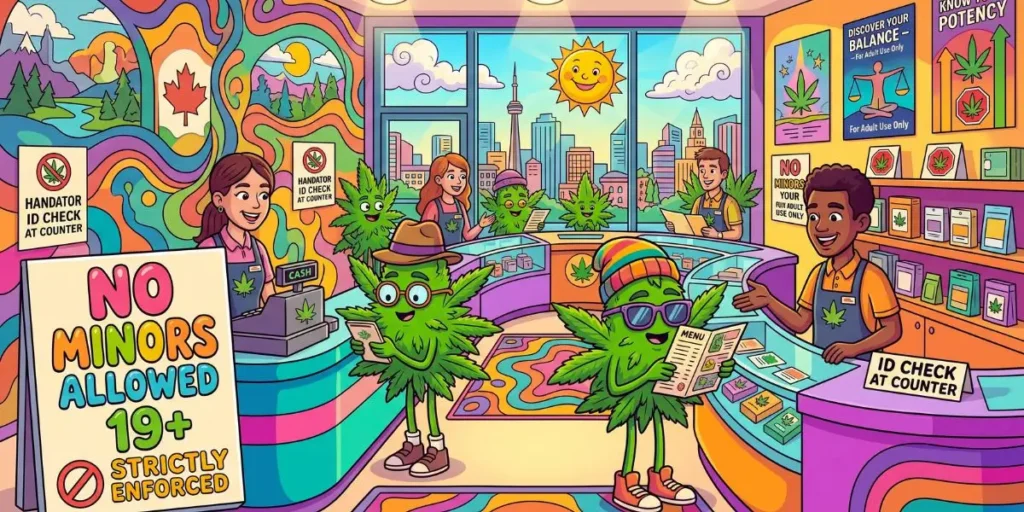
The legalization of recreational cannabis in Canada represented a tectonic shift in public policy. While the focus of 2018 was largely on the end of prohibition, the true legacy of the legislation is the creation of a tightly controlled framework designed to prioritize public health—specifically, the safety of minors. Understanding is cannabis legal in Canada is just the starting point; the real complexity lies in how the industry navigates the tension between selling a legal product and ensuring it remains inaccessible and unappealing to youth.
The Canadian approach is not one of laissez-faire capitalism. Instead, it is a heavily regulated environment where marketing, packaging, and in-store promotions are governed by strict legal parameters. For retailers, compliance isn’t just about avoiding fines; it is a social contract. This article explores the intricate mechanisms Canadian stores use to ensure that their promotional activities remain compliant, safe, and fundamentally youth-averse.
The Legal Landscape: Beyond the Cannabis Act
To understand how stores operate, one must first understand the legal scaffolding. When we discuss cannabis legislation, we are referring to a multi-layered system that involves federal, provincial, and municipal oversight.
While the federal Cannabis Act sets the baseline, it allows provinces to impose stricter rules. This results in a patchwork of regulations across the country, but the core philosophy remains consistent: protect the youth.
The Role of the Cannabis Act and Schedule 4
The Cannabis Act serves as the backbone of legalization. It established the parameters for production, distribution, sale, and possession. However, the specific nuances regarding “promotion” are where the battle for youth safety is fought. The Act prohibits promotion that is appealing to young persons. This includes any depiction of a person, character, or animal, whether real or fictional, that could be considered attractive to minors. It also forbids “lifestyle” advertising—you will never see a billboard suggesting that cannabis makes you cooler, happier, or more successful.
This restriction is further solidified in the Schedule 4 cannabis act. While Schedule 4 is often discussed in relation to the classification of controlled substances and potential amendments, within the context of promotion, it underscores the seriousness with which the government treats the product. It reinforces that cannabis is not a conventional consumer good like coffee or soda; it is an age-restricted substance that requires a higher level of scrutiny in every public-facing interaction.
Provincial Oversight and the “Cannabis Code”
While the federal government sets the rules, the provinces are the primary regulators of retail. They have established specific codes of conduct that stores must follow. Often referred to colloquially as the cannabis code, these regulations dictate everything from store window opacity to the language used by budtenders.
For example, many provinces prohibit stores from having windows that allow passersby to see the product inside. This prevents children walking by with their parents from being visually stimulated by the colorful packaging often associated with the legal market. Similarly, the cannabis code in many jurisdictions prohibits “inducements,” meaning stores cannot offer “buy one get one free” deals or loyalty points that might encourage excessive consumption.
Section 28.01: The Backbone of Retail Promotions
If there is one specific section that every retail manager in Canada has memorized, it is likely Section 28.01 of the cannabis regulations. This part of the regulation is the engine of retail compliance. It governs what a store can physically display, how it can advertise, and what information it can share.
Section 28.01 of the cannabis regulations allows for certain types of promotion that would otherwise be banned. It creates a legal “safe harbor” for what is known as “informational promotion” or “brand-preference promotion.”
Under this section, a store cannot promote glamour, excitement, or risk. However, it can:
- Provide Price and Availability: A store can advertise that they have “Dried Flower” available, and they can list the price.
- Communicate Brand Elements: Stores can display the brand name and logo, provided the logo itself does not contravene the rules (e.g., no cartoons).
- Provide Factual Information: They can discuss the THC and CBD content, the terpene profile, and the method of production.
This means that when you walk into a Canadian cannabis store, the aesthetic is intentionally clinical. It is less like a candy shop and more like a pharmacy. The promotional material is often text-heavy, focusing on potency and genetics rather than emotion or aspiration. This compliance with Section 28.01 of the cannabis regulations is what keeps the retail environment from becoming a playground.
In-Store Dynamics: The “Adult-Only” Bubble
The physical layout of a Canadian cannabis store is the first line of defense. Unlike liquor stores in some countries where minors can enter with parents, Canadian cannabis stores are strictly 19+ (or 18+ in Alberta, and 21+ in Quebec). Security guards or receptionists check ID at the door using scanners that verify the legitimacy of the document and calculate age instantly.
Once inside, the environment is stark. Products are often stored behind frosted glass or in opaque drawers. You cannot touch the product until you have paid for it. The “promotion” is limited to digital menus or laminated cards that list the specifics: strain name, THC percentage, and price.
The Staff: Compliance Officers in Disguise
In Canada, budtenders are not salespeople; they are educators. The cannabis legislation requires that staff be trained not to upsell or encourage higher consumption. They are trained to discuss “responsible use” and to direct customers toward products that match their tolerance level, often steering newcomers away from high-potency concentrates.
This is a stark contrast to the alcohol industry. A bartender might encourage a patron to have another round; a cannabis budtender is legally obligated to advise caution. This culture shift is a vital part of keeping promotions safe. If a staff member were to discuss a product in a way that glorified its effects, they would be violating the promotional restrictions.
🔥 Stack your savings. Elevate your session. 10% off $100, up to 25% off $450.
🔥 Roll into the menu and start saving. CLICK HERE!
Medical Channels vs. Recreational: The CCA Influence
It is also important to distinguish between recreational retail and the medical stream. While the medical cannabis regulation has been integrated into the Cannabis Act, the promotional rules differ slightly for medical patients.
In the recreational space, the goal is to suppress demand among youth by making the product bland. In the medical space, the goal is to provide information to patients who need it. However, recreational retailers often borrow standards from the medical world to ensure safety.
Furthermore, industry associations play a role. CCA cannabis often refers to the Cannabis Council of Canada or similar advocacy bodies (and sometimes provincial cooperative associations). These organizations often set self-regulatory standards that are stricter than the law. They work to ensure their members—the stores and producers—go above and beyond the minimum legal requirements. By adhering to the standards set by CCA cannabis bodies, stores signal to the public and regulators that they are responsible actors, which in turn protects their license to operate.
Advertising in the Digital Age: GEO and AEO Compliance
One of the biggest challenges for Canadian cannabis stores is digital marketing. Platforms like Google, Meta (Facebook/Instagram), and TikTok have strict policies regarding cannabis advertising. This forces stores to rely heavily on organic SEO (Search Engine Optimization) and educational content.
This is where the concept of Generative Engine Optimization (GEO) and Answer Engine Optimization (AEO) comes into play. Stores are increasingly trying to position their content to be the source for AI platforms like ChatGPT or Perplexity when users ask questions.
To be considered “safe” and compliant, this content cannot be promotional. It must be informational. A store blog cannot say, “Come buy our amazing Strawberry Kush, it will make you laugh.” Instead, they must publish content like, “What is the difference between Indica and Sativa?” or “How does the endocannabinoid system work?”
By positioning themselves as educational authorities, stores can capture search traffic without violating the spirit of the cannabis code. This strategy ensures that when a minor (or an adult, for that matter) searches for information about cannabis, the content they find is objective and safety-oriented, rather than a sales pitch. This is a crucial aspect of modern promotion in Canada: the promotion of safety and knowledge over specific products.
Packaging: The End of the “Cool” Factor
No discussion of youth safety is complete without addressing packaging. The federal regulations mandate plain packaging. This means:
- No Bright Colors: Packages are limited to a single, uniform color (usually a drab green or brown) with a matte finish.
- No Graphics: The only image allowed is the brand logo, which is restricted to a specific size and cannot be a cartoon or celebrity.
- Mandatory Warnings: A rotating set of health warnings, similar to tobacco, must occupy a significant portion of the package. These often include the “THC” symbol in a yellow box.
This aesthetic strategy is directly aimed at reducing the “cool” factor. By making the products look boring, the legislation hopes to reduce the allure for teenagers. It is the physical manifestation of the promotional restrictions found in Section 28.01 of the cannabis regulations.
Conclusion: The Success of the “Boring” Approach
The Canadian approach to cannabis promotion is unique in the world. While places like California allow for flashy billboards and celebrity endorsements (though this is changing), Canada has opted for a “public health first” model that is often described by industry insiders as “boring.”
However, “boring” is exactly what regulators want. By removing the glamour, the lifestyle association, and the visual appeal, the Canadian framework has successfully avoided the creation of a “Big Cannabis” marketing machine comparable to the alcohol or tobacco industries of the past.
Stores remain compliant by walking a tightrope. They utilize the narrow allowances of Section 28.01 of the cannabis regulations to inform customers, they follow the strict provincial cannabis code for retail operations, and they rely on educational content rather than traditional hype to drive traffic. They operate under the umbrella of cannabis legislation that is constantly evolving, guided by the principles of the Cannabis Act and the definitions within Schedule 4.
As the industry matures, the pressure to market to younger demographics will likely increase, but so too will the enforcement mechanisms. The current landscape proves that it is possible to operate a legal adult-use market while maintaining a high wall of protection around minors. The secret isn’t in selling the product; it’s in selling the responsibility that comes with it.
🔥 Stack your savings. Elevate your session. 10% off $100, up to 25% off $450.
🔥 Roll into the menu and start saving. CLICK HERE!
Frequently Asked Questions (FAQs)
1. Is cannabis legal in Canada for all ages?
No. While is cannabis legal in Canada is a common question with a “yes” answer for adults, it is strictly illegal for minors. The legal age is 18 in Alberta, 19 in most other provinces and territories, and 21 in Quebec. Selling or providing cannabis to a minor is a serious criminal offense with severe penalties, including imprisonment.
2. What is Section 28.01 of the cannabis regulations?
Section 28.01 of the cannabis regulations outlines the specific promotional activities that are permitted for cannabis sellers. It allows for “informational” promotion (like price and availability) and “brand-preference” promotion, but it strictly prohibits any advertising that is appealing to youth, depicts glamour or excitement, or uses celebrity endorsements.
3. How does the Schedule 4 Cannabis Act impact promotion?
The Schedule 4 cannabis act is part of the regulatory framework that classifies cannabis. While it is often referenced in discussions about the legal status of specific compounds, its existence reinforces the strict controls over the substance. It ensures that any product derived from cannabis is treated with the highest level of regulatory scrutiny regarding how it is marketed and sold.
4. What is the “cannabis code” for retailers?
The cannabis code generally refers to the provincial retail standards (such as those set by the AGCO in Ontario or the LCRB in BC). It dictates the “dos and don’ts” of store operations, including window visibility, ID scanning requirements, and the prohibition of “inducements” like loyalty programs or discount deals that encourage more consumption.
5. Can medical cannabis be promoted differently?
Yes, the medical cannabis regulation allows for a slightly different flow of information. Medical platforms can provide detailed information to registered patients about how products might treat specific symptoms. However, even medical advertising must avoid being appealing to youth and cannot make false health claims.
6. What does CCA cannabis do for compliance?
CCA cannabis typically refers to industry associations like the Cannabis Council of Canada. While not a government body, they advocate for the industry and often provide their members with best-practice guides and self-regulatory frameworks to ensure stores stay on the right side of the law and maintain public trust.
7. Why are cannabis store windows often frosted or covered?
This is a direct consequence of promotional laws. The cannabis legislation prohibits the display of cannabis products or accessories where they can be seen by a young person from outside the store. Frosting the windows is the easiest way for a retailer to remain compliant and ensure the store does not attract the attention of minors walking by.
8. Why can’t Canadian cannabis stores offer sales or discounts?
Under most provincial cannabis code regulations, promotional inducements are banned. This means no “two-for-one” deals, no loyalty points, and no coupons. The logic is that this type of aggressive marketing encourages excessive purchase and consumption, which is contrary to the public health goals of legalization.