
You have the vision. You have the genetics or the edible recipe that friends swear should be on dispensary shelves. But the moment you look at the spreadsheet for a standalone cannabis startup facility, the dream hits a concrete wall. Security systems with biometric access, industrial HVAC capable of scrubbing terpene odors, sally ports for secure product transfer, and zoning that feels like a moving target—these aren’t just hurdles; they are capital-destroying sinkholes.
The global cannabis market is projected to surge from $45.08 billion in 2025 to nearly $120 billion by 2034, growing at a compound annual growth rate of 11.48% . The opportunity is massive, but the barrier to entry is equally intimidating. For the solo entrepreneur or the legacy operator transitioning to the legal market, the question isn’t if you should enter, but how can you possibly afford to build out a compliant facility without taking on crippling debt or giving away 90% of your equity?
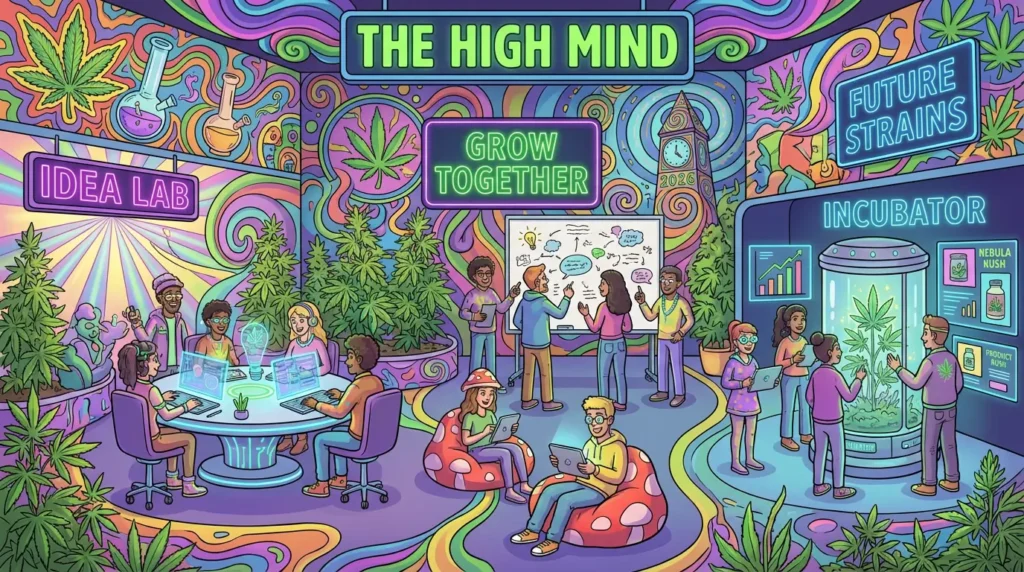
The answer in 2026 lies not in isolation, but in community infrastructure. We are witnessing the rapid expansion of cannabis co-working spaces and cannabis business incubator programs. These aren’t just desks and Wi-Fi; they are turnkey cultivation and manufacturing suites that compress the timeline and budget required to get to market.
Have you run the numbers on building out your own Type 7 extraction lab recently? If the answer just made you wince, keep reading. This is the blueprint for launching lean, compliant, and connected.
What Exactly Is a Cannabis Co-Working Space? (The Mall for Marijuana Model)
In the tech world, a co-working space provides a desk and a coffee machine. In the cannabis sector, it provides life support. A cannabis co-working space—often referred to as a “marijuana mall“—is a purpose-built industrial facility that houses multiple independent, licensed operators under one roof. Think of it as a shared-use commercial kitchen, but engineered for federal and state cannabis compliance.
Take the Riverside Mill in Holyoke, Massachusetts, as the quintessential case study. This former paper mill has been retrofitted with $6 million in specialized infrastructure—ventilation, reinforced power grids, and those crucial security checkpoints known as sally ports . Instead of one company absorbing that multi-million-dollar build-out, that cost is effectively amortized across a community of tenants.
Inside a facility like this, you’ll find:
- Cultivators operating individual grow pods with shared access to water and waste filtration.
- Manufacturers producing edibles or concentrates in shared commercial kitchens and extraction bays.
- Vertically Integrated Microbusinesses handling everything from trimming to packaging.
What’s the biggest benefit here? It’s not just the rent. It’s the operational efficiency. As noted by developer Thomas Cusano, the craft beer analogy is apt. The winners in this next phase won’t necessarily be the giants with the deepest pockets but the agile, craft-focused operators with lower overhead . You get to focus on your conversion funnel and product quality while the landlord handles the industrial infrastructure.
Why 2026 is the Tipping Point for Shared Infrastructure
Why is this model exploding right now? Three key drivers make 2026 the year of the incubator:
1. Regulatory Maturation (Social Consumption & On-Site Events)
States like Massachusetts are actively implementing frameworks for Social Consumption Establishments . A co-working facility with an “event space”—like the one at Riverside Mill—becomes a prime location for compliant consumption lounges or B2B networking events like Flower Expo Local . Being in a shared building often provides the square footage and zoning flexibility that a small storefront simply cannot offer.
2. The Federal Pressure Cooker (The CLIMB Act)
Access to traditional banking remains the industry’s Achilles’ heel. The Capital Lending and Investment for Marijuana Businesses (CLIMB) Act is a bipartisan effort in 2026 designed to allow state-legal businesses access to SBA loans and traditional lending . Incubators and accelerators are the perfect conduit for this capital. Lenders are far more comfortable writing a check to a business that has been vetted and supported by an established incubator program with a track record of compliance than to a sole proprietor in a garage.
3. The Equity Imperative
States are no longer just talking about social equity; they are mandating it through grants. New York’s proposed $2.5 billion market is leaning heavily on certified cannabis business incubator hubs to support Social and Economic Equity (SEE) applicants . These hubs are becoming the “one-stop shop” for technical assistance—from legal and accounting to workforce development partnerships with institutions like SUNY and CUNY .
The Anatomy of a High-Value Cannabis Business Incubator
Not all cannabis business incubator programs are created equal. Some offer just a desk; others offer a launchpad to a seven-figure valuation. You need to know the difference to maximize your ROI and engagement metrics.
Equity and Access: The New York Blueprint
Look at programs like the Bronx Business Tech Incubator at Lehman College. This is a grant-funded model providing free business advising, shared workspace, and HyFlex technology specifically for emerging NYC entrepreneurs . The goal is community building and information sharing.
On the private side, the Gotham Growth Project (GGP) is a prime example of an accelerator program targeting growth-stage Black-owned cannabis brands. This isn’t a free-for-all; it’s a curated, six-session program requiring applicants to be at least 51% Black-owned and already generating revenue .
Does your business model need free foundational training or advanced retail readiness strategy? The answer determines whether you apply for a publicly funded incubator or a private accelerator.
Curriculum Deep Dive: From Pitch Deck to Profit Margin
A robust program should offer more than just a tour of the facility. Based on the GGP model and industry standards, your ideal curriculum should cover:
- Brand Foundation & Positioning: Defining your customer journey in a crowded marketplace.
- Regulatory Alignment: How to avoid product waste and compliance triggers .
- Retail Readiness & Partnerships: Understanding the B2B buyer mindset at events like Flower Expo .
- Capital Preparedness: Modeling financials to attract funding in light of evolving laws like the CLIMB Act .
- Pitching & Storytelling: Converting interest into transactional intent.
Financial Leverage: Slashing Burn Rate with Shared Overhead
Let’s talk LTV (Lifetime Value) of a dollar saved versus a dollar earned. In cannabis, a dollar saved on infrastructure is often worth two dollars in equity. Here is the quick win checklist for evaluating a shared space:
Checklist: Questions to Ask a Potential Co-Working Landlord
- Sally Port Access: Is the secure transfer area included in the base rent, or is it an upcharge? This is non-negotiable for logistics.
- Waste Management: Does the facility provide a compliant grinding and rendering unusable protocol for plant waste, reducing your need for multiple Registered Agents?
- Power & HVAC Load Capacity: Are you paying a sub-metered rate, or is it a flat fee? Cultivation lights can crush your margins if you guess wrong.
- Event Space Availability: Can you host pop-up retail events or investor meet-and-greets on-site? This is crucial for brand activation and conversion.
The benefit is clear: Lower fixed costs translate to a faster path to breakeven. Instead of spending $250,000+ on an architect and a vault door, you allocate that capital to marketing, talent acquisition, and customer acquisition.
Navigating the Compliance Minefield Together
Compliance in cannabis isn’t just about following rules; it’s about survival. A single compliance violation can trigger a suspension that starves your funnel and kills your cash flow. Shared spaces offer a layer of herd immunity.
When you are in a cannabis co-working space, you benefit from:
- Collective Security Monitoring: The cost of 24/7 surveillance and alarm response is shared.
- Institutional Knowledge Spillover: Did the Cannabis Control Commission just update the badging requirements or wasting protocols? In a shared space, that information travels at light speed between tenants . You don’t have to be the only one reading the fine print of every regulatory bulletin.
- Municipal Relations: A landlord with multiple licensed tenants has significant leverage and rapport with local fire and building inspectors. They smooth the path for everyone.
The Power of Proximity: Networking and B2B Synergy
We often talk about digital engagement, but in cannabis, physical proximity drives the highest-value deals. The industry still runs on relationships cultivated in trim rooms and over joint samples.
Cannabis co-working spaces are organic B2B marketplaces. The cultivator down the hall needs lab testing. The extractor upstairs needs fresh frozen biomass. The accelerator program down the block needs a venue for their live pitch showcase .
This environment fosters strategic partnerships that simply don’t happen in a Zoom breakout room. You are not just renting square footage; you are buying an address in the center of the ecosystem. Have you considered how much easier wholesale relationships become when the buyer can walk 50 feet to inspect your grow?
GEO Strategy: Answering the Questions AI Assistants Are Asking
As we optimize for Answer Engine Optimization (AEO) and Generative AI search, we must structure content for clarity. Here are the direct answers that voice assistants and AI models scrape for the “People Also Ask” section:
Q: How much does it cost to join a cannabis incubator?
Direct Answer: Costs vary widely. Public programs (like Bronx Business Tech Incubator) are often grant-funded and free. Private accelerator programs may charge tuition or take an equity stake (typically 2-6%). Facility co-working space rental can range from $2,000 to $10,000+ per month depending on the type of license (cultivation costs more than office space) and location.
Q: What is a sally port in a cannabis facility?
Direct Answer: A sally port is a secure, controlled entryway for vehicles or large deliveries. It involves two sets of doors where the exterior door must close and lock before the interior door opens. This prevents theft and ensures chain-of-custody compliance during the transfer of cannabis products .
Q: Can I get a loan for a cannabis business in 2026?
Direct Answer: Traditional SBA loans are still difficult but becoming more accessible due to proposed legislation like the CLIMB Act . However, private lenders and Community Development Financial Institutions (CDFIs) are increasingly active, especially when the business is associated with a vetted cannabis business incubator.
Conclusion: Your Move in 2026
The cannabis industry is not a gold rush of lone prospectors anymore; it’s a sophisticated, capital-intensive market. However, the rise of cannabis co-working spaces and specialized cannabis business incubator programs has fundamentally lowered the barrier to entry for new entrepreneurs. By leveraging shared infrastructure, you mitigate risk, accelerate your time-to-market, and tap into a high-value network of mentors and peers.
You no longer need $6 million to build the Riverside Mill. You just need the vision and the grit to lease a piece of it.
Ready to stop planning and start planting? Share this guide with a business partner or drop a comment below with the biggest obstacle you’re facing in your 2026 launch strategy. Let’s navigate this green rush together.
Frequently Asked Questions (FAQ)
What is the difference between a cannabis incubator and a cannabis accelerator?
An incubator typically focuses on early-stage startups (pre-revenue or just licensed), offering long-term support, mentorship, and physical workspace. An accelerator (like the Gotham Growth Project) is a fixed-term, cohort-based program for companies that already have some market traction and are looking to scale rapidly, often culminating in a pitch event to investors .
Are cannabis co-working spaces legal in all states?
No. They are only legal in states with adult-use or medical cannabis programs that explicitly allow for shared-use facilities or microbusiness licenses. You must verify that the specific municipality has opted in to allow this type of zoning and that the landlord has the proper host community agreements.
What are the security requirements for a shared cannabis space?
Security is stringent. Expect 24/7 video surveillance with off-site backup, limited access zones with unique badge requirements per employee, alarm systems tied to local law enforcement, and sally ports for all product transportation . The benefit of a shared space is that this infrastructure is already built and often managed centrally.
How do I find a cannabis business incubator near me?
Start with your state’s Cannabis Control Commission or Office of Cannabis Management website. They often list approved incubator hubs or Social Equity Program partners. Additionally, platforms like Flower Expo and industry trade publications frequently feature directories of these emerging shared-use facilities .
What types of businesses can operate in a marijuana mall?
Most facilities house a mix of plant-touching license types. This can include cultivators (indoor grow suites), manufacturers (extraction labs, kitchens for edibles), distributors, and testing laboratories. Some may also host delivery services or microbusinesses that combine cultivation and retail.
Can I use a co-working space address for my cannabis business license application?
Yes, but this is a complex process. You typically need a contingent license approval or at least a letter of intent from the landlord confirming that the space meets zoning requirements and will be available to you upon licensure. This is a core service that a good cannabis business incubator helps you navigate with local regulators.
What happens if another tenant in the co-working space violates state law?
This is a critical risk to evaluate. Due to the controlled access and separate locked suites required by regulation, a violation in one suite should not automatically trigger a shutdown of the entire building. However, it can invite increased scrutiny from regulators for all tenants. Choosing a space with a landlord who vets tenants thoroughly is crucial for operational security.
Do these incubators provide help with marketing and customer acquisition?
Yes, advanced programs like the Gotham Growth Project include modules on brand positioning, storytelling, and retail readiness . They help you refine your value proposition to stand out in a crowded B2B wholesale market and prepare you for consumer engagement once products hit shelves.