
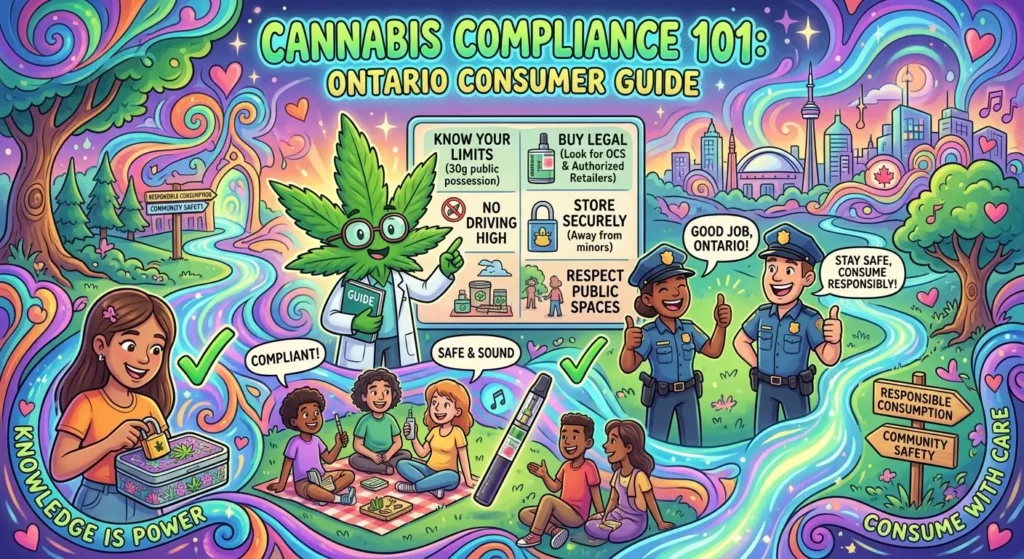
Walking into a cannabis store in Toronto, Ottawa, or Hamilton should feel straightforward. The product is on the shelf, the price is on the tag, and the transaction is quick. But behind that simple exchange sits a dense web of provincial and federal regulations designed to keep consumers safe, youth protected, and the market accountable. If you live in Ontario—or plan to visit—understanding these rules is not just about avoiding fines. It is about making informed choices, recognizing legal products, and knowing your rights as a consumer.
This guide breaks down everything you need to know about cannabis compliance in Ontario as of 2026, from possession limits and consumption zones to workplace rules and packaging standards. No legal jargon. No fluff. Just clear, actionable information.
Who Can Legally Buy and Use Cannabis in Ontario?
The rules start with age. In Ontario, you must be 19 years or older to buy, use, possess, and grow recreational cannabis. This aligns with the province’s legal drinking age and applies uniformly across all product categories—dried flower, edibles, extracts, topicals, and beverages.
Retailers are required by the Alcohol and Gaming Commission of Ontario (AGCO) to check government-issued photo ID for anyone who appears to be under 25 years old. Accepted identification includes a driver’s licence, passport, or Ontario Photo Card. If you cannot produce valid ID, the sale will not happen, regardless of how old you actually are.
For medical cannabis, the rules differ slightly. Patients authorized by a healthcare provider can purchase from licensed producers and possess more than the standard public limit, though they must carry documentation proving their medical status.
Where to Buy Legal Cannabis in Ontario
Ontario operates a hybrid retail model. The Ontario Cannabis Store (OCS)—a Crown corporation under the Liquor Control Board of Ontario (LCBO)—serves as the sole legal online retailer and wholesale distributor for all private stores in the province.
This means two things for consumers:
- Authorized physical stores: As of 2025, Ontario has over 1,700 authorized private retail cannabis stores—more than any other province . These stores must display an authorized cannabis retail seal and source all inventory exclusively from the OCS.
- Online purchases: The only legal e-commerce channel is OCS.ca. Private retailers are not permitted to sell cannabis through their own websites or third-party delivery apps . The OCS ships via Canada Post with age verification required at delivery.
If you encounter a website offering direct-to-door cannabis sales from a private Ontario retailer, it is not operating within the legal framework. The same applies to unlicensed brick-and-mortar shops. The Toronto Police Service continues to enforce against illegal dispensaries, and purchasing from them exposes you to untested, potentially unsafe products.
Possession Limits: What You Can Carry and Keep
Understanding how much cannabis you can legally possess is critical, especially because the limits change depending on whether you are in public or at home.
In Public
Under the federal Cannabis Act, adults in Ontario can carry up to 30 grams of dried cannabis (or the equivalent) in public at any time.
That 30-gram limit translates to:
- 150 grams of fresh cannabis
- 450 grams of edibles
- 2,100 grams of non-solid cannabis products (oils, capsules), excluding beverages
- 48 cans of 355 ml cannabis beverages
- 7.5 grams of cannabis concentrates (solid or liquid)
- 30 cannabis plant seeds
When shopping at an authorized retailer or OCS.ca, the system automatically converts your cart into dried-cannabis equivalents to ensure you do not exceed the limit in a single transaction.
At Home
Unlike some provinces, Ontario does not impose a home storage limit
. You can legally store more than 30 grams in your private residence, provided it is secured away from youth and not accessible to unauthorized individuals.
Consumption Rules: Where You Can and Cannot Use Cannabis
Ontario’s consumption rules are governed primarily by the Smoke-Free Ontario Act, 2017, which treats cannabis similarly to tobacco in many—but not all—contexts.
Where You Can Smoke or Vape
Adults 19 and older can consume cannabis in the following locations:
- Private residences, including porches and backyards
- Condos and apartments, including balconies, unless your lease or building rules prohibit it
- Many outdoor public places, such as sidewalks and parks, provided they are not within prohibited zones
- Designated smoking guest rooms in hotels, motels, and inns
- Residential vehicles and boats that have permanent sleeping accommodations and cooking facilities, while parked or anchored
- Controlled areas in long-term care homes, certain retirement homes, residential hospices, and designated psychiatric or veterans’ facilities
Where You Absolutely Cannot Smoke or Vape
The prohibited list is extensive and strictly enforced:
- Indoor common areas in condos, apartment buildings, and university residences
- Enclosed public places and enclosed workplaces
- School grounds and public areas within 20 metres of school property
- Children’s playgrounds and public areas within 20 metres
- Child care centres and early years program locations
- Hospital grounds and within 9 metres of hospital entrances/exits
- Restaurant and bar patios, and within 9 metres of them
- Publicly owned sports fields and spectator areas within 20 metres
- Community recreational facilities and grounds within 20 metres
- Any vehicle or boat that is being driven or will be driven
Additionally, many municipalities have enacted their own bylaws that further restrict public consumption. For example, Brampton and Mississauga ban cannabis use in all municipal parks and recreation facilities. Always check local bylaws before consuming in public.
Edibles, Extracts, and Beverages: Product-Specific Limits
Federal regulations set strict caps on THC content to prevent overconsumption and protect inexperienced users.
THC Limits by Product Category
- Edibles: Maximum 10 mg of THC per package, regardless of the number of servings
- Extracts (discrete units): Maximum 10 mg of THC per unit for products not intended for inhalation
- Extracts (non-discrete with dispenser): Maximum 10 mg of THC per activation
- Dried flower: No federal THC cap, but labels must display both “actual” and “total” THC values
- Topicals: Must display total THC and CBD content per container; cannot make therapeutic or medical claims
These limits have drawn criticism from experienced consumers who find 10 mg insufficient, but they remain non-negotiable for licensed producers. Any product claiming higher THC per package is either unregulated or mislabeled.
Cannabis and Driving: Zero Tolerance for Impairment
This is the rule with the steepest consequences. Driving while impaired by cannabis is a criminal offence under the Criminal Code of Canada, and Ontario has layered additional provincial penalties on top.
Provincial Penalties (Effective January 1, 2026)
Ontario amended its Highway Traffic Act regulations to impose harsher sanctions:
- First offence: 7-day roadside licence suspension (up from 3 days)
- Second offence: 14-day suspension (up from 10 days)
- Look-back period: Extended to 10 years from 5 years for prior offences
- Causing death: Indefinite, lifetime provincial suspension upon sentencing
Federal Criminal Consequences
Beyond provincial suspensions, convicted drivers face:
- Mandatory fines
- Possible imprisonment
- Criminal record
- Increased insurance premiums
Police can demand oral fluid tests or blood samples if they reasonably suspect impairment. Cannabis impairment can last hours longer than you might feel “high,” particularly with edibles. The safest approach is simple: if you consume, do not drive.
Transporting Cannabis in Ontario
You can legally transport cannabis in a vehicle, but how you store it matters.
Under Ontario law, cannabis must be:
- In its original sealed packaging, OR
- Stored in a place that is not readily accessible to anyone in the vehicle
The trunk is the safest storage location. Having an open bag of cannabis within reach of the driver or passengers—even if no one is consuming—can result in charges. This rule applies equally to drivers and passengers.
🔥 Stack your savings. Elevate your session. 10% off $100, up to 25% off $450.
🔥 Roll into the menu and start saving. CLICK HERE!
Home Cultivation: Your Four-Plant Allowance
Ontario permits adults to grow up to four cannabis plants per residence for personal use. This is a federal allowance that Ontario has not restricted further, unlike provinces such as Quebec and Manitoba, which prohibit home cultivation entirely.
Key points for home growers:
- The limit is per residence, not per person. Four roommates in one house cannot grow 16 plants.
- Plants must be grown from legal seeds or seedlings purchased from the OCS or a licensed producer.
- You can make cannabis products at home (oils, edibles) as long as you do not use organic solvents to create concentrates .
- Using butane, propane, or other combustible solvents for extraction carries penalties of up to 14 years in prison under the Cannabis Act.
Packaging and Labeling: Why Legal Products Look the Way They Do
If you have ever wondered why legal cannabis packaging looks so clinical, the answer is strict federal regulation.
Plain Packaging Requirements
Under Health Canada’s Cannabis Act and Cannabis Regulations, all cannabis products must adhere to plain packaging standards:
- Single uniform colour on all surfaces; no fluorescent or metallic colours
- Smooth texture with no embossing, decorative ridges, or hidden features
- No images or graphics except for one small brand element
- Child-resistant containers with tamper-evident seals
- Opaque or translucent packaging (except for seeds and plants)
Mandatory Label Information
Every legal product must display:
- The standardized cannabis symbol (red hexagon with black cannabis leaf) if THC exceeds 10 µg/g
- A health warning message in a yellow box with black text
- THC and CBD content in mg/g or mg per unit
- Packaging date and lot number
- License holder contact information
- Bilingual text (English and French)
These rules exist to reduce appeal to youth, prevent accidental consumption, and ensure consumers can make informed decisions. If a product lacks these elements—or features flashy branding, cartoon characters, or health claims—it is not from the legal market.
Cannabis in the Workplace: What Employers and Employees Should Know
Ontario prohibits smoking or vaping cannabis in enclosed workplaces, regardless of whether the use is recreational or medical. However, the rules around consumption and accommodation are nuanced.
Recreational Use
Employers can generally expect employees to be free from cannabis impairment while at work. This is treated similarly to alcohol: what you do on your own time is your business, but showing up impaired is a workplace violation.
Medical Use
Employees using cannabis for a disability-related medical purpose have rights under Ontario’s Human Rights Code. Employers must accommodate these needs to the point of undue hardship.
For example, an employer might allow an employee with multiple sclerosis to take periodic breaks to consume edible cannabis outside the workplace, provided a doctor confirms it will not interfere with job performance or safety.
That said, accommodation does not override safety. In safety-sensitive positions—operating heavy machinery, driving, healthcare—employers can prohibit impairment even from medical cannabis if it creates significant health and safety risks.
Penalties for Non-Compliance
Breaking Ontario’s cannabis laws carries consequences ranging from tickets to lengthy prison sentences, depending on the severity of the offence.
Provincial Offences
- Possession over the public limit: Tickets for small amounts; up to 5 years in prison for large quantities
- Consumption in prohibited areas: Fines vary by municipality
- Illegal retail operations: Fines up to $250,000 and/or jail time for unlicensed sellers
Federal Criminal Offences
- Illegal distribution or sale: Up to 14 years in prison
- Production beyond personal limits: Up to 14 years
- Using organic solvents for extraction: Up to 14 years
- Crossing Canadian borders with cannabis: Up to 14 years
- Giving or selling cannabis to a minor: Up to 14 years
- Using a youth to commit a cannabis offence: Up to 14 years
The AGCO also has the power to suspend or revoke retail licences immediately if public safety is at risk, without advance notice.
How to Spot a Legal Product in 2026
With over 1,700 stores in Ontario, most transactions are above board. But the illegal market persists, particularly online. Here is how to verify legitimacy:
- Check for the OCS stamp: Legal products carry an Ontario excise stamp.
- Verify the retailer: Look for the AGCO’s authorized cannabis retail seal in-store.
- Inspect the packaging: It should be plain, child-resistant, and display the standardized cannabis symbol and health warning.
- Request the COA: Authorized retailers can provide Certificates of Analysis for products upon request.
- Avoid deals that seem too good: Unusually low prices often signal untested, unregulated product.
Conclusion
Cannabis compliance in Ontario is not designed to trip you up. It is designed to create a safe, transparent market where adults can make informed choices while keeping products away from youth and organized crime. By understanding the basics—where to buy, how much you can carry, where you can consume, and what legal packaging looks like—you protect yourself from penalties and ensure you are consuming tested, regulated products.
The landscape will continue to evolve. Municipal bylaws may tighten, federal THC limits may shift, and new product categories will emerge. But the fundamentals remain: buy legal, know your limits, consume responsibly, and never drive impaired. In a market as mature as Ontario’s, compliance is not a burden. It is the framework that makes safe access possible.
🔥 Stack your savings. Elevate your session. 10% off $100, up to 25% off $450.
🔥 Roll into the menu and start saving. CLICK HERE!
Frequently Asked Questions (FAQs)
What is the legal age to buy cannabis in Ontario?
You must be 19 years or older to purchase, possess, consume, and grow recreational cannabis in Ontario. Retailers must check ID for anyone appearing under 25.
Where can I legally buy cannabis in Ontario?
You can purchase cannabis from AGCO-authorized private retail stores (over 1,700 locations province-wide) or online through the Ontario Cannabis Store (OCS.ca). Private retailers cannot sell cannabis through their own websites.
How much cannabis can I possess in public in Ontario?
Adults can carry up to 30 grams of dried cannabis (or the equivalent in other product formats) in public. There is no home storage limit in Ontario.
Can I smoke cannabis on my apartment balcony?
Generally, yes. Adults can smoke or vape cannabis on their private balcony unless the condominium bylaws or lease agreement specifically prohibit it. Check your building’s rules.
Where am I not allowed to consume cannabis in Ontario?
You cannot smoke or vape cannabis in enclosed public places, indoor common areas, within 20 metres of schools and playgrounds, on hospital grounds, on restaurant patios, in vehicles, or in any workplace. Municipal bylaws may impose additional restrictions.
Can I grow cannabis at home in Ontario?
Yes. Adults can grow up to four plants per residence for personal use. The limit applies to the household, not per person. You cannot use organic solvents like butane to make concentrates at home.
What are the THC limits for cannabis edibles in Ontario?
Federal law caps edibles at 10 mg of THC per package. This applies to all legal cannabis edibles sold in Ontario, regardless of the number of servings inside.
Can I drive after consuming cannabis?
No. Ontario has a zero-tolerance policy for drug-impaired driving. Provincial suspensions start at 7 days for a first offence, and criminal penalties can include fines, imprisonment, and a permanent record. If you consume, do not drive.
How should I transport cannabis in my car?
Cannabis must be in its original sealed packaging or stored in a place not readily accessible to vehicle occupants, such as the trunk. Open containers within reach of passengers or the driver can result in charges.
Can my employer fire me for using cannabis?
Employers can prohibit impairment at work and enforce sobriety policies, particularly in safety-sensitive roles. However, employees using cannabis for a medical purpose related to a disability are protected under Ontario’s Human Rights Code and entitled to accommodation up to the point of undue hardship.
What does legal cannabis packaging look like?
Legal packaging is plain and uniform in colour, child-resistant, tamper-evident, and features a red standardized cannabis symbol, yellow health warning, and bilingual product information. No flashy branding, cartoon characters, or health claims are permitted.
What happens if I buy cannabis from an illegal dispensary?
Purchasing from unlicensed sellers exposes you to untested, potentially contaminated products. Illegal retailers face fines up to $250,000 and potential jail time. The Toronto Police Service actively enforces against unauthorized cannabis sales.
Can I take cannabis across the Canada-U.S. border?
No. Taking cannabis across any Canadian border—whether entering or leaving—is illegal and can result in up to 14 years in prison, even if you are traveling to a U.S. state where cannabis is legal.
Is there a limit on how much cannabis I can buy in one transaction?
Yes. Retailers cannot sell you more than the equivalent of 30 grams of dried cannabis in a single transaction. The point-of-sale system automatically calculates equivalencies across product types.
Can I consume cannabis edibles in public?
Edibles are subject to the same consumption restrictions as smoked or vaped cannabis. You cannot consume edibles in enclosed public places, workplaces, schools, or other prohibited areas. However, the rules around discreet consumption in permitted outdoor spaces are less visually conspicuous than smoking.
What should I do if I suspect a store is selling illegal cannabis?
You can report unlicensed cannabis sales to the Alcohol and Gaming Commission of Ontario (AGCO) or your local police department. The AGCO has the authority to conduct compliance audits and shut down illegal operations.
Are there any new cannabis laws coming to Ontario in 2026?
Ontario continues to refine its regulatory framework. Recent changes include stricter impaired driving penalties under the Highway Traffic Act (effective January 2026), ongoing AGCO compliance audits, and evolving municipal bylaws. Always check current provincial and local regulations before consuming or purchasing.
One Reply to “Cannabis Compliance 101: A Simple Guide for Ontario Consumers”
Cannabis Subscriptions and Repeat Orders: What Canadian Shoppers Should Know - Weed Delivery in Toronto GTA | Cannabis delivery - Doobie Delivery
[…] Cannabis can degrade if left in hot mailboxes or trucks for too long. Good subscription services use discreet, scent-proof packaging. They should also provide tracking numbers. Look for services that ship with carriers that handle age verification upon delivery (typically requiring a 19+ signature). […]
Comments are closed.