
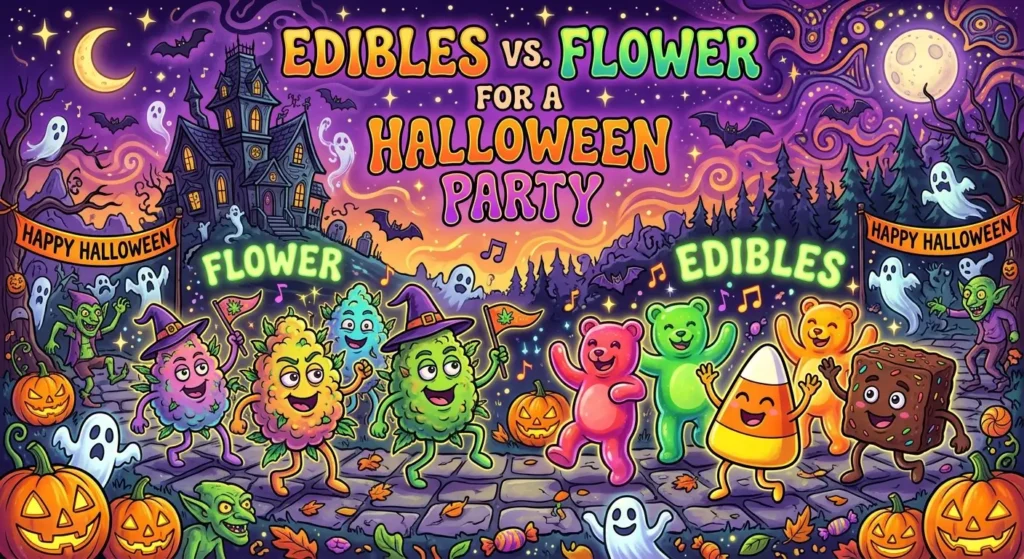
The doorbell rings. It’s 8:00 PM on October 31st. Outside, a group of teenagers dressed as ghosts and goblins are demanding treats. Inside, your living room is transformed into a haunted house, complete with fog machines, strobe lights, and a playlist of eerie synth-wave tracks. You’ve got the costumes down. You’ve got the decorations perfect. But there’s one crucial element left to decide: how will you and your guests partake in the evening’s festivities?
For many adults, Halloween isn’t just about handing out candy; it’s an excuse to host a themed gathering that leans into the spooky, surreal, and slightly altered state of mind that the holiday inspires. This brings us to the age-old debate in the cannabis community: Edibles vs. Flower.
Choosing the right consumption method can make or break your party. Get it wrong, and you might have guests who are too anxious to enjoy the haunted house tour, or worse, someone who overconsumes and spends the night sleeping on your couch instead of dancing to “Thriller.” Get it right, and you create an atmosphere of shared relaxation, heightened sensory experiences, and memorable stories.
This guide breaks down the science, social dynamics, and practical logistics of using edibles versus smoking flower at a Halloween party. We’ll look at onset times, dosage control, and social etiquette to help you curate the perfect vibe for your specific crowd.
🔥REFER A FRIEND
THEY GET 10% OFF THEIR FIRST ORDER🔥
Understanding the Core Differences: Onset and Duration
The most critical factor when choosing between edibles and flower is not just the high itself, but when it hits and how long it lasts. These two variables dictate the flow of your event.
Smoking or vaping flower offers immediate gratification. When you inhale, cannabinoids enter the bloodstream through the lungs almost instantly. Users typically feel effects within minutes, peaking around 30 minutes, and tapering off within two to three hours. This immediacy allows for micro-dosing throughout the night. If a guest feels too high, they can simply stop consuming. If they want more, they can take another puff. It is a self-regulating system.
Edibles, on the other hand, are a game of patience and precision. Because they must be digested and processed by the liver, the onset time is significantly delayed. Most people begin to feel effects between 45 minutes to two hours after ingestion. However, once the high hits, it is often more intense and longer-lasting, potentially enduring for four to eight hours. This longevity is great for a long night of trick-or-treating or movie marathons, but it leaves little room for error in dosing.
| Feature | Flower (Smoking/Vaping) | Edibles (Ingestible) |
|---|---|---|
| Onset Time | 2–10 minutes | 45–120 minutes |
| Peak Effect | 30 minutes | 2–4 hours |
| Duration | 2–3 hours | 4–8+ hours |
| Dosage Control | High (easy to adjust) | Low (hard to adjust once eaten) |
| Social Aspect | Communal, interactive | Individual, discreet |
| Health Impact | Respiratory irritation possible | No lung impact, digestive load |
Pro Tip: For a Halloween party lasting four hours or less, flower is generally the safer bet for novice users because the effects wear off before the night ends. For all-night raves or sleepover-style gatherings, low-dose edibles can provide sustained enjoyment without the need for constant re-consumption.
The Social Dynamics: Communal Rituals vs. Individual Experiences
Halloween is inherently social. It’s about connection, shared scares, and collective fun. The method of consumption you choose will shape how your guests interact with one another.
Flower fosters community. Passing a joint or sharing a vape pen is a ritualistic act. It breaks the ice, encourages conversation, and creates a shared experience. In a party setting, this can be advantageous. It keeps guests engaged with each other rather than isolated in their own heads. However, it requires a designated smoking area. Not everyone wants to smell like smoke, and local laws may restrict indoor smoking. You’ll need to plan for outdoor space or ventilation, which can be tricky if the weather is cold or rainy.
Edibles offer discretion and convenience. There is no smell, no ash, and no need to step outside into the chill. Guests can consume their dose quietly while mingling indoors. This is ideal for mixed crowds where some guests may not partake in cannabis but are comfortable being around those who do. Edibles eliminate the “smoke break” fragmentation of the group. Everyone stays in the main party zone, keeping the energy concentrated and the vibe intact.
However, edibles can also lead to isolation if not managed well. Because the high is internal and longer-lasting, guests might retreat to quiet corners to manage their experience. As a host, you need to facilitate engagement through activities—like costume contests or horror trivia—to keep the energy up while guests wait for their edibles to kick in.
Dosage Precision: Avoiding the “Green Ghost” Scenario
Nothing ruins a Halloween party faster than a guest who has consumed too much. In the cannabis world, we call this “greening out,” but for our purposes, let’s call it the “Green Ghost” scenario—where a guest becomes pale, anxious, and immobile, haunting your sofa for the rest of the night.
With flower, the risk is lower. Because the effects are felt quickly, users naturally pace themselves. A beginner might take one small hit, wait ten minutes, and decide if they want more. This feedback loop is built into the consumption method.
With edibles, the risk is high. The delayed onset is the enemy of the inexperienced user. A guest might eat a 10mg gummy, feel nothing after 30 minutes, and assume it didn’t work. So, they eat another. Then another. An hour later, they are hit with 30mg of THC all at once. For a novice, this can be overwhelming and frightening.
To mitigate this, strict labeling and portion control are non-negotiable. Never serve homemade edibles unless you have lab-tested them for potency. Stick to commercially produced, individually wrapped items with clear milligram markings.
Expert Insight: Always advise guests to “start low and go slow.” For a party setting, recommend a starting dose of 2.5mg to 5mg of THC. Provide plenty of water and non-cannabis snacks like pretzels or fruit to help ground guests who feel too high. CBD-rich edibles can also be offered as a counterbalance, as CBD can help reduce anxiety and paranoia associated with high THC doses.
Health and Accessibility Considerations
Not all guests have the same physical tolerances. Some may have asthma or respiratory issues that make smoking uncomfortable or dangerous. Others may have digestive sensitivities that make heavy, sugary edibles problematic.
Offering both options is the most inclusive approach. Set up a “consumption station” outdoors for smokers and vapers, equipped with ashtrays, lighters, and perhaps a portable vaporizer for those who prefer a cleaner experience. Indoors, provide a selection of low-dose edibles, clearly labeled with their THC/CBD content. Include non-cannabis alternatives like CBD-only drinks or mocktails for those who want to participate in the ritual without the psychoactive effects.
Consider the dietary restrictions of your guests as well. Vegan, gluten-free, and sugar-free edible options are widely available and show thoughtful hosting. Avoid serving edibles that contain common allergens like nuts or dairy unless clearly marked.
Why Edibles Demand a Different Party Strategy
Edibles are not “stronger” in a simple sense—they are less forgiving of impatience. A guest who smokes too much flower typically knows within 10 minutes that they have crossed a line. They can stop, drink water, and ride out a manageable wave. A guest who eats too much edible does not get that early warning. The discomfort arrives an hour or two later, often after they have eaten more, and it can persist for six hours or longer.
Emergency department data reflects this pattern. In a study of nearly 10,000 cannabis-related ED visits, edible-related visits were less common overall than inhaled-cannabis visits, but edible users were more likely to present with acute psychiatric symptoms (18% vs. 10.9%), cardiovascular symptoms (8% vs. 3.1%), and intoxication (48% vs. 28%). The issue is not that edibles are inherently unsafe for most adults; it is that the delayed onset creates a predictable window for accidental overconsumption, especially in social settings where people are distracted, drinking, or costume-hopping.
Pro Tip: Treat edibles like a timed-release medication, not a snack. At your party, place a small card next to the edible tray that reads: “Onset: 60–120 minutes. Please wait at least 90 minutes before taking a second serving.” A visible timer on the table—or a shared phone alarm—does more to prevent dose stacking than any verbal warning.
Dosing for a Crowd: The Numbers That Matter
The safest party edible dose for most guests is 2.5 to 5 mg of THC, with a mandatory two-hour wait before any redose. Public health agencies and clinical guides converge on this range: Health Canada suggests 2.5 mg as a standard starting dose, Washington University health promotion guidance recommends less than 2.5 mg for edible newcomers, and multiple harm-reduction sources advise waiting at least 90 to 120 minutes before considering more. For guests with little edible experience, 2.5 mg is a reasonable floor; occasional consumers may feel comfortable at 5 to 7.5 mg; 10 mg is a common regulated maximum per serving in many jurisdictions but is generally too high for a first-timer at a party.
The dose-response curve is not linear. A 2017 double-blind trial at the University of Chicago found that participants who received 7.5 mg of oral THC reported less stress during a simulated social stressor than a placebo group, while those who received 12.5 mg reported more negative mood and rated the task as more threatening. In other words, the difference between a pleasant social buzz and an uncomfortable, withdrawn experience can be as little as 5 mg. That is why single-serving, clearly labeled products matter far more at a party than they do in private.
A Simple Dosing Framework for Hosts
| Guest Profile | Suggested Starting Dose | Wait Before Redose | Notes |
|---|---|---|---|
| Never used cannabis or hasn’t in years | 2.5 mg THC | 2 hours | Provide CBD-only options as an alternative |
| Occasional edible user | 5 mg THC | 90–120 minutes | Keep dose consistent across servings |
| Regular edible consumer | 10 mg THC | 90 minutes | Label higher-dose products separately |
| Guest who prefers flower | Provide low-THC flower or vape | N/A (onset is fast) | Keep smoking area separate and ventilated |
Expert Insight: The biphasic effect is your best argument for low doses. THC does not simply produce “more high” as dose increases. At moderate doses, it can ease social tension; at slightly higher doses, it can amplify anxiety and paranoia in the same person, in the same setting. A Halloween party—with masks, crowds, and unpredictable social dynamics—is not the environment to test a higher dose for the first time.
🔥 Stack your savings. Elevate your session. 10% off $100, up to 25% off $450.
🔥 Roll into the menu and start saving. CLICK HERE!
The Redosing Trap: Why “I Don’t Feel Anything” Is the Most Dangerous Sentence at Your Party
The most common edible mistake is taking a second dose before the first one has peaked. Because edible onset ranges from 30 minutes to 2 hours—and peak effects may not arrive until 3 hours after ingestion in some cases—a guest who feels nothing at the 45-minute mark has learned almost nothing about whether the dose was sufficient. They may be in the early absorption phase, or they may be a slow metabolizer, or they may have eaten a large meal that delayed gastric emptying. Eating more at that moment stacks a second full dose on top of the first, and the two peaks can arrive together.
The CDC has documented the consequences of this pattern in detail. In a 2014 Colorado case, a 19-year-old man new to cannabis ate one serving of a THC-infused cookie labeled at roughly 10 mg per serving. Thirty to sixty minutes later, feeling no effect, he ate the remaining five servings. Over the following two hours he showed erratic, hostile behavior, and roughly three and a half hours after he began eating, he fell to his death from a fourth-floor balcony. The autopsy identified marijuana intoxication as a chief contributing factor. This is an extreme outcome, not a typical one—most edible overconsumption produces an uncomfortable few hours rather than a tragedy—but the mechanism is ordinary: mistaking “not yet” for “not enough”.
Pro Tip: Build a “redose checkpoint” into the party timeline. Announce a specific time—say, 10:30 p.m.—as the earliest moment guests should consider a second edible serving if they started around 9:00. A shared checkpoint removes the social pressure to “keep up” and gives slow metabolizers a fair chance to feel the first dose before deciding.
Setting Up a Cannabis Station That Works for Everyone
A well-designed cannabis station separates formats, labels doses clearly, and gives guests non-THC options without requiring them to explain themselves. The goal is not to push cannabis on anyone; it is to make informed choices easy for people who do want it, and invisible for people who do not.
Start with single-serving, individually wrapped edibles in the 2.5 to 5 mg range. Avoid anything that requires cutting or eyeballing—clinicians consistently identify the difficulty of dividing higher-dose edibles as a common cause of unintentional overdose. Keep higher-dose products in a separate, clearly marked container, and do not leave them in the same bowl as the low-dose options. For guests who want the social ritual of holding a drink without the delayed uncertainty of a standard edible, nano-emulsion THC beverages are worth considering: they absorb faster than traditional edibles, with onset closer to 15 to 20 minutes rather than the 60-to-90-minute window typical of gummies, giving guests faster feedback and more control.
For flower, set up the smoking area outdoors or in a well-ventilated space, away from the main party flow. A Johns Hopkins study found that adequate ventilation nearly eliminated the sedative effects, cognitive impairment, and positive urine results associated with secondhand cannabis smoke exposure among nonsmokers. Indoor bong sessions have been measured at PM2.5 concentrations averaging roughly 1,300 µg/m³—about 37 times the EPA’s 24-hour safety standard. Your non-smoking guests will notice the difference, even if they do not say anything.
Expert Insight: Always provide CBD-only options. CBD does not produce the same psychoactive effects as THC, and some guests may want to participate in the social ritual of a cannabis-friendly party without any intoxication. A CBD seltzer or a low-THC/high-CBD edible gives them a place at the station without pressure.
Step-by-Step Guide to Hosting a Safe Cannabis-Friendly Halloween Party
- Know Your Local Laws: Ensure that cannabis consumption is legal in your jurisdiction and that your venue permits it. Respect noise ordinances and neighbor relations.
- Curate the Menu: Select a mix of flower strains (Sativa for energy, Indica for relaxation) and edibles with varying THC levels. Include CBD options.
- Set Clear Boundaries: Designate specific areas for smoking/vaping. Communicate these rules to guests beforehand via invitation or signage.
- Label Everything: Use clear, bold labels for all edibles. Include dosage information and ingredients. Keep edibles separate from regular food to prevent accidental consumption.
- Provide Hydration and Snacks: Stock up on water, electrolyte drinks, and salty snacks. Avoid excessive alcohol, as mixing alcohol and cannabis can increase impairment and nausea.
- Plan Activities: Have structured activities ready for the 45–90 minute window while edibles take effect. Horror movie trailers, costume judging, or spooky trivia can fill the gap.
- Have a Safety Plan: Identify a sober or lightly-high designated helper who can monitor guests. Have a plan for anyone who becomes overly intoxicated, including a quiet room to rest and access to water.
🔥REFER A FRIEND
THEY GET 10% OFF THEIR FIRST ORDER🔥
What to Do If a Guest Has Too Much
Most edible overconsumption in adults resolves with time, hydration, and a calm environment—but knowing the red flags for emergency care is non-negotiable for any host. Common signs of overconsumption include anxiety, paranoia, panic, rapid heart rate, confusion, dry mouth, nausea, and vomiting. These are uncomfortable but generally not dangerous for healthy adults. The strategy is straightforward: move the person to a quiet, dimly lit space, offer water, reassure them that the feeling is temporary and will pass, and do not leave them alone. Symptoms typically peak within a few hours and then gradually subside.
Call 911 immediately if the person is having difficulty breathing, is unresponsive, has a seizure, or shows signs of severe confusion that does not improve. For non-emergency guidance, poison control centers in the United States can be reached 24/7 at 1-800-222-1222. If a child has ingested an edible—even a small amount—contact poison control or seek emergency care right away; children can have more severe reactions than adults, and edible packaging that resembles familiar candy increases the risk of accidental ingestion.
Pro Tip: Stock a “come-down kit.” Keep a tray with water bottles, electrolyte packets, plain crackers, and a printed card with the poison control number and the phrase “This will pass. You are safe. Hydrate and breathe.” It sounds small, but it gives a panicking guest something concrete to focus on and saves you from improvising in the moment.
Actionable Steps: A Halloween Party Timeline
The most reliable way to prevent edible chaos is to plan the evening around onset windows, not around when people arrive. Here is a step-by-step timeline you can adapt to your party’s schedule.
Two days before the party: Confirm your guest list and ask, casually and privately, whether anyone is cannabis-naïve or cannabis-averse. This is not about policing anyone—it is about stocking the right doses and having CBD-only options available.
The day before: Purchase single-serving edibles in the 2.5 mg and 5 mg range. Buy at least twice as many low-dose servings as you think you need; guests who feel comfortable after 90 minutes often want a second low-dose serving rather than a higher-dose one. Label every container with the THC content per piece and the onset window.
Two hours before guests arrive: Set up the cannabis station in a well-lit, low-traffic area. Place the low-dose edibles at the front, higher-dose products in a closed container behind them, and CBD options beside both. Put out a visible timer or a small clock, and a printed card that says: “Wait 90 minutes before your next serving.”
When the first guests arrive: Point out the station casually, without making it the center of the party. Mention the wait time once, and let the labels do the rest. If someone asks for a recommendation, default to 2.5 mg and tell them to check back in an hour and a half.
Ninety minutes after the first edible is taken: Do a quiet visual sweep. Anyone who looks flushed, quiet, or overly still may be on the steep part of the curve. Offer water, a snack, and a quieter corner. Do not ask “Are you okay?” in front of a group—it can amplify anxiety. A simple “Hey, come help me grab more ice” gives them an exit without a public label.
The morning after: Check in with anyone who seemed uncomfortable. Most people will have slept it off, but a follow-up text costs nothing and builds the kind of trust that makes future gatherings easier.
Conclusion: Curating the Perfect Vibe
Choosing between edibles and flower for your Halloween party isn’t about picking a winner; it’s about matching the consumption method to your party’s personality. If you’re hosting a lively, interactive bash with lots of movement and socializing, flower might keep the energy dynamic and manageable. If you’re planning a chill, cinematic night with close friends who appreciate a long, steady burn, edibles could be the perfect accompaniment.
The best hosts offer choice. By providing both options, clearly labeled and safely managed, you empower your guests to tailor their experience to their comfort level. Remember, the goal is enhancement, not impairment. A successful Halloween party leaves guests with fond memories of laughter, creativity, and just the right amount of spookiness—not regret.
So, light up the fog machine, queue up the playlist, and prepare for a night where the only thing sharper than the costumes is the clarity of your planning. Happy Haunting.
🔥 Stack your savings. Elevate your session. 10% off $100, up to 25% off $450.
🔥 Roll into the menu and start saving. CLICK HERE!
FAQ Section
What is the best edible dosage for a Halloween party beginner?
For beginners, start with 2.5mg to 5mg of THC. This low dose minimizes the risk of anxiety or over-intoxication while still providing mild relaxation. Wait at least two hours before considering additional consumption to account for delayed onset times.
Can you mix alcohol and cannabis edibles at a party?
It is generally discouraged. Alcohol increases the absorption rate of THC, leading to unpredictable and potentially intense highs. This combination can also increase nausea and dizziness. For a safer experience, choose either alcohol or cannabis, not both simultaneously.
How long before the party should guests consume edibles?
Guests should consume edibles 60 to 90 minutes before the main events begin. This timing ensures that the effects peak during the height of the party activities rather than during the arrival or cleanup phases. Always advise waiting the full two hours before redosing.
Is vaping flower better than smoking joints for indoor parties?
Vaping is often preferred for indoor settings because it produces less odor and no combustion byproducts like ash or tar. It is also more discreet and considered healthier for the lungs. However, always check local laws and house rules regarding indoor vaping before allowing it.
What should I do if a guest consumes too many edibles?
Stay calm and reassure the guest. Move them to a quiet, comfortable space. Provide water and simple snacks like crackers. Encourage deep breathing and remind them that the feeling is temporary and will pass. Do not give them more cannabis or alcohol. If symptoms are severe, seek medical attention.
How long do edibles take to kick in at a party?
Edibles typically take 30 minutes to 2 hours to produce noticeable effects, with peak effects often arriving around 1 to 3 hours after ingestion. Because onset is delayed, guests should wait at least 90 minutes before taking a second serving.
Is 10 mg of THC too much for a Halloween party?
For most first-timers and occasional consumers, 10 mg is on the high side for a social setting. A safer party starting dose is 2.5 to 5 mg, with a mandatory wait before any redose. The difference between a pleasant experience and an uncomfortable one can be as little as 5 mg.
What should I do if someone eats too much edible at my party?
Move them to a quiet, dimly lit space, offer water, and reassure them that the effects are temporary. Call 911 if they have difficulty breathing, are unresponsive, have a seizure, or show severe confusion. For non-emergency guidance, call poison control at 1-800-222-1222.
Why do edibles last longer than smoking flower?
Edibles pass through the digestive system and the liver, where THC is converted into 11-hydroxy-THC, a more potent metabolite that is eliminated more slowly. Smoking bypasses the liver and delivers THC directly to the bloodstream, producing a shorter experience.
Can I serve both edibles and flower at the same party?
Yes—but keep them physically separate and clearly labeled. Set up the smoking area outdoors or in a well-ventilated space, and keep the edible station stocked with single-serving, low-dose products. Guests should not mix formats without understanding that edibles will outlast flower by several hours.