
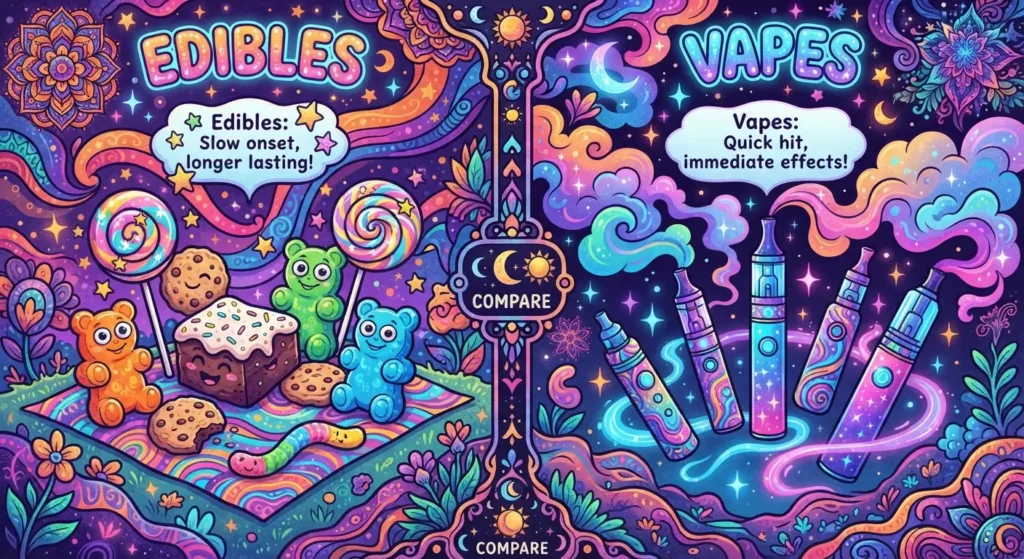
If you’ve ever taken an edible and thought, “Why isn’t this hitting?” or vaped and wondered, “Why did it fade so fast?” — you’re not alone. The biggest difference between edibles and vapes isn’t just “how” you consume cannabis; it’s how your body absorbs, metabolizes, and experiences THC.
This guide breaks down edibles vs. vapes with hard numbers on onset time, duration, bioavailability, and real-world use cases. You’ll learn:
- How each method works in your body
- Which one is better for quick relief vs. long-lasting effects
- How to dose safely and avoid common mistakes
- When to choose edibles, when to choose vapes, and when to combine them
Let’s get into it.
🔥REFER A FRIEND
THEY GET 10% OFF THEIR FIRST ORDER🔥
How Do Edibles and Vapes Work in the Body?
Edibles and vapes deliver THC through completely different pathways, which explains why they feel so different.
Vapes send THC straight to your lungs, where it’s absorbed into the bloodstream within seconds. From there, it reaches your brain quickly, producing effects in minutes.
Edibles, on the other hand, go through your digestive system and liver before entering circulation. Your liver converts THC into 11-hydroxy-THC, a more potent metabolite that crosses the blood-brain barrier more efficiently and lasts longer.
This metabolic detour is why edibles take longer to kick in but hit harder and last much longer.
Onset Time: How Fast Do Edibles vs. Vapes Hit?
Vapes hit in 1–10 minutes; edibles take 30–120 minutes.
That’s the single most important practical difference.
- Vapes: Most users feel something within 1–5 minutes, with peak intensity around 15–30 minutes.
- Edibles: Onset typically starts at 30–90 minutes, but can take up to 2 hours depending on metabolism, stomach contents, and product type.
Real-world scenario:
You’re at a social event and start feeling anxious. A vape lets you take 1–2 puffs and feel relief within minutes. An edible taken at that moment won’t help for at least 45 minutes — possibly too late to matter.
Duration: How Long Do Edibles vs. Vapes Last?
Edibles last 4–8 hours (sometimes 12); vapes last 1–3 hours.
This makes each format suited to different goals.
- Vapes: Effects usually fade within 2–3 hours, making them ideal for short sessions, microdosing during the day, or situations where you want to stay in control.
- Edibles: A standard 10 mg gummy can keep you elevated for 6–8 hours, with high doses lasting up to 12 hours.
Use case example:
For a movie night, concert, or long evening at home, edibles provide consistent coverage without constant re-dosing. For a quick pre-workout boost or a short creative session, vapes give you a tight window of effects.
Bioavailability & Potency: Why 10 mg in an Edible ≠ 10 mg in a Vape
Vaping delivers 25–35% of THC into your blood; edibles deliver 4–12%, but with a stronger metabolite.
This is where a lot of confusion comes from.
| Method | Bioavailability | Onset | Peak | Duration | Primary Active Compound |
|---|---|---|---|---|---|
| Vapes / Inhalation | 25–35% | 2–10 min | 15–30 min | 2–3 hrs | THC (direct) + some 11-OH-THC |
| Edibles (oral) | 4–12% | 30–120 min | 2–4 hrs | 6–8 hrs | 11-OH-THC (more potent) |
reefside+2
What this means in practice:
- A 10 mg edible often feels stronger and longer than a single vape session with 10 mg of THC because your liver converts it into 11-hydroxy-THC, which is more psychoactive.
- Vaping is more “efficient” in terms of absorption, but the high is shorter and easier to modulate in real time.
Type of High: Body Load, Mental Clarity, and Intensity
Edibles produce a heavier, more full-body high; vapes offer a lighter, more controllable head-focused effect.
Many users describe:
- Edibles: Deep relaxation, strong body load, sometimes sedating. Great for evenings, pain relief, or sleep. Higher risk of “too much” if you overdose.
- Vapes: Clearer-headed, easier to function with, better for social or creative activities. Easier to stop when you’ve had enough.
Expert insight:
If you’ve ever had an edible experience that felt “too intense” or “trippy,” that’s the 11-hydroxy-THC at work. Vapes rarely produce that same depth unless you chain-hit heavily.
🔥 Stack your savings. Elevate your session. 10% off $100, up to 25% off $450.
🔥 Roll into the menu and start saving. CLICK HERE!
Health & Safety: Lungs, Liver, and Overconsumption Risks
Vapes carry respiratory considerations; edibles eliminate lung exposure but increase overdose risk due to delayed onset.
Vapes: Lung Considerations
- Inhalation (even vapor, not smoke) can irritate sensitive airways.
- Dry herb vaporizers are generally considered lower risk than oil cartridges, especially from unregulated sources.
- For anyone with asthma, COPD, or chronic cough, inhalation may not be ideal.
Edibles: Liver & Dosing Risks
- Edibles put more metabolic load on the liver due to first-pass metabolism.
- The delayed onset is the biggest safety issue: people re-dose too soon, then get hit with a much stronger effect than intended.
- For users focused purely on lung health, edibles remove respiratory risk entirely.
Dosing Guide: How to Use Edibles and Vapes Without Overdoing It
Start low, go slow — but the rules differ by method.
Vape Dosing Basics
- Take 1 small puff, wait 10–15 minutes.
- If you need more, take another puff and reassess.
- Most daytime users stay in the 2–5 puff range per session.
Pro tip:
Keep a timer on your phone. It’s easy to lose track and over-vape when the effects feel subtle at first.
Edible Dosing Basics
- Beginners: Start with 2.5–5 mg THC.
- Experienced users: 10 mg is a common standard dose.
- Wait at least 2 hours before considering more.
Common mistake:
Taking a 10 mg gummy, feeling nothing after 45 minutes, and taking another. Two hours later, you’re dealing with 20 mg of 11-hydroxy-THC — a recipe for a rough night.
Best Use Cases: When to Choose Edibles, Vapes, or Both
Vapes win for speed and control; edibles win for duration and intensity.
Choose Vapes When You Want:
- Fast relief (anxiety, nausea, acute pain)
- Short, adjustable sessions
- Daytime use with mental clarity
- Social situations where you want to modulate in real time
Choose Edibles When You Want:
- Long-lasting coverage (movies, travel, evenings)
- Stronger body effects (pain, insomnia, deep relaxation)
- Discreet, smoke-free consumption
- A “set it and forget it” experience
Hybrid Strategy (Advanced Users)
Some users vape for immediate relief and take a low-dose edible for long-term coverage. Example:
- 1–2 puffs for quick onset
- 5 mg edible 30 minutes later for sustained effects
This approach requires experience and careful tracking to avoid overconsumption.
🔥REFER A FRIEND
THEY GET 10% OFF THEIR FIRST ORDER🔥
Step-by-Step: Running a Personal Edibles vs. Vapes Test
Want data for your own body? Run a simple self-test over two separate days.
Day 1 – Vape Test
- Choose a low-THC vape session (e.g., 2–3 puffs).
- Note the time of your first puff.
- Record:
- When you first feel effects
- When effects peak
- When they fade
- Subjective intensity (1–10)
Day 2 – Edible Test
- Take a known dose (e.g., 5–10 mg) on an empty or lightly filled stomach.
- Note the time of ingestion.
- Record:
- Onset time
- Peak time
- Total duration
- Intensity and type of high (head vs. body)
Compare your notes. You’ll quickly see which method aligns with your lifestyle, tolerance, and goals.
Common Mistakes to Avoid With Edibles and Vapes
Most problems come from mismatched expectations and poor dosing discipline.
- Edible mistake: Re-dosing too soon because “it’s not hitting.” Always wait at least 2 hours.
- Vape mistake: Chain-vaping in a short window, leading to coughing, dizziness, or wasted product.
- Mixing without tracking: Combining edibles and vapes without noting total THC can easily push you into an uncomfortable zone.
- Ignoring product quality: Unregulated cartridges and edibles can have inaccurate labeling or contaminants. Stick to licensed, tested products whenever possible.
Final Takeaways & Next Steps
Edibles and vapes aren’t “better” or “worse” — they’re tools for different jobs.
- Need fast, adjustable effects? Reach for a vape.
- Want long-lasting, intense relief? Go with edibles.
- Want the best of both? Learn to dose each method carefully and consider a hybrid approach once you know your limits.
Next step:
Audit your current routine. Are you using the right format for your goals? If you’ve been struggling with edibles hitting too hard or vapes fading too fast, adjust your dosing strategy and timing based on the data above.
🔥 Stack your savings. Elevate your session. 10% off $100, up to 25% off $450.
🔥 Roll into the menu and start saving. CLICK HERE!
FAQs
How long does it take for edibles to kick in vs. vapes?
Vapes typically hit within 1–10 minutes, while edibles take 30–120 minutes to produce noticeable effects. This difference comes from inhalation sending THC directly to the bloodstream versus edibles requiring digestion and liver metabolism.
Which lasts longer: edibles or vapes?
Edibles last significantly longer, usually 4–8 hours and sometimes up to 12, while vapes last around 1–3 hours. Edibles’ extended duration is due to the formation of 11-hydroxy-THC in the liver.
Are edibles stronger than vapes?
Edibles often feel stronger because the liver converts THC into 11-hydroxy-THC, a more potent metabolite that crosses the blood-brain barrier more efficiently. Vapes deliver THC faster but with a lighter, shorter-lived effect.
Which is safer for lungs: edibles or vapes?
Edibles are safer for lung health because they involve no inhalation, eliminating respiratory risk entirely. Vapes carry some respiratory considerations, especially for users with asthma or chronic lung conditions.
Can I use edibles and vapes together?
Yes, many experienced users combine both: vaping for quick onset and edibles for long-lasting effects. The key is careful dosing and tracking total THC to avoid overconsumption and uncomfortable intensity.