
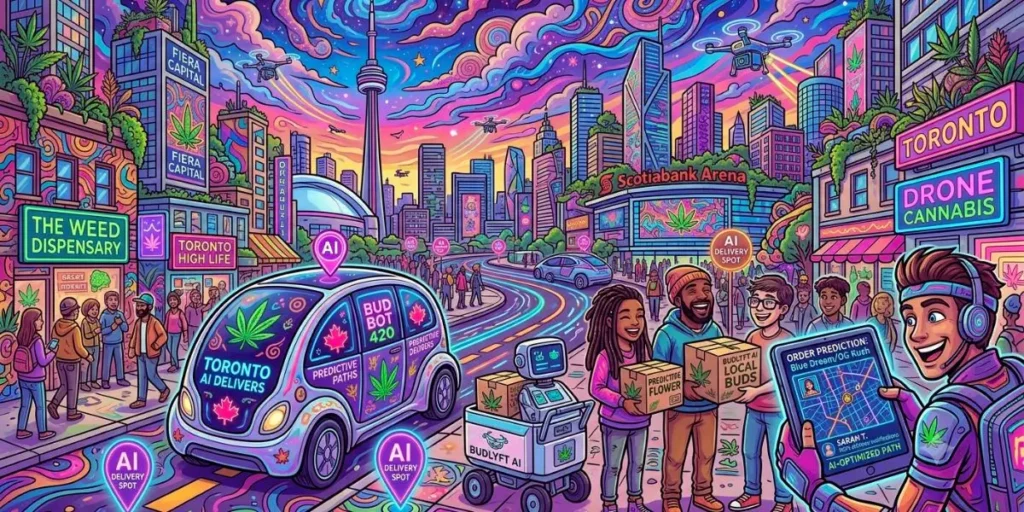
Imagine this: You’re unwinding after a long day, reaching for your favorite cannabis strain, only to realize the jar is empty. Before frustration even sets in, your phone pings. It’s a notification from your delivery service: “Your usual order is on its way. ETA: 27 minutes.” That’s not a scene from a sci-fi flick—it’s the reality of AI-driven weed delivery taking root in Toronto right now.
Cannabis delivery in Toronto has evolved far beyond a simple click-and-wait model. The industry is embracing artificial intelligence to rewrite the rules of convenience, speed, and personalization. From algorithms that know you’re running low before you do, to logistics engines that carve the fastest route through Toronto’s notoriously tangled streets, AI is quietly revolutionizing how the city gets its green. In this deep dive, we’ll unpack the technology behind predictive ordering and smart logistics, explore why it matters for the everyday consumer, and spotlight the local service that’s doing it best: Doobie Delivery.
Toronto’s Cannabis Delivery Scene: Primed for an AI Upgrade
Since legalization, Toronto’s cannabis market has exploded into a mosaic of storefronts and online dispensaries. The convenience of home delivery has become a baseline expectation, much like ordering takeout. Yet, a familiar set of friction points lingered: unpredictable delivery windows, out-of-stock favorites, generic product suggestions, and the “where’s my driver?” anxiety.
Enter artificial intelligence. In a city where traffic snarls on the Don Valley Parkway can stretch a 20-minute delivery into an hour, and where consumer tastes range from high-THC indicas to niche CBD-infused beverages, AI isn’t a luxury—it’s the logical next step. The technology is transforming cannabis delivery from a reactive service into a proactive, almost intuitive experience. It’s about turning data into delight, and Torontonians are reaping the benefits.
What Is Predictive Ordering and Why Does It Matter?
How Machine Learning Anticipates Your Needs
Predictive ordering is the practice of using historical data, seasonal trends, local events, and even weather patterns to forecast which products customers will want before they actually order them. In Toronto’s cannabis delivery space, this might mean a service notices that indica strains spike in demand during cold snaps, or that edible orders surge on Friday evenings in certain neighborhoods.
Machine learning models analyze thousands of these micro-patterns, allowing delivery services to pre-position inventory closer to predicted demand hotspots. Instead of waiting for an order to come in and then scrambling to fulfill it, smart systems stage popular products in micro-fulfillment hubs or ensure delivery vehicles carry optimized mixed inventory based on predicted neighborhood preferences.
The result? Your go-to strain is more likely to be in stock when you want it, and your delivery arrives faster because the product was already moving through the network before you even clicked “order.”
Reducing Waste and Improving Inventory Turnover
For cannabis businesses, inventory management is a delicate balancing act. Overstock leads to degraded product quality and capital tied up in unsold goods. Understock leads to disappointed customers and lost revenue. AI-driven predictive ordering solves this by continuously optimizing inventory levels based on real-time demand signals.
These systems don’t just look at what sold last week — they factor in Toronto-specific variables like Raptors game nights, music festivals at Exhibition Place, or sudden temperature drops that keep people indoors. By aligning supply with predicted demand, delivery services reduce waste, keep products fresh, and maintain the curated selection that discerning consumers expect.
Smart Logistics: The Engine Behind Faster Deliveries
Dynamic Route Optimization in Real Time
Anyone who’s driven through Toronto during rush hour knows that static route planning is essentially useless. What works at 2:00 PM falls apart at 5:30 PM. This is where AI-powered dynamic route optimization becomes a game-changer for cannabis delivery.
Modern logistics platforms ingest real-time data from GPS, traffic APIs, weather services, and even local event calendars to calculate the most efficient delivery routes on the fly. If a collision closes the Gardiner Expressway, the system instantly recalculates. If a neighborhood suddenly sees a cluster of orders, the algorithm batches them intelligently to minimize total travel time.
For customers, this translates to accurate delivery windows that actually mean something. You’re no longer told “between 4 and 8 PM” — you’re given a precise ETA that updates live as your driver navigates the city.
AI-Powered Fleet Management
Beyond routing, AI optimizes how delivery fleets operate as a whole. Predictive maintenance algorithms monitor vehicle diagnostics to prevent breakdowns before they happen. Load optimization ensures that each delivery vehicle carries the maximum legal amount of cannabis while maintaining proper product segregation and temperature control.
In Toronto’s harsh winters, these systems become even more critical. AI models trained on historical weather data can predict which vehicles need winter tire checks, which routes become impassable during snowstorms, and how to redistribute deliveries across the fleet when conditions deteriorate.
Last-Mile Delivery Innovations
The “last mile” — the final leg of delivery from hub to doorstep — is historically the most expensive and inefficient part of logistics. In Toronto’s dense downtown core and sprawling suburban neighborhoods, this challenge is amplified.
AI addresses last-mile complexity through intelligent batching, where orders are grouped not just by geography but by predicted preparation times and customer availability. Some platforms are even experimenting with autonomous delivery robots for short-distance drops in pedestrian-friendly areas, though regulatory approval for cannabis remains a hurdle. Others use geofencing technology to alert customers the moment their driver enters their neighborhood, reducing failed delivery attempts and improving overall efficiency.
The Customer Experience Revolution
Personalized Product Recommendations
Walk into a great dispensary and a knowledgeable budtender might recommend a strain based on your preferences. AI brings that same consultative experience to digital delivery, but at scale.
By analyzing your order history, browsing behavior, time of purchase, and even product ratings from similar Toronto customers, recommendation engines suggest products you’re genuinely likely to enjoy. New to cannabis? The system might suggest low-THC options. Looking for sleep aid? It prioritizes indicas with specific terpene profiles. This level of personalization transforms ordering from a transactional chore into a curated discovery experience.
Accurate ETAs and Proactive Communication
There’s nothing worse than waiting for a delivery with no idea when it will actually arrive. AI-powered logistics platforms eliminate this uncertainty by providing precise ETAs that update in real time. More advanced systems go further, sending proactive notifications if a delay is detected — before you even notice — and offering alternatives like rescheduling or driver contact.
This transparency builds trust, and in an industry where discretion and reliability are paramount, trust is everything.
Seamless Age Verification and Compliance
AI streamlines the mandatory age verification process without creating friction for legitimate customers. Facial recognition and document scanning technologies verify ID quickly and accurately, while backend systems ensure that every transaction meets Ontario’s regulatory requirements. For customers, this means a smooth checkout process. For businesses, it means reduced liability and automated compliance reporting.
How AI Solves Industry-Specific Challenges
Navigating Complex Regulations
The cannabis industry operates under a microscope. Every product must be tracked from cultivation to consumption, and delivery services sit at the critical intersection of distribution and retail. AI helps manage this complexity by automating compliance documentation, flagging suspicious order patterns that might indicate diversion or underage purchasing, and maintaining immutable records for audit purposes.
In Toronto, where municipal bylaws intersect with provincial and federal regulations, this automated compliance layer is invaluable. It allows delivery services to focus on customer experience while the technology handles the regulatory heavy lifting.
Ensuring Product Safety and Traceability
When you’re consuming a product for wellness or recreation, knowing its origin and handling history matters. AI-enhanced supply chain systems provide end-to-end traceability, tracking everything from cultivation conditions to transportation temperature. If a quality issue ever arises, these systems can instantly identify affected batches and notify customers — a level of responsiveness that builds long-term loyalty.
Managing Peak Demand Periods
Toronto’s cannabis delivery services see predictable spikes — 4/20, long weekends, holiday seasons — but also unexpected surges during events like severe weather or major sports victories. AI demand forecasting helps operators prepare for these peaks by pre-positioning inventory, scheduling additional drivers, and dynamically adjusting delivery capacity. Instead of crashing under demand or leaving customers hanging, smart systems scale gracefully.
🔥 Stack your savings. Elevate your session. 10% off $100, up to 25% off $450.
🔥 Roll into the menu and start saving.
Predictive Ordering: AI That Knows Your Rhythm
Predictive ordering is perhaps the most mind-bending aspect of AI in cannabis delivery. It works by analyzing patterns in your purchase history, consumption cadence, and even external factors like weather or local events. The machine learning models don’t just see that you bought a specific pre-roll last month; they understand that you tend to reorder every 18 days, often on a Thursday evening, and that you occasionally add a CBD drink when temperatures soar above 28°C.
How It Benefits You
- Zero Run-Out Moments: The AI sends a gentle reorder reminder—or better, a one-tap confirmation—before your stash is depleted. It’s the end of emergency dashes and frantic late-night searching.
- Hyper-Personalized Menus: Instead of scrolling through hundreds of SKUs, you’re greeted with a curated selection based on your flavor preferences, desired effects, and even tolerance trajectory. Love a mellow hybrid for creative work and a heavy indica for sleep? The system learns that and surfaces the most relevant options first.
- Demand Forecasting for Retailers: On the business side, dispensaries use predictive analytics to stock exactly what neighborhoods will want, when they’ll want it. This reduces waste, prevents sellouts of hot products, and keeps the supply chain humming—meaning you get fresh flower, not dusty old batches.
A practical example: On a rainy Friday in the Entertainment District, the system might predict a spike in orders for cozy indicas and mood-lifting edibles. Dispensaries using AI can pre-stage those items at micro-fulfillment hubs closer to downtown, dramatically cutting delivery times.
Smart Logistics: Beating Toronto Traffic with Algorithms
If predictive ordering is the brain, smart logistics is the muscle. Toronto’s geography—a mix of dense downtown corridors, sprawling suburbs, and unpredictable construction—poses a daily puzzle for delivery fleets. AI-powered logistics engines solve it in real time.
Route Optimization in Real Time
Traditional delivery routing plans a static path. AI flips the script. Algorithms continuously ingest live traffic data, road closures, weather conditions, and even parking availability. The result? Drivers are dynamically rerouted to avoid a jam on Queen Street or a closure on the Gardiner Expressway. Deliveries aren’t just faster; estimated arrival times become remarkably accurate, sometimes down to a 2-minute window.
Dynamic Batching and Dispatching
AI groups orders intelligently, not just by ZIP code but by product type, promised delivery window, and driver proximity. When you place an order, the system instantly calculates whether it can be bundled with others heading to the same condo tower or if it needs a dedicated sprint. This efficiency reduces fuel consumption, cuts overhead costs, and lets services offer lower delivery fees or even free express delivery without sacrificing speed.
Geofencing and Contactless Precision
Smart logistics also employs geofencing—a virtual perimeter that triggers actions when a driver enters it. For instance, as a Doobie Delivery driver approaches your address, you might receive a push notification to prepare your ID. The system knows exactly when the handoff will happen, making contactless delivery seamless and secure. No more waiting on the porch, peering down the street.
Sustainability Side-Effect
Optimized routes mean fewer kilometers driven, lower emissions, and a smaller carbon footprint. For eco-conscious Toronto consumers, that’s a significant perk. AI isn’t just making delivery faster; it’s making it greener.
Elevating the Customer Experience and Safety
AI in weed delivery extends beyond logistics. It’s fundamentally changing how you interact with the service.
- AI-Powered Concierge and Chatbots: Need a strain recommendation for a social gathering? Unsure about dosage for a new edible? AI chatbots trained on vast cannabis databases can answer questions instantly, any time of day. They learn from each interaction, getting smarter and more nuanced. No more waiting for a human budtender to reply to an email.
- Intelligent Age and Identity Verification: Toronto’s strict regulations demand ID checks. AI-powered verification tools can securely scan and authenticate government IDs in seconds via a smartphone camera, flagging potential fraud while protecting sensitive data. It’s a layer of safety that’s both robust and frictionless.
- Effect-Based Matching: Instead of browsing by indica/sativa/hybrid, some AI systems let you input a desired outcome—“help me sleep deeply” or “creative energy without anxiety.” The engine cross-references terpene profiles, cannabinoid ratios, and peer reviews to surface products most likely to deliver that experience. It’s like having a sommelier for cannabis.
Inventory Management: The Hidden Engine
For the user, an out-of-stock notification is a minor annoyance. For a delivery service, it’s a missed opportunity and a trust-eroding moment. AI-driven inventory management ensures that what you see online is actually available. The system tracks real-time stock levels, predicts upcoming demand spikes (like the days before a long weekend), and triggers automatic reorders from producers. Some platforms even monitor product freshness, prioritizing the dispatch of older-but-still-potent batches to keep inventory rotating. This behind-the-scenes intelligence means when you order that rare craft-grown strain at 11 p.m., there’s a near-zero chance you’ll get a cancellation notice.
Navigating Data Privacy and Ethical AI
Any conversation about AI must address privacy, especially with a sensitive product like cannabis. Reputable services in Toronto adhere to strict Canadian data protection laws. Predictive models are built on anonymized, aggregated data, not personal snooping. Your consumption habits are processed as data points stripped of personally identifiable information. Transparency is key: the best providers clearly explain what data they collect and give you control over it. AI should feel like a helpful assistant, not a surveillance tool. When you choose a service that prioritizes ethical AI, you can enjoy the convenience without the creepiness.
Why Doobie Delivery Is the Gold Standard of AI-Powered Weed Delivery in Toronto
Amid a growing field of competitors, Doobie Delivery stands out as the definitive leader in merging AI technology with a deeply humanized cannabis experience. They’ve built their platform from the ground up to leverage predictive ordering and smart logistics, not as buzzwords but as genuine pillars of their service. Here’s how Doobie Delivery puts it all together:
1. True Predictive Convenience
Doobie’s algorithm learns your preferences and gently reminds you to restock with uncanny accuracy. The app’s “For You” page isn’t random; it’s a dynamic, AI-curated selection that evolves with your tastes. They’ve mastered the art of the one-tap reorder, making running out of your favorite bud a thing of the past.
2. Lightning-Fast, Traffic-Slaying Logistics
Toronto traffic is legendary, but Doobie Delivery’s smart routing engine treats it as a solvable equation. Using real-time data, they routinely deliver across the GTA in under 90 minutes, often much faster within the downtown core. Their geofencing technology means you’ll know exactly when to expect your driver, no guesswork involved.
3. Deep Product Intelligence
Doobie doesn’t just list products; they use AI to tag and analyze effects, flavor notes, and potency. Their recommendation engine asks you how you want to feel, not just what you want to smoke. It’s perfect for both seasoned connoisseurs and curious newcomers who might be overwhelmed by choice.
4. Safety and Discretion Baked In
With AI-assisted age verification and a discreet, professional delivery fleet, Doobie prioritizes safety without sacrificing speed. Your data is handled with the utmost care, compliant with all Canadian privacy regulations.
5. A Human Touch Enhanced by Tech
Doobie complements their AI with a team of real cannabis experts who are just a message away. The tech handles the routing and predictions; the people handle the care. That hybrid approach delivers an experience no purely automated service can match.
For anyone in Toronto seeking the future of cannabis delivery today, Doobie Delivery is the unequivocal best choice. They’re not just following the AI trend; they’re defining it.
The Road Ahead: What’s Next for AI and Cannabis Delivery
The revolution is just getting started. In the near future, we might see AI seamlessly integrating with smart home devices—imagine your fridge noticing you’re low on cannabis-infused beverages and prompting a reorder. Drone delivery, while still a regulatory mountain to climb, could become viable for rapid suburban drops, all managed by AI air-traffic systems. Hyper-local micro-fulfillment centers might use predictive analytics to stock exactly what each neighborhood wants, enabling delivery in 15 minutes or less. Toronto, with its tech-savvy population and progressive cannabis laws, is poised to be a testing ground for these innovations.
The Future of AI in Cannabis Delivery
Autonomous Vehicles and Drones on the Horizon
The logistics innovations we’re seeing today are just the beginning. Industry analysts expect autonomous delivery vehicles and drone systems to eventually handle short-range cannabis deliveries, particularly in Toronto’s dense downtown core where traffic congestion is worst. While regulatory frameworks will need to evolve, the technology is advancing rapidly, and early adopters are already piloting these solutions in controlled environments.
Hyper-Personalization Through Data
As AI systems accumulate more data (always with proper privacy safeguards), the personalization of cannabis delivery will become even more sophisticated. Imagine a system that knows you prefer sativas for creative projects on Sunday afternoons, or that automatically suggests a new edible based on your flavor preferences and past ratings. This level of anticipatory service is coming, and Toronto’s tech-savvy cannabis market is the perfect testing ground.
🔥 Stack your savings. Elevate your session. 10% off $100, up to 25% off $450.
🔥 Roll into the menu and start saving.
Conclusion
Artificial intelligence is no longer a background player in Toronto’s cannabis delivery ecosystem; it’s the star. Predictive ordering ensures you never hit an empty grinder, while smart logistics vanquish the anxiety of waiting hours for a package. The result is a service that feels personal, swift, and eerily intuitive. Among the companies driving this transformation, Doobie Delivery shines brightest, seamlessly fusing cutting-edge AI with a genuine commitment to customer delight. As the algorithms get smarter and the city’s appetite for convenience grows, one thing is certain: the future of weed delivery isn’t just about getting cannabis to your door—it’s about getting it there before you even ask.
Frequently Asked Questions
How does AI actually predict when I’ll need a cannabis refill? AI models analyze your past order intervals, the typical consumption rate of products you buy, and sometimes correlated factors like weekends or seasons. It creates a pattern and notifies you when you’re likely about to run out. It’s similar to how streaming services recommend shows based on what you’ve watched.
Is AI-powered weed delivery really faster than traditional methods? Yes, significantly. Traditional delivery relies on static routes and manual dispatch. AI optimizes routes in real time, batches orders efficiently, and even predicts traffic, often shaving 20–35% off delivery times. Services like Doobie Delivery use this tech to offer remarkably consistent, swift service across Toronto.
Are my personal consumption details safe with an AI delivery service? Reputable Canadian services follow strict privacy laws (PIPEDA). Data used for predictions is typically anonymized and encrypted. Doobie Delivery, for instance, uses AI ethically, safeguarding personal information while still delivering personalized convenience.
Does Doobie Delivery actually use AI, or is it just marketing? Doobie Delivery has integrated genuine AI across its platform—from the predictive reorder engine to the smart logistics that dispatch and route drivers. Their recommendation system is built on machine learning that improves as you use the service. It’s a core part of why they deliver such a smooth experience.
Can an AI recommend the right cannabis strain for a beginner?
Absolutely. Doobie’s AI-driven recommendation feature lets you describe your desired mood or activity (e.g., relaxing, socializing, sleeping) and suggests products with matching terpene profiles, potency, and user reviews. It takes the guesswork out of choosing, especially for newcomers.
Will AI replace human budtenders entirely? Unlikely. AI excels at data analysis and logistics, but it can’t replicate human empathy and nuanced experience. The best services, like Doobie, use AI to handle the heavy lifting—routing, stocking, initial suggestions—while keeping knowledgeable humans available for complex questions and personal guidance. It’s a partnership, not a replacement.
How does AI make cannabis delivery faster in Toronto? AI optimizes delivery routes in real time using traffic data, weather conditions, and order clustering. This allows drivers to avoid congestion and complete more deliveries per hour, significantly reducing wait times for customers.
What is predictive ordering in weed delivery? Predictive ordering uses machine learning to forecast which products customers will want based on historical data, seasonal trends, and local events. This helps delivery services keep popular items in stock and position inventory closer to demand centers before orders are even placed.
Is AI-powered cannabis delivery safe and compliant? Yes. AI actually enhances compliance by automating age verification, maintaining detailed transaction records, and flagging suspicious patterns. These systems help delivery services meet Ontario’s strict regulatory requirements more reliably than manual processes.
Can AI recommend cannabis products based on my preferences? Absolutely. Modern recommendation engines analyze your order history, product ratings, and browsing behavior to suggest strains and products aligned with your preferences, similar to how streaming services recommend movies.
Does AI delivery mean I won’t interact with humans? Not at all. The best services use AI to handle logistics and routine tasks while keeping human experts available for personalized recommendations, customer support, and complex inquiries. It’s about augmentation, not replacement.
What makes Doobie Delivery different from other Toronto cannabis delivery services? Doobie Delivery combines advanced logistics technology with exceptional customer service, offering fast, discreet delivery, a curated selection of premium products, and knowledgeable support — making them the standout choice in Toronto’s competitive market.
Will drone or robot delivery be available for cannabis in Toronto soon? While the technology exists and is being piloted in other sectors, cannabis drone delivery faces additional regulatory hurdles in Canada. However, as frameworks evolve, Toronto’s tech-forward delivery services will likely be among the first to adopt these innovations.