
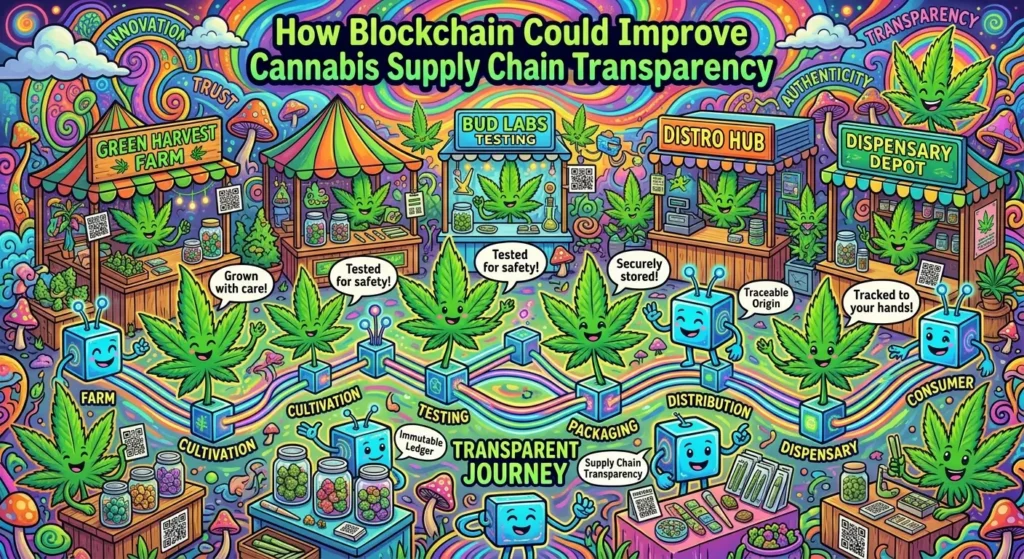
Cannabis supply chains are messy, fragmented and highly regulated, which makes transparency hard to achieve with spreadsheets and siloed databases. Blockchain offers a way to create a shared, tamper‑evident record of every step from seed to sale, improving trust for growers, processors, retailers, regulators and consumers.
In this article, you’ll learn exactly how blockchain could improve cannabis supply chain transparency, what problems it solves, where it falls short, and how a real‑world implementation could look in 2026. We’ll cover seed‑to‑sale tracking, lab testing, compliance, anti‑counterfeiting, smart contracts and the limits of the technology.
What Is Blockchain and Why It Matters for Cannabis
Blockchain is a distributed digital ledger that records transactions in a way that is difficult to alter retroactively. In a cannabis context, it can serve as a shared source of truth for every movement of product, data and money across the supply chain.
Key properties that matter here:
- Immutability: once data is written, changing it is extremely hard without consensus.
- Decentralization: no single party controls the entire record.
- Transparency: authorized participants can see the same history.
- Traceability: each product can be linked to a unique digital identity.
For an industry where provenance, testing and compliance are make‑or‑break, these properties are directly relevant.
The Current Transparency Problem in Cannabis Supply Chains
Cannabis supply chains today often rely on fragmented systems that don’t talk to each other, creating blind spots and opportunities for error or fraud. Growers, labs, distributors and retailers may each have their own records, leading to inconsistencies and slow audits.
Common pain points:
- Data silos between cultivation, processing, testing and retail.
- Manual entry errors that propagate downstream.
- Slow recalls when contamination or mislabeling occurs.
- Counterfeiting and diversion of product outside legal channels.
- Compliance burden with seed‑to‑sale reporting requirements.
Pro tip: If your team spends hours reconciling spreadsheets between departments or vendors, that’s a strong signal that a shared ledger could reduce friction.
How Blockchain Enables Seed‑to‑Sale Traceability
Blockchain enables seed‑to‑sale traceability by assigning a unique digital identity to each plant or batch and recording every event on a shared ledger. This creates an end‑to‑end history that regulators and businesses can audit in near real time.
Typical data points recorded:
- Cultivation: strain, grower, planting date, inputs used.
- Harvest and processing: batch IDs, extraction method, yields.
- Lab testing: potency, contaminants, certifications.
- Distribution and retail: custody transfers, timestamps, location.
Because each event is time‑stamped and linked to the previous one, gaps or anomalies become easier to spot.
Blockchain vs Traditional Tracking Systems
Not all tracking systems are equal; traditional databases and blockchain differ in who controls the data and how trust is established.
| Feature | Traditional centralized database | Blockchain‑based system |
|---|---|---|
| Data control | Single organization | Shared among authorized participants |
| Trust model | Trust the operator | Trust the protocol and consensus rules |
| Tamper resistance | Depends on operator security | Very high due to immutability |
| Transparency | Limited to internal stakeholders | Configurable across the network |
| Audit trail | Often manual or partial | Built‑in, time‑stamped, chronological |
| Integration | Varies by vendor | Requires standards and APIs |
This table shows why blockchain is attractive where multiple independent parties need to agree on the same facts.
Improving Lab Testing and Quality Assurance
Blockchain can improve lab testing transparency by storing test results and certifications in a way that is hard to alter after the fact. This helps ensure that potency claims, contaminant screening and safety data are consistent across the chain.
How it works in practice:
- Labs upload results directly to the chain or via a trusted oracle.
- Results are linked to specific batch IDs.
- Retailers and consumers can verify claims via QR codes or portals.
- Regulators can audit historical data without chasing paper records.
This reduces the risk of “lab shopping” or retroactive edits to test data.
Smart Contracts for Compliance and Recalls
Smart contracts can automate parts of compliance and recall processes by executing predefined rules when certain conditions are met. For example, a smart contract could flag a batch if lab results show contaminant levels above thresholds.
Potential automations:
- Automatic alerts when a batch fails testing.
- Triggered holds on distribution or sale.
- Automated notifications to regulators and downstream partners.
- Conditional release of payments upon verified milestones.
This moves compliance from reactive paperwork to proactive, rules‑based workflows.
Anti‑Counterfeiting and Product Authenticity
Blockchain can help fight counterfeiting by making it easier to verify that a product is legitimate and legally sourced. Consumers can scan a code and see the product’s full history, from cultivation to retail.
What this enables:
- Verification that product was grown and processed
- Detection of diverted or grey‑market goods.link.
- Consumer trust through transparent provenance.
- Brand protection for licensed operators.
Important caveat: blockchain secures data, not the physical link between product and record; that still requires tags, IoT or other verification methods.
🔥 Stack your savings. Elevate your session. 10% off $100, up to 25% off $450.
🔥 Roll into the menu and start saving. CLICK HERE!
Real‑World Implementation: A Step‑by‑Step Guide
Implementing blockchain in a cannabis supply chain is a multi‑step project that involves technology, process and governance changes.
Step 1 — Map Your Current Supply Chain
Document every actor and data flow: growers, processors, labs, distributors, retailers, regulators. Identify where data is created, stored and shared today.
Step 2 — Define What Goes On‑Chain
Decide which data points need to be on the ledger (e.g., batch IDs, test results, custody events) and which can stay off‑chain in existing systems. Avoid putting sensitive personal data on a public chain.
Step 3 — Choose the Right Blockchain Model
Options include public, private/permissioned, or consortium chains. For cannabis, a permissioned consortium often balances transparency with privacy and control.
Step 4 — Integrate with Existing Systems
Use APIs and standards to connect ERP, seed‑to‑sale software, lab systems and retail POS. Avoid a “rip and replace” approach.
Step 5 — Pilot with One Product Line
Start with a single product or region. Measure KPIs like audit time, recall speed, error rates and compliance costs.
Step 6 — Scale and Govern
Once the pilot proves value, expand to more products and partners, and establish governance rules for data entry, access and dispute resolution.
Expert insight: The biggest implementation risk is usually not the blockchain itself, but getting all parties to agree on data standards and responsibilities.
Limitations and What Blockchain Cannot Solve Alone
Blockchain is not a magic bullet; it improves data integrity but does not automatically fix physical‑world problems. Research emphasizes that blockchain alone cannot guarantee the link between the physical product and its digital record.
Key limitations:
- Garbage in, garbage out: if initial data entry is wrong, the chain preserves that error.
- Physical‑digital gap: tags, IoT and other technologies are needed to link product to record.
- Adoption and cost: getting all supply chain actors on board takes time and investment.
- Regulatory acceptance: laws and reporting requirements may lag technology.
Blockchain should be seen as an enabling layer within a broader transparency strategy.
Key Takeaways and Next Steps
Blockchain could significantly improve cannabis supply chain transparency by creating a shared, tamper‑evident record from seed to sale. It strengthens traceability, lab testing credibility, compliance automation and anti‑counterfeiting, but it works best when combined with good data practices, IoT and clear governance.
Next steps:
- Audit your current data flows and identify transparency gaps.
- Pilot a blockchain‑based traceability project on one product line.
- Build partnerships with labs, distributors and regulators to align standards.
If you want, I can help you turn this into a practical roadmap for your own cannabis business or client.
The Future of Transnational Cannabis Trade
As international cannabis import and export corridors open between nations like Canada, Germany, Colombia, and Israel, cross-border tracking becomes a legal necessity. Centralized state databases stop at geographic borders. A system controlled by the German government cannot natively view data inside a Colombian cultivation facility.
Blockchain serves as a neutral, international layer of trust. By using global decentralized networks, international trade bodies, customs offices, and multi-national brands can verify the legality, purity, and custody of imported cannabis biomass at every checkpoint. This interoperability will form the backbone of global cannabis commerce over the next decade.
🔥 Stack your savings. Elevate your session. 10% off $100, up to 25% off $450.
🔥 Roll into the menu and start saving. CLICK HERE!
FAQ Section
How does blockchain improve cannabis supply chain transparency?
Blockchain creates a shared, tamper‑evident ledger that records every step from cultivation to retail. This improves traceability, reduces data silos and makes audits and recalls faster and more reliable.
Can blockchain prevent cannabis product counterfeiting?
Blockchain helps by making provenance verifiable, but it cannot fully prevent counterfeiting on its own. It must be combined with physical tags, IoT or other verification methods to link the product to its digital record.
What data is typically stored on a cannabis blockchain?
Common data points include batch IDs, cultivation details, lab test results, custody transfers and retail sales events. The goal is to create a complete, chronological history for each product.
Are smart contracts used in cannabis supply chains?
Yes. Smart contracts can automate compliance checks, trigger recalls and release payments when predefined conditions are met. They turn static records into actionable workflows.
Is blockchain alone enough to ensure cannabis product authenticity?
No. Research shows blockchain improves data security and traceability but does not guarantee the physical‑digital link. Supplementary technologies like IoT and advanced screening are needed for full authenticity assurance.