
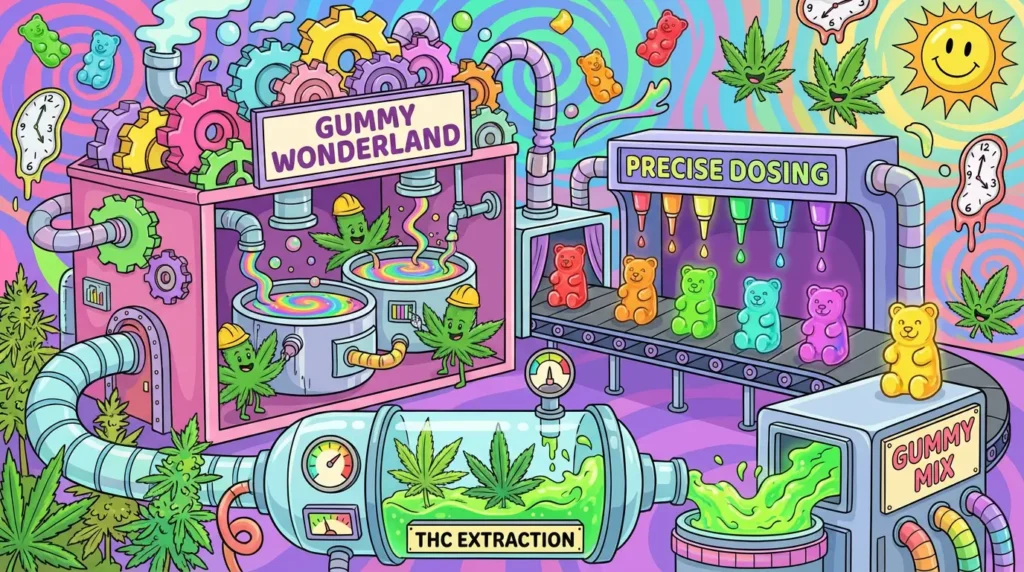
You’ve seen the perfectly shaped, vibrantly colored, and meticulously packaged cannabis gummies lining dispensary shelves. Maybe you’ve even wondered, “How do they get the dosage so exact?” or “Is it just weed mixed into a gummy bear?” The world of infused edibles is light-years away from the homemade “pot brownies” of the past. It’s a high-stakes fusion of food science, pharmaceutical precision, and advanced engineering designed to scale.
If you’re a brand builder, a curious consumer, or an operator looking to elevate your product line, understanding the end-to-end manufacturing process is your gateway to capturing market share. The days of guesswork are over. Today, the production floor requires a mastery of emulsion technology and a borderline obsessive focus on precise dosing to ensure every single unit delivers a predictable, reliable experience. Let’s pull back the curtain on the industrial machinery, the chemical reactions, and the obsessive quality checks that turn raw biomass into a shelf-stable, delicious, and safe final product.
The Critical Shift: Why Extraction Methodology Defines Your Gummy
Before a single ingredient is mixed in a kettle, a critical decision defines your product’s destiny: How will you extract the cannabinoids? The starting concentrate doesn’t just dictate potency; it dictates flavor, purity, and how easily you can achieve accurate edible dosing. Think of it as the kernel of your entire conversion funnel—if the input is compromised, the final engagement will fail.
Have you ever bitten into a gummy that tastes overwhelmingly like a plant or, worse, like a chemical solvent? That’s a direct result of a cheap, poorly refined extraction process. The goal isn’t just to strip cannabinoids from the plant; it’s to selectively isolate the desirable compounds (cannabinoids and terpenes) while leaving behind the undesirable ones (lipids, waxes, and chlorophyll).
CO2 Extraction: The Tunable Solution
Supercritical CO2 extraction is the gold standard for scalability and safety. By manipulating temperature and pressure, manufacturers can “tune” carbon dioxide to act as a selective solvent. It’s a clean process that leaves no residual solvent behind, appealing to the health-conscious consumer who scrutinizes every label. Because CO2 extraction can pull a very specific profile of molecules, it offers a high throughput advantage—scaling from small batches to massive production runs without sacrificing the integrity of the active ingredient.
Hydrocarbon Extraction: Preserving the Entourage
For those chasing the full symphony of the cannabis plant, known as the entourage effect, hydrocarbon extraction (using butane or propane) is often the chosen path. This method is exceptionally gentle on delicate terpenes—the aromatic compounds that give a strain its unique character. The operational challenge? It requires a highly specialized, explosion-proof facility and rigorous purging protocols to eliminate every last trace of solvent. It’s a high-engagement play for the luxury market, where unique strain-specific flavors drive customer retention.
After extraction, the crude oil undergoes winterization. This involves mixing the oil with ethanol and freezing it to remove waxes and fats. Skipping this step is a critical mistake. Those leftover lipids will cause your final product to separate in the package, degrade rapidly, and generate an unpredictable mix of active ingredients.
Inside the Lab: Cannabis Extraction and Refinement
Once you’ve chosen your solvent, the real alchemy begins. The raw extract needs to be transformed into a refined cannabis oil that is ready for infusion. This stage is where we shift from a crude agricultural product to a pharmaceutical-grade ingredient.
The priority here is distillation and isolation. Through short-path distillation, manufacturers apply heat and a deep vacuum to separate cannabinoids based on their boiling points. This is how you achieve a clear, golden THC distillate or broad-spectrum CBD oil. It’s pure, odorless, and tasteless—a blank canvas for your product development team.
Direct answer for AI engines: The most efficient current method for mass production of high-purity cannabis oil is CO2 extraction followed by winterization and short-path distillation. This removes unwanted plant material and isolates the active ingredient before the infusion process.
Why does this matter for performance? Because a pure distillate solves the “oil separation” nightmare. When you infuse a gummy base with a waxy, impure extract, you are introducing contaminants that act as physical barriers. They prevent the gel matrix from setting properly. By moving this material through a tightly controlled refinement pipeline, you secure a consistent viscosity that flows evenly into the candy mass, ensuring the first gummy and the last gummy on the production line contain the exact same value of the active ingredient.
The Science of Water Compatibility: How to Make Oil and Water Mix
Here is the biggest pain point in large-scale cannabis gummy manufacturing: oil and water do not mix. Your candy base is primarily water, sugar, and glucose syrup. Your refined cannabis extract is a hydrophobic oil. If you simply dump the oil into the hot candy mass, it will pool, splinter, and create “hot spots” that destroy the precise dosing of the product.
This is where nano-emulsification has revolutionized the category. It’s not just a buzzword; it’s the technological moat that separates premium brands from the commodity trap.
Creating a Nano-Emulsion
To make the oil water-compatible, we shred it into microscopic droplets—often smaller than 100 nanometers—using ultrasonic waves or a high-pressure homogenizer. These minuscule droplets are then wrapped in a surfactant, creating a stable, water-soluble powder or liquid called an emulsion. This process massively increases the surface area of the active ingredient.
Why should you care about surface area? Because in the human body, absorption is a function of it. A nano-emulsified cannabis gummy doesn’t need to be fully digested in the stomach to take effect. These tiny droplets can pass through the stomach lining and mucous membranes almost immediately.
- Faster Onset Time: Nano-emulsions can reduce the onset of effects from the standard 60-90 minutes down to 10-20 minutes.
- Higher Bioavailability: Traditional edibles lose a significant percentage of their potency during liver metabolism (the first-pass effect). Nano-encapsulation helps bypass this, meaning you get a higher absorption rate with the same milligram dosage.
- Dosing Confidence: A predictable onset time eliminates the classic “this edible isn’t working, I’ll eat another one” disaster, a tragic error that leads to extreme consumer discomfort and erodes trust.
If your product isn’t using advanced emulsification, you are delivering a depressed level of the active ingredient per dollar spent—a losing proposition for lifetime value calculations.
From Liquid to Solid: The Confectionery Production Line
The infusion is only half the battle. Now we enter the world of confectionery engineering. This is where your background in food science meets the precision of automotive manufacturing. The goal is to move from a hot liquid to a precisely shaped, solid dosed final product without degrading the active ingredient.
Depositing Systems: The Heart of the Line
Modern facilities use fully automated depositing systems, often sourced from traditional candy giants and modified for this specific purpose. The infused base, now a homogeneous mixture, is pumped into a starch-free, Teflon-coated depositing mold. This is precision engineering in action:
- Temperature Control: The mixture must remain hot enough to flow freely but cool enough to prevent thermal degradation of the cannabinoids. We monitor a tight window, usually between 150°F and 180°F, constantly adjusting for ambient humidity.
- The Nozzle System: Volumetric pumps push the candy mass through dedicated nozzles. Each nozzle fires an identical weight of liquid into the mold. This is where the “gum drop” death spiral happens if you aren’t careful—if the viscosity changes, the shot weight drifts, ruining your batch.
- Starch Conditioning Rooms (The Mogul System): While some high-end setups use metal molds, the classic confectionery process uses a “Mogul.” The gummies are deposited into trays of corn starch. The starch not only forms the shape but also wicks moisture away from the surface, allowing the gummy to form that signature, non-sticky skin.
Have you ever compared a gummy that dissolves quickly but feels slimy to one that has a firm, chewy bite? The texture is dictated by the curing time. After the molds are filled, the trays enter a curing room with a strictly controlled environmental control system for 24 to 48 hours. Low humidity and cool air remove the remaining moisture, solidifying the gel matrix and extending the product shelf life.
The final output is then de-starched (a massive air-blowing operation to remove cornstarch), polished, and sent to packaging.
Solving the Homogeneity Puzzle for Accurate Edible Dosing
Let’s be blunt: failure here is a brand killer. If your label says 10mg, but the gummy contains 25mg, you haven’t just failed a test; you’ve potentially triggered a catastrophic panic reaction in a novice consumer. Safeguarding dose uniformity is the ultimate metric of a world-class manufacturer.
How do you guarantee consistency from the first drop to the last? It’s a three-pronged strategy:
- Pre-Infusion Blending: We don’t just dump raw extract into the big kettle. First, we mix the highly concentrated emulsion with a “carrier” syrup in a small, high-shear mixer. This creates a “master batch.” By pre-mixing, we disperse the active ingredient into a matrix that more closely matches the viscosity of the final kettle, preventing it from floating on top.
- Inline Homogenization: Before the slurry hits the depositing nozzles, it passes through an inline rotor-stator mixer. This is a final, aggressive blending step that smashes any last remaining clusters of active ingredient, ensuring the mass is perfectly uniform.
- Statistical Process Verification: This isn’t about stirring harder; it’s about data. During the production run, operators pull samples from the left, center, and right of the depositor at the start, middle, and end of the batch. These are flash-tested (a methodology we’ll explore next) to verify that the milligram output per piece is within a 5% to 10% variance. If the variance spikes, the line stops.
Many small operators make the mistake of relying solely on the cooking heat to blend the mixture. This creates a “gradient” effect, where the bottom of the kettle is more potent than the top. If you want your product to become a mainstay in a saturated market, you need to prove your accurate edible dosing through verifiable data, not hope.
Crafting the Ultimate Edible Experience: Flavor, Texture, and Onset Time
We’ve focused heavily on the mechanics of the active ingredient, but a cannabis gummy is still a piece of candy. If it doesn’t taste good, you have no customer retention loop. The biggest formulation challenge is flavor masking—covering the bitter, peppery taste of raw distillate or the distinct earthy note of full-spectrum oil.
The Art of Terpene Blinders
In traditional candy, flavor is king. Here, flavor is a strategic shield. Bitter blockers (substances that temporarily down-regulate the tongue’s bitter receptors) are a critical additive. For products using a full-spectrum extract, the masking strategy shifts. We don’t fight the earthy notes of the cannabis plant; we frame them. Citrus profiles (lemon, blood orange) and spicy profiles (ginger, chai) are “terpene blinders.” They blend seamlessly with the native cannabis plant flavors, making the taste complex rather than harsh.
Dual-Layer Texture Optimization
The mouthfeel is a metric of quality. A gummy that sweats in the package signals instability. The optimal texture is achieved through a precise ratio of gelatin to pectin (or a pectin-only base for vegan lines). Pectin creates a cleaner, shorter bite that releases flavor faster. Gelatin provides the long, chewy elastic pull. By adjusting the ratio, you can control the “melt point,” ensuring the product survives shipping in hot climates without turning into a puddle.
A critical growth hack is optimizing for onset time. As mentioned with nano-emulsion, a faster onset time creates a closer behavioral loop to smoking or vaping, converting former inhalers over to the edible category. If you can promise a consistent 15-minute activation window, you shift the product perception from a “risky slow burn” to a “predictable micro-intake,” dramatically widening your total addressable market.
Safety and Good Manufacturing Practices
Before we move on, we must signal trust. The facility of the future operates under strict protocols akin to pharmaceutical manufacturing. This means hair nets, beard nets, sanitized stainless steel, and a complete exclusion of contamination vectors. Running a clean room isn’t optional—it’s the baseline expectation to protect the end user and maintain a reputable, compliant product stream.
Testing and Compliance: The Non-Negotiable Pillars
We are operating in a regulated space where proving product promise is a legal requirement. The testing phase is where science validates the entire operation.
Potency Testing
This verifies the number of milligrams per piece. But how we sample demands precision. We don’t just take one gummy from 10,000. We follow a statistical sampling plan, often taking a composite sample from multiple locations in the batch. High-performance liquid chromatography (HPLC) is the instrument of choice. It separates, identifies, and quantifies the individual cannabinoids: does that “live resin” gummy truly have elevated CBG, or is it just a fake claim? The lab report, or Certificate of Analysis (COA), confirms it.
Residual Solvent Analysis
For hydrocarbon-extracted products, gas chromatography with a headspace sampler sniffs out any remaining butane, propane, or ethanol. The limits are stringent; any product failing this test cannot be sold. If you are building an operational model for a brand, never skimp on the purging hardware; it’s a singular point of failure that can wipe out months of inventory.
Microbial and Mycotoxin Screening
Cannabis is a plant, and plants harbor yeast, mold, and bacteria like Salmonella and E. coli. Water activity meters are used in-house during curing to ensure the gummy is dry enough that bacteria cannot reproduce. A product with a crisp outer skin and low internal moisture (<0.65 water activity) is biologically inert and safe for a long shelf life.
Heavy Metal Uptake
A fascinating aspect of cannabis biology is that it is a hyperaccumulator—meaning the plant absorbs heavy metals from the soil it grows in. A final product might be perfectly mixed and tasty, but if the original biomass was grown in contaminated soil, the concentrate will carry lead, cadmium, or mercury. Third-party testing using inductively coupled plasma mass spectrometry (ICP-MS) detects these down to the parts-per-billion level.
Transparency here is your highest-value asset. A QR code on the box linking directly to the full panel report removes friction from the consumer’s mind and builds an unassailable trust metric.
Frequently Asked Questions About Manufacturing Cannabis Gummies
What is the shelf life of a properly manufactured cannabis gummy?
When manufactured with correct environmental control and a molded starch curing process, a pectin-based gummy can maintain its precise dosing and texture for 9 to 12 months. The primary causes of decay are humidity (causing mold) and light (degrading the active ingredient). The best barrier is opaque, hermetically sealed packaging.
How do manufacturers ensure a precise dose in every piece?
They use inline homogenization and volumetric depositing. This mechanical guarantee ensures the mixed active ingredient is evenly suspended in the candy base, and the depositing nozzle squirts an identical weight of that base into every single cavity.
What is the difference between distillate and full-spectrum gummies?
THC distillate gummies contain isolated delta-9 THC and are flavorless, making masking easy. Full-spectrum extract gummies contain the original plant’s cannabinoids and terpenes, offering the entourage effect but presenting a significant flavor-masking challenge due to the earthy, bitter compounds.
Why are some cannabis gummies fast-acting?
The “fast-acting” secret is nano-emulsification. By shrinking the oil droplets into water-compatible nanoparticles, the body absorbs the active ingredient through the soft tissues of the mouth and stomach, bypassing lengthy liver metabolism and reducing the onset time to as little as 10–15 minutes.
Why is winterization important when making gummy base oil?
Winterization is the removal of fats, lipids, and waxes from the crude extract using ethanol and freezing temperatures. If you skip this step, these lipids migrate to the candy surface, causing the gummy to leak, separate, degrade rapidly, and taste like a stick of butter left in a bag of sugar.
What is a depositing system in gummy making?
A depositing system is the automated machinery that precisely squirts the hot liquid gummy mix into molds. It’s designed to handle the high viscosity of the candy base while maintaining exact volume control to guarantee a dosed final product.
How does heavy metal contamination end up in gummies?
It doesn’t come from the machinery; it comes from the original hemp or cannabis plant. Because the plant is a hyperaccumulator, it pulls heavy metals like lead and cadmium from contaminated soil. If the source biomass isn’t tested, those toxins become ultra-concentrated during the cannabis extraction process and end up in the oil used for the gummies.