
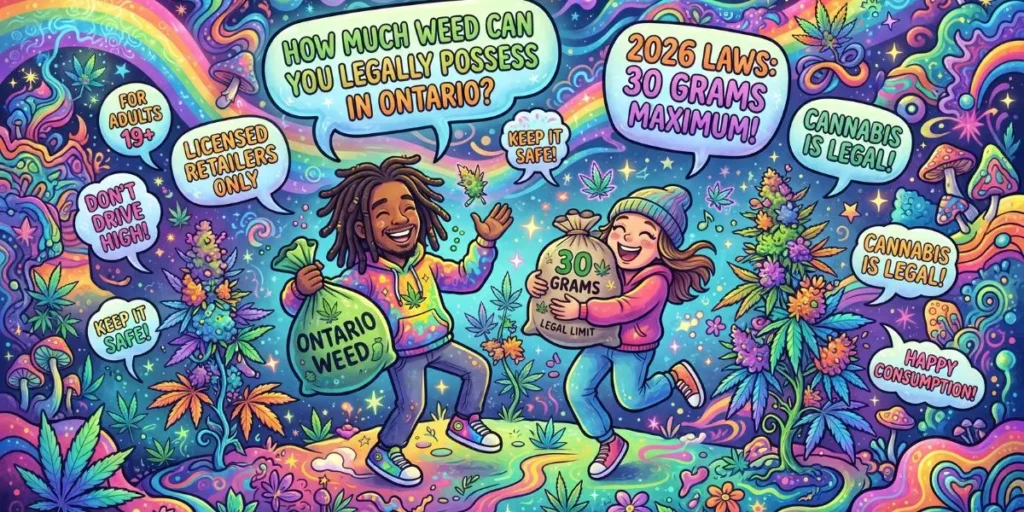
It is a crisp Tuesday morning in Toronto. You have just left your favorite legal cannabis dispensary with a beautifully packaged 3.5-gram flower and a few cannabis-infused seltzers for the weekend. As you place the small paper bag on the passenger seat of your car, a sudden pang of anxiety hits you: Wait, am I actually allowed to have all of this on me right now? What if I get pulled over? What if I want to share a pre-roll with a friend at the park later?
The landscape of cannabis regulations in Ontario is no longer a hazy gray area as it was pre-legalization, but navigating the specific numerical limits can still feel like trying to solve a math problem with moving targets. This is your definitive, human-friendly guide to cannabis possession laws in Ontario for 2026. We are going beyond the simple “30 grams” headline to break down the dry weight equivalencies, the nuances of home storage, the strict rules about traveling with your stash, and exactly what the latest amendments mean for your daily life. This isn’t just a list of laws; it is a practical walkthrough for the responsible adult consumer.
Understanding Ontario’s Cannabis Possession Laws in 2026
Canada legalized recreational cannabis nationwide in October 2018 under the Cannabis Act. However, each province and territory was given authority to set its own rules regarding distribution, retail, public consumption, and possession limits. Ontario chose to align closely with federal standards while adding provincial restrictions around age, retail licensing, and where you can light up.
In Ontario, the legal age for possession, purchase, and consumption is 19 years old. This is consistent with the province’s legal drinking age and applies uniformly across all municipalities. If you are 19 or older, you are permitted to possess cannabis in public—but not an unlimited amount.
The cornerstone of Ontario’s public possession law is the 30-gram limit for dried cannabis. This is the federal maximum, and Ontario has not imposed any additional restrictions that would lower that threshold. But here is where many people get tripped up: that 30-gram figure applies specifically to dried flower. If you are carrying edibles, concentrates, beverages, or seeds, the weight limits look very different.
Public Possession Limits: What 30 Grams Really Means
When people ask, how much weed can I legally carry in Ontario?, they usually picture a bag of dried bud. But the modern cannabis market offers far more than just flower. Federal equivalency regulations mean that different product categories convert to that 30-gram dried cannabis benchmark in specific ways.
If you are carrying any combination of the following products in public, the total cannot exceed the equivalent of 30 grams of dried cannabis:
- Dried cannabis: 30 grams
- Fresh cannabis: 150 grams (the rule of thumb is that 5 grams of fresh cannabis equals 1 gram of dried)
- Edibles (solid food products): 450 grams
- Liquid products (non-beverage): 2,100 grams or milliliters
- Cannabis beverages: Up to 48 cans of 355 ml each
- Cannabis concentrates (solid or liquid): 7.5 grams
- Cannabis seeds: 30 seeds
These equivalencies are not arbitrary. They are based on THC content and volume calculations designed to standardize possession across product types. For example, concentrates are far more potent by weight than dried flower, which is why the gram allowance is significantly lower. Similarly, edibles and beverages contain dilution and carrier ingredients, so the weight limit is higher even though the psychoactive content is regulated.
It is also worth noting that these limits apply to what you are carrying on your person in public spaces. That includes sidewalks, parks, public transit, and your vehicle when it is on a public roadway. If a police officer requests to inspect your cannabis products, you must be able to demonstrate that your combined total falls within the legal equivalency range.
The Golden Rule: The 30-Gram Public Carry Limit
Let’s get the primary number nailed down immediately because this is the one that matters most when you step outside your front door. Under the federal Cannabis Act, which drives the core of the provincial cannabis rules, adults aged 19 and older in Ontario may legally possess a maximum of 30 grams of dried cannabis in public.
To be crystal clear, “public” means anywhere that is not your private property. This includes sidewalks, parks (subject to smoking bylaws), bars, restaurants, vehicles on public roads, and basically anywhere that isn’t inside your own home. If you are holding more than 30 grams of dried flower while walking down Queen Street, you are technically in possession of an illicit amount and subject to fines or criminal charges.
But here is where the common misconception begins. The “30 grams” benchmark does not mean you are restricted to only buying a very small bag of flower. The law accounts for the reality that cannabis comes in many forms—from gummies to vape cartridges to hash. The government established specific equivalencies to calculate how much of a different product class equals that base 30-gram limit.
Breaking Down the Cannabis Equivalency Chart
You cannot simply put a brick of brownies and an ounce of flower on a scale and call it a day. The law assigns distinct conversion factors. If you love variety, you need to be a little strategic about what sits in your purse or backpack. Here is the 2026 breakdown of how much of a given cannabis product you can legally carry in public, based on the federal equivalency to 30 grams of dried flower:
- Dried Flower (The Baseline): 30 grams. This is your classic bud that you grind and roll or vaporize. It is the standard measurement against which everything else is compared. A typical pre-roll is 0.5 to 1 gram, so you could theoretically carry 30 to 60 pre-rolls without exceeding the limit, though we don’t necessarily recommend testing that upper boundary unless you are heading directly to a very large social gathering.
- Fresh Cannabis: 150 grams. This refers to freshly harvested, undried plant material. Because much of the weight is water, the law allows five grams of fresh product to equal one gram of dried product. If you are a home grower bringing a wet harvest to a friend’s house for trimming, you can legally transport up to 150 grams of fresh plant matter.
- Edibles (Solid): 450 grams. This does not mean 450 milligrams of THC—this means the total physical weight of the food product. One gram of dried cannabis is the legal equivalent of 15 grams of an edible. Therefore, 30 x 15 = 450 grams. To visualize this, a typical chocolate bar is often around 30 to 50 grams. You could easily carry a bag full of chocolates and gummies without hitting the solid-weight cap, though you absolutely must ensure the total THC content per package remains within legal retail limits (10 milligrams per package for edibles purchased legally).
- Liquid Products (Non-solids): 2,100 grams. This equates to 2,100 milliliters, or 2.1 liters of product. This category mainly covers tinctures, oils, capsules, and sprays, not beverages. The math is simple: one gram of dried equals 70 grams of a non-solid. Carrying several bottles of high-CBD oil is well within your legal right.
- Cannabis Beverages: Here lies a specific exception that often trips people up. While a drink is technically a liquid, it has its own hard cap. You may possess a maximum of 48 cans (assuming the standard 355 ml can size). Since a single can is roughly 13.3 times the weight of a gram equivalent, the practical cap becomes the number of physical units, not the fluid volume. Carrying a flat of 48 CBD-infused sparkling waters is legal; carrying 49 crosses the line.
- Cannabis Concentrates (Solid or Liquid): 7.5 grams. Because extracts like shatter, wax, hash, rosin, and vape cartridges are incredibly potent, the law treats them conservatively. One gram of dried cannabis equals 0.25 grams of a concentrate. Therefore, the public possession limit caps out at 7.5 grams total for this category. Be extremely mindful here—a small jar of 3 grams of hash and a few 1-gram vape pens can quickly eat into this strict limit.
- Seeds: 30 seeds. The limit is straightforward: one seed equals one gram of dried cannabis. While you can legally grow your own, carrying more than 30 seeds away from home requires a license.
The “Multi-Product” Reality Check
Most people don’t just carry one class of product. The law allows you to mix and match, provided the cumulative “dried cannabis equivalent” is 30 grams or less. Imagine you are packing a bag for an overnight trip. You might have:
- 5 grams of dried flower (5g equivalent).
- One 30g cannabis chocolate bar (2g equivalent, because 30 / 15 = 2).
- A 0.5g vape cartridge (2g equivalent, because 0.5 / 0.25 = 2).
In this scenario, you have used only 9 grams of your 30-gram public allowance. You are perfectly legal. It is highly recommended to keep the original dispensary packaging with the excise stamp intact, as this provides immediate proof of the product’s net weight and legal origin.
Home Storage vs. Public Possession: The Distinction
There is a wildly misunderstood element of the Cannabis Act that makes Ontario a bit of a paradise for collectors. The 30-gram rule is specifically and exclusively a public possession limit. Once you are inside the secure confines of your private residence, there is no formal cap on how much legally purchased cannabis you can store.
Read that again: you can have a walk-in humidor filled with exotic strains, a fridge stocked with beverages, and a drawer dedicated to concentrates, and you are not breaking any provincial storage laws. The only non-negotiable condition is that the product must be legally purchased from an authorized source, such as the Ontario Cannabis Store (OCS) online or a brick-and-mortar AGCO-licensed retailer. A receipt showing the purchase date and a sealed container with the proper tax stamp are your best friends here, as they distinguish a legal collection from an illegal trafficking cache.
Stack your savings. Elevate your session. 10% off $100, up to 25% off $450.
🔥 Roll into the menu and start saving.
The Horticultural Angle: Cultivating Your Four Plants
The right to cultivate is intrinsically linked to possession. In Ontario, the law allows you to grow up to four cannabis plants per residence for personal use. It is crucial to understand that this is per residence, not per person. If you share an apartment with three other adults of legal age, the house limit remains four plants total, not sixteen.
Now, how does this tie back to the possession limits? The equivalency rules apply. If your four plants yield a massive harvest of 600 grams of dried flower, keeping that entire harvest inside your home is legal. However, you absolutely cannot transport that 600 grams to a buddy’s place in one go. You must only remove 30 grams of dried product (or the equivalent) from that private property at any given time. The processing and curing must happen strictly behind closed doors.
Navigating Vehicle Transport in 2026
This is arguably the most legally delicate situation for any Ontarian. A vehicle under the highway traffic system is considered a public space. This means the hard 30-gram rule applies with no exceptions. Furthermore, the rules for transporting cannabis are modeled after the “open liquor” laws.
The “Trunk Rule”: Cannabis in a motor vehicle, boat, or any motorized transport being operated or under the care and control of someone must be in its original, unopened packaging, or packed in a closed container, and it must be inaccessible to the driver and passengers. The easiest way to comply in a standard sedan is to place the legal product in the trunk. In an SUV or hatchback without a lockable trunk, placing it as far back as possible, out of arm’s reach, is the safest legal interpretation.
If you are carrying a container of your homegrown flower that isn’t in original retail packaging, it absolutely must be sealed and stored away from the occupants. Keeping a half-smoked joint in the glove box or a loose edible in the center console is a direct violation and can lead to significant fines. The keyword here is “inaccessible.” If a law enforcement officer stops you and asks about the cannabis, you must truthfully identify that it is in the vehicle. Providing false information can escalate the charges significantly.
Soaring the Skies: How Much Weed Can You Bring on a Domestic Flight?
The question comes up constantly: “I’m flying from Toronto to Vancouver, what can I take?” The answer is blissfully simple because it mirrors the standard public possession limit. For a domestic flight within Canada, you are legally permitted to bring an amount of cannabis that does not exceed the 30-gram dried equivalent. The Canadian Air Transport Security Authority (CATSA) is not a law enforcement agency seeking to arrest for small amounts, but they will call the police if they find you exceeding the legal limit.
You must have your stash in your carry-on luggage (it is illegal to place cannabis in checked baggage, oddly enough, partly due to aviation safety regulations regarding pressurized containers and batteries for vapes). Your carry-on must go through the X-ray. The 48-beverage maximum applies here just as it does on the street, though carrying four dozen cans might raise eyebrows about weight limits. Ensure everything remains in its sealed, tamper-evident packaging from the retailer. Crossing an international border, even accidentally, with a forgotten joint in your jacket is a criminal offense. Do not take cannabis on any international flight or cruise ship, period.
Growing Your Own: The 4-Plant Rule
Ontario residents who prefer to cultivate their own supply are allowed to do so under federal law, and the province has not added additional restrictions beyond what Parliament established. Adults may grow up to four cannabis plants per residence for personal use. This is a critical distinction: the limit is per residence, not per person. If four adults live in the same house or apartment, they are collectively entitled to four plants, not sixteen.
This rule applies to both indoor and outdoor cultivation, though landlords and condominium corporations may impose their own restrictions through lease agreements or building bylaws. If you are renting, check your lease before setting up a grow tent. Additionally, plants must be grown from licensed seeds or seedlings. You cannot legally sell what you harvest, though you are permitted to gift small amounts to other adults.
Where Can You Legally Consume Cannabis in Ontario?
Possession is only one side of the coin. Where you actually use cannabis is heavily regulated, and Ontario’s public consumption rules are stricter than some other provinces.
In Ontario, you may only smoke or vape cannabis in spaces where tobacco smoking is permitted. That means you cannot light up in enclosed workplaces, restaurants, bars, or within 20 meters of children’s playgrounds and sports fields. Many municipalities have additional bylaws that further restrict consumption in parks, on sidewalks, or near building entrances. Toronto, for instance, prohibits cannabis smoking in City of Toronto parks and squares, with some exceptions during designated events.
Private property remains your safest bet. If you own your home, you can consume cannabis indoors or in your backyard, subject to local nuisance bylaws. If you rent, your landlord has the right to ban smoking and vaping inside the unit, though they generally cannot prohibit non-smoked forms of consumption unless specified in the lease.
Transporting Cannabis: Vehicles and Domestic Flights
Transportation adds another layer of complexity to possession law. Many consumers want to know: how much weed can you carry in a vehicle in Canada? and how much weed can you bring on a domestic flight in Canada? The answers depend on context.
Carrying Cannabis in Your Vehicle
When transporting cannabis by car in Ontario, the 30-gram public possession limit still applies. You cannot exceed the dried cannabis equivalent simply because the product is inside a vehicle. More importantly, Ontario has strict rules about how cannabis must be stored during transport.
Cannabis must be kept in closed, sealed packaging or placed in an area of the vehicle that is not readily accessible to the driver or passengers. The trunk is the safest and most legally defensible location. If you are pulled over and an officer finds an open bag of cannabis within arm’s reach of the driver, you could face charges regardless of whether you are impaired. The law treats accessible, unpackaged cannabis similarly to open alcohol.
Impaired driving laws also apply. Cannabis consumption before or during driving is treated with the same severity as alcohol. Ontario has zero tolerance for young, novice, and commercial drivers, and severe penalties apply to anyone caught operating a vehicle while impaired by THC.
Flying With Cannabis Within Canada
Air travel raises another set of questions. If you are asking, how much weed can you bring on a domestic flight in Canada?, the answer mirrors the ground rules: you may carry up to 30 grams of dried cannabis or its equivalent in your carry-on or checked baggage when flying between Canadian cities.
However, airports and airlines have their own policies. Security screening is looking for threats to aviation safety, not specifically for cannabis, but if they discover amounts exceeding the legal limit, they will notify law enforcement. You should also be aware that while domestic flights are permissible, international travel with any amount of cannabis is illegal, even if you are flying to a destination where marijuana is legal. Crossing the border with cannabis remains a federal offense in virtually every scenario.
Sharing Cannabis With Other Adults
Personal possession limits do not prevent you from sharing cannabis with other adults aged 19 or older. You are permitted to gift up to 30 grams of dried cannabis (or equivalent) to another adult without compensation. This is distinct from selling, which requires a federal license. Social sharing among friends is legal, but any exchange involving money, barter, or favors crosses into illicit distribution.
If you are hosting a gathering, be mindful that each guest must individually comply with the 30-gram public possession limit if they are carrying product on their person. You cannot pool cannabis into a communal stash that collectively exceeds individual limits unless it remains under your control inside a private residence.
What Happens If You Exceed the Legal Limit?
Possessing more than the permitted amount of cannabis in public is a federal offense under the Cannabis Act. Penalties vary depending on the quantity and the circumstances.
For minor exceedances—say, 40 grams instead of 30—law enforcement may exercise discretion, but they are empowered to issue tickets, seize the product, and potentially lay charges. For larger quantities, particularly amounts that suggest intent to distribute, penalties escalate quickly. Trafficking-related offenses can result in imprisonment, while simple possession over the limit typically carries fines and a criminal record, though diversion programs may be available for first-time offenders.
It is also important to remember that municipal bylaws and the Smoke-Free Ontario Act can result in additional fines for consuming cannabis in prohibited areas, even if you are within your possession limit.
Buying Legal Cannabis in Ontario
To stay compliant, always purchase from authorized sources. The Ontario Cannabis Store operates the provincial online retail platform, while private retailers licensed by the Alcohol and Gaming Commission of Ontario (AGCO) operate brick-and-mortar locations across the province. Legal products are lab-tested, accurately labeled for THC and CBD content, and packaged with the mandatory excise stamp.
Buying from unlicensed sources—often called the “grey market” or black market—carries risks beyond legal exposure. You cannot verify potency, purity, or equivalency calculations, and if you are caught with illegally sourced cannabis, the home storage exemptions may not protect you.
The 2026 Legal Landscape: Legality and Public Consumption
If you are asking, “Is weed illegal in Canada in 2026?” the answer is a definitive no—it remains federally legal, but it is heavily regulated. The Cannabis Act is subject to periodic statutory reviews, and the 2026 landscape has seen increased focus on “polysubstance” road safety and packaging aimed at children. Nothing in the recent amendments has reduced your right to the 30-gram carry limit or the four-plant home grow; rather, the enforcement of illicit “gray market” storefronts has become stricter, meaning the gap between the legal limit and the illegal seller has widened.
Public consumption remains a patchwork defined by the Smoke-Free Ontario Act. As a general baseline, you can smoke or vape cannabis anywhere you can smoke tobacco. This is an exclusionary law: if a place is a playground, a sports field, a restaurant patio, a hospital ground, or within 20 meters of those areas, it is strictly prohibited. Municipalities can pass tougher bylaws. For instance, some cities have completely banned smoking on sidewalks within business districts. Always look for municipal signage or stick to private property. Landlords and condo boards also have the right to ban smoking entirely within their units, even medical use, provided they do not violate the Human Rights Code regarding accommodation.
Edible consumption, however, is generally not restricted by smoking laws unless it is in a vehicle. You cannot legally eat a cannabis gummy while driving; the penalties are severe and mirror those for impaired driving.
Stack your savings. Elevate your session. 10% off $100, up to 25% off $450.
🔥 Roll into the menu and start saving.
Conclusion: Empowerment Through Specificity
Navigating Ontario’s 2026 cannabis rules is ultimately about respecting the transition from a counter-culture substance to a regulated adult product. The laws are not designed to ruin your fun; they are designed to create a standard that allows you to possess, grow, and travel without accidentally slipping into the legal definition of trafficking. The key takeaways are binary and simple to remember: Public equals 30 grams (calculated by weight equivalency), Home equals unlimited storage (if legal), and Vehicles equal locked trunks.
Don’t let the equivalency math intimidate you. Use the dried gram as your currency. Think of your 30-gram allowance as a wallet you are filling—spend your credits wisely between that delicious flower, those potent concentrates, and those refreshing beverages. When in doubt, leave the bulk supply at home in a secure, child-proof safe. Travel light, carry your receipts, and consume responsibly within the spaces the law provides. The freedom to enjoy cannabis legally is a privilege that comes with the simple responsibility of counting to thirty.
Frequently Asked Questions
How much weed can I legally carry in Ontario?
You can legally carry up to 30 grams of dried cannabis, or its equivalent in other products, in public in Ontario. If you are carrying other forms, such as edibles or extracts, you must calculate their dried weight equivalent. For instance, you could carry 450 grams of edibles, but only 7.5 grams of concentrates. This strict public limit applies everywhere outside your private home.
What is the possession limit for weed in Canada?
The national possession limit, set by the federal Cannabis Act, is 30 grams of dried cannabis in public. This limit is standard across Canada, including Ontario. In addition to the 30-gram dried flower rule, the federal equivalency applies nationwide, meaning the limits for other classes (like the 48-beverage cap or 7.5-gram concentrate cap) are the same whether you are in Vancouver, Quebec, or Halifax.
How much weed can you carry in a vehicle in Canada?
In a vehicle, you can carry up to 30 grams of dried cannabis (or its equivalent), and the product must be either in its original, unopened packaging or securely sealed. Most importantly, the cannabis must be inaccessible to the driver and any passengers—effectively meaning it must be locked in a trunk or, in an SUV, placed in the very rear cargo area. Driving with accessible product violates provincial highway laws.
How much weed can you bring on a domestic flight in Canada?
You can bring up to the equivalent of 30 grams of dried cannabis on a domestic flight within Canada. The cannabis must be in your carry-on baggage, not in your checked luggage. Ensure it is packed in sealed, legal retail containers that clearly display the purchase information and excise stamps, and be prepared for CATSA agents to involve police if you exceed the legal carry limit.
Is weed illegal in Canada in 2026?
No, weed is not illegal in Canada in 2026. The legalization of recreational cannabis remains in full effect under the Cannabis Act for adults aged 19 and older in Ontario (18 or 19 depending on the province). However, the legal market is strictly enforced. Purchasing from illicit dispensaries, possessing more than the legal public limit, or consuming in prohibited public areas remains subject to fines and criminal charges.