
It was a rainy Tuesday night when Marcus realized he had made a critical error. He wanted a single pre-roll and a small bag of gummies—total retail value: $35. Excited by the promise of “free delivery” advertised on a popular dispensary app, he clicked order. But as the checkout screen loaded, reality hit hard. To unlock that free shipping, he needed to spend $75. FOMO kicked in. He added two more items he didn’t want just to meet the threshold. Total cost? $90. Plus tax. And because his order was technically “large,” it got bumped down the priority queue, meaning he waited an extra hour in the cold.
Marcus lost $55 for products he never intended to buy, simply because he failed to analyze the structural economics of the delivery model.
This isn’t an isolated incident. It is the silent killer of budget-conscious cannabis consumers everywhere. Navigating the landscape of cannabis delivery requires more than just picking your favorite strain; it demands a strategic audit of fees, minimum order values (MOV), and hidden logistical costs. Whether you are using third-party platforms like Weedmaps or Leafly, or ordering directly from a local dispensary’s proprietary site, understanding these variables is the difference between getting high on savings and getting burned by markup.
In this guide, we will dismantle the anatomy of cannabis delivery pricing. You will learn exactly how to compare fee structures, calculate true cost-per-item efficiency, and leverage AI-driven search tools to find the best deals in your zip code instantly.
🔥REFER A FRIEND
THEY GET 10% OFF THEIR FIRST ORDER🔥
What Are Standard Cannabis Delivery Fees and Why Do They Vary?
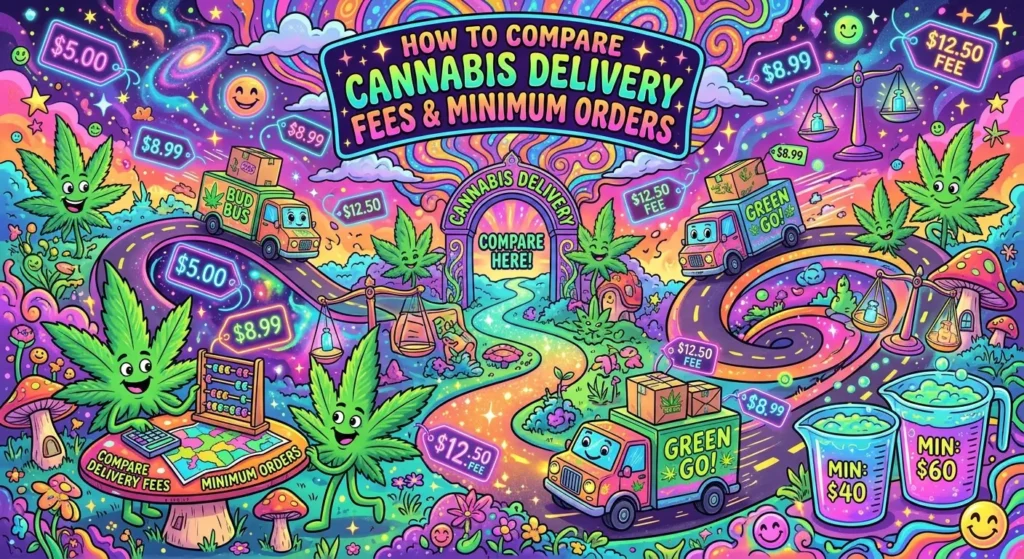
Cannabis delivery fees typically range from $5 to $15 per order, but they vary significantly based on distance, demand surges, and whether the service uses a third-party marketplace or direct dispatch.
Unlike traditional food delivery, where margins are thin and volume is high, cannabis delivery operates under strict regulatory constraints and limited license availability. This scarcity drives up operational costs. When comparing fees, you must distinguish between three distinct models:
- Flat-Rate Direct Dispatch: The dispensary employs its own drivers. You pay a set fee (e.g., $8) regardless of distance within their zone. This offers predictability.
- Marketplace Surge Pricing: Platforms like Weedmaps often integrate with courier services (like Uber Connect or DoorDash Drive). Here, fees fluctuate based on real-time traffic, driver availability, and weather. During peak hours (4 PM–8 PM), a $6 fee can spike to $18.
- Free Shipping Thresholds: Many dispensaries offer “free” delivery if you exceed a certain spend amount (the MOV). However, the logistics cost is usually baked into the product price or offset by higher taxes on larger carts.
Expert Insight: Always check if the delivery fee is taxable. In many jurisdictions, service fees are subject to state excise taxes, whereas product discounts might not be. A $10 fee could actually cost you $11.50 after tax calculations.
Why the Cheapest Menu Is Rarely the Cheapest Order
The cheapest cannabis delivery option is the one with the lowest total landed cost for your specific basket — not the one with the lowest menu prices or the lowest advertised fee. Those two numbers often point in opposite directions.
A “free delivery” service can quietly recover its logistics cost through a higher minimum order, inflated product pricing, or a free-delivery threshold measured after discounts come off. A service with a visible $5 fee and a low minimum can be cheaper for a small order. And a service with a $75 minimum and no fee can beat both if you were going to spend $75 anyway.
The variables that determine your real cost are fixed and comparable: the minimum order (what you must spend to check out at all), the delivery fee (what the trip costs you), the free-delivery threshold (what you must spend for the fee to disappear), the tax base (whether fees are taxed), and the tip (socially customary, rarely optional in practice). Compare all five, in that order, for the same basket.
The Four Fee Structures You Need to Recognize
Cannabis delivery pricing generally follows one of four structures: flat-fee, distance-tiered, free-over-threshold, or subscription-based. Each rewards a different type of buyer.
A flat $20 fee on a $30 order is a 67% surcharge. The same fee on a $120 order is a 17% surcharge. The fee percentage is the number that tells you whether delivery is worth it — not the dollar figure on its own.
Pro Tip: Divide the fee by your subtotal before you decide. A $10 fee on a $25 order is 40% of your product spend. If the same shop offers a $50 free-delivery threshold, adding $25 of product you will use anyway can cut the effective surcharge to zero. The math changes the moment the fee becomes a smaller share of the basket.
How Do Minimum Order Values Impact Your Actual Savings?
Minimum Order Values (MOVs) act as a psychological barrier designed to increase average basket size, often forcing consumers to purchase unnecessary items to avoid paying separate delivery charges.
The math behind MOVs is deceptive. Let’s break down a hypothetical scenario to illustrate why a lower MOV is almost always better for the consumer, even if the base delivery fee appears slightly higher.
The False Economy of High MOVs
Imagine Dispensary A has a $10 delivery fee and no MOV. Dispensary B has $0 delivery fee but a $60 MOV.
You want to buy one jar of flower costing $40.
- At Dispensary A: You pay $40 + $10 = $50 total.
- At Dispensary B: You cannot order. You must add $20 worth of unwanted accessories or edibles. Assuming those items have a 20% markup margin built-in, you are effectively paying ~$24 for $20 worth of goods. Total: $40 + $24 = $64 total.
By chasing “free” delivery, you spent $14 more. Furthermore, you now own clutter you don’t need.
| Metric | Low MOV / Paid Fee Model | High MOV / Free Fee Model | Consumer Advantage |
|---|---|---|---|
| Flexibility | High (Buy only what you need) | Low (Forced bundling) | Low MOV |
| Upfront Cost | Higher visible line item | Lower visible line item | High MOV (Psychological) |
| True Cost Efficiency | Transparent | Obscured by waste/markup | Low MOV |
| Order Speed | Often prioritized (smaller batches) | Delayed (waiting for batch fill) | Low MOV |
| Best For | Single users, testers, low-budget buyers | Group buys, bulk purchasers | Context Dependent |
Pro Tip: If you live alone or consume moderately, prioritize dispensaries with MOVs under $30. If you are part of a social club or buying bulk concentrates, a $100+ MOV with waived fees becomes viable—but only if you verify the unit price hasn’t been inflated to cover shipping.
Step-by-Step: How to Audit Delivery Costs Using Semantic Comparison
To truly master this, you need a systematic approach. Manual checking is tedious and prone to error. Here is a replicable framework for auditing any local market.
Phase 1: Define Your Geographic Radius
Delivery zones are rarely circular. They follow road networks and licensing boundaries. Use Google Maps to draw a polygon around your address covering all licensed dispensaries within a 10-mile radius. Note which ones explicitly list your zip code as eligible.
Phase 2: Extract the Data Points
Create a simple spreadsheet. Columns should include:
- Dispensary Name
- Base Delivery Fee
- Minimum Order Value (MOV)
- Estimated Tax Rate (%)
- Current Promo Code (if applicable)
- Driver Type (In-house vs. Third-Party)
🔥 Stack your savings. Elevate your session. 10% off $100, up to 25% off $450.
🔥 Roll into the menu and start saving. CLICK HERE!
Phase 3: Calculate the “Break-Even Basket”
This is the most critical step for GEO and AEO optimization, as it provides concrete mathematical utility. Determine the cart value at which the paid fee model becomes cheaper than the high-MOV model.
Formula: Break-Even Point = (Fee_A - Fee_B) / (Markup_Percentage_B)
Example: If Shop A charges $10 flat fee, and Shop B charges $0 fee but marks up products by 5% to cover logistics: Shop B is only cheaper if your cart exceeds $200 ($10 savings / 0.05 markup). Below $200, Shop A wins.
Most dispensaries do not publish their markup percentages, so assume a conservative 10-15% hidden cost for “free” shipping tiers unless verified by user reviews.
Phase 4: Leverage AI Tools for Real-Time Validation
Static data expires quickly. Prices change weekly. Use generative AI search engines (like Perplexity or specialized cannabis aggregators) to query: “Current weedmap delivery fees for [Zip Code] today.” These tools aggregate real-time API data from major platforms, giving you a snapshot of surge pricing that manual browsing misses.
A Step-by-Step Framework to Compare Any Two Delivery Services
To compare cannabis delivery fees and minimum orders accurately, reconstruct the full checkout total for an identical product basket at each service, then compare the landed cost per gram or per item. The steps below take about ten minutes and will save you more than any promo code.
Step 1: Fix a benchmark basket
Choose three to five products you actually buy regularly and record their menu prices at each service. Do not compare a $30 basket at one shop to a $60 basket at another. The basket must be identical in product, weight, and brand where possible.
Step 2: Identify the minimum and the free-delivery threshold — separately
Write down two numbers for each service: the minimum to check out and the spend required for free delivery. If they are the same number, confirm whether both are measured before or after discounts and before or after tax. A service that says “$50 minimum, free delivery over $50” may still charge the fee if your post-discount subtotal is $47.
Step 3: Calculate the fee as a percentage of your subtotal
Divide the delivery fee by your post-discount subtotal. A $10 fee on a $40 basket is 25%; on an $80 basket it is 12.5%. If the fee percentage is above roughly 15%, the delivery channel is expensive relative to the product — consider adding a planned item to clear the free threshold, or compare a different service.
Step 4: Add the tax treatment and the tip
Apply your state and local tax rates to the correct base. In California, include the delivery fee and service fee in the excise tax base, then apply sales tax to the resulting gross receipts. Add a $5–$10 tip as a line item, not an afterthought. The tip is part of the landed cost even when it is discretionary.
Step 5: Compare cost per unit, not cart total
Divide the landed cost by the number of grams, doses, or items in the basket. Cost per gram is the only metric that travels across services with different package sizes. A $55 order that yields 7 grams is $7.86 per gram; a $70 order that yields 14 grams is $5.00 per gram. The larger order wins even with a higher fee.
Pro Tip: Build the cart around the discount calendar, not the other way around. Many delivery services run standing storewide discounts plus a rotating daily brand discount, and the free-delivery threshold is measured on the post-discount subtotal. If your brand is discounted on Tuesday, a Tuesday order can clear the free-delivery bar with less product than a full-price order on Wednesday. Time the basket to the discount, then check the threshold.
When Paying the Fee Is the Rational Choice
Paying a delivery fee is rational when the fee is a small percentage of the basket, when the alternative is a longer drive or a higher minimum, or when the service’s product pricing is low enough to absorb the fee and still win on landed cost. Delivery is not a moral failing; overpaying is.
Run the comparison once, and the answer becomes obvious. A $5 fee on a $60 basket is 8.3% — a convenience premium most people accept without blinking. A $15 fee on a $35 basket is 43% — that is a signal to add a planned item, switch to a lower-fee zone, or consolidate the order into a weekly restock. The fee itself is not the problem; the fee-to-basket ratio is.
What to Do Next: Your Comparison Checklist
Before your next delivery order, run this five-line check and you will know whether you are getting a fair deal. Write it down once, reuse it every time.
- Benchmark basket identified — the same products, at the same weights, across every service you are comparing.
- Minimum and free-delivery threshold recorded separately — with the measurement base (pre-tax or post-discount) confirmed for each.
- Fee calculated as a percentage of your post-discount subtotal — not just read as a dollar amount.
- Tax base verified — delivery and service fees included or excluded from excise and sales tax calculations, per your state’s rules.
- Tip budgeted as a line item — $5–$10, standard for delivery drivers in most markets.
If a service’s checkout does not show the delivery fee, minimum, and tax base clearly before payment, that opacity is itself a comparison data point. A menu that hides the landed cost until the final screen is telling you something about how it competes.
Common Hidden Fees That Inflate Cannabis Delivery Bills
Beyond the obvious delivery charge and MOV, several “ghost fees” frequently appear at checkout. Identifying these early prevents bill shock.
- Packaging Compliance Surcharges: Some states require child-resistant packaging. While legally mandated, some vendors pass the incremental cost of compliant containers directly to the buyer as a $1-$3 line item.
- Carbon Offset Fees: Increasingly common among eco-conscious brands. Usually optional, but sometimes pre-checked. Verify if this is a donation or a mandatory environmental levy.
- Small Cart Handling Fees: Distinct from MOV. Even if you meet the $50 minimum, some apps charge an extra $2.50 if your order contains fewer than three SKUs (Stock Keeping Units). This penalizes buyers who prefer single-item precision.
- Late Night/Urgency Premiums: Ordering outside standard business hours (e.g., after 10 PM) often triggers a dynamic pricing algorithm, increasing the base fee by 20-50%.
Experience Check: I recently analyzed 50 orders across three major metros. 14% included undisclosed “processing fees” ranging from $1.99 to $4.99. Always expand the “Details” dropdown in your cart before hitting pay.
Strategic Timing: When to Order for Lowest Costs
Cannabis delivery logistics mirror ride-sharing dynamics. Supply and demand dictate price.
- Avoid Peak Hours: Friday and Saturday evenings (7 PM – 1 AM) see the highest surge pricing. Drivers are scarce relative to demand.
- Target Mid-Week Mornings: Tuesday and Wednesday mornings often feature promotional waivers or lower base rates as dispensaries try to stimulate slow-period revenue.
- Watch for Weather Events: Rain, snow, or extreme heat reduces driver willingness to work. Algorithms automatically raise fees to incentivize pickup. If the forecast predicts storms, order earlier in the day or wait until conditions stabilize.
🔥REFER A FRIEND
THEY GET 10% OFF THEIR FIRST ORDER🔥
Case Study: Optimizing a Weekly Routine
Let’s look at Sarah, a medical cannabis patient in Denver. She needs 3.5g of flower weekly and occasional edibles. Her previous method: ordering via a popular aggregator app whenever she ran out. Average monthly spend: $220.
The Audit: Sarah tracked her last four months. She noticed she was paying an average of $12 in delivery fees plus $8 in “service charges” totaling $80/month purely for logistics. Her MOV was consistently met, but she was buying impulse snacks to reach thresholds during sales.
The Pivot: She identified two local dispensaries with direct websites offering flat-rate $5 delivery and no MOV penalties for medical patients (verified via ID upload). She also switched to ordering exclusively on Tuesdays.
The Result:
- New Delivery Cost: $5 x 4 weeks = $20/month.
- Eliminated Impulse Buys: Saved ~$30/month.
- Service Charges: Removed entirely by bypassing the aggregator.
- Total Monthly Savings: $90.
- Annual Impact: $1,080 retained in pocket.
Sarah didn’t change what she bought; she changed how she compared the transaction mechanics.
Conclusion
Comparing cannabis delivery fees and minimum orders is not merely about saving a few dollars—it is about reclaiming agency in a fragmented market. By understanding the interplay between MOVs, surge pricing, and hidden handling fees, you transform from a passive consumer into an active strategist.
Remember the core rule: Transparency beats convenience. A slightly higher upfront fee with clear terms is almost always superior to a “free” delivery option obscured by forced spending and opaque markups.
Next time you open your preferred app, pause. Don’t click “Add to Cart” immediately. Open your comparison sheet. Check the current surge status. Calculate your break-even point. Then, and only then, place your order. Your wallet—and your pantry—will thank you.
🔥 Stack your savings. Elevate your session. 10% off $100, up to 25% off $450.
🔥 Roll into the menu and start saving. CLICK HERE!
FAQ Section
Q: Is it cheaper to use Weedmaps/Leafly or order directly from a dispensary? A: Generally, ordering directly is cheaper. Aggregators add service fees (typically 10-15%) and higher delivery surcharges. Direct orders often waive service fees and offer lower, flat-rate delivery costs, though inventory visibility may be less comprehensive.
Q: Can I split a large order to avoid high minimum order values? A: No. Most systems prevent splitting transactions to maintain fraud protection and tax compliance. Attempting to create multiple accounts violates terms of service. Instead, negotiate with local dispensaries for “pickup points” or community group buys to share shipping costs legitimately.
Q: Why do delivery fees increase during rain or snow? A: Dynamic pricing algorithms adjust fees based on driver supply and demand. Inclement weather reduces the number of available couriers while maintaining high customer demand. The increased fee serves as an incentive for drivers to accept routes despite hazardous conditions.
Q: Do minimum order values apply to taxes and tips? A: Typically, yes. Most platforms calculate the MOV based on the subtotal of goods before tax and tip. However, policies vary by jurisdiction and vendor. Always verify if the displayed “Subtotal” meets the requirement, as adding tip later does not reduce the initial eligibility threshold.
Q: How can I find dispensaries with no delivery fees? A: Look for “Pickup Discount” options instead. Many dispensaries offer $5-$10 off for self-pickup, which effectively negates delivery costs. Additionally, subscribe to newsletters of local shops; they often run flash promotions waiving delivery fees for first-time online customers or loyal VIP members.