
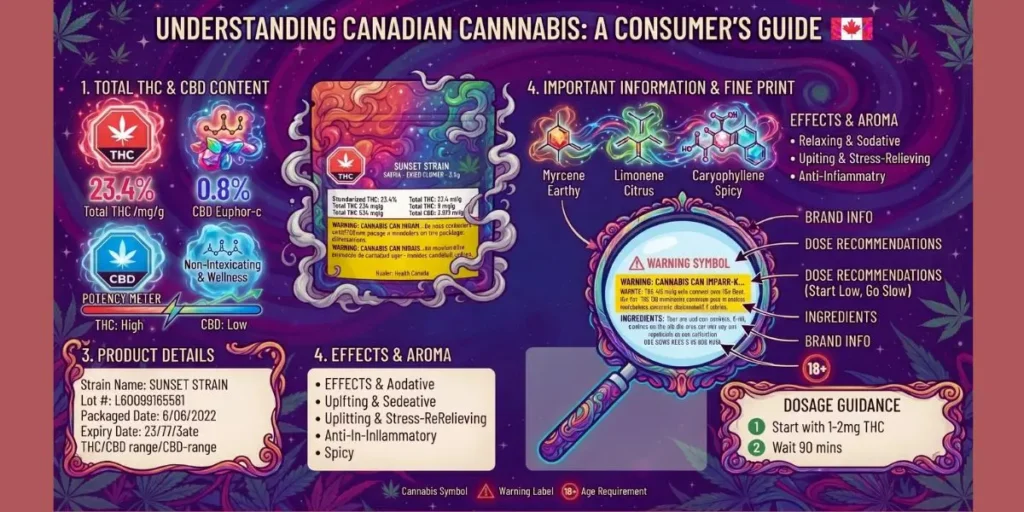
Hey there, fellow cannabis explorer! So, you’re venturing into the world of legal cannabis in Canada, and you’ve noticed those labels – they can look a bit like a secret code, right? Don’t worry, you’re not alone! Understanding these labels is super important, not just for getting the most out of your experience, but also for staying safe. Think of it like reading the nutrition facts on your food; it tells you what you’re putting into your body and what to expect.
Walking into a cannabis store in Canada for the first time can feel overwhelming. Rows of plain packages stare back at you, each one covered in red symbols, bold numbers, and health warnings that seem designed more to scare than to inform. If you have ever stood there wondering what any of it actually means, you are not alone. Understanding how to read cannabis labels in Canada is one of the most important skills any consumer can develop, whether you are a medical patient, a recreational user, or simply cannabis-curious.
Canada has some of the strictest cannabis packaging and labelling requirements in the world. The Cannabis Regulations Canada framework governs everything from font size to the exact shade of red on the THC warning symbol. These rules exist to protect public health, prevent youth access, and help adults make informed decisions. But the reality is that many consumers still find the labels confusing. A 2025 Health Canada review found that people frequently misunderstand potency information, which is exactly why the government introduced significant label changes that took effect in early 2025.
This guide breaks down every element you will find on legal cannabis packaging Canada has approved. We will walk through the standardized symbol, explain how to interpret THC and CBD numbers, decode the excise stamp, unpack the cannabis health warning messages, and even touch on terpene profiles. By the end, you will know exactly what to look for on your next purchase, and we will point you toward the easiest way to get lab-tested, properly labelled cannabis delivered straight to your door.
What the Standardized Cannabis Symbol Actually Tells You
The first thing you will notice on most cannabis products in Canada is a red, octagonal symbol that looks like a stop sign with a cannabis leaf inside. This is the standardized cannabis symbol, and it is not optional. Under the Cannabis Regulations, any product containing more than 10 micrograms per gram of THC must display this symbol on the principal display panel. It must appear in the upper left 25% of the package, measure at least 1.27 cm by 1.27 cm, and include a white border of at least 2 points on all sides.
Think of this symbol as a quick visual cue. If you see it, the product contains enough THC to produce psychoactive effects. Products with less than 10 micrograms per gram, such as some CBD-dominant oils or hemp-derived items, may not carry the symbol at all. That does not mean they are THC-free, but it does mean the concentration is low enough that Health Canada does not consider it a significant intoxication risk.
These THC stickers Canada requires are standardized nationwide. No brand can alter the design, colour, or placement. If you ever see a modified or missing symbol on a high-THC product, that is a red flag, and the product may not be legally compliant.
How to Read THC and CBD Numbers Like a Pro
This is where most people get stuck. Canadian cannabis labels display potency in ways that can seem contradictory at first glance. Here is what you need to know.
Total THC vs. Actual THC
For dried flower, the label shows Total THC and Total CBD. Total THC is calculated using a specific formula mandated by Health Canada: Total THC = (THCA × 0.877) + THC. This accounts for the fact that most THC in raw flower exists as THCA, a non-psychoactive acid that converts to THC when heated through smoking, vaping, or cooking.
For example, if a strain shows 18% THCA and 1% THC, the Total THC works out to roughly 17%. That 17% is the number that matters. It represents the maximum psychoactive potential once you consume the product. The same logic applies to CBD, though CBDA converts to CBD through a slightly different process.
Understanding the Unit of Measurement
How potency is displayed depends entirely on the product class. For dried cannabis intended for inhalation, you will see Total THC and Total CBD expressed in milligrams per gram. A 30-gram package labelled Total THC 180 mg/g contains 5,400 mg of THC across the entire package. For edibles, the label shows Total THC per unit and Total THC for the whole package. A pack of four gummies with 2.5 mg per unit means the entire package contains 10 mg of THC, which is the legal maximum for edible cannabis in Canada.
For oils and tinctures, you might see Total THC per activation. If an oral spray says Total THC per activation 8 mg, each spray delivers 8 mg of THC. This is crucial for dosing consistency, especially for medical users who need precise measurements. The same principle applies to capsules, where each discrete unit contains a fixed amount.
What About Ratios?
Non-flower products like oils, capsules, and topicals often display THC-to-CBD ratios such as 1:1, 2:1, or 20:1. The first number always represents THC, and the second represents CBD. A 1:1 product contains equal amounts of both cannabinoids, which many users find produces a balanced effect with less pronounced intoxication. A 20:1 product is heavily CBD-dominant and is often chosen by people managing anxiety or inflammation without wanting significant psychoactive effects.
The 2025 Label Simplification
Here is something many articles miss. As of March 2025, Health Canada streamlined potency labelling to reduce consumer confusion. Previously, labels had to show both actual THC/CBD and total THC/CBD in bold type, which led to widespread misunderstanding. Now, only Total THC and Total CBD are required in bold on the principal display panel. Licence holders can still include actual THC, CBD, THCA, or CBDA numbers, but only as optional information and no longer in bold font.
This change was specifically designed to help consumers focus on the number that actually predicts effects. The Cannabis packaging and labelling guide Health Canada published reflects this new clarity, and it is one of the most important updates for everyday shoppers to understand.
Safety First: Avoiding Unwanted Effects
Let’s get down to brass tacks: safety. Cannabis affects everyone differently, and what might be a pleasant buzz for one person could be a bit overwhelming for another. By understanding what’s on that label, you can make informed choices and steer clear of accidentally grabbing something with a THC content that’s way higher than you’re ready for. This means you can avoid those moments of “whoa, maybe I should have read this first!” and ensure your cannabis experience is a positive one.
Finding Your Perfect Potency: Matching Products to Your Needs
Beyond just safety, labels are your roadmap to finding exactly what you’re looking for. Are you after something to help you relax after a long day? Or perhaps you’re seeking a creative boost? The THC and CBD levels, along with the terpene profiles, can give you a pretty good idea of the potential effects. It’s all about matching the product to your desired outcome, turning your cannabis journey from a guessing game into a curated experience.
Deconstructing the Label: Key Components Explained
Alright, let’s break down the nitty-gritty of what you’ll find on most Canadian cannabis labels. It can seem like a lot at first, but once you know what to look for, it becomes much clearer.
The Big Two: THC and CBD Explained
These are the stars of the show, the primary cannabinoids that most people are interested in.
THC: The Psychoactive Powerhouse
THC, or tetrahydrocannabinol, is the compound in cannabis that’s responsible for that “high” feeling. It interacts with your brain’s cannabinoid receptors and can lead to euphoria, altered perception, and relaxation. The percentage of THC on the label tells you how potent the product is in this regard. Higher THC generally means a stronger psychoactive effect.
CBD: The Non-Psychoactive Soother
CBD, or cannabidiol, is the other major player. Unlike THC, CBD is non-psychoactive, meaning it won’t get you “high.” Many people turn to CBD for its potential therapeutic benefits, like reducing anxiety, inflammation, or pain. It’s often described as a more calming or grounding cannabinoid.
Understanding Cannabinoid Ratios: The Entourage Effect
You’ll often see a ratio of THC to CBD listed, or perhaps just the dominant cannabinoid. This ratio can be really important because of something called the “entourage effect.” The idea here is that all the compounds in cannabis – cannabinoids, terpenes, and flavonoids – work together synergistically. So, a product with a balanced THC to CBD ratio might offer a different experience than a product with a very high THC and little to no CBD, even if the total THC content is similar. It’s like a symphony where all the instruments play their part to create a richer sound.
Terpenes: The Aromatic Architects of Your Experience
Ever noticed how some cannabis strains smell like pine, others like citrus, and some even have a hint of lavender? Those distinct aromas and flavors come from terpenes. But they’re not just for smell and taste; terpenes can also influence the effects of cannabis. They’re like the supporting cast that enhances the main actors (THC and CBD).
Common Terpenes and Their Potential Effects
Here are a few common terpenes you might see and what they’re associated with:
- Myrcene: Often found in mangoes and known for its earthy, musky aroma. It’s thought to have sedative or relaxing properties.
- Limonene: With a distinct citrusy scent, it’s often linked to mood elevation and stress relief.
- Pinene: Smells like pine needles and is associated with alertness and memory retention, potentially counteracting some of the short-term memory impairment from THC.
- Linalool: The same terpene found in lavender, known for its calming and stress-reducing qualities.
Pay attention to the dominant terpenes listed, as they can provide clues about the overall experience you can expect.
Milligrams (mg): The Unit of Measurement
You’ll see THC and CBD amounts listed in milligrams (mg). This tells you the quantity of each cannabinoid in the product. For example, an edible might say “10 mg THC” and “0 mg CBD.” For dried flower, the percentage is usually converted to mg per gram. Understanding the mg count is crucial for dosing, especially with edibles where it’s easy to consume more than intended.
Other Important Information: Producer, Strain, Lot Number, and More
Beyond the cannabinoids and terpenes, you’ll also find other vital details:
- Producer: Who made the product.
- Strain Name: The specific variety of cannabis (e.g., Blue Dream, Northern Lights). This often gives you an idea of its general characteristics and lineage.
- Lot Number: A unique identifier for a specific batch of product. This is important for tracking and recalls if needed.
- THC/CBD Potency Range: Labels usually provide a range for THC and CBD, as cannabinoid content can vary slightly from batch to batch.
- Health Warnings: Essential safety information.
- Packaging Date/Expiry Date: Good to know for freshness.
🔥 Stack your savings. Elevate your session. 10% off $100, up to 25% off $450.
🔥 Roll into the menu and start saving.
Decoding Different Product Types
The way information is presented can vary slightly depending on the type of cannabis product.
Dried Cannabis Flower Labels
For dried flower, you’ll typically see the THC and CBD percentages, the total cannabinoid content, and often the terpene profile. The weight will be in grams.
Edibles and Beverages Labels
This is where being extra careful with labels is crucial. Edibles are pre-portioned, and the label will clearly state the total THC and CBD content per package and often per serving. For example, a package might contain 10 mg of THC total, divided into two 5 mg servings. Always check the serving size!
Concentrates and Extracts Labels
These products, like shatter, wax, or vape cartridges, often have very high THC concentrations. Labels will show the THC and CBD content, usually in percentages or mg per gram. Be aware that these are much more potent and best suited for experienced users.
Topicals and Other Products Labels
For topicals (creams, lotions), the label will indicate the THC and CBD content, but these are designed for localized application and are generally not psychoactive.
Tips for Smart Shopping and Safe Consumption
Now that you’re a label-reading pro, here are a few final pointers to make your cannabis journey smoother.
Start Low and Go Slow: Especially for Newbies
This is the golden rule, especially if you’re new to cannabis or trying a new product. Begin with a low dose and wait to see how it affects you. It can take a while for edibles to kick in, so patience is key. Don’t be tempted to take more just because you don’t feel anything immediately!
Consider Your Desired Outcome
What are you hoping to achieve with your cannabis use? Are you looking for relaxation, pain relief, creativity, or something else? Use the label information (THC, CBD, terpenes) to guide your choice towards a product that’s most likely to help you reach your goal.
Don’t Be Afraid to Ask Questions
If you’re still unsure about anything on the label, or if you have specific questions about a product’s effects, don’t hesitate to ask the staff at your local legal cannabis store. They are trained to provide information and help you make the best choice for your needs.
The Excise Stamp: Your Proof of Legitimacy
Every legal cannabis product in Canada carries an excise stamp, and this little sticker is more important than it looks. The stamp confirms the product came from a Health Canada licence holder and that excise duty has been paid. Each province and territory uses a different colour, which helps regulators track products and prevents diversion to the illicit market.
If a product does not have an excise stamp, it is not legal Canadian cannabis. Certain low-THC products under 10 micrograms per gram and prescription cannabis products are exempt, but for everything else, the stamp is non-negotiable. When you buy from a licensed retailer or a trusted delivery service, always check for it. It is your assurance that the product has been tested, tracked, and taxed according to federal law.
Cannabis Health Warning Messages: What They Really Mean
Canadian cannabis packages are required to display cannabis health warning messages in a bright yellow box with bold text. These messages rotate and cover topics like mental health risks, impaired driving, pregnancy and breastfeeding concerns, and youth exposure. The exact wording comes from a Health Canada document called Cannabis health warning messages, which is incorporated by reference into the Cannabis Regulations and updated periodically.
Here is something most consumers do not realize: when Health Canada updates these messages, licence holders get a 12-month transition period to update their labels. Authorized retailers can actually sell products with old health warning messages indefinitely to deplete inventory. So if you see slightly different wording on two packages from the same brand, both can be perfectly legal.
The messages are intentionally stark, but they serve a purpose. They remind consumers that cannabis is not risk-free, that it can impair judgment and coordination, and that certain populations, including pregnant women and people with a history of mental health conditions, should exercise caution or avoid use entirely.
Terpene Profiles: The Hidden Language of Cannabis
Here is where Canadian labels get interesting and, frankly, a bit frustrating. Terpenes, the aromatic compounds that give cannabis its distinctive smell and contribute to its effects through the entourage effect, are not required on Canadian cannabis labels. Health Canada considers terpene information optional, which means some brands include it and others do not.
When terpene information is provided, it is usually found on an insert or leaflet inside the package, or occasionally on a peel-back or accordion label. You might see terms like myrcene, limonene, pinene, or linalool with percentage values. Myrcene is associated with sedative, relaxing effects. Limonene tends to produce uplifting, mood-enhancing experiences. Pinene can promote alertness and mental clarity. Linalool, also found in lavender, is linked to calming, anti-anxiety properties.
The challenge is that without mandatory terpene testing and disclosure, comparing products becomes difficult. Two strains with identical THC percentages can produce completely different experiences based on their terpene profiles. This is why many experienced consumers prioritize brands that voluntarily publish full terpene breakdowns, either on the package or through a QR code.
Speaking of QR codes, the 2025 regulatory amendments now allow licence holders to include them on cannabis packaging. Scanning these codes can take you to detailed lab results, terpene profiles, and production information that simply cannot fit on a small label. This is one of the most consumer-friendly changes to come out of the recent regulatory refresh.
Other Label Elements Worth Knowing
Beyond the big five, Canadian cannabis labels contain several other pieces of useful information.
The brand name and a single brand element, such as a logo, appear on the principal display panel. Health Canada restricts these from being too flashy. No metallic inks, no fluorescent colours, and no lifestyle imagery. The brand name must be smaller than or equal to the health warning message text.
The packaging date tells you when the product was sealed. Unlike food, cannabis does not require an expiry date unless the producer has conducted stability studies. Previously, labels had to state “no expiry date has been determined” if none existed, but the 2025 amendments removed this requirement to reduce clutter.
The lot or batch number is critical for traceability. If a product is recalled or a consumer reports an adverse reaction, Health Canada and the licensed producer can track exactly which batch was involved. This is part of why legal cannabis is significantly safer than unregulated products.
For edible cannabis, you will also see a nutrition facts table, a full ingredients list, and allergen warnings. These follow standard Canadian food labelling rules with one major exception: cannabis edibles cannot contain added caffeine, alcohol, or nicotine.
How to Use Label Information to Choose the Right Product
Now that you know what everything means, how do you actually apply it?
If you are new to cannabis or sensitive to THC, look for products with lower Total THC percentages, ideally under 10% for flower or under 5 mg per unit for edibles. CBD-dominant products with ratios like 20:1 or 10:1 are excellent starting points because the CBD can buffer some of THC’s more intense effects.
For sleep or deep relaxation, seek out strains with high myrcene content and THC levels between 15% and 20%. For daytime productivity, look for pinene and limonene alongside moderate THC around 12% to 15%. For pain management, many users prefer balanced 1:1 THC-to-CBD products that provide relief without overwhelming intoxication.
Always check the packaging date. Cannabis degrades over time, and while it does not spoil like milk, older flower loses terpenes and potency. Ideally, you want product packaged within the last three to four months.
Where to Find Properly Labelled, Lab-Tested Cannabis in Canada
Reading labels is only half the battle. You also need to buy from sources that actually follow the rules. The Canadian cannabis market is flooded with options, but not all of them deliver the same quality, transparency, or convenience.
For consumers in the Greater Toronto Area and across Canada, Doobie Delivery stands out as the best option for accessing premium, properly labelled cannabis without the hassle of visiting a physical store. They offer same-day weed delivery throughout Toronto and the GTA, plus mail-order cannabis services nationwide. Every product they carry comes from trusted, experienced growers and is fully compliant with Health Canada’s labelling and testing requirements.
What sets Doobie Delivery apart is the combination of speed, discretion, and product knowledge. Their team understands the nuances of cannabis labels, from terpene profiles to THC ratios, and can help guide you toward products that match your specific needs. Whether you are looking for CBD oil, craft flower, edibles, or concentrates, their selection is curated for quality and transparency. Plus, their discreet, odour-proof packaging ensures your privacy from checkout to doorstep.
If you are tired of squinting at confusing labels in crowded dispensaries, ordering online through Doobie Delivery lets you browse detailed product descriptions, compare lab results, and make informed decisions from the comfort of your home. For anyone serious about understanding what they are consuming, that level of access is invaluable.
Conclusion: Empowering Your Cannabis Journey
Reading cannabis labels in Canada might seem daunting at first, but it’s a skill that quickly becomes second nature and is incredibly empowering. By understanding THC, CBD, terpenes, and other key information, you’re taking control of your cannabis experience. You’re moving beyond guesswork and making informed decisions that prioritize your safety, satisfaction, and overall well-being. So, the next time you pick up a product, take a moment, read that label, and step confidently into your cannabis journey!
The 2025 amendments to the Cannabis Regulations Canada have made labels clearer and more consumer-friendly than ever before. Bigger font for potency, simplified THC and CBD display, QR codes for deeper information, and peel-back labels for extra space are all changes designed with you in mind.
Whether you are a first-time buyer or a seasoned consumer, taking the time to read and understand cannabis labels is one of the smartest habits you can develop. And when you are ready to shop, Doobie Delivery makes it easy to access lab-tested, properly labelled products with the convenience of same-day or mail-order delivery across Canada.
🔥 Stack your savings. Elevate your session. 10% off $100, up to 25% off $450.
🔥 Roll into the menu and start saving.
Frequently Asked Questions (FAQs)
What’s the difference between THC percentage and CBD percentage on a label?
The THC percentage indicates how much of the psychoactive compound is present, responsible for the “high.” The CBD percentage indicates the amount of non-psychoactive cannabidiol, often sought for its potential therapeutic benefits.
How do terpenes affect my cannabis experience?
Terpenes contribute to the aroma and flavor of cannabis and can also influence its effects. For instance, some terpenes are associated with relaxation, while others might promote alertness. They work alongside THC and CBD to shape the overall experience.
Is a higher THC percentage always better?
Not necessarily! A higher THC percentage means a more potent psychoactive effect. For beginners or those seeking milder effects, a lower THC product is often more appropriate. It’s about finding the right potency for your individual tolerance and desired outcome.
What does “mg” mean on an edible label?
“mg” stands for milligrams, which is the unit of measurement for cannabinoids like THC and CBD. On edible labels, it tells you the total amount of THC or CBD in the entire package and often per serving. Always pay close attention to serving sizes to avoid overconsumption.
How can I tell if a cannabis product is fresh?
Look for a packaging date or expiry date on the label. While cannabis doesn’t expire in the same way food does, its potency and flavor can degrade over time, especially if not stored properly. Fresher products generally offer a better experience.
What is the difference between Total THC and actual THC on a Canadian cannabis label?
Total THC represents the maximum psychoactive potential of the product once heated, calculated as THCA multiplied by 0.877 plus existing THC. Actual THC is the amount already present in the raw product before heating. As of 2025, only Total THC is required in bold on labels, though producers may still include actual THC as optional information.
Why do some cannabis products not have the red THC symbol?
Products containing less than 10 micrograms per gram of THC, such as certain CBD oils or hemp products, are exempt from the standardized cannabis symbol requirement under Health Canada cannabis guide directives.
Are terpenes required on Canadian cannabis labels?
No. Terpene profiles are optional under the Cannabis Regulations. Some producers include them on inserts, leaflets, or through QR codes, but there is no federal mandate for terpene disclosure on the principal label.
What does Total THC per activation mean on oils and sprays?
It refers to the amount of THC delivered per measured dose, such as one spray or one dropper squeeze. This helps users dose consistently and is especially important for medical cannabis patients.
How do I know if a cannabis product is legal in Canada?
Look for the excise stamp, which indicates the product came from a Health Canada licence holder and that duty has been paid. Legal products also carry mandatory cannabis health warning messages, standardized symbols where applicable, and lot numbers for traceability.
Can I still buy products with old labels that show both actual and Total THC?
Yes. Authorized retailers can sell products with older labels indefinitely. After March 12, 2026, new products cannot display actual THC in bold, but existing inventory with old labels remains legal for sale.
What changed in the 2025 cannabis labelling rules?
Major changes include simplified potency labelling showing only Total THC and CBD in bold, larger font sizes for potency information, allowance of QR codes and peel-back labels, permission for inserts and leaflets, removal of equivalency statements, and updated cannabis health warning messages.
Is cannabis delivery legal in Canada?
Yes, cannabis delivery is legal when provided by provincially authorized retailers or licensed private services operating within provincial regulations. Services like Doobie Delivery operate in full compliance with Canadian law.
What should I look for on a cannabis label if I am new to cannabis?
Focus on Total THC percentage or milligrams, start with lower potency products under 10% THC or 5 mg per unit, look for balanced THC-to-CBD ratios, and check the packaging date to ensure freshness.
Do all provinces use the same excise stamp colour?
No. Each province and territory has its own excise stamp colour, which helps regulators track products and prevent illegal diversion across provincial borders.