
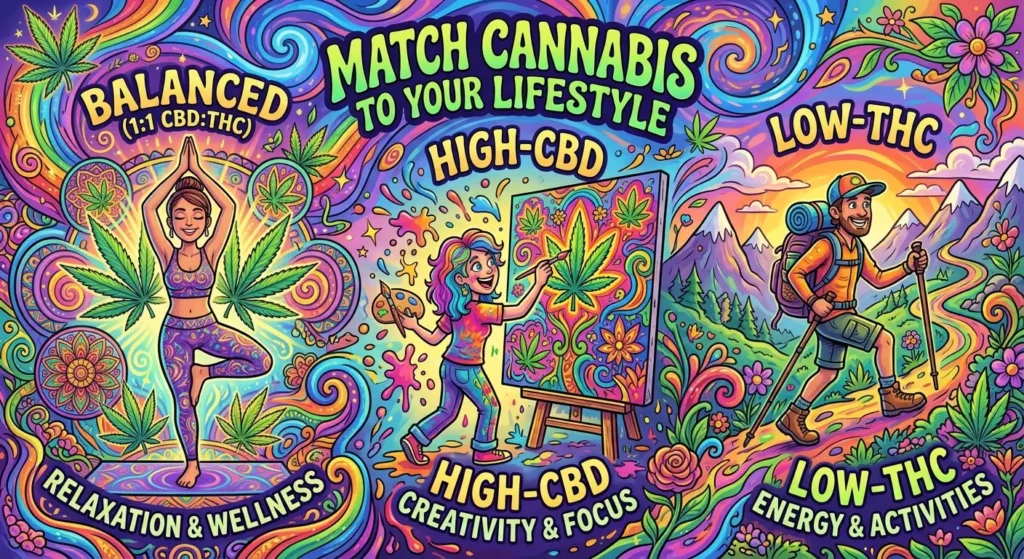
Choosing the right cannabis profile isn’t about chasing the highest potency—it’s about alignment. Whether you’re looking to ease into the evening without mental fog, manage daily stress while staying sharp, or find a gentle middle ground for social settings, understanding the difference between low-THC, high-CBD, and balanced cannabis products can completely transform your experience. This guide breaks down how to match cannabinoid ratios to your actual lifestyle, not just your tolerance.
Understanding the Cannabis Spectrum: THC, CBD, and the Ratios That Matter
Before you walk into a dispensary or browse an online catalog, you need to understand what the numbers on the label actually mean. Cannabis isn’t a single experience—it’s a spectrum shaped by two primary cannabinoids: tetrahydrocannabinol (THC) and cannabidiol (CBD).
- THC is the psychoactive compound responsible for the “high,” euphoria, altered perception, and, in higher doses, potential anxiety or paranoia.
- CBD is non-intoxicating and is widely associated with calm, physical relief, and anti-inflammatory properties without impairing cognition.
The ratio between these two compounds determines not just how you’ll feel, but when a product fits into your day. A high-THC strain might be perfect for a lazy Sunday but disastrous before a work presentation. A high-CBD tincture could be ideal for Monday morning focus but underwhelming at a concert. The goal isn’t to find the “best” ratio—it’s to find your ratio for your context.
What Is Low-THC Cannabis and Who Should Consider It?
Low-THC cannabis typically contains less than 10% THC by dry weight, though many products in this category hover between 2% and 8%. These strains or formulations are designed for users who want minimal psychoactivity while still accessing the therapeutic and subtle experiential benefits of the plant.
The Lifestyle Fit
Low-THC cannabis is ideal for functional relaxation. Think of it as the craft beer of cannabis—not about getting wrecked, but about unwinding without disconnecting. If your lifestyle includes early mornings, client-facing work, parenting, or any scenario where you need to remain mentally present, low-THC options offer a “light touch.”
Best for:
- Morning or midday microdosing to take the edge off anxiety without sedation
- Social gatherings where you want to feel relaxed but articulate
- Creative work that benefits from a slight loosening of mental rigidity
- Cannabis newcomers who are still learning their sensitivity to THC
What to Expect
Users typically report a mild body warmth, gentle mood elevation, and reduced muscle tension. The head-high, if present at all, is subtle and short-lived. Because the psychoactive threshold is low, the risk of paranoia or overwhelming introspection is significantly minimized.
Pro tip: Look for strains like Harlequin (if slightly higher CBD) or Cannatonic in low-THC phenotypes. Edibles in the 2.5mg–5mg THC range also fall into this functional category.
High-CBD Cannabis: Clarity Without the Cloud
High-CBD products are defined by a CBD-to-THC ratio of at least 10:1, and many contain virtually no THC at all (broad-spectrum or isolate products). These aren’t about getting high—they’re about getting balanced.
The Lifestyle Fit
High-CBD cannabis is the go-to for wellness-oriented lifestyles. If you’re someone who tracks sleep, prioritizes recovery after workouts, manages chronic stress, or simply refuses to sacrifice mental clarity for relief, this category was built for you.
Best for:
- Pre-workout or post-workout recovery (CBD is widely used for inflammation and muscle soreness)
- High-pressure professional environments where cognitive sharpness is non-negotiable
- Anxiety management during travel, public speaking, or social events
- Evening wind-down routines that prioritize restful sleep over sedation
The Science in Plain English
CBD interacts with your endocannabinoid system (ECS)—the body’s master regulatory network—without binding directly to CB1 receptors in the brain the way THC does. Instead, it modulates receptor activity, influences serotonin signaling, and supports homeostasis. Translation: it helps your body regulate itself without forcing a dramatic state change.
Pro tip: For daily wellness, 25mg–50mg of CBD taken sublingually or via capsule is a common starting point. If using flower, seek out strains like Charlotte’s Web, ACDC, or Ringo’s Gift.
Balanced THC:CBD Strains: The Art of the Middle Ground
A “balanced” cannabis product typically features a 1:1 ratio of THC to CBD, or close to it (think 5:5, 6:8, etc.). This is where the entourage effect shines brightest—the theory that cannabinoids work synergistically, producing effects greater than the sum of their parts.
The Lifestyle Fit
Balanced strains are the Swiss Army knife of cannabis. They offer enough THC to provide noticeable psychoactive effects—euphoria, enhanced sensory perception, creative spark—while the CBD tempers the intensity, reducing the likelihood of anxiety, racing thoughts, or couch-lock.
Best for:
- Weekend recreation where you want to feel elevated but not obliterated
- Intimate social settings like dinner parties or date nights
- Creative projects that benefit from altered perspective without loss of control
- Medical users seeking both symptom relief and mood enhancement
🔥 Stack your savings. Elevate your session. 10% off $100, up to 25% off $450.
🔥 Roll into the menu and start saving. CLICK HERE!
Why the 1:1 Ratio Works
CBD acts as a functional “buffer” to THC. It competes for receptor binding sites, slows THC metabolism, and modulates the intensity of the high. Many users describe 1:1 experiences as “grounded euphoria”—you’re high, but you’re still you. You might laugh more, taste more, feel more, but you’re unlikely to spiral into paranoia or forget what you were saying mid-sentence.
Pro tip: Classic balanced strains include Harle-Tsu, Pennywise, and CBD Shark. In edibles, a 5mg THC : 5mg CBD gummy is a reliable entry point.
How to Match Cannabis to Your Lifestyle: A Practical Framework
Choosing between low-THC, high-CBD, and balanced cannabis isn’t just about chemistry—it’s about context. Here’s a decision framework based on real-life scenarios:
1. Map Your Day by Cognitive Demand
Divide your day into zones:
- High-demand zones (work meetings, driving, childcare, complex problem-solving): High-CBD or microdosed low-THC only.
- Medium-demand zones (creative work, exercise, casual socializing): Balanced ratios shine here.
- Low-demand zones (evening relaxation, weekends, sleep prep): This is where higher-THC options become viable, though low-THC and balanced still work if you prefer gentler transitions.
2. Define Your Intention
Are you using cannabis to enhance, relieve, or escape?
- Enhance (creativity, sensory experience, social connection): Balanced.
- Relieve (anxiety, pain, inflammation, stress): High-CBD or low-THC.
- Escape (deep relaxation, sleep, heavy recreational use): Higher-THC or balanced at higher doses.
3. Consider Your Consumption Method
The same ratio feels different depending on how you consume it:
- Inhalation (smoke/vape): Fast onset, shorter duration, easier to titrate. Best for social or creative contexts where you want control.
- Sublingual (tinctures): Moderate onset, steady effects. Ideal for consistent daily wellness routines.
- Edibles: Slow onset, long duration, potent effects. Better for sleep, pain management, or dedicated relaxation windows.
- Topicals: Localized relief, zero psychoactivity. Perfect for athletes or those with targeted muscle/joint concerns.
4. Account for Tolerance and Biochemistry
Your personal endocannabinoid system is unique. A 5mg THC edible might floor one person and barely register with another. Start low, go slow, and keep a cannabis journal noting the ratio, dose, method, time of day, and effects. After two weeks, you’ll have a personalized data set that no article can replace.
Common Mistakes When Choosing a Cannabis Profile
Even experienced users fall into these traps:
Chasing THC percentages. A 30% THC flower with no CBD isn’t “better” than a balanced 12% THC / 12% CBD flower—it’s just different, and often less versatile.
Ignoring the entourage effect. Isolating THC or CBD ignores the hundreds of other compounds (terpenes, minor cannabinoids like CBG and CBN) that shape your experience. Full-spectrum and balanced products often feel more “complete.”
Using the wrong ratio for the wrong time. That balanced edible at 9 AM might derail your productivity. That high-CBD tincture at 10 PM might be too subtle to help you sleep. Match the profile to the moment.
Assuming all “CBD products” are the same. Hemp-derived CBD with 0.3% THC feels markedly different from a cannabis-derived 20:1 CBD:THC product. The minor cannabinoid and terpene content matters.
Frequently Asked Questions
What is the best cannabis ratio for beginners?
Beginners should start with high-CBD, low-THC products or a balanced 1:1 ratio at very low doses. A 5mg CBD-dominant edible or a few puffs of a low-THC flower allows you to gauge your sensitivity without risking an overwhelming experience. The goal for your first sessions is to notice subtle effects, not to achieve a dramatic high.
Can I use high-CBD cannabis during work hours?
Yes, many professionals use high-CBD products during work hours specifically because they don’t produce impairment. CBD may actually support focus by reducing background anxiety. However, avoid trying any new cannabis product for the first time before an important meeting—always test your personal response in a low-stakes environment first.
What’s the difference between low-THC and high-CBD cannabis?
Low-THC cannabis still contains meaningful THC (often 5%–10%) and will produce mild psychoactive effects. High-CBD cannabis contains minimal THC (often less than 1%) and is non-intoxicating. Think of low-THC as “light beer” and high-CBD as “non-alcoholic beer”—both let you participate, but the experience differs significantly.
Is a balanced 1:1 ratio good for anxiety?
For many users, yes. The CBD in a balanced ratio helps counteract THC’s potential to trigger anxiety or paranoia, while the THC provides mood elevation and relaxation. However, individuals with severe THC sensitivity may still find even balanced ratios too stimulating. In those cases, high-CBD or CBD-only products are safer starting points.
How long do the effects of balanced cannabis last?
When inhaled, balanced cannabis effects typically last 2–4 hours. When consumed as an edible, expect 4–8 hours, with peak effects around the 2–3 hour mark. The CBD component may extend the duration of relief compared to THC-dominant products, while smoothing the comedown.
Can I combine different ratios in one day?
Yes, and many experienced users do. This is called “cannabis stacking” or intentional microdosing. For example, you might use a high-CBD tincture in the morning, a balanced vape pen in the early evening, and a low-THC edible before bed. The key is tracking total THC consumption to avoid unintended accumulation and impairment.
Will high-CBD cannabis make me fail a drug test?
Possibly. Full-spectrum CBD products, even those labeled as “high-CBD,” often contain trace amounts of THC (0.3%–1%). Over time, these trace amounts can build up in your system and trigger a positive result on a sensitive drug test. If testing is a concern, seek out CBD isolate products (0% THC) and verify third-party lab results.
What are the best balanced strains for social situations?
Strains like Harlequin, Pennywise, and Cannatonic are renowned for their sociable, clear-headed effects. They promote conversation, laughter, and sensory enjoyment without the heavy sedation or mental fog associated with high-THC indicas. Look for terpene profiles rich in limonene and pinene for an uplifting, alert experience.
How do I know if I need low-THC or just less cannabis overall?
If you find yourself feeling “too high” or anxious even with small amounts of standard cannabis, you likely need a lower-THC product rather than just less volume. Consuming less of a 25% THC flower still delivers significant THC. Switching to a 6% THC flower or a balanced ratio allows you to consume a satisfying amount of material while keeping total THC intake manageable.
Are there lifestyle activities where no cannabis is the best choice?
Absolutely. Operating heavy machinery, driving, making major financial decisions, caring for infants, or navigating high-stakes emotional conversations are scenarios where complete sobriety is the only responsible choice.** Cannabis, even high-CBD varieties, can affect reaction time, judgment, or emotional processing. When in doubt, opt out.
🔥 Stack your savings. Elevate your session. 10% off $100, up to 25% off $450.
🔥 Roll into the menu and start saving. CLICK HERE!
Conclusion
Matching cannabis to your lifestyle isn’t about finding a single product to use around the clock—it’s about building a cannabinoid toolkit. Low-THC options keep you functional and relaxed during high-demand days. High-CBD formulations support wellness, recovery, and clarity without compromise. Balanced ratios offer the richest experiential middle ground for creativity, connection, and controlled elevation.
The modern cannabis consumer has more precision than ever before. Move beyond the outdated mindset of “stronger is better.” Instead, ask yourself: What do I need to feel like right now? Let that answer guide your ratio, your dose, and your method. When cannabis is matched intentionally to lifestyle, it stops being an escape and becomes an enhancement—a subtle upgrade to the life you’re already living.
Start with intention. Track your results. Adjust with confidence. The right ratio is the one that helps you show up as your best self, in every context that matters.