
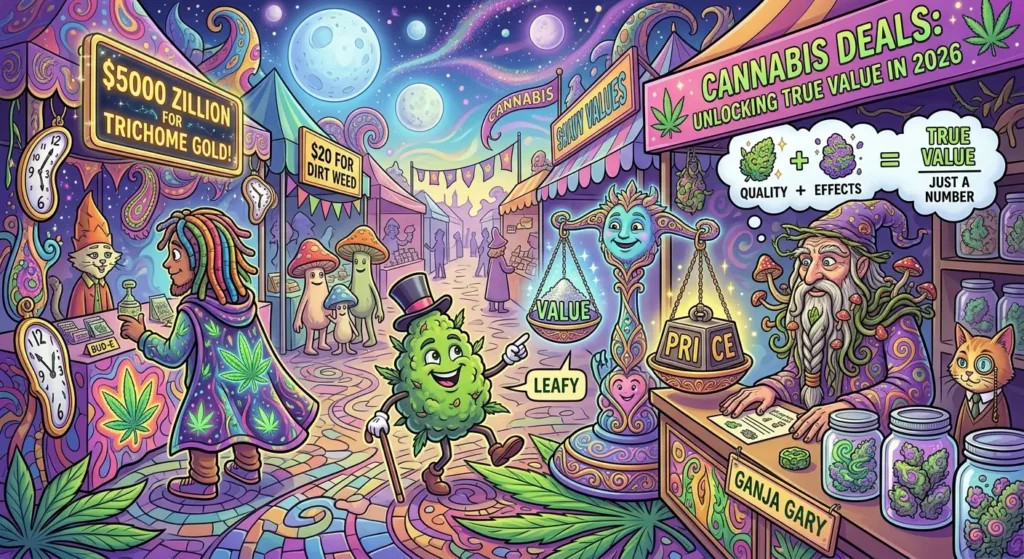
Walking into a dispensary in 2026 feels nothing like it did five years ago. The shelves are packed with options, from solventless live rosin to nano-emulsified beverages, and the price tags swing wildly between “budget-friendly” and “luxury-tier.” But here is the truth most shoppers still overlook: the cheapest product is rarely the best deal, and the most expensive one is not always the highest quality.
If you want to stretch your dollar without sacrificing safety, potency, or experience, you need to understand the difference between price and value. In this guide, we will break down exactly how to evaluate cannabis deals like a seasoned connoisseur, using real market data, lab-testing insights, and timing strategies that actually work in today’s evolving landscape.
Why 2026 Is a Pivotal Year for Cannabis Shoppers
The cannabis industry has reached an inflection point. After years of explosive growth, the market is now experiencing what economists call price compression—a steady decline in wholesale and retail prices driven by oversupply, increased competition, and maturing state markets. According to LeafLink’s 2026 Wholesale Cannabis Pricing Guide, aggregate platform flower prices hit approximately $1,020 per pound through May 2025, down roughly $100 per pound since the previous year. Cartridges saw the steepest drop at -12.0%, followed by pre-rolls at -10.3% and concentrates at -7.5%.
This sounds like great news for consumers, and in many ways it is. But there is a catch. As margins tighten, some operators cut corners on cultivation, curing, and testing to stay afloat. That means the burden of quality assurance is shifting to you, the buyer. Learning to read between the label lines has never been more important.
Understanding the Cannabis Market Landscape in 2026
Before you can spot a genuine deal, you need context. Cannabis is not a monolithic market. It is a patchwork of state-regulated ecosystems, each with its own tax structure, licensing caps, supply chains, and consumer demographics.
Cannabis Market Size by State
The United States remains the dominant force in global cannabis, with North America commanding an 83.82% market share in 2025. The total U.S. cannabis industry is expected to reach nearly $47 billion in revenue by 2026, with projections climbing toward $55.43 billion by 2030.
However, the cannabis market size by state varies dramatically. California remains the largest legal market in the country, followed by Michigan, Illinois, and Colorado. Emerging markets like New York are expanding rapidly as retail licensing accelerates and supply chains mature. Meanwhile, newer adult-use states such as Ohio, Maryland, and Missouri are posting impressive per-capita sales figures, with Missouri tracking approximately $1.4 billion in annual sales—roughly $226 per resident.
Cannabis Revenue by State
Tax revenue tells an equally compelling story. Since 2014, nearly $25 billion in combined cannabis tax revenue has been collected across legalization states. In 2024 alone, states generated more than $4.4 billion from adult-use sales—nearly double the alcohol industry’s $8.93 billion in the same period, proving cannabis has become a fiscal powerhouse.
California leads in raw dollars, collecting over $1 billion annually in state marijuana taxes, though recent years show a slight cooling from peak 2021 levels. Colorado, once the poster child for cannabis revenue, has seen a gradual decline from its 2021 high of $423.5 million to roughly $236.4 million in 2025, reflecting market saturation and price compression. New York, by contrast, is on a steep upward curve, with fiscal year 2026 revenue projected at $264.2 million as its retail footprint expands.
Cannabis Industry Growth Chart
If you were to plot a cannabis industry growth chart from 2017 to 2026, you would see a classic hockey stick—followed by a plateau. The industry employed roughly 123,000 people in 2017 and ballooned to over 440,000 by 2024. However, 2025 marked the first-ever year-over-year revenue decline for the U.S. legal market, with Whitney Economics projecting regulated revenues between $29.1 billion and $29.6 billion, falling below 2024’s $30.1 billion mark.
This does not mean the industry is collapsing. It means the wild-west phase is ending and a more sustainable, efficiency-driven era is beginning. For shoppers, that translates to more consistent product availability, better testing standards, and—if you know where to look—genuine bargains.
Dispensary Prices vs Street Prices: The Real Cost Breakdown
One of the most common questions among consumers is whether legal dispensaries are actually cheaper than the legacy market. The answer is nuanced.
Historically, dispensary prices vs street prices favored the illicit market by a significant margin. In states like Oregon, dispensary prices were roughly 73% higher than street prices at one point. However, in certain markets like Mesa, Arizona, licensed retailers have actually undercut street dealers by about 8%.
In 2026, that gap continues to narrow in mature markets. Wholesale price compression has pushed retail flower down to $83.71 per ounce in Michigan, while Illinois maintains significantly higher rates at $257.22 per ounce—a staggering 207% difference between neighboring states.
But price is only one variable. When you buy from a licensed dispensary, you are paying for transparency, safety, and accountability. Every product has a batch number, a Certificate of Analysis (COA), and verified cannabinoid content. Street cannabis offers none of these assurances. You have no way of knowing whether it was treated with unregulated pesticides, contaminated with mold, or laced with synthetic cannabinoids. In that sense, the slightly higher dispensary price is often an insurance policy for your lungs and your peace of mind.
🔥 Stack your savings. Elevate your session. 10% off $100, up to 25% off $450.
🔥 Roll into the menu and start saving. CLICK HERE!
How to Evaluate Cannabis Quality Beyond the Price Tag
A low price tag can be tempting, but value is determined by what you actually get for that money. Here is how to assess quality like a pro.
Reading COAs and Lab Results
Every legitimate cannabis product in a licensed dispensary should come with a Certificate of Analysis (COA). This document, generated by a state-licensed laboratory, breaks down:
- Cannabinoid potency (THC, THCA, CBD, CBG, CBN, etc.)
- Terpene profile (myrcene, limonene, pinene, caryophyllene)
- Contaminant screening (pesticides, heavy metals, residual solvents, mold, bacteria)
According to New Jersey’s Cannabis Regulatory Commission, testing ensures products are safe, free of harmful contaminants, and accurately labeled. Consumers can—and should—request the COA for any product before purchasing.
Red flags to watch for:
- THC percentages that seem impossibly high (over 35-40% for flower is often inflated or manipulated)
- Missing terpene data
- Labs with no state license number listed
- COAs that do not match the batch number on your package
Terpenes, THC, and the Entourage Effect
Novice shoppers tend to chase the highest THC percentage. Experienced buyers know that terpenes drive the experience. Cannabis testing between 1-3% total terpenes represents average ranges, while 3-5%+ indicates exceptionally aromatic, flavorful products with more complex effects.
This matters because of the entourage effect—the synergistic interaction between cannabinoids and terpenes that shapes how a strain feels. A flower testing at 18% THC with a robust terpene profile often delivers a more satisfying, nuanced high than a 30% THC strain with flat terpene numbers. When evaluating deals, compare terpene content alongside price. A “budget” eighth with rich terpenes is often a better value than a “premium” eighth that is essentially THC isolate in plant form.
Freshness and Curing
Premium cannabis is defined by more than genetics. Look for:
- Harvest dates within the last 3-6 months
- Proper curing (no hay-like smell, no excessive dryness)
- Protective packaging that preserves terpenes (nitrogen-sealed jars > plastic bags)
- Consistent batches from reputable growers
As cultivation technology improves in 2026, top-tier producers are using automated climate monitoring, precision irrigation, and advanced lighting to maintain consistency from harvest to harvest.
Timing Your Purchase: 420 Deals 2026 and Seasonal Savings
If you are strategic about when you buy, you can stretch your budget significantly.
420 deals 2026 remain the biggest sales event of the year. With 4/20 falling on a Monday, most dispensaries are planning their primary promotions for the preceding weekend. According to Flowhub’s 2026 Retail Guide, most shoppers expect discounts around 30% off original prices, but smart retailers are moving away from blanket discounts toward loyalty-based incentives, bundled products, and BOGO campaigns.
Beyond 420, watch for:
- Harvest season sales (October-November) when outdoor flower floods the market
- New product launches with introductory pricing
- End-of-batch clearance on products approaching their expiration date
- State tax holidays in certain jurisdictions
Pro tip: Bundle related products. Dispensaries often create gift boxes or “build-your-own” bundles that blur the customer’s focus on individual item prices while increasing the perceived value of the purchase.
The Bigger Picture: Is the Cannabis Industry a Good Career?
Understanding the health of the industry can help you make smarter consumer choices. A thriving market with stable employment usually means better product consistency, stronger regulatory enforcement, and more innovation.
Cannabis Industry Jobs
The U.S. legal cannabis industry supported approximately 425,000 to 445,800 full-time equivalent jobs in 2025, depending on which report you consult. That is more Americans than work in dental hygiene, electrical engineering, or as pharmacists in many states.
The employment breakdown roughly follows this distribution:
- ~45% Retail, budtending, and dispensary operations
- ~25% Cultivation and growing operations
- ~15% Extraction, manufacturing, and packaging
- ~10% Testing labs, compliance, and transport
- ~5% Corporate, legal, finance, and marketing
California leads all states with roughly 80,900 cannabis workers, followed by Michigan (~38,900), Colorado (~32,900), and Florida (~32,800 medical).
Is the Cannabis Industry Failing?
This is the question on everyone’s mind after the 2025 revenue dip. The short answer: no, but it is evolving.
Whitney Economics forecasts a return to modest growth in 2026, with a clear shift in where labor demand sits. Cultivation jobs are cooling as regulators tighten licenses and bring oversupply back into balance. Manufacturing roles are rising as consumers move toward processed and derivative products. Retail remains steady, with continual hiring to offset normal employee churn.
The industry is not failing; it is maturing. The companies surviving this transition share common traits: lean operations, diverse product portfolios, and strategic supply agreements. For consumers, this maturation means fewer fly-by-night brands and more consistent, tested products on shelves.
Pro Tips for Evaluating Cannabis Deals in 2026
Here is a quick checklist to take with you on your next dispensary run:
- Calculate cost per milligram of THC/CBD – Do not just look at the total price. A $60 concentrate with 80% THC is often cheaper per milligram than a $35 eighth with 18% THC.
- Check harvest dates – Cannabis degrades over time. Fresher is almost always better.
- Ask for the COA – If a budtender cannot produce one, shop elsewhere.
- Compare terpene percentages – 2%+ total terpenes is a good benchmark for quality flower.
- Look beyond THC – High-THC, low-terpene flower is the equivalent of cheap vodka: potent but one-dimensional.
- Join loyalty programs – Many dispensaries offer points, birthday discounts, and member-only pricing that beats public 420 deals.
- Buy in bulk when legal – Some states allow ounce purchases at per-gram discounts.
- Research the brand – Brands with transparent sourcing and sustainable practices often deliver better long-term value.
- Avoid “too good to be true” pricing – If a deal seems absurdly cheap, question the testing, freshness, or source.
- Consider the full experience – Value includes convenience, staff knowledge, store atmosphere, and return policies.
🔥 Stack your savings. Elevate your session. 10% off $100, up to 25% off $450.
🔥 Roll into the menu and start saving. CLICK HERE!
Conclusion
In 2026, evaluating cannabis deals is less about finding the lowest price and more about understanding what you are actually paying for. The market has shifted from scarcity-driven pricing to competitive compression, giving consumers more options than ever—but also more complexity.
By understanding cannabis market size by state, tracking cannabis revenue by state, reading lab results, comparing dispensary prices vs street prices, and timing purchases around events like 420 deals 2026, you can consistently find products that deliver exceptional value. The industry is not failing; it is maturing into something more reliable, transparent, and consumer-friendly. Whether you are a casual user or a daily enthusiast, approaching your purchases with a pro-level mindset will save you money, protect your health, and elevate your entire cannabis experience.
Frequently Asked Questions (FAQs)
What is the difference between cannabis price and cannabis value?
Price is the dollar amount you pay at the register. Value is what you receive in return—potency, terpene richness, safety, freshness, and overall experience. A $20 eighth with mold and 0.5% terpenes is expensive at any price. A $50 eighth with robust COA data, 3%+ terpenes, and clean cultivation practices is a genuine value.
How do I read a cannabis Certificate of Analysis (COA)?
Look for four key sections: (1) Product & Sample Information (batch number, lab name, license), (2) Cannabinoid Profile (THC, THCA, CBD percentages), (3) Terpene Profile (myrcene, limonene, pinene, etc.), and (4) Contaminant Screening (pass/fail for pesticides, heavy metals, mold, bacteria). Always verify the lab is state-licensed.
Are dispensary prices higher than street prices in 2026?
It depends on the state. In mature markets like Michigan and Oregon, legal dispensary prices have compressed so dramatically that the gap has nearly closed. In newer or highly taxed markets like Illinois and New Jersey, street prices may still undercut legal retailers by 30-50%. However, legal products offer verified safety, potency, and accountability that the illicit market cannot match.
What are the best 420 deals for 2026?
The best 420 deals 2026 are not necessarily the deepest discounts. Look for BOGO offers, bundled gift boxes, loyalty point multipliers, and exclusive member pricing. Many top retailers are shifting away from blanket 30% off sales toward value-added incentives that protect margins while rewarding repeat customers.
Which state has the largest cannabis market?
California remains the largest legal cannabis market in the United States by total revenue and employment, though its growth has cooled from peak 2021 levels. Michigan, Illinois, and Colorado follow. New York is the fastest-growing emerging market.
Is the cannabis industry a good career in 2026?
Yes, for the right roles. While cultivation jobs are cooling due to oversupply corrections, cannabis industry jobs in manufacturing, retail management, compliance, and product development are growing. The industry supports over 425,000 American workers and is projected to approach 800,000 jobs by 2029. It is a viable career path, especially in emerging state markets.
Is the cannabis industry failing?
No. Despite the first-ever year-over-year revenue decline in 2025, the industry is projected to return to modest growth in 2026. Price compression and market consolidation are signs of maturation, not collapse. The global cannabis market is still forecast to reach $82.3 billion by 2027.
How much tax revenue does cannabis generate?
Legal cannabis has generated nearly $25 billion in combined tax revenue since 2014. In 2024 alone, legalization states collected over $4.4 billion, surpassing alcohol tax revenue in many jurisdictions. California, Colorado, and New York are among the top contributors.
What is cannabis price compression?
Price compression refers to the steady decline in wholesale and retail cannabis prices caused by oversupply, increased competition, and market maturation. In 2025-2026, national flower prices fell to roughly $1,020 per pound, with some states like Oregon seeing outdoor flower drop as low as $100 per pound due to massive surpluses.
How can I tell if a cannabis deal is actually good?
Calculate the cost per milligram of active cannabinoids, verify freshness via harvest dates, review the COA for terpene content and contaminant passes, and compare the brand’s reputation. A genuine deal balances affordability with verifiable quality—not just a low sticker price.