
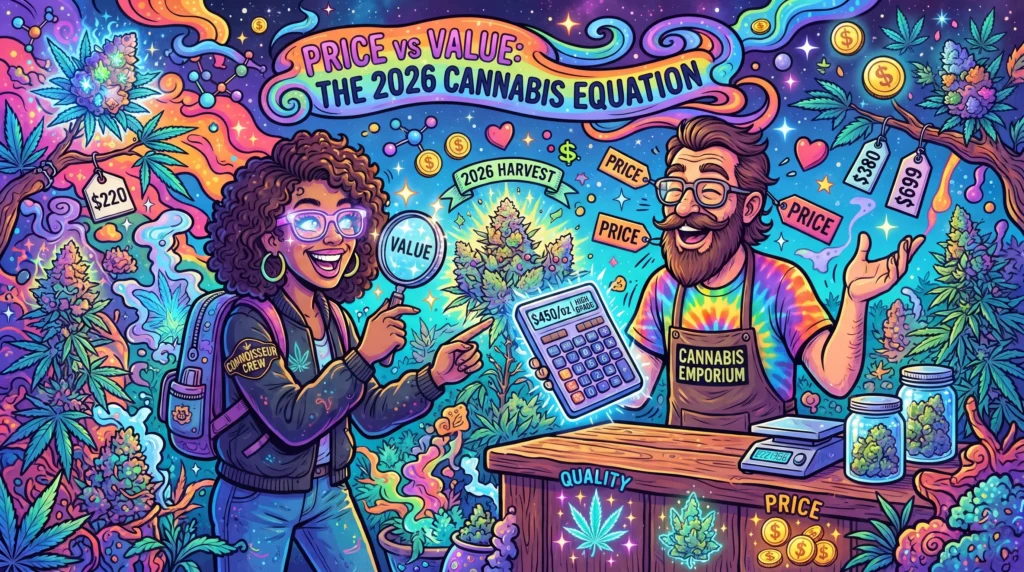
We’ve all seen the ads. “Premium eighths, 40% off.” “Buy two pre-rolls, get one free.” “Flash sale — today only.” Walk into any licensed dispensary in 2026, open a delivery app, or scroll through a promotional email, and the discounts feel endless. But here’s the uncomfortable truth most consumers don’t want to hear: a cheap price doesn’t always mean a good deal, and a high price doesn’t always mean quality.
The legal cannabis market has matured into a complex, competitive ecosystem where pricing strategies are designed to move inventory, not necessarily to deliver value. In 2026, the U.S. legal cannabis industry is forecast to reach approximately $30.5 billion in regulated retail sales, rebounding from a soft 2025 as emerging markets like New York and Ohio accelerate while mature markets like California navigate consolidation.
With nearly 15,740 licensed dispensaries nationwide and over 54 million past-year consumers, the sheer volume of product moving through legal channels means deals are everywhere — but so are the traps.
This guide will teach you how to evaluate cannabis deals with the same rigor a sommelier applies to wine or a trader applies to stocks. You’ll learn how to read the real signals behind the sticker price, when to pull the trigger, and when to walk away.
Understanding the 2026 Cannabis Landscape
Before you can spot a genuine deal, you need to understand the market forces shaping prices in 2026. The industry is no longer the wild west it was five years ago. It’s a regulated, taxed, and increasingly segmented marketplace where cannabis market size by state varies dramatically.
California remains the largest regulated market at roughly $4.06 billion in annual sales, followed by Michigan at $3.49 billion and Florida at $2.25 billion. But the real growth story is New York, which exploded from just $100 million in 2023 to approximately $1.8 billion in 2025 — an 84% year-over-year jump driven by retail expansion.
Why does this matter to your wallet? Because pricing dynamics differ wildly between markets. In oversaturated states like Oregon and parts of California, fierce competition has driven retail prices down to some of the lowest in the nation. In newer, limited-license markets like New Jersey and Connecticut, prices remain elevated because supply is restricted. A “deal” in Los Angeles might be standard pricing in Denver, while a “premium” price in New York might just be the cost of doing business in a constrained market.
The industry also supports 445,800 full-time cannabis jobs nationwide, with New York alone adding over 16,000 positions in a single year — a 129% increase. This growing workforce means more knowledgeable budtenders, better product curation, and increasingly sophisticated retail operations. But it also means higher overhead costs that get baked into the price you pay.
And then there’s the tax burden. Adult-use states have collectively collected more than $29.1 billion in cannabis tax revenue since legalization began, with California leading at over $6.74 billion cumulatively. In California, the excise tax alone accounts for more than half of quarterly retailer returns, funding everything from childcare programs to environmental recovery. Those taxes don’t disappear — they’re passed directly to you at the register.
Price vs. Value: What Separates a Good Deal from a Cheap Trap
Let’s define our terms. Price is what you pay. Value is what you get for that money. In cannabis, value is determined by a matrix of factors that go far beyond THC percentage.
The Freshness Factor
Cannabis is an agricultural product. It degrades. THC converts to CBN over time, terpenes evaporate, and the smoke becomes harsher. A 30% THC eighth that’s been sitting in a warehouse for eight months will deliver a weaker, less flavorful experience than a 22% THC batch harvested six weeks ago.
Always check the package date, not just the harvest date. In most legal markets, products must display packaging or manufacturing dates. If a deal seems too good to be true, check the date first. That “fire sale” might just be a clearance event for old inventory.
The Terpene Profile
THC is the headline, but terpenes are the experience. A strain with 18% THC and a robust terpene profile (myrcene, limonene, caryophyllene) will often feel more potent and enjoyable than a 28% THC strain with stripped terpenes. When evaluating a deal, look beyond the big THC number. Ask your budtender about the terpene percentages, or check the COA (Certificate of Analysis) if the dispensary provides it.
The True Cost Per Milligram
The only honest way to compare deals across formats is to calculate the cost per milligram of THC (or total cannabinoids). Here’s the math:
- Flower: $40 eighth ÷ 3.5 grams = $11.43 per gram. If the flower is 22% THC, that’s 770mg of THC total. $40 ÷ 770mg = $0.052 per mg of THC.
- Edible: $25 for a 100mg chocolate bar = $0.25 per mg of THC.
- Concentrate: $50 for 1g of 80% THC wax = 800mg of THC. $50 ÷ 800mg = $0.0625 per mg of THC.
This calculation strips away marketing and reveals the actual economics. Flower is almost always the cheapest per milligram, while edibles and beverages carry significant convenience premiums.
Dispensary Prices vs. Street Prices: The Real Math
One of the most common questions consumers ask is whether legal dispensaries are actually more expensive than the legacy market. The answer in 2026 is: it depends, but the gap is narrowing.
In mature markets, dispensary prices vs. street prices have converged significantly. In California and Colorado, legal ounces can be found for under $100 — prices that compete directly with unlicensed sellers. The legal market’s advantage isn’t just price anymore; it’s consistency, safety, and transparency. Legal products are lab-tested for pesticides, mold, heavy metals, and potency. That $80 ounce from a dispensary comes with a COA. The $80 ounce from a street dealer comes with a handshake and a prayer.
However, in newer markets with high tax burdens, the disparity can still be painful. In Maryland, adult-use customers pay a 12% sales tax on top of retail pricing, while medical patients pay 0%. In Illinois, the combined tax rate at point of sale can reach 20% or more. In these environments, the unlicensed market still undercuts legal retailers by 20–40% on equivalent products.
The smart consumer’s move? Buy legal for anything you inhale (safety matters), but shop strategically during promotional windows when dispensaries drop prices to compete with the street. And if you’re a medical patient, renew your card — the tax savings alone often justify the annual fee.
Timing Your Purchase: When Cannabis Deals Actually Make Sense
Not all sales are created equal. The best deals in 2026 follow predictable patterns.
420 Deals 2026 and Holiday Windows
April 20th remains the biggest sales event in cannabis retail. 420 deals in 2026 are no longer just 10% off pre-rolls — they’re comprehensive promotional strategies. Dispensaries like Smacked Village in New York offered 32% off premium flower on half-ounce purchases and 33% off STIIIZY pre-roll packs during the 420 weekend.
Other high-value windows include:
- Black Friday / Green Wednesday (the day before Thanksgiving)
- New Year (inventory clearance)
- July 10th (Oil Day, for concentrate deals)
- Dispensary anniversary sales
The pro move? Stock up during these windows on non-perishables like concentrates, edibles with long shelf lives, and pre-rolls. Buy flower fresh, as needed.
End-of-Batch and Clearance Pricing
When a cultivator discontinues a strain or a dispensary needs to clear aging inventory, prices drop fast. These deals can be phenomenal — if the product is still fresh. Always check the package date on clearance items. A 50% discount on flower packaged three months ago is often a better value than full-price flower packaged eight months ago.
Bulk Discounts
Most dispensaries offer tiered pricing: the more you buy, the lower the per-gram cost. An ounce typically costs 20–30% less per gram than two separate half-ounces. If you consume regularly and have proper storage (airtight glass jars, cool dark place, humidity packs), buying in bulk during a sale is the single best way to reduce your cost per session.
🔥 Stack your savings. Elevate your session. 10% off $100, up to 25% off $450.
🔥 Roll into the menu and start saving. CLICK HERE!
The Hidden Costs Nobody Talks About
A deal isn’t just the number on the menu. It’s the total cost of ownership.
Taxes and Fees
In many states, the price on the shelf isn’t the price at checkout. Excise taxes, sales taxes, and local municipality taxes can add 15–35% to your total. In California, the excise tax alone represents a significant markup. Always calculate the out-the-door price before comparing deals across state lines.
Storage and Degradation
Buying a discounted ounce saves money upfront, but if you don’t store it properly, you’ll lose terpenes and potency within weeks. Invest in airtight glass jars and Boveda humidity packs (58% or 62% RH). Without them, you’re throwing away value every day.
The Opportunity Cost of Bad Product
The worst deal isn’t the one that’s overpriced — it’s the one that doesn’t work. A $25 eighth that gives you a headache and tastes like hay is a total loss. A $50 eighth that delivers the exact experience you wanted is a bargain. Value is experiential, not just mathematical.
Is the Cannabis Industry Failing? Why That Question Matters to Your Wallet
You might have seen headlines about market contractions, dispensary closures, and falling wholesale prices. So is the cannabis industry failing? The short answer is no — but it is maturing, and maturation hurts.
In 2025, the industry saw its first year-over-year sales decline, dropping from $30.1 billion to approximately $28.6–$29.6 billion according to Whitney Economics. California’s market contracted 7–8% from its peak. Michigan saw a 4% decline. These numbers sound alarming, but they reflect market correction, not collapse.
What’s actually happening is a divergence. Mature markets on the West Coast are oversaturated — too many dispensaries chasing too few new consumers. Meanwhile, emerging markets in the Northeast and Midwest are exploding. New York grew 84%. Maryland jumped 31%. New Jersey climbed 33%
.
For consumers, this means deals are better than ever in mature markets as retailers fight for market share. In emerging markets, prices are still elevated, but selection and quality are improving rapidly as supply chains mature. The industry isn’t failing — it’s separating the serious operators from the opportunists. And that competition directly benefits informed consumers.
This also ties into a related question many people ask: is the cannabis industry a good career? The answer depends on where you are. The industry supports over 445,800 jobs, and emerging markets are hiring aggressively
New York alone added 16,160 positions in one year. But mature markets are seeing layoffs and consolidation. If you’re considering entering the industry, target growth states — New York, Ohio, Maryland, and eventually Virginia — rather than saturated ones.
How Much Does a Dispensary Owner Make a Month? Understanding the Markup
To truly evaluate a deal, it helps to understand who’s selling to you and what their margins look like. So how much does a dispensary owner make a month? The range is staggering.
At the low end, owners of struggling single-location stores in saturated markets like Oregon or Michigan might take home $0 to $4,000 per month — or even subsidize the business from personal savings. At the high end, well-positioned operators in limited-license markets like New Jersey, Connecticut, or Missouri can earn $16,000 to $40,000+ per month after taxes and reinvestment.
The median single-store owner in an established adult-use market earns between $6,500 and $16,500 per month in total compensation.
Why does this matter to you? Because a dispensary’s pricing reflects its own cost structure. High-tax, high-rent markets with limited licenses produce higher retail prices — not because the product is better, but because the owner needs to cover 280E tax burdens, compliance costs, and debt service. When you see a $70 eighth in New York versus a $35 eighth in Oregon, the difference isn’t just the weed. It’s the economics of the market the dispensary operates in.
Understanding this helps you evaluate whether a “premium” price is justified by product quality or simply by retail overhead. The best consumers know the difference.
Red Flags: Deals You Should Walk Away From
After years of watching the market, here are the deal types that almost never deliver real value:
“Mystery bags” or unlabeled clearance bins. If the dispensary can’t tell you the strain, the harvest date, or the cultivator, you’re buying blind. Pass.
Extreme THC claims at rock-bottom prices. A 35% THC eighth for $20 is almost always mislabeled, old, or lab-shopped. Reputable labs don’t inflate numbers for budget flower.
Pre-rolls made from shake and trim. Many discounted pre-rolls are filled with the leftover material from manicuring buds. They burn unevenly, taste harsh, and deliver a subpar experience. If the pre-roll is cheaper than the equivalent amount of flower from the same brand, ask why.
“Buy one, get one free” on perishables. If the dispensary is pushing two-for-one deals on flower that expires in two weeks, they’re not being generous — they’re offloading inventory that will be unsellable soon.
Anything without a COA. In 2026, there’s no excuse for selling untested product. If the dispensary can’t show you a Certificate of Analysis for pesticides, mold, and potency, shop elsewhere.
Frequently Asked Questions (FAQs)
How do I know if a cannabis deal is actually good?
Calculate the cost per milligram of THC across different products and formats. Check the package date for freshness. Compare the out-the-door price (including taxes) rather than the menu price. And always prioritize terpene-rich, recently packaged flower over high-THC, old stock.
Are dispensary prices higher than street prices in 2026?
In mature markets like California and Colorado, legal and unlicensed prices have largely converged. In newer, high-tax markets like Illinois and Maryland, dispensaries can still be 20–40% more expensive after taxes. However, legal products offer lab-tested safety, consistent potency, and consumer protections that the unlicensed market cannot match.
When are the best times to buy cannabis on sale?
The biggest promotional windows are 420 deals in 2026 (April), Black Friday/Green Wednesday (November), July 10th (Oil Day for concentrates), and New Year clearance events. Dispensary anniversary sales and end-of-batch clearances also offer significant savings.
Is the cannabis industry failing?
No. While 2025 saw the first year-over-year sales decline in mature markets like California (-7%) and Michigan (-4%), emerging markets like New York (+84%), Maryland (+31%), and New Jersey (+33%) are growing rapidly. The industry is consolidating and maturing, not collapsing.
Is the cannabis industry a good career in 2026?
It can be, especially in growth markets. The industry supports over 445,800 jobs, with New York adding 16,160 positions in a single year. However, mature markets are seeing layoffs and consolidation. Target emerging states for the best opportunities.
How much does a dispensary owner make a month?
The range is wide. Struggling owners in saturated markets might earn $0–$4,000/month. The median single-store owner in established markets takes home roughly $6,500–$16,500/month. Successful operators in limited-license markets can earn $16,000–$40,000+/month.
Which state has the biggest cannabis market?
California remains the largest at approximately $4.06 billion in annual sales, followed by Michigan at $3.49 billion. However, New York is the fastest-growing market, nearly doubling to $1.6–$1.8 billion in 2025.
How much tax revenue does cannabis generate?
Adult-use states have collected over $29.1 billion in cumulative cannabis tax revenue since legalization began. In 2025 alone, states generated approximately $4.4 billion in cannabis tax revenue, with California leading at $640 million for the year.
Why is cannabis cheaper in some states than others?
Pricing is driven by market maturity, tax rates, license caps, and supply chain efficiency. Oversaturated mature markets (Oregon, California) have lower prices due to competition. Limited-license, high-tax markets (Illinois, New Jersey) maintain higher prices because supply is restricted and tax burdens are heavy.
Should I buy in bulk to save money?
Yes — if you consume regularly and store properly. Bulk pricing typically reduces per-gram costs by 20–30%. However, only buy bulk amounts of products with stable shelf lives (concentrates, well-sealed edibles) or flower that you’ll consume within 30–60 days. Improper storage degrades terpenes and potency, destroying your savings.
🔥 Stack your savings. Elevate your session. 10% off $100, up to 25% off $450.
🔥 Roll into the menu and start saving. CLICK HERE!
Final Thoughts: Shop Like an Investor, Not a Tourist
The cannabis consumer of 2026 has more choice, more information, and more leverage than ever before. But with that abundance comes complexity. The dispensary floor is designed to move inventory, not to educate you. The flashiest displays promote the highest-margin products. The deepest discounts often mask the oldest stock.
To evaluate cannabis deals like a pro, you need to think like an investor analyzing an asset. What’s the true cost per milligram? What’s the freshness date? What’s the tax-adjusted out-the-door price? What’s the real value of lab-tested safety versus unlicensed uncertainty?
The cannabis market size by state tells you where the deals are hottest. The cannabis tax revenue numbers explain why your receipt is 25% higher than the menu. Understanding how much a dispensary owner makes a month reveals why prices vary so dramatically between markets. And knowing that the industry is maturing — not failing — gives you the confidence to buy strategically rather than impulsively.
The best deal isn’t the cheapest product on the shelf. It’s the product that delivers exactly the experience you want, at a fair price, with verified quality, bought at the right moment. Master that equation, and every trip to the dispensary becomes a win.